

创作上传
VIP
收藏下载
登录 | 注册有礼
查看完整案例

收藏

下载

分享
Capital gains: ZIN by 51N4E, Jaspers-Eyers Architects and l’AUC
The transformation of the World Trade Center in Brussels into a home for the Flemish government exposes the forces of capital at work
Seldom has the transformation of a building in Brussels been so discussed as that of the World Trade Center (WTC). The project has been praised and condemned, often in the same sentence. About one thing, there seems to be no discussion: the original complex was terrible. Completed between 1972 and 1976, the two 102m‑tall office towers – a quarter of the height of the buildings of the same name in New York City, erected around the same time – were embedded in a colossal and impenetrable four‑storey plinth.
Connections to the neighbourhood were non‑existent. In fact, there was no longer a neighbourhood to speak of; in the 1960s, developer Charly De Pauw had been given free rein to demolish 530,000m2 of a densely populated working‑class district, close to Brussels‑North station. Around 11,000 people were expropriated. The idea was to build 78 office towers on the vacated terrain, connected by highways and pedestrian bridges. The World Trade Center would give, in the words of De Pauw, ‘solid form to our era, characterised by the “planetisation” of the economy. In a giant beehive the showrooms will reflect a permanent exhibition of all world products. All this is really the beginning of the era of the purchase order’.

When the World Trade Center in Brussels was conceived in the late 1960s, the ground floor was envisioned as the realm of the motor car, with pedestrians accessing the building via a network of streets in the sky. Credit: CIVA

The reimagined building repairs the relationship between the ground floor and the street. Credit: Vlaamse Overheid
Fortunately, the oil crisis of 1973 intervened, and only a fraction of the number of buildings were realised. A large part of the site remained fallow, and it required the optimism following European unification in the 1990s to add more office buildings. Brussels’ Northern Quarter remained a wasteland: commuters slipped out of the station to their offices and back, while the pavements and scarce green areas were used at night by sex workers.
Until 2018, the Immigration Office was also located in the WTC. Refugees waiting for their files to be processed spent the night in tents in a park; some of them were temporarily housed in the towers.
‘These mechanisms of participation and cultural programming can be considered a smoke screen, hiding a real‑estate operation’
In 2016, eight real‑estate and investment companies who own the majority of the quarter started a non‑profit organisation called Up4North, realising that the district had lost its speculative potential. In a partnership with Brussels‑based practice
51N4E
, think tank Architecture Workroom Brussels (AWB) and Parisian design agency Vraiment Vraiment, a ‘laboratory’ was created to imagine, according to the press release, ‘how the district can gain back an inclusive place in the city’. Ten floors of one of the towers were rented out in 2017 for activities that, Up4North claimed, could ‘start to show the possibilities for mixed and hybrid use’ while ‘local initiatives strive for more green and local food production or provide legal assistance for newcomers, administrations co‑construct public space initiatives, property owners explore new tenant models, etc’. For one academic year, the KU Leuven Faculty of Architecture partially moved to the 24th floor. Students were offered the opportunity to experience the difficulties of urban change, although critics suggested they were dangerously exposed to asbestos. 51N4E and AWB installed themselves on the 16th floor, and in 2018, part of the International Architecture Biennale Rotterdam was organised on the 23rd floor, with slogans such as ‘The Future is Here’, and dedicated to strategies to achieve ‘climate objectives’, supposedly turning the WTC into a ‘World Transformation Center’.

The entrance for the Flemish government – which has an 18-year-long lease – is located in the new volume constructed between the two towers. Credit: Maxime Delvaux
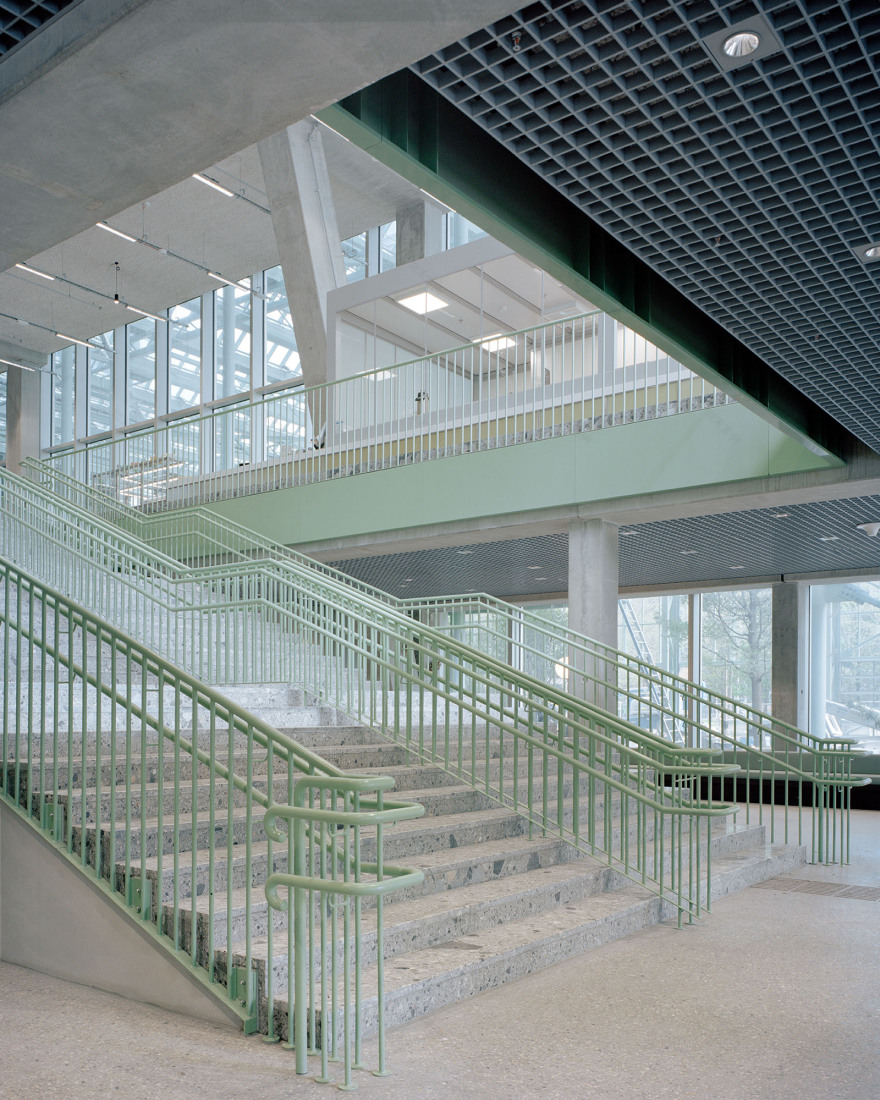
Sweeping stairs lead up from the entrance to a bright and airy first-floor reception area and café. Credit: Maxime Delvaux

Credit: Maxime Delvaux
As architecture student Julie‑Anna Barès suggested in her 2023 thesis ‘From Hard to Soft Power: Gentrification and the Transformation of the Northern Quarter in Brussels’, these mechanisms of participation and cultural programming can be considered a smoke screen, hiding a real‑estate operation. It is certain that the process was not a model of transparency. In 2020, Dutch philosopher Lietje Bauwens and Belgian artist Wouter De Raeve made the film
WTC A Love Story
, produced by independent production company Video Power; it was followed, in 2023, by the sequel
WTC A Never‑Ending Love Story
. In both films, actors portray the characters in the ‘real’ saga: owners, investors, designers, politicians and consultants, but also social workers and activists. The result is a critical tragicomedy of errors but also of resignation, in which, as Belgian architect Julie Mabilde wrote in a review in
De Witte Raaf
, the architects 51N4E remain nearly invisible: ‘It never really becomes clear what the office stands for.’
‘It is questionable whether the process justified publishing a book entitled
How To Not Demolish A Building
’
What complicates matters further is that the transformation of the WTC was initially going to be carried out by another office, Jaspers‑Eyers Architects – a maligned firm that has made itself indispensable in large construction projects in Brussels since the 1980s, and has been co‑operating recently with younger, more popular architects, to improve the quality of their projects. It was the Brussels
Bouwmeester
, or city architect, Kristiaan Borret, who convinced real‑estate company Befimmo, the owner of the WTC, to organise a competition, after which Jaspers‑Eyers was asked to collaborate with 51N4E and French practice l’AUC on the design for the transformed building.

The new volume, constructed out of concrete, includes all the spaces necessary for bureaucratic operations, such as auditoria, conference rooms and a mix of open-plan office space and meeting rooms, interspersed with kitchenettes. Credit: Maxime Delvaux

Credit: Vlaamse Overheid
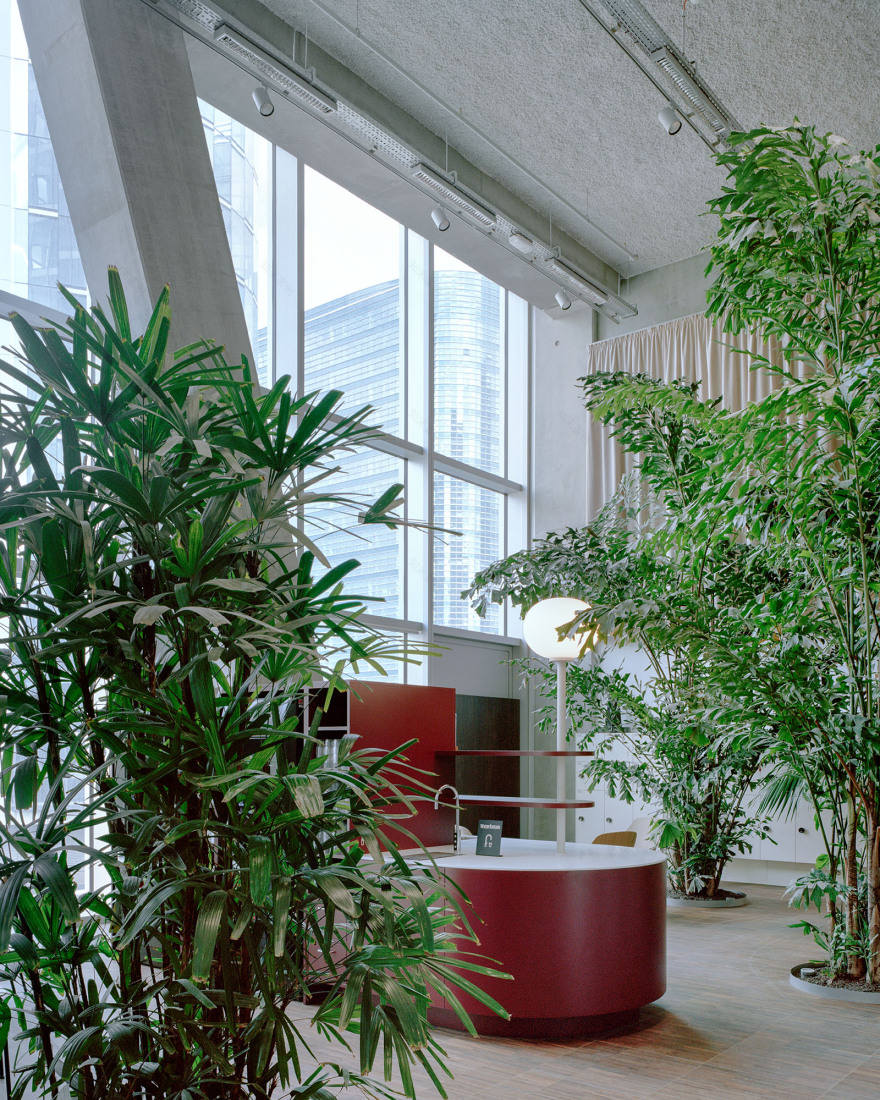
The lofty double‑height floors are lushly planted; vegetation is accommodated in large wells integrated into the deep floor section as well as in individual pots. Credit: Maxime Delvaux

Credit: Maxime Delvaux
Referred to as ZIN –
zinnekes
is the nickname for the inhabitants of Brussels, referring to the city river Senne – the transformation will be finished by the end of this year, although the office floors have been in use by the Flemish government since February. The architects’ main decision was to add a volume between the two towers, resulting in one single building and attempting to disrupt the towers’ corporate identity. The underground parking floors and the concrete circulation cores remain; however, in the added volume the floors are double‑height, which, for structural reasons, required removing (and rebuilding) the floor slabs and the facades of the former towers. The four‑storey plinth was also demolished, to enable a more direct connection to the neighbourhood. While much of the removed material was reused in the new building, or put on sale on the website of Brussels‑based recycled materials co‑operative Rotor, it is questionable whether the process justified publishing a book entitled
How To Not Demolish A Building
– as the architects did in 2023. It is, however, indicative of the pressure on architects to work in a way that appears to be ‘sustainable’ while clients often simply want a brand new building as quickly and efficiently as possible.
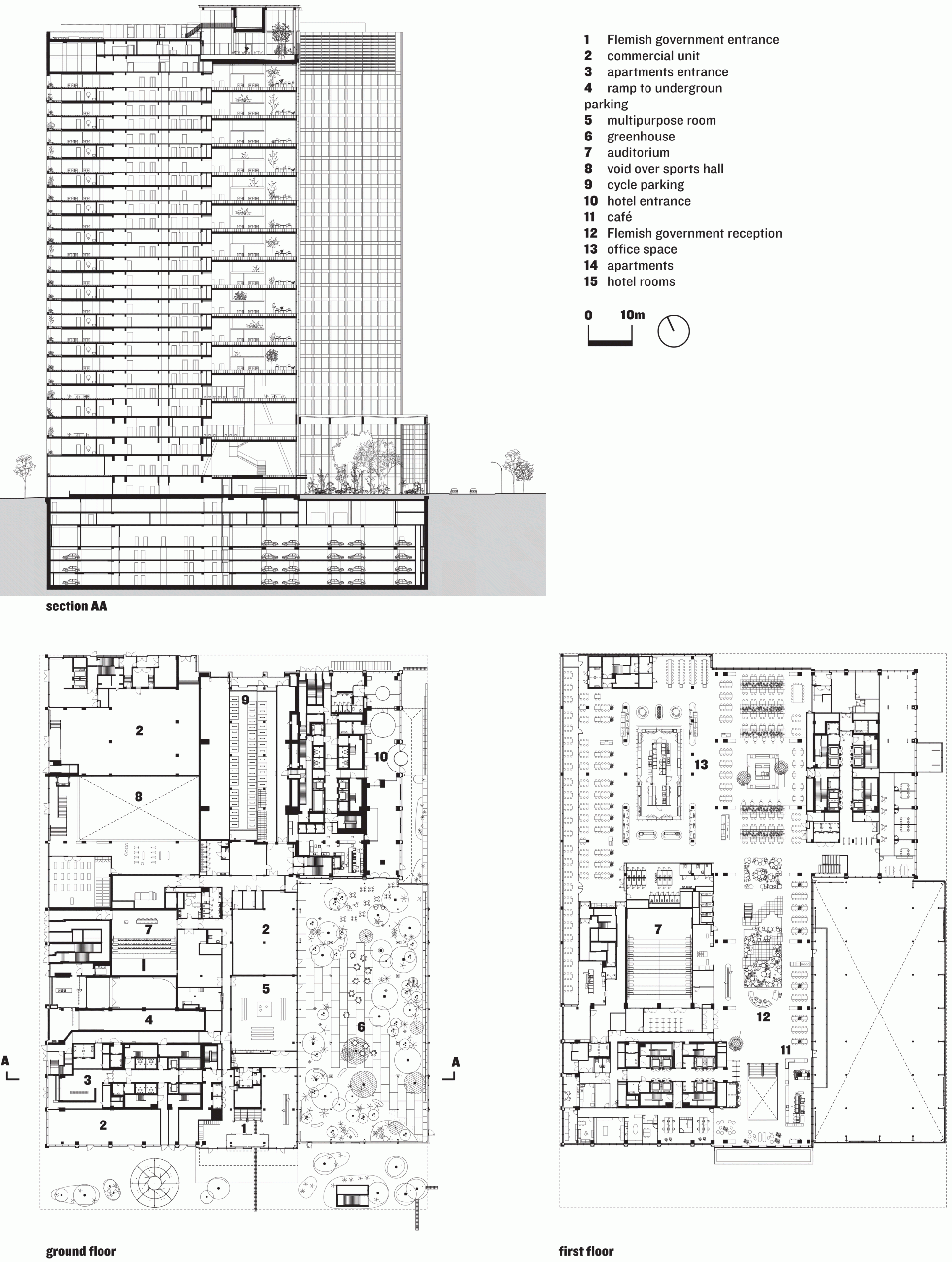
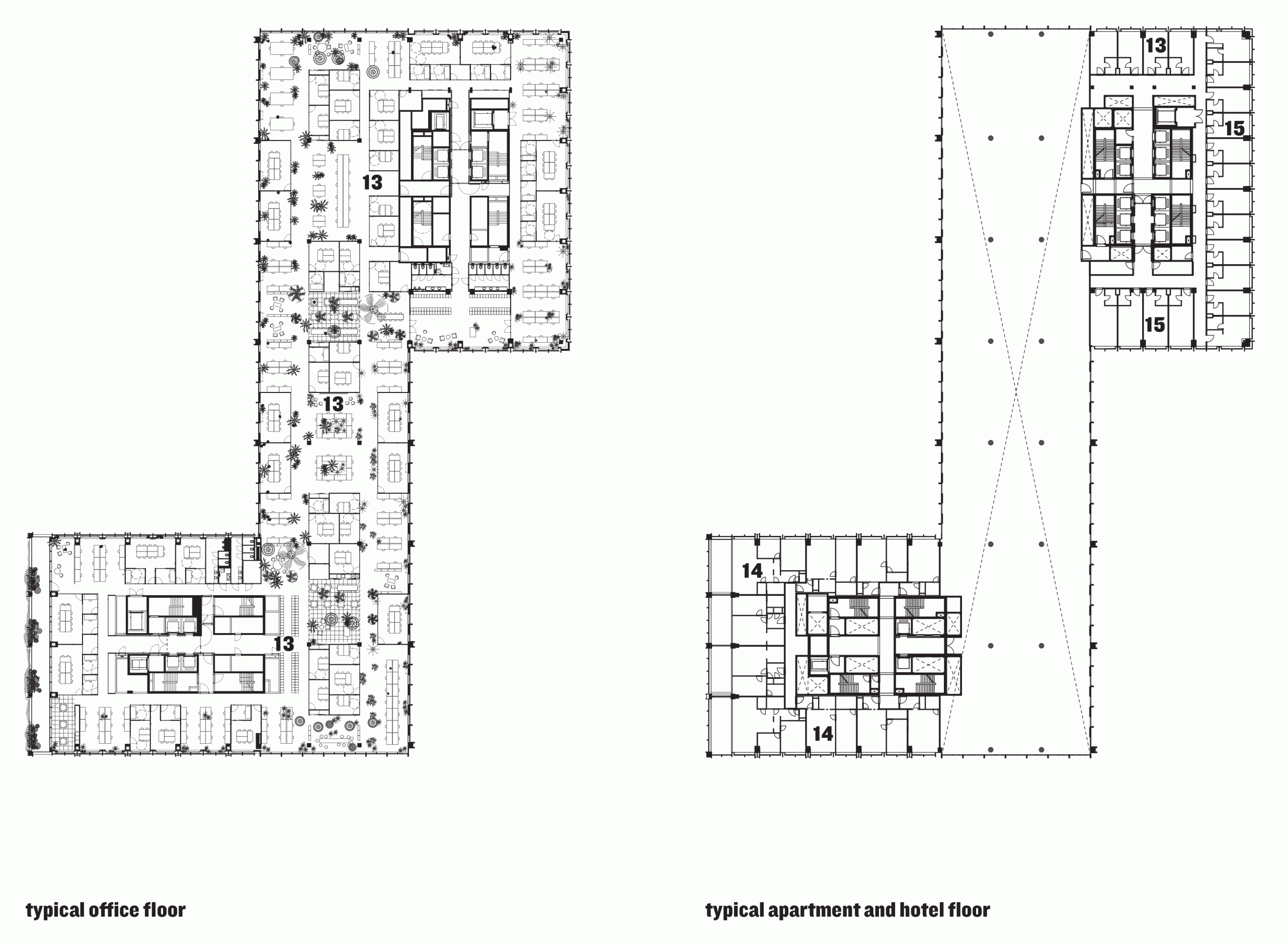
The typological innovation of ZIN is the connection of the double‑height floors of the added middle volume with half of the floors in the old (now rebuilt) towers. This results in uninterrupted, airy
Bürolandschaften
, or office landscapes, that run from one extremity of the complex to the other – though the floors have been filled with thousands of potted and integrated plants as well as cubicles to organise smaller meetings, so that the space is divided and compartmentalised after all. The storeys alternate in programme, creating a zebra‑effect on the facades: in the southern tower, office floors alternate with rental apartments with spacious terraces, and in the eastern tower, the offices alternate with hotel floors. This represents long‑awaited functional diversity in this neighbourhood, although the different users – tenants, clerks, tourists – will use different circulation routes. Two lower volumes have been added too: at the back, there is a large sports hall, which can only be used by those working on the office floors (use by other groups, such as local residents, is considered too organisationally complex); on the street side, closest to the train station, a large greenhouse is under construction that will be accessible for everyone. The same goes for the covered rooftop garden, provided by the hotel with a restaurant, and described by the architects as ‘the first public rooftop destination within the Northern Quarter’.

The existing towers were almost entirely rebuilt (just the cores and underground floors remained). Credit: Maxime Delvaux

The reconstructed floors of the towers alternate in programme: in the southern tower, office floors, which connect to the double-height floors of the new volume, alternate with apartments; in the eastern tower, office floors are interspersed with hotel floors. Circulation for the different uses, however, will remain separate. Credit: Maxime Delvaux
All the office floors have been leased from Befimmo by the Flemish government for 18 years, and 2,400 civil servants relocated to ZIN. Brussels is the capital of Belgium, but it doesn’t belong to the Flemish Region – within the federal state of Belgium, the city is a region of its own (the Brussels‑Capital Region). For Flemish, Dutch‑speaking politicians, presence and representation in Brussels has always been of the utmost importance. The government of Flanders can manifest itself by means of this building, half a century old, while neither the city of Brussels nor the Belgian government had much to do with its creation: the transformation of the WTC is an initiative of Befimmo. Although this large investment company hasn’t obtained its power by means of a democratic process, it will be paid handsomely, during the next 18 years, to secure the presence of the Flemish government in the capital of Belgium.

A rooftop garden crowns the added volume that sits between the two towers. Though described as ‘public’, the terrace is provided by the hotel with a restaurant. Credit: Maxime Delvaux
南京喵熊网络科技有限公司 苏ICP备18050492号-4知末 © 2018—2020 . All photos and trademark graphics are copyrighted by their owners.增值电信业务经营许可证(ICP)苏B2-20201444 苏公网安备 32011302321234号
苏公网安备 32011302321234号客服
消息
收藏
下载
最近