

创作上传
VIP
收藏下载
登录 | 注册有礼
查看完整案例

收藏

下载

分享
A contemporary bungalow reimagines vernacular architecture in rural Karnataka
In the old town of Tiptur, a traditional
katte
becomes the inspiration for a couple's dream home, celebrating community, nature and the local materiality of the land.

Across the rural landscape of Karnataka, a
katte
or an elevated platform is a symbol of community, tradition and social interaction. Whether it’s an altar in front of a home, a public stage for gatherings or a protective wall around sacred plants like a banyan or peepal tree—a
katte
serves as a vital meeting spot for transactions, gossip, discussions, and even major village events.

Addressing concerns for privacy and security, the house is wrapped within a protective random rubble granite wall sourced from a local quarry nearby; its structure is designed to visually resemble a fort protecting the home.

The formal and informal living room is sandwiched in between two garden courtyards.
When a couple in their late 40s bought a parcel of land in Tiptur—around 150 kilometres from Bengaluru—they were looking to build a home for themselves and their teenage daughters, where they could regularly host their family and friends who lived close by in the neighbouring villages. For architects Avinash Ankalge and Harshith Nayak—the duo behind the multidisciplinary design firm A Threshold—a traditional
katte
immediately came to mind. “Their brief was to entertain everyone beyond common spaces like the living and dining rooms. And, being a family of farmers, they wanted the home to be as open and connected to nature wherever possible,” explain the duo.


Narrow slits within the concrete ceiling create skylights that flood the house with sunlight.
The plot of land was situated in a corner on a road, without any immediate neighbours or “architectural forms or context we could rely on. We wanted to bring in local elements and a vernacular design story here, drawing inspiration from traditional homes in the region,” Ankalge remembers. Noticing many houses in the area using black granite mined from a quarry a stone’s throw away, the team decided to begin their designs with a random rubble black granite stone wall that wraps around the house to form a protective fortress of sorts. Inside, wrapped between a series of landscaped plantations and skylights that “blur the boundaries between walls,” the all-white façade of the home visually seems to float against its dark outer stone wall.

The bold yellow metal staircase becomes an element of surprise within the home’s overarching tonal material palette of black granite floors, white walls and grey ceilings.

The 4,200-square-foot house recreates stepped gathering platforms from the old town of Tiptur through indoor-outdoor spaces interwoven with each other, resembling verandahs at multiple levels connecting different spaces, forming semi-public gathering zones within the house. “These areas not only utilise transition spaces effectively, but also breathe life into the home—reminiscent of the lively atmosphere found in the village. The design strategically incorporates staggered, overlapping courtyards, providing captivating views of every place within the house. Everything is interconnected with gardens at every level,” Ankalge and Nayak point out.
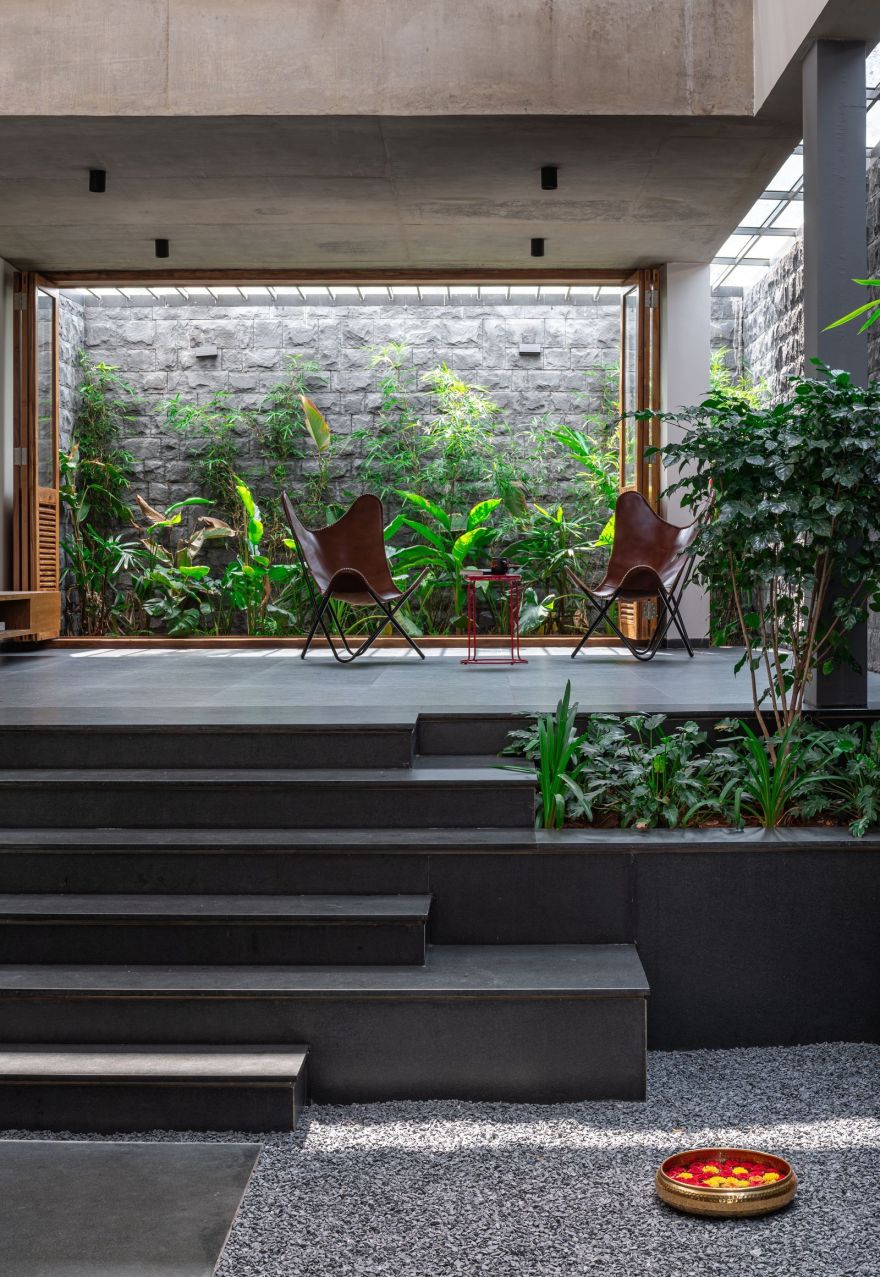
The formal and the informal living areas are connected by a series of steps and platforms to draw on the local concept of katte.
Situated between two courtyards—one to the east and the other to the west—the living room extends into the kitchen, which opens into its own kitchen garden, a nod to the family’s farming roots, where they still grow their own produce. The first-floor bedrooms are thoughtfully designed with large sliding folding door windows, which join the rooms with the living
courtyards
when open; while the
children's bedroom
unfolds into a double-height green court, which in turn seamlessly connects to the common areas, creating a fluid connection with the overall living space.
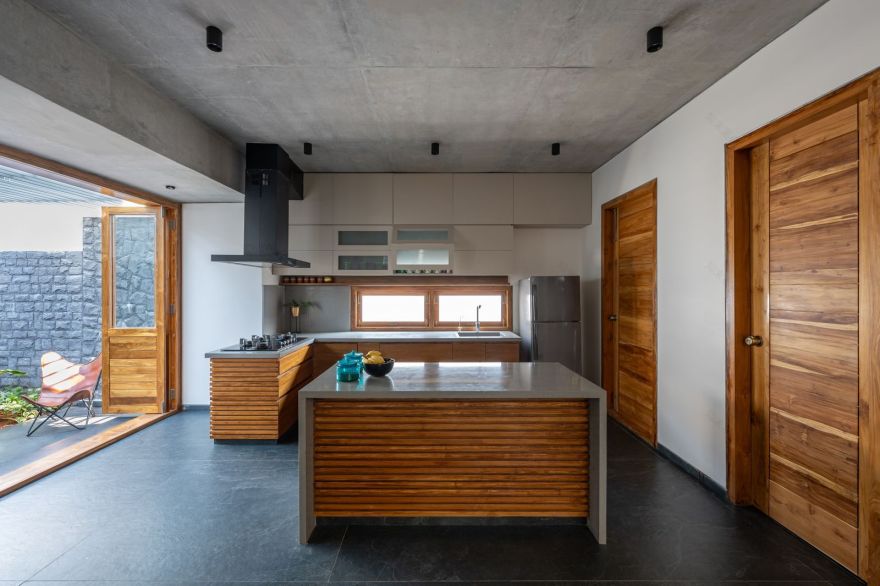
A series of floor-to-ceiling accordion doors open one side of the kitchen into the outdoor courtyard, with the other end flowing into the adjoining dining and living spaces with a floor plan that keeps the family constantly connected to nature.
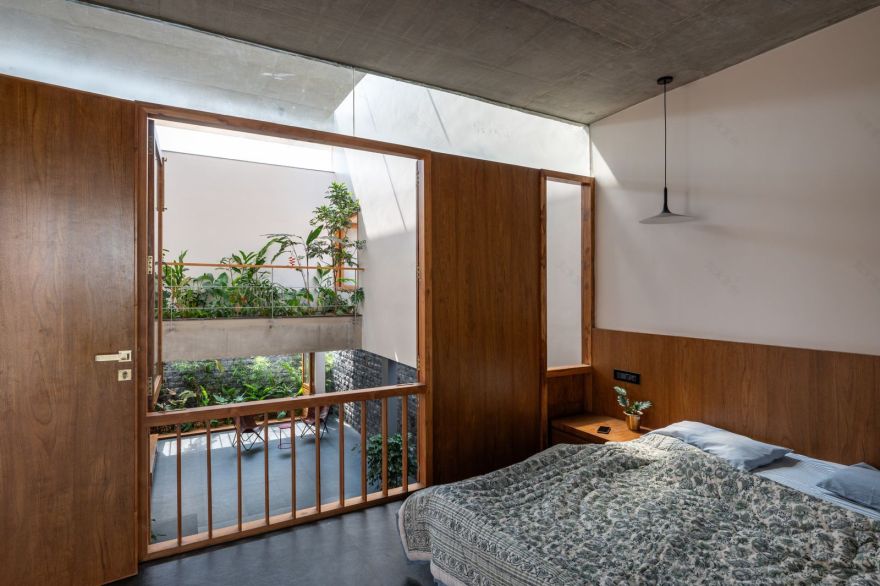
The first-floor bedrooms are thoughtfully designed with large slide-and-fold door windows that extend the room into the living courtyards when open.

“In any home, especially situated in a rural town, context is so important,” describes Ankalge, explaining how many new homes built across the country disturb the vernacular architectural language of the region. “You need to take clues from the surrounding homes to blend in with the ways of the place, rather than change the landscape with what you build.” Unfortunately, building on a plot in the middle of a deserted road without another house in sight didn’t give the team any form of inspiration. “So we used the land as clues!” they exclaim. “From the rich stone that’s quarried here to the plants that were thriving around the home, and even the way the sun moved across the property in Karnataka—it all helped us build in harmony with the place.”
南京喵熊网络科技有限公司 苏ICP备18050492号-4知末 © 2018—2020 . All photos and trademark graphics are copyrighted by their owners.增值电信业务经营许可证(ICP)苏B2-20201444 苏公网安备 32011302321234号
苏公网安备 32011302321234号客服
消息
收藏
下载
最近