

创作上传
VIP
收藏下载
登录 | 注册有礼
查看完整案例

收藏

下载

分享
Shen Ting Tseng Architects, Taiwan

Located on the grounds of Cheng Kung University, a building containing the former university residence of dean Kun‑Yen Huang has been transformed into a public building
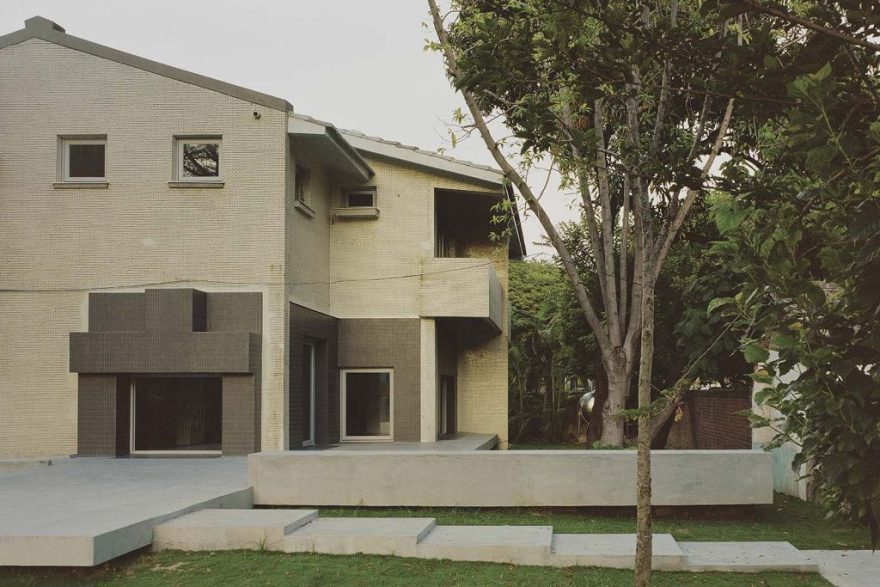
Sculptural pediments, executed in dark-grey tile, help to indicate a change of architectural register, from private dwelling to public space
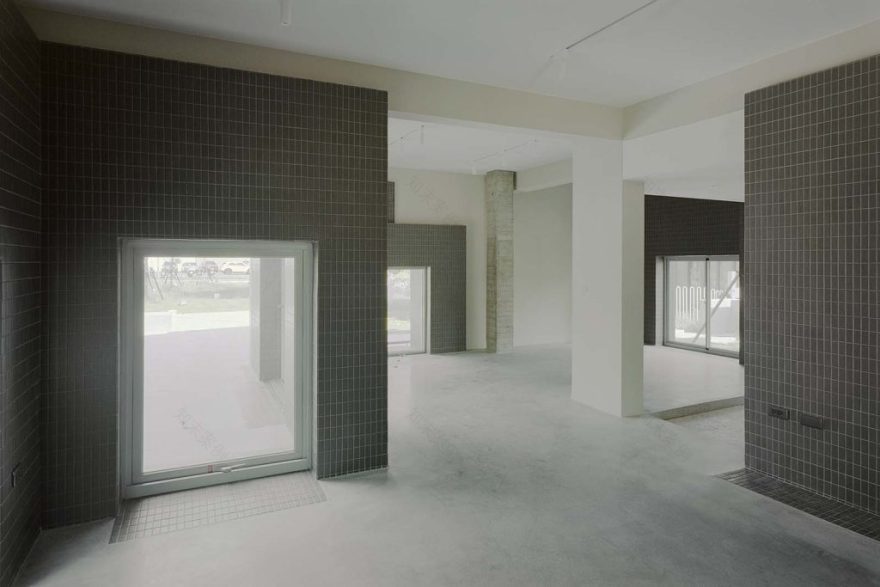
The removal of the party wall and most of the partition walls on the ground floor has given
the previously domestic setting a civic quality

The two existing switchback staircases have been turned into a dramatic X-shape stairway and large glazed openings have been introduced

On the first floor, the pitched ceiling now stretches out uninterrupted

Services are held in pipes that stand out as sculptural elements within the rooms
By a careful process of removal and reconfiguration, this practice has transformed a residence in Taiwan into a public building
Shen Ting Tseng Architects was shortlisted for the AR Emerging awards 2024. Read about the full shortlist
The Cheng Kung University Faculty Dormitory was completed in 1982 on the university grounds in Tainan, in the south of Taiwan. One half of the symmetrically arranged accommodation was occupied until 2000 by the university dean Kun‑Yen Huang. Following the dean’s death in 2012, in 2020 the university decided to open the building to the public to designs by Shen Ting Tseng Architects.
The party wall previously separating the dean’s residence to the east from its adjacent western wing has been removed to create a single larger building. A pitched ceiling runs uninterrupted at the first‑floor level, unifying both halves into a coherent whole. The two original staircases have been reconfigured so that they cross each other, and are set in a double‑height space to ‘bring a new sense of scale and verticality’ to the building, according to practice director Shen Ting Tseng, ‘facilitating the transition from a residential to a public building’. The converted residence now includes a bookshop and kitchen on the ground floor, and an exhibition space, administrative office, and meeting and dining rooms upstairs.

The architects adopted an approach that identifies new interventions within the existing spaces, allowing visitors to ‘recognise contrasts and expressions of memory’. This has been achieved through a consistent and codified use of finishes. Additional structural walls are covered in glazed green tiles, while new partition walls are painted white to match the existing walls. The first floor has been finished in an unglazed version of the wall tiles, while any retained columns are picked out in grey paint. The mechanical and electrical services are contained in visible pipes, themselves becoming sculptural elements within the space.
Windows on the ground floor have been replaced with large, glazed openings, flooding the space with light. The new tiled structural walls deepen these openings and dramatically frame the views of the garden. This connection to the exterior is further accentuated by the laying of floor tiles at the windows, extending from the interior to the exterior, blurring the boundaries between the two.
‘The architects hope that visitors will recognise contrasts and expressions of memory’
Shen Ting Tseng Architects have a diverse portfolio; they are also currently working on a playground, a landscape project and an underground car park at a school in Chiayi City. The practice previously designed the Floating Pavilion for the Taipei Fine Arts Museum’s annual temporary pavilion competition, for which they were shortlisted for the AR Emerging awards in 2016.
Shen also produces watercolour paintings, which allow him to negotiate the formal, spatial and programmatic constraints of architecture in a more abstract visual language. These ethereal artworks are ‘about space’ in his words, ‘its freedom, its abstraction and its emotion’. He insists that his paintings have no direct relationship to his buildings, though he admits to ‘compositional similarities’.
南京喵熊网络科技有限公司 苏ICP备18050492号-4知末 © 2018—2020 . All photos and trademark graphics are copyrighted by their owners.增值电信业务经营许可证(ICP)苏B2-20201444 苏公网安备 32011302321234号
苏公网安备 32011302321234号客服
消息
收藏
下载
最近