

创作上传
VIP
收藏下载
登录 | 注册有礼
查看完整案例

收藏

下载

分享
Inside the Box: Kokoon by Helsinki’s Aalto University Wood Program Students, Finland


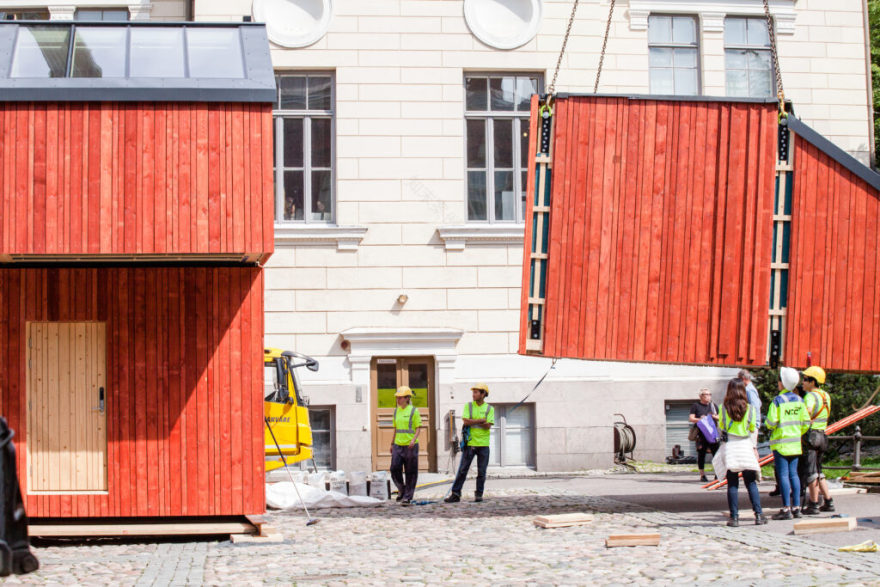
AR House 2018 Commended: made of stackable units providing living space for up to three months, this modular, portable and temporary housing system suggests new possibilities for superior forms of emergency shelter
Amid the red brick, sleek ceramic tiles and ubiquitous Stool 60s of Helsinki’s Aalto University, a curious pile of wooden structures lies at an anonymous grassy corner. Each is about 2m tall, and functionally ambiguous: there are interlocking A-frames, a hive-like tunnel and something resembling both a bench and a deck-chair under a slatted cover. For such intricately engineered objects, it’s strange to see them discarded in such disarray. It’s like glimpsing the trash of a secret experimental arm of Artek, making future furniture for functional uses we haven’t quite arrived at yet.
In fact, these are early projects by students of Wood Program, a specialist design and build studio run semiautonomously out of the university’s Department of Architecture. Now in its 24th year, the programme has become something of a trailblazer for excellence in wood as a material for architectural design and construction. Each year an international cohort of around 15 students dives into all things wooden, covering everything from foresting to finishes, with practical projects starting at the scale of a hand-held block and working up to a collectively produced final structure (via the aforementioned frames, the results of an intermediate project to help students design at human scale).
‘Kokoon presents the possibility for a superior model of refugee housing’
The final projects are wildly impressive. Over the years, students, led by Professor Pekka Heikkinen and architect Philip Tidwell, have produced pavilions, emergency shelters and a lifeguard tower for one of Finland’s beaches. Most ambitious, however, is the Kokoon project. Completed by the students of 2015/16, Kokoon is a modular, portable, temporary housing system composed of stackable units that provide living space for up to three months.
Kokoon (which roughly translates to ‘assembled’, not ‘cocoon’) was conceived as a response to the theme set out by Heikkinen and Tidwell, which asked students to think about temporary housing solutions for transient populations such as refugees, as well as students and other residents of Helsinki. As happens each year, students submit proposals as individuals and a winner is selected by the tutors, at which point ‘it goes from being one person’s problem to everyone’s problem’. So, although Kokoon was initially proposed So, although Kokoon was initially proposed by Swedish student Käbi Noodapera Ramel, the project is authored by the whole cohort –each person brings their varying skills to the collective effort.
The project naturally evolves as the collective process takes hold, but Ramel’s initial line drawings are remarkably close to the finished product. As it stands, Kokoon comprises three units, each a cube with a corner chamfered for skylights. Stacked at 90-degree rotations to one another, the units create a cantilever supported by laminated veneer lumber panels that form the interior walls and provide overall structural support. The cantilevered sections give a porch-like cover to the entrance and a view to upper units from the inside.
Of the three units, two are ‘wet’ and include a kitchen area (complete with Iittala glassware, of course), shower and freezing toilet, while one is ‘dry’ and features a bed, built-in desk and seating area. As a rule, in use, the wet units would always sit below the dry, although in its current iteration on display at the university, a ramp leads up to the entrance of one wet unit and an internal staircase leads to a dry unit above. The second wet unit is currently inaccessible; lacking funds and time, the plan for an external staircase was abandoned – however, the third unit was still included in the ensemble to illustrate its stacking potential.

Exploded axonometric drawing of Kokoon by Aalto University Wood Program Students
‘When we chose the project we thought it demonstrated the excitement of this stacking system,’ explains Tidwell. ‘But if you build just one unit and you say it’s stackable, it’s not that interesting. Many people have done that and said, “Well it could be stacked, we’ll show you renderings of how it could stack”. We said, “No, we’re going to have to build three.’ With their vertical spruce cladding – painted in
punamulta
(falu red) that riffs on the tone of traditional Finnish farmhouses – the three appear unified from the outside, with the first two entirely coherent from within.
At 3.5m across, the units are the maximum width possible to fit on a regular lorry, enabling simple transportation without special permissions; the three units can be dismantled, moved and reassembled in a day. Heikkinen, Tidwell and the students were, however, wary of the dangers of following standardised dimensions alone. Their research for Kokoon centred around the widespread use of shipping containers as a domestic solution, which ‘take these things that are very good for shipping and try and make them into housing’. Tidwell continues, ‘We did 1:1 mock-ups in the workshop to test the relative scale of the interior, to see if truck dimensions were reasonable. Could it be narrower? Longer? What we found is that the dimensions of a standard shipping container are really too narrow and long, they create hallway-like space – a little bit shorter and fatter is more reasonable.’
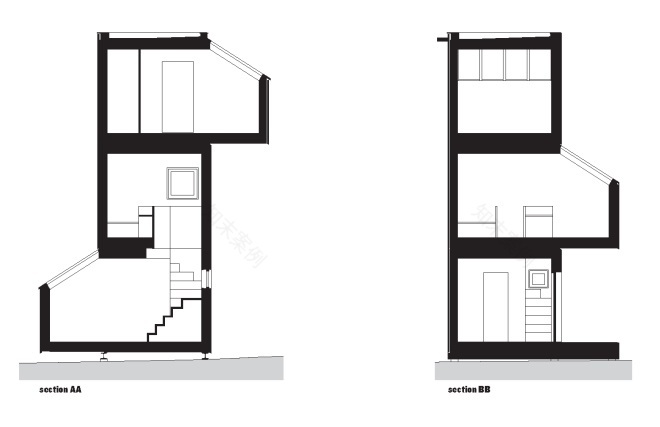
Section of Kokoon by Aalto University Wood Program Students
The internal staircase is also central in the provision of Kokoon’s domestic atmosphere. Aside from its basic function as space of transition, the switchback staircase provides visual and audible connections between the units, creating a sense of space that is not only far greater than each unit’s 11m2, but also in marked contrast to the squat isolation of a shipping container. The stair also unifies the separate units: the only interior sign of their separation is a thin band of heavyweight felt insulating the gap between them. A more heavy-duty locking system made from steel plates is hidden between the cladding and interior surfaces at each corner; this is replaced by a custom bracket when the units are separated by crane.
Kokoon is clearly a technical success, although this is perhaps unsurprising given the collective effort that went into it. As Tidwell concedes, ‘You just couldn’t have this many people working this many hours on a cheap house in an office … it’s not emulating a model of practice.’ Nor is it currently emulating a model of housing – as a prototype, it has only been slept in by a handful of students who had a hand in its construction, so any sense of its longerterm viability is highly dependent on hypothetical manufacturers, owners and deployment contexts.

Section of Kokoon by Aalto University Wood Program Students
At €20,000, each Kokoon unit is worth around four times the amount of a shipping container, so manufacturers would likely reduce the quality of material elements – such as the skylights, which constituted a third of the budget alone – to produce them at any kind of wider scale. Nor does the ‘cost’ account for students’ free labour, although the design is clearly complete and Tidwell and Heikkinen are not precious about holding onto it: ‘We’d be happy to hand it off as a drawing or design if someone wanted to develop it as a system’.
Were Kokoon to be manufactured on an industrial scale, its flexibility and quality design suggest it would be suitable for a range of domestic scenarios. Designed primarily with an urban context in mind – as opposed to a setting in which immediate emergency shelter is required – its stackable nature means it could fit into a dense environment, while the skylights and curtains allow for sufficient privacy.

Plan of Kokoon by Aalto University Wood Program Students
Retaining an emphasis on its temporary nature – that is, up to three months – Kokoon does present the possibility for a superior model of refugee housing to anything previously seen. The scale of its spaces, provision of basic facilities and material quality make it a pleasant area in which to spend time. What’s more, it is insulated to meet Finnish housing standards and subtle flourishes ensure it keeps up with the country’s design standards: repeated wooden rails are used as bannisters, curtain rails and a towel rack; the first two have LEDs neatly integrated to illuminate the units (so potential residents would not have to buy lights), and furniture – built in or freestanding – is included.
‘Homelier than an emergency shelter and more mobile than a permanent home’
As architects who specialise in wood, Tidwell and Heikkinen are understandably reluctant to proclaim Kokoon as any kind of solution to issues beyond their remit. ‘We’re not well positioned to say whether or not this is better than a hostel to house an incoming migrant population. But we are well positioned to design the objects in a more thoughtful way. When I look at those other stacked systems, the orientations are all wrong: they’re too long. As architects, I think we can do better than that.’ As such, they also imagine Kokoon as a solution for a variety of contexts beyond the needs of refugees. One attractive possibility is that of a construction company, developer or even local authority buying several units as part of regeneration or refurbishment projects that require residents to be temporarily rehoused. This is, of course, reliant on the process taking no longer than three months. While Kokoon is exceptionally well executed, it is too small to live in beyond that timeframe – and filling it with more than three people seems out of the question.
What it does do, however, is raise the levels of quality and possibility for temporarily housing precarious or transitory populations. Homelier than an emergency shelter and more mobile than a permanent home, Kokoon brings something new to discussions around housing in a time of transition. It would be a shame for this prototype to go no further than the dumping ground of its timber siblings.
Designer
Käbi Noodapera Ramel
Project team
2015/16 students of the Wood Program, Aalto University, Helsinki, Finland, under the tuition of Pekka Heikkinen and Philip Tidwell
Photographs
Tuomas Uusheimo
Marc Goodwin
Juho Haavisto
Anne Kinnunen
南京喵熊网络科技有限公司 苏ICP备18050492号-4知末 © 2018—2020 . All photos and trademark graphics are copyrighted by their owners.增值电信业务经营许可证(ICP)苏B2-20201444 苏公网安备 32011302321234号
苏公网安备 32011302321234号客服
消息
收藏
下载
最近