

创作上传
VIP
收藏下载
登录 | 注册有礼
查看完整案例

收藏

下载

分享
Mumbai: Swiss modernism and Japanese minimalism meet in this seafront apartment
With all-timber finishes, quiet marble floors and an abiding lightness of being, this light box-like apartment rises and sets with the sun.

In Mumbai's Parel, where skylines soar like slender mountains, is a home that allegorically levitates somewhere between Geneva and Tokyo, although as architects Huzefa Rangwala and Jasem Pirani of Mumbai-based interdisciplinary design studio MuseLAB point out, it exists in a metaphysical realm of its own. Their explanation finds reason in the home’s modernist Swiss sensibility and distinctly zen spirit, which together hold a mirror to its owner’s encounters with calm on either side of the world. “He spent a lot of time in Switzerland and travels frequently for work to
Japan
, so he was keen on a design aesthetic informed by these shared design values,” Rangwala says of the client, for whom it was important that the home be timeless, yes, but also practical enough for his
multigenerational family
, which includes his parents, his daughter, and the family's rambunctious pup, Leo.

The entrance parlays into a passage, which, in turn, leads to a wood-and-glass door that serves as an overture to the primary suite and daughter’s bedroom. The art is a Riyesh Patil work.

The living room’s floating shelf system plays host to delicate objets d’art. The unit, like nearly every other piece of furniture in the home, was custom-built to the client’s needs.


Maybe it’s the muted palette or the minimal decor. Or perhaps it's the fact that nothing about the apartment seems over-engineered. Whatever it is, there’s something about the home that feels like it could have come to be without the slightest human touch—an illusion, the architects explain, that wasn’t just left to chance. Rangwala and Pirani maintained breathing room between objects to create a light box that keeps the elements front and centre. One intervention of note was the floor, which the architects hushed with Botticino marble in the common areas and warm oak veneer in the bedrooms. They whited out the walls and ceilings to highlight the woodwork, and carved out functional realms to serve the family through the day. As Pirani puts a finer point on the subject, “The client was clear about how everything had to have a home.” And so, giving everything—and everyone—equal pride of place was the first order of business.

The living-dining area follows an L-shaped layout that oscillates between serving as a lounge, a sunroom and a music room. A piano takes pride of place in one corner.

The dining room is anchored by a 14-foot-long table with an Italian marble top. A recess in the wall, part of a larger crockery cabinet, masquerades as the bar.
When it came to organising the interior, Rangwala and Pirani, and their team—which included architects Shikha Mehta, Sakina Kothawala and Hussain Mukadam—worked backwards, assessing the spaces available and retrofitting them with special moments. Exhibit A: the living room, which seemingly rings with euphony, thanks to the grand piano that inhabits one corner. Most evenings, it is summoned to life by father or daughter, both equally adept at the clavichord, and when it isn't, it affords interludes quietly orchestrated by a floating shelf here or a Jeanneret armchair there. As the architects recall, the adjacent dining room, or more specifically the bar to which it would play host, was a particular conundrum. “We didn’t want to introduce an actual piece of furniture because we were wary of minimising the footprint,” recalls Rangwala. And so, they didn’t. Instead, they carved the bar into the wall, inside an invisible wall-sized crockery unit, and used the space they had left to highlight the real crown jewel: the 14-foot table crowned in Alaska Elegance marble.

The primary bedroom is a timber cocoon that keeps the sun close. A bijou walk-in closet separates the boudoir from the bathroom beyond.
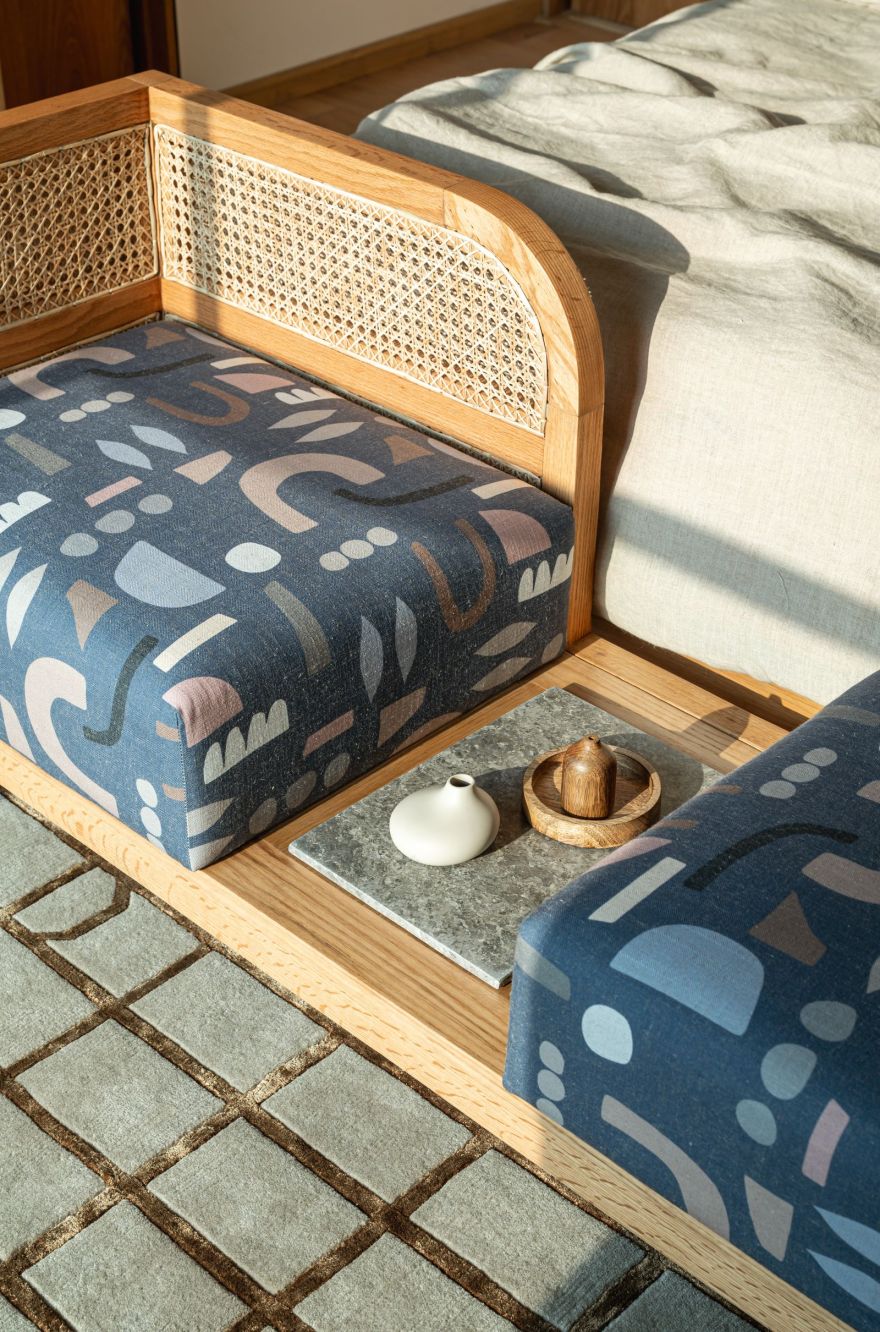
The parents’ bedroom is a meditative hideaway that serves as the calm before the chaos (of the city). A daybed at the foot of the bed affords unfettered views of the coastline.

The guest bedroom features two-way oak panelling and indigo ceramic art by Yashashri Shildhankar. “This bedroom is one of our favourites. A guest wouldn’t want to leave,” muses Pirani.

The daughter’s bedroom is tricked out with a loft bed with a slumber zone above and a knock-back space below.

No two bedrooms did Rangwala and Pirani design alike. Whereas they held a mirror to the coastline in the parents’ room using neutral tones and natural finishes, they did the opposite in the guest bedroom, employing two-way oak panelling and indigo Japanese characters to conjure an inward-looking sanctum. As for the daughter’s bedroom, they ventured upward rather than outward, introducing a loft bed with a lower level that doubles as a knock-back zone. With the bedrooms, as with the rest of the home, the architects maintained a lightness of touch, giving each space its own identity while imbuing in it the same spirit as the space that came before it. The result is a haven where the elements take centre stage, and where people and place exist on an even plane.
南京喵熊网络科技有限公司 苏ICP备18050492号-4知末 © 2018—2020 . All photos and trademark graphics are copyrighted by their owners.增值电信业务经营许可证(ICP)苏B2-20201444 苏公网安备 32011302321234号
苏公网安备 32011302321234号客服
消息
收藏
下载
最近