

创作上传
VIP
收藏下载
登录 | 注册有礼
查看完整案例

收藏

下载

分享
Revisit: Meisterhaus Kandinsky/Klee in Dessau, Germany by Walter Gropius
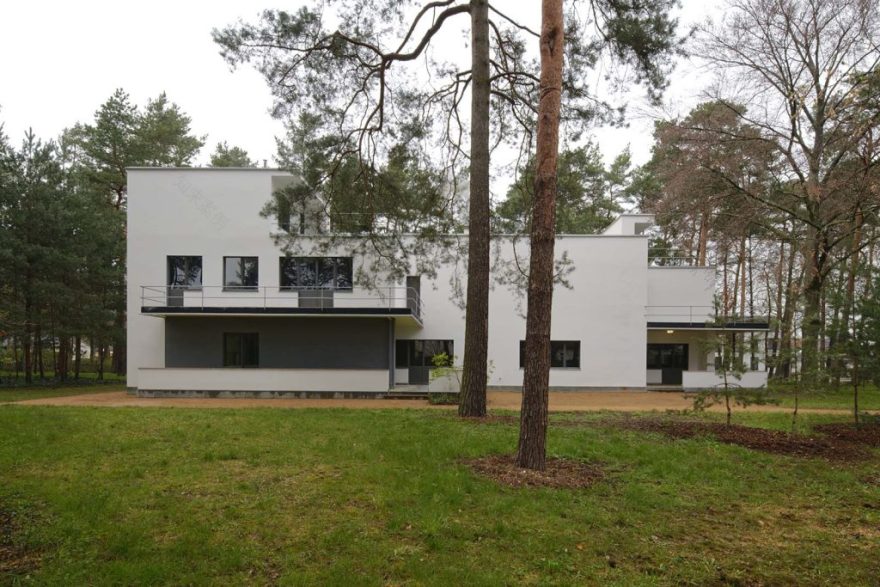
Artists Wassily Kandinsky and Paul Klee lived in the Meisterhaus Kandinsky/Klee from 1926–32. The house was one of four buildings designed by Walter Gropius for the staff of the Bauhaus. comprising one villa for himself (left of drawing) and three semi-detached homes. Kandinsky and Klee’s house was at the opposite end of the plot from Gropius’

The exterior was restored in 1998, but the interiors were only fully restored in 2019. The rooms of Klee’s half of the house are accessed from the brightly coloured entrance hall

The restored dining room features mint-green built-in cupboards

The Bauhaus classic colour combination
of blue, red and yellow
has been revived in the first-floor staircase
of Klee’s house

During the 1998 project, an internal opening was made between the two halves of the house.
This has now been closed and the houses are entered through their original front doors – pictured here is the entrance to Kandinsky’s half of the Meisterhaus

Visible from the dining room is the meticulously restored gold wall in Kandinsky’s living room

In comparison to Klee’s staircase, Kandinsky’s is slightly more subdued

Kandinsky’s studio is greyscale, without the yellow ceiling that Klee added

The rooms now act as receptacles for the coloured walls, rather
than as exhibition spaces, as they were after the 1998 restoration
The restoration of the house designed by Walter Gropius for artists Wassily Kandinsky and Paul Klee in Dessau, Germany, lives on as a walk‑in artwork
The Meisterhäuser, icons of classical white modernism, shimmer softly through the tall trunks of the pine trees along a quiet, suburban street in Dessau, Germany, just as they did in Lucia Moholy’s photograph when they were brand new in 1926 and the
– the teachers at the Bauhaus – had just moved in with their families. But this wasn’t always the case: the buildings have a very chequered history, and were not always considered the modern icons they are today.
For only six years, from 1926 to 1932, the four Meisterhäuser served as residences for their intended residents, among whom were artists Lyonel Feininger, László Moholy‑Nagy and his wife Lucia Moholy, Georg Muche, Oskar Schlemmer, Wassily Kandinsky and Paul Klee. After Adolf Hitler’s fascist NSDAP (commonly known among English speakers as the Nazi Party) won the local elections in 1931, Dessau’s city council decided almost immediately to cut all funding for the Bauhaus, forcing the school to close its doors within a year. In fact, the fascists had been agitating and raging against the school and its architecture for years. They found it decadent, bourgeois and emphatically un‑German.

The two artists Paul Klee and Wassily Kandinsky lived in the Meisterhaus Kandinsky/Klee in Dessau (lead image) between 1926 and 1932. The house was photographed by Lucia Moholy in 1926, when it was newly completed.
In 1939, the city of Dessau sold the houses to aircraft manufacturer Junkers whose founder, engineer Hugo Junkers, in a bitter twist of fate, had once been a fierce supporter of the Bauhaus – without his financial support, the Bauhaus would likely never have moved to Dessau in 1924. But in 1933, Junkers had been expropriated by the Nazis to become one of Germany’s leading arms producers. The Meisterhäuser were to become homes for Junkers’ growing staff. To make their intentions very clear, the city sold the houses with the contractual obligation to ‘redesign the exterior of these houses in consultation with the municipal building authority … in such a way that the foreign architecture disappears from the cityscape’. It was only the severe housing shortage during this time that kept the Meisterhäuser and the Bauhaus main building from simply being torn down.
Destruction still happened, however, as all the Bauhaus buildings were ruthlessly remodelled. For the Meisterhäuser, this involved the replacement of most of the large windows in the studios and stairwells with smaller ones, while partition walls were installed to divide the large studio spaces into smaller living units. The beginning of the Second World War in 1939 prevented further alterations, but Dessau became a major target for bombings because of the prominence of the Junkers company and its military aircraft; a single bomb hit the Meisterhäuser ensemble – destroying the villa that Walter Gropius had designed for himself, as well as the adjacent half of the first Meisterhaus designed for Moholy‑Nagy – leaving Lyonel Feininger’s half standing by itself.

Paul Klee (left) and Wassily Kandinsky (right) outside their house in Dessau
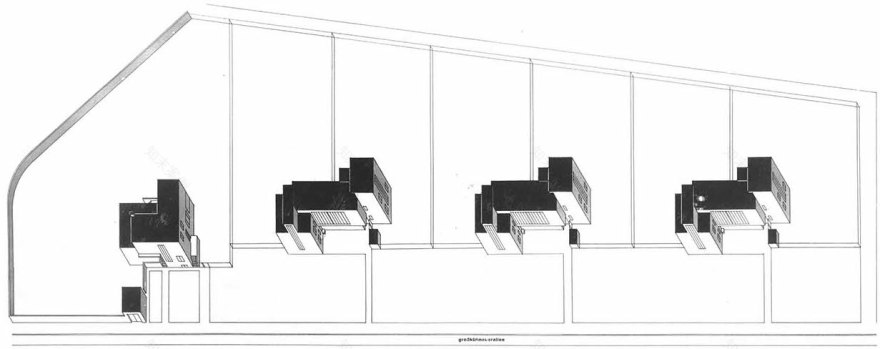
The house was one of four buildings designed by Walter Gropius for the staff of the Bauhaus, comprising one villa for himself (left) and three semi-detached homes
After the end of the Second World War, Dessau became part of the German Democratic Republic (GDR), and the young socialist state showed no interest in the Bauhaus legacy. Further conversions happened to the Bauhaus buildings: in the Meisterhäuser, coal stoves were installed to replace the poorly functioning central heating, adding brick chimneys to their increasingly strange silhouettes. Rough render was applied and further walls and small windows installed. Open terraces were partly covered to turn them into additional living spaces. Over the decades, the new residents added their own extensions and replaced worn‑out parts. The bombed Moholy‑Nagy house was never rebuilt, while on the foundations of Gropius’s villa, the city allowed a rather more conventional house with a traditional gable roof to be built, as if to ultimately erase all memory of the Bauhaus and its ‘flat roof philosophy’.
A discussion about the Bauhaus and its legacy started slowly in the GDR. In 1976, the main building was restored and from 1986 it was used as a
(design centre), tied to the GDR’s ministry of building and construction. The remaining Meisterhäuser, on the other hand, were put back into use as functioning homes. Only after German reunification and the Bauhaus Dessau Foundation was set up in 1994, moving into the main building, were plans made to restore the Meisterhäuser. Central to this task were questions of what to preserve: should the buildings be restored to their original ‘as new’ state, or should the traces of almost a hundred years of German history be preserved instead? Was it justifiable to demolish the house that had been built in place of Gropius’s villa in order to reconstruct the original? Could Moholy‑Nagy’s lost half‑house be rebuilt as if no Second World War had ever happened, or could it be reconstructed in a way that its destruction would still be apparent? And should the two remaining pairs of semi‑detached houses of Muche/Schlemmer and Kandinsky/Klee be restored to their former glory or should their brutal and highly politically motivated alterations be preserved, in order to tell this important part of their story? For years, a furious debate raged on about how to deal with these buildings as witnesses of such a complex history.

The first structure to be restored was Feininger’s half of the Meisterhaus Moholy‑Nagy/Feininger house in the early 1990s. Here the decision was made to restore the building’s exteriors to their original glory, while the interiors were radically transformed to be used as office, exhibition and event spaces for the newly founded Kurt Weill Centre, honouring the Dessau‑born composer who had almost no connection to the Bauhaus at all. Following this, the Meisterhaus Kandinsky/Klee was restored in 1998 with almost the same philosophy: to use it as an exhibition centre for the Bauhaus and its masters. Again, the exteriors were reshaped to Gropius’s original design, removing all traces of any alterations post‑1939, while the interiors were radically altered: on the ground floor, a wall was removed to create a larger exhibition space and to make a circular tour through both halves of the house possible. Additional lighting and technical features for use as an exhibition space were installed, though the original wall colours, chosen by Kandinsky and Klee, were restored.
Next in line was the Meisterhaus Muche/Schlemmer in 2001. The project was heavily supported by the Wüstenrot Foundation, an independent private foundation concerned with preserving modern heritage, who argued to reconstruct the building in its 1939 state and to make visible the ‘desecration’ of the Nazi era. In combination with and in contrast to the two renovated Meisterhäuser to the left and right, the foundation argued that this would create a strong narrative and preserve an important aspect of the Bauhaus history. In the end, a compromise was made: the outer appearance of Meisterhaus Muche/Schlemmer was restored to its 1926 condition, while inside traces of the entire history were preserved, including radiators from the GDR epoch and lines in the linoleum flooring where walls had been added and then removed in later years or where the charcoal stoves once stood.

After the closure of the Bauhaus in 1933, the Meisterhaus Kandinsky/Klee was transformed, first by the aircraft company Junkers, then when Dessau became part of the GDR, by which point the building was altered beyond recognition
Finally, and after another very long discussion and two architectural competitions, the city of Dessau and the Bauhaus Dessau Foundation decided to tear down the pitched‑roof house in order to complete the Meisterhaus ensemble by rebuilding Gropius’s missing villa and the Moholy‑Nagy half‑house. Winning the international architecture competition in 2010, Berlin‑based office Bruno Fioretti Marquez Architects introduced a ‘blurry’, abstract interpretation of the historic building; a concept to ‘evoke absence and presence’, dealing with the imprecisions of human memory. Indeed, the abstract shapes of both buildings now shimmer through the trees like phantoms of the past – or memories of loved ones who left us too soon. It’s a stunning project demonstrating that architecture can be abstract, blurry and vague, even when physically built.
By 2017, the lively and productive discourse generated by the reconstructions had made the Bauhaus Dessau Foundation increasingly dissatisfied with the restoration of Meisterhaus Kandinsky/Klee. Co‑operating again with the Wüstenrot Foundation, the Bauhaus Dessau Foundation set up a task force to discuss and analyse the building once again. The results led to another thorough renovation. A feasibility survey discovered two key findings: firstly, that beneath the layers of paint – including the 1998 restoration – the houses had retained an incredible wealth of traces of the original colour schemes with which Kandinsky and Klee had painted their interiors; and secondly, that their use as a small museum for just two decades had already caused significant damage to the small houses. Quickly, the decision was taken to renovate Meisterhaus Kandinsky/Klee once more, turning the building from an exhibition venue back into an exhibition object in its own right.

Klee’s studio, was drawn by Gropius (above) and photographed by Lucia Moholy in 1927 (below)


It was converted into a space for exhibitions during the restoration in 1998

Today, the original colours have been reinstated
This renovation had to first remove what had been added before. The passageway that had been constructed between the two halves was closed so that the semi‑detached houses were once again separated. Technical features like air conditioning, cables and lighting – all of which had been installed for the use as a museum – were removed. Based on precise restoration studies, the colour palettes of the two masters, totalling almost a hundred shades, were brought back to life. As the colour samples demonstrated, both Kandinsky and Klee had – independent of, yet certainly motivated by, each other – turned the inside of Gropius’s austere white shell into a treasure chest of vivid colour (presumably Gropius was aware that his white cubes would be colourfully decorated after artists like Kandinsky and Klee moved in, but there is no evidence of what he thought of this). Each and every surface of their houses was painted, from walls to handrails to window frames to the radiator covers, turning the small houses into walk‑in paintings. Additionally, the samples proved that Kandinsky and Klee never stopped painting their spaces – many of the surfaces had been painted several times between 1926 and 1932.
Since both artists had their own theories on colour and space, their interiors clearly differ from each other. Kandinsky preferred cool, clear colours, while Klee chose a palette of warm and earthy tones. Klee kept his studio in modest tones of dark blue and white, with a dark yellow ceiling answering the dark grey of the floor, while Kandinsky’s studio was painted in various shades of grey and white with strong black lines along the borders of the floor and ceiling. In the spaces of the staircases, with the doors left open, all lines and colours from the adjoining rooms come together, exhibiting the two very different ways Kandinsky and Klee played with the Bauhaus’s famous colour combination of blue, red and yellow.

The black walls of Kandinsky’s dining room have been restored

However, the furniture and Kandinsky’s artwork On White II (1923), depicted in this photograph from 1926, have not been reinstated
As part of extensive restoration work, the colours were reconstructed according to the latest scientific findings, including their chemical pigment composition and using the exact same techniques and tools of Kandinsky and Klee’s times. This went much further than the restoration of 1998: all surfaces have been given the colours, textures and gloss levels that come closest to the last coherent version as it existed at the time of the artists’ departure, when the Bauhaus closed in 1932. In this way, the restoration gives an almost painfully exact reproduction of the colour schemes. This is best demonstrated in Kandinsky’s living room, in which he had painted a wall a shimmering gold that very softly reflects its surroundings. After almost a hundred years, this restoration brought back the golden wall in all its glory, with the same meticulousness as if it had been one of his paintings. Additionally, a special LED lighting system was installed to make different light modes possible. Now it is possible to change between the lighting we are used to today and a lighting which simulates the (darker) lighting that was used at the times of Kandinsky and Klee.
Today, all spaces have been left empty, so that no furniture or installation distracts from the effects of the colours. Instead of turning these two homes into a museum of local history, where you might encounter Kandinsky’s desk or Klee’s bathtub, only the empty rooms are on display, complemented by historical black‑and‑white photographs of how they were once furnished. The combination of historic photograph and colourful space leaves it to the visitors’ own imagination to conjure those who lived here, how the spaces were furnished and what happened in all the years which have passed since then. Wandering around the houses feels like walking through an art installation – or two architectural‑scale paintings. In the contrast of white abstract shell and colourful interior, the Meisterhaus Kandinsky/Klee demonstrates the complexity of the Bauhaus art school in its Dessau times, when different artistic currents could still coexist and unfold together.
南京喵熊网络科技有限公司 苏ICP备18050492号-4知末 © 2018—2020 . All photos and trademark graphics are copyrighted by their owners.增值电信业务经营许可证(ICP)苏B2-20201444 苏公网安备 32011302321234号
苏公网安备 32011302321234号客服
消息
收藏
下载
最近