

创作上传
VIP
收藏下载
登录 | 注册有礼
查看完整案例

收藏

下载

分享
Delhi's iconic Chandni Chowk is now home to India's largest food court
India takes you inside this magnificent eatery, Dawatpur, designed by The Melange Studio and Chromed Design Studio.

is more than just a location—it’s an emotion, a vibrant blend of experiences that captivate one with mouth-watering delicacies, an array of wedding shopping choices, and historic monuments. Embracing and elevating this essence, Mr. Jatin Goel, executive director at Omaxe Ltd., envisioned Dawatpur, India’s largest food court at Chandni Chowk. Spanning 1,00,000 square feet, Dawatpur welcomes over 2,000 visitors daily, offering 45 food outlets and five fine-dining restaurants. Crafting a space that stirs nostalgia is no small feat; therefore, Dhruv DV and Pranvi Jain of The Melange Studio and Abhigyan Neogi of Chromed Design Studio joined forces to dive deep into the rich history of Chandni Chowk, creating a design that beautifully merges heritage with modern functionality.


The flooring is a mix of concrete tiles from KG Tiles, and cobblestone and granite locally sourced by the contractor
Avesh Gaur
Inspired by the vibrant energy of Shahjahanabad (Old Delhi), the team comprising Tenzin Dodhen, Harsh Bhansali, Sarthak Makkar, and Karan Sonkar, designed Dawatpur using classic planning principles drawn from this historic area. The food court is thoughtfully divided into four major zones, featuring food retail, a children's play area, digital screens, performance stages, and anchor stores. To capture the essence of Chandni Chowk, elements like movement nodes, and water features were reinterpreted, bridging the old city's charm with a modern context. The four evenly divided zones are linked by a central axis, featuring a series of fountains called Chand Gali, inspired by the historic water channel that flowed through Chandni Chowk during the Mughal era. The ceiling is inspired by traditional metal
jalis
, allowing natural light to filter through for a unique ambience.
Each zone of Dawatpur is named after a unique design theme— Sunehri Nagri, Laal Bagh, Neel Nagar, and Panna Puri—each celebrating its own cultural inspiration.
Avesh Gaur
Avesh Gaur
Sunehri Nagri
The decorative lights are from Bhagirath Palace, Delhi. Sanitary fittings are from Duravit & Uronics.
Avesh Gaur
Adjacent to Laal Bagh, this zone captures the vibrant energy of Chandni Chowk's street food culture. The flooring showcases distinct patterns and cobblestone designs, while wrought iron railings define secondary movement axes, guiding visitors through the bustling, market-like environment.
Laal Bagh
Avesh Gaur
Drawing inspiration from the iconic red sandstone buildings of the Red Fort, this space pays homage to its grandeur. The expansive double-height area features a “bazaar lane” with charming food kiosks, reminiscent of the Meena Bazaar. Graceful arches, faux balconies, and intricate patterns in the tiles enhance the visual appeal, while red sandstone clads the columns up to the dado level, complemented by textured exterior paint in two contrasting shades.
Neel Nagar & Panna Puri
All wrought iron tables and chairs were custom-designed and crafted by various artisans and vendors across India.
These two zones are characterized by distinct colour palettes—indigo in Neel Nagar and green in Panna Puri.
Mughal
-inspired motifs, rendered in digital art, adorn the columns, which are clad in Indian Makrana marble and Baroda green up to the dado level, complementing the overall colour scheme. The spaces showcase intricately hand-painted designs by local artisans, with a central dome painted by artist Rahul Kumar in fresco as the focal point.

Avesh Gaur
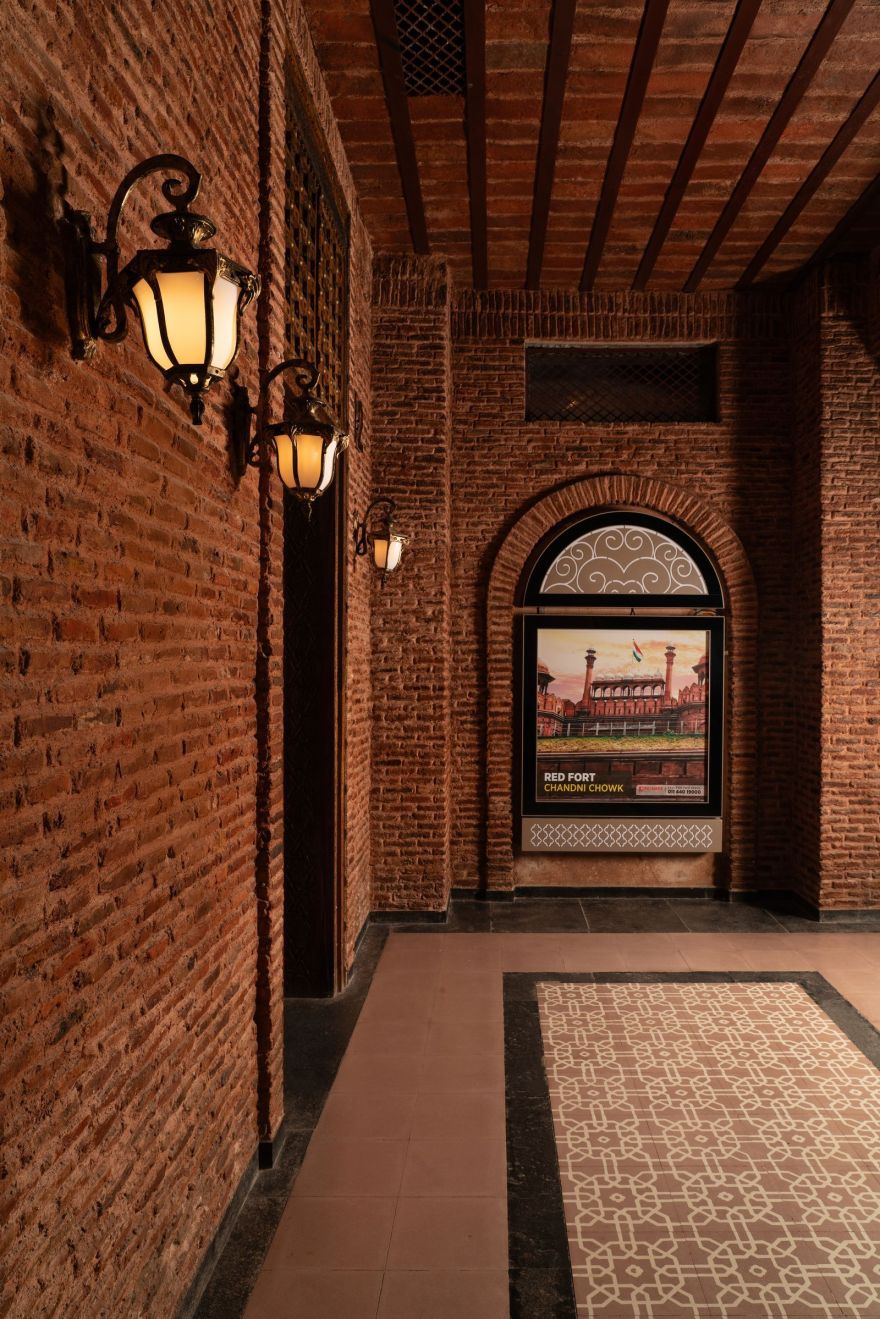
The lift lobbies of Dawatpur are thoughtfully designed to evoke nostalgia and historical charm, featuring original
lakhori
bricks and imitation stone slabs reminiscent of Chandni Chowk’s historic havelis. Vintage doors, carefully sourced from Jodhpur, Rajasthan, add to the authenticity. Arched panels display historical information and Red Fort paintings, some doubling as wayfinding signage. Inspired by traditional haveli aesthetics, the flooring patterns divide the food court into distinct zones, with custom tiles bordered by cobblestone and black granite, guiding foot traffic while narrating a story. Custom signage, created by Shubham Torani from The Neat Trick, reminiscent of Delhi’s road signs, appears in a "vandalized" style, adding to the raw, urban vibe of the space.
Avesh Gaur

Avesh Gaur
Dawatpur is a culinary world unto itself. It pays homage to the rich history of its surroundings while offering patrons a contemporary experience. This “organized chaos” brings together diverse textures, patterns, and design elements in a visually captivating way.
南京喵熊网络科技有限公司 苏ICP备18050492号-4知末 © 2018—2020 . All photos and trademark graphics are copyrighted by their owners.增值电信业务经营许可证(ICP)苏B2-20201444 苏公网安备 32011302321234号
苏公网安备 32011302321234号客服
消息
收藏
下载
最近