

创作上传
VIP
收藏下载
登录 | 注册有礼
查看完整案例

收藏

下载

分享
Revisit: Sexto Panteón in Buenos Aires, Argentina
The brutalist underground necropolis in Buenos Aires is beginning to emerge from a pit of neglect and misattribution
In 1949, when Argentina was among the most powerful countries in the world, the city of Buenos Aires began construction of the Sexto Panteón (literally, ‘sixth pantheon’), an underground necropolis designed to house 150,000 graves. Sitting within the city’s Chacarita cemetery, this monumental brutalist wonder was the first and largest experiment in modern architecture in the funerary field, although it remains largely unknown.
The forgotten architect of the project, Ítala Fulvia Villa (1913–1991), was one of Argentina’s first female architects and urban planners. A pioneer of South American modernism, she notably contributed to the development of Le Corbusier’s 1937 masterplan for Buenos Aires. If several factors can explain why the Sexto Panteón, as well as the name of its architect, have fallen into oblivion, it seems that the gender of its designer certainly played a significant role. Despite her substantial contribution to Argentinian architecture and urban planning, Villa, like many other female architects of her generation, was largely overlooked in architectural history, and her Sexto Panteón often unfairly attributed to her male colleague, Clorindo Testa. Villa primarily worked for public institutions – whether by choice or not is uncertain – and never established her own firm, which meant she did not personally sign her projects. Furthermore, as an only child with no spouse or descendants, there was no one to advocate for her legacy.

If it were not for the top canopies of the trees planted two floors down, the necropolis’s ground floor level would reveal very little of the project’s radical sectionality. (Nuestra Arquitectura n°379, 1961)

(Nuestra Arquitectura n°379, 1961)

(Archivo Alberto Aquilino López, Secretaría de Desarrollo Urbano, Jefatura de Gabinete de Ministros, Gobierno de la Ciudad Autónoma de Buenos Aires)
Located in the eponymous neighbourhood of Buenos Aires, the Chacarita cemetery was historically intended for the city’s middle classes, in contrast to the patrician Recoleta cemetery, which houses the tombs of the most illustrious figures in Argentinian history. With its 95 hectares, Chacarita is one of the largest cemeteries in the world, a true city within the city. Its funerary architectural eclecticism is striking, featuring a mix of vaults and mausoleums, tombstones, ossuaries, columbariums and underground pantheons. Opposite the main entrance, richly decorated marble mausoleums from the second half of the 19th century echo the bourgeois buildings of European influence found in the chic districts of Buenos Aires. On the outskirts, the simple wooden crosses marking the location of the graves in a vast expanse of freshly turned earth evoke the housing of self‑built settlements. Villa’s modern necropolis, the Sexto Panteón, sits in the heart of the cemetery, resonating with the large complexes and urban planning of the second half of the 20th century.
The Sexto Panteón was constructed in the context of rapid urbanisation in Buenos Aires, which had been set in motion a few decades earlier by an economic boom, with Argentina supplying Europe with grain, wool and meat. Between 1920 and 1960, the population of the capital tripled, from one to three million inhabitants, making it essential for the city authorities to develop new public infrastructure, including funeral spaces. The Dirección General de Arquitectura y Urbanismo entrusted Villa, the body’s coordinator at the time, and her team (including a young Clorindo Testa), with the design of a new pantheon in the Chacarita cemetery. The Sexto Panteón was an opportunity to express the ambitions of the city through the construction of a large‑scale public project. The chosen location in the centre of the cemetery was particularly symbolic, forming an axis with the cemetery’s main entrance, the chapel and the crematorium.

The textures and ornaments of the concrete formwork add warmth and expression to the otherwise austere shapes. (Federico Cairoli)

Air vents, part of a now-defunct ventilation system, artfully line each quadrant of the necropolis. (Federico Cairoli)

(Federico Cairoli)
The scale of the programme is unique in the world: it is estimated from the initial plans that it was designed to accommodate approximately 150,000 burials – 96,000 niches for coffins, 7,000 for bones and 42,000 for cinerary urns. Due to its scale, the work on the Sexto Panteón took place in three phases, spread out between 1949 and 1966. The first phase (1949–53) concerned three of the segments and initially included only one lower ground level. During the second phase (1955–58), the decision was made to densify the structure by adding a second basement level in three further segments. Finally, the last phase (1958–66) saw the development of the two last segments.
Inspired by the principles of Le Corbusier’s Congrès Internationaux d’Architecture Moderne (CIAM) of 1928–58, as well as those of Antonio Bonet and Argentinian designers Jorge Ferrari‑Hardoy and Juan Kurchan (all members of the Estudio del Plan de Buenos Aires, founded in 1947), Villa adopted a resolutely modern architectural approach. Breaking with traditional funerary forms, she developed the concept of a vertical cemetery‑park, proposing an underground necropolis in the image of the ancient Roman catacombs. In this innovative vision, the ground level was conceived as a garden intended for the living, while the covered underground space becomes a collective burial reserved for the dead. This new typology was made possible by the constructional innovations of the time, including the use of hydraulic excavators, and the construction of imposing retaining walls made possible by the progress in the implementation of reinforced concrete and waterproofing systems.

The underground architecture of the Sexto Panteón is structured around double‑height open air patios that provide natural light and ventilation to the funerary galleries. The enfeus – funerary niches typical of southern Europe – were treated by Villa and her team as functional modules, aligned and superimposed on each side of the long galleries, allowing an optimal density for the necropolis. They accommodate three types of funerary niches: enfeus for coffins (mostly), ossuaries, and smaller niches reserved for urns.
A dual ventilation system, out of service since the 1980s, was designed to ensure the elimination of odours from the decomposition of the bodies: on the one hand, the air escaping from the back of the enfeus was treated with nitrogen before being evacuated to the surface via ventilation vents; on the other, the circulation areas were equipped with an air supply system to supplement the natural ventilation.

The pantheon is designed to accommodate 150,000 graves in the form of enfeus, ossuaries, and burial chambers. (Federico Cairoli)
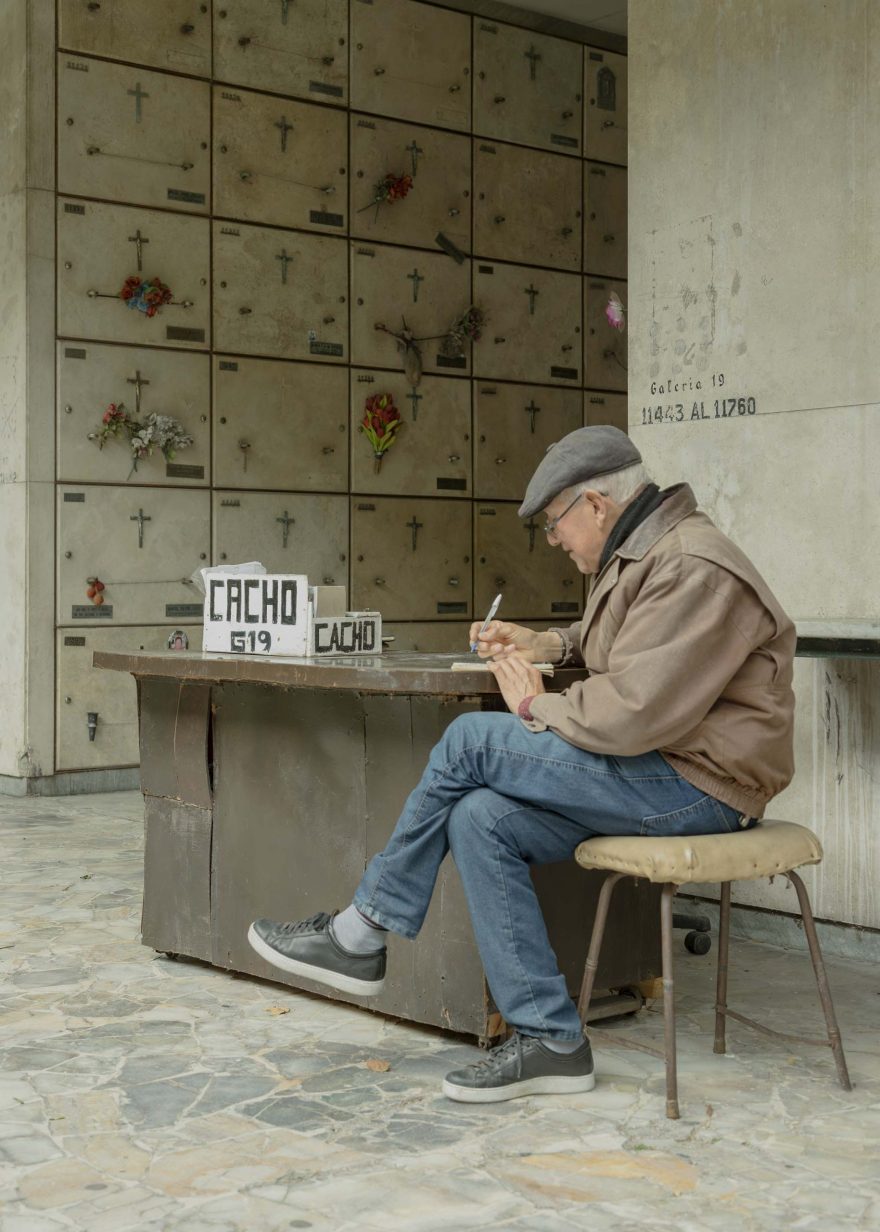
(Federico Cairoli)
The upper level of the necropolis is spread out in the form of a vast grassy esplanade of 90,000m2 punctuated by pedestrian paths and pierced by rectangular sunken patios of varying dimensions. Nine concrete temple‑like canopies are arranged at the four corners, on the sides and in the centre of the plot. Imposing and sculptural, they constitute the same number of entrances to the various underground galleries, while protecting the vertical circulation routes from the elements. Other formal elements contribute to animating this park: concrete walls with geometric shapes offer formal variation, while the alignments of the extraction vents bring a little texture to the view. The tops of the trees planted in the patios below ground surprise the eye and allow a glimpse of the subterranean organisation of the necropolis.
An article published in the magazine Nuestra Arquitectura in June 1961 specified that the landscape project ‘was designed in connection with the architecture in such a way that the two interpenetrate’. It provided for the choice of an elaborate plant palette on the esplanade and in the patios: ‘The associations of plants and flowers were studied taking into account the colour of the leaves, their size, their texture, their brightness, as well as the flowering period.’ These developments, like the water mirrors and fountains that were to occupy the patios, were never carried out for financial reasons, leaving the Sexto Panteón project partially unfinished today.
Villa’s vision for the Sexto Panteón went beyond a simple response to a given programme: she invented a new funerary aesthetic. Unlike classic cemeteries in which imposing mausoleums are dedicated to aristocratic families and illustrious people, the Sexto Panteón communicates a wholly modern conception of death in its egalitarian dimension. Monumentality is reserved only for the thresholds and staircases that connect the depths with the sky. Hierarchy is abolished – all are equally called to salvation and redemption.

The descent to the lower floors evokes the labyrinthine structures of Piranesi’s Imaginary Prisons, though open double-height spaces are never far away. (Federico Cairoli)
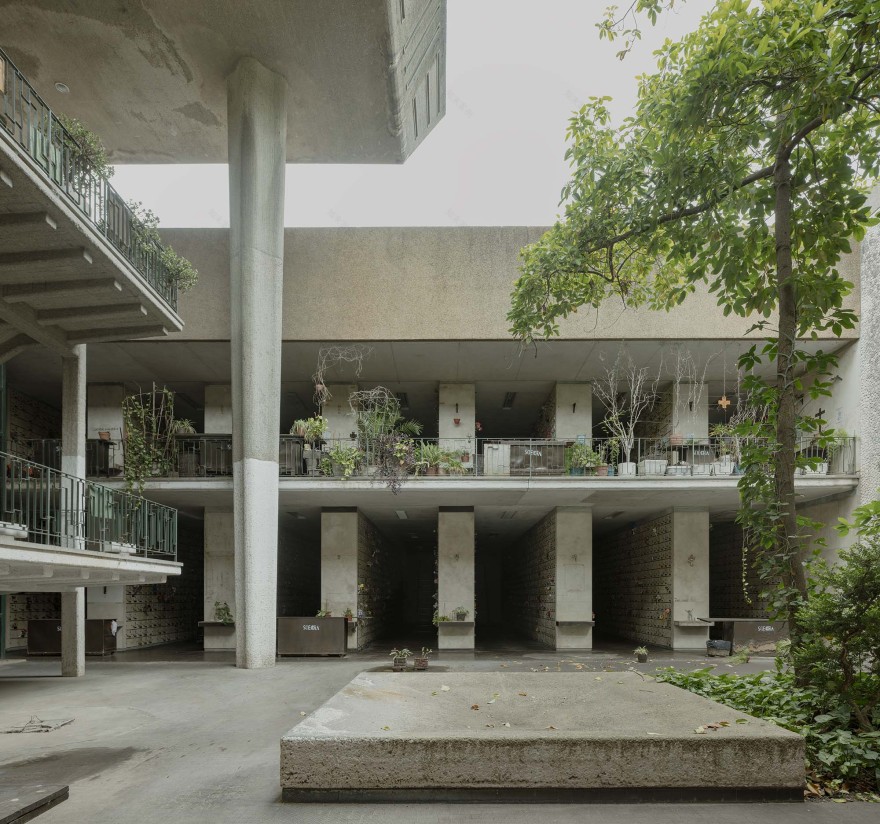
(Federico Cairoli)
Through the choice of the brutalist style, Villa summoned the plasticity of concrete and its abstract imagination to produce an austere sacred character necessary for a place of mourning and meditation. Like the stained‑glass windows that adorn gothic cathedrals, the delicacy of the textures and ornamental patterns of the concrete increases tenfold the expressive force of the imposing structures of the necropolis and generates a unique spatial experience in this descent into the kingdom of the dead.
Since the completion of the Sexto Panteón in 1966, Argentina has gone through several political and economic crises, accompanied by a marked evolution in funeral practices. The city of the dead, once regularly visited and honoured by the living, has gradually become a deserted space, abandoned by the public authorities, which no longer invest a single peso in its maintenance. Faced with the difficulty of meeting the needs of the living, the authorities have withdrawn from the funeral world in favour of private cemeteries, inspired by the US model.

According to guards, the Sexto Panteón was once the most ‘select’ places to be buried in the city, but in recent decades, its lower floors have fallen into a state of disrepair. (Federico Cairoli)

Though the necropolis is still in use, the faulty ventilation system has been inoperative since the 1980s. (Federico Cairoli)

This has led to unpleasant odours in the underground spaces on hot days, when natural ventilation fails (Federico Cairoli)

(Federico Cairoli)
While the level of the garden of the Sexto Panteón, visible from the main axis linking the entrance, the chapel and the crematorium, is still regularly maintained by the municipal services, the basements are rapidly deteriorating, with continual water infiltration, ripped false ceilings and damaged floors. Once considered, according to several guards, as the most ‘select’ place to be buried in Buenos Aires, the Sexto Panteón now arouses unease for the families who come to pay their respects there. Although still in operation, the number of burials is decreasing, raising questions about the future of this unique necropolis.
Long neglected by Argentinian heritage authorities – partly due to modern society’s aversion towards death and, by extension, to cemeteries – the brutalist underground necropolis and its architect are finally beginning to get the recognition they deserve. Thanks to a petition initiated by the feminist architecture collectives Nuestras Arquitectas and Soy Arquitecta, the Sexto Panteón was officially declared a cultural heritage site of the City of Buenos Aires in February 2023. This status will make it difficult to demolish the Sexto Panteón, but it remains unclear what measures, if any, will be taken to repair and maintain its structures as a result.

Villa was generally not credited for the design of the Sexto Panteón, although she led the project. It was instead frequently wholly attributed to the young Clorindo Testa, who had been part of the team. Only recently has this misattribution been challenged, and the project’s significance championed. In February last year, it was named a cultural heritage site of the City of Buenos Aires
南京喵熊网络科技有限公司 苏ICP备18050492号-4知末 © 2018—2020 . All photos and trademark graphics are copyrighted by their owners.增值电信业务经营许可证(ICP)苏B2-20201444 苏公网安备 32011302321234号
苏公网安备 32011302321234号客服
消息
收藏
下载
最近