

创作上传
VIP
收藏下载
登录 | 注册有礼
查看完整案例

收藏

下载

分享
National Portrait Gallery in London, UK by Jamie Fobert Architects and Purcell
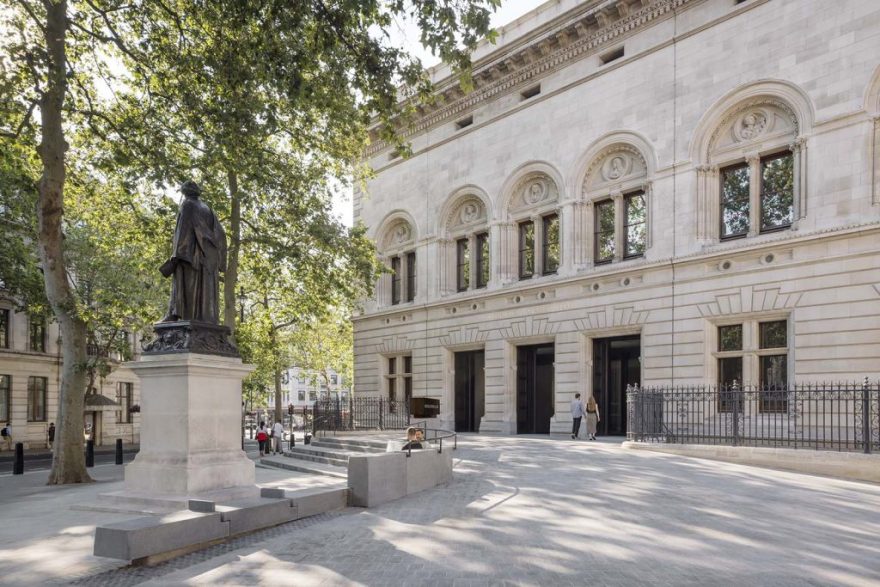
One of the primary transformations of the National Portrait Gallery (NPG) was the creation of a new public square, onto which the entrance opens

The new front doors feature an artwork by Tracey Emin

An assemblage of busts greets visitors in the new entrance hall
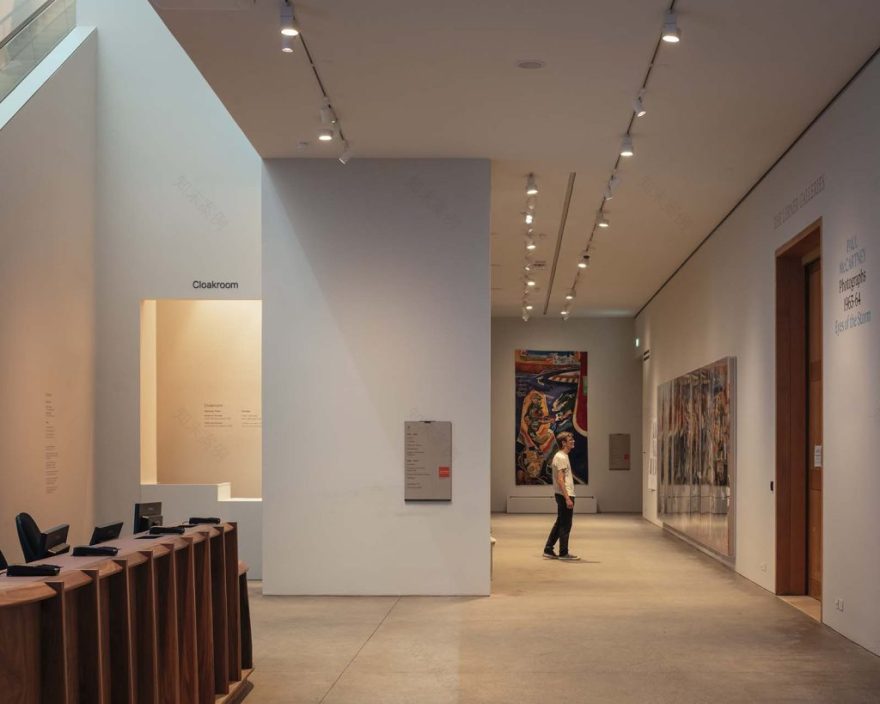
The Ondaatje Wing, remodelled by Dixon Jones in 2000, has been furnished with a new ticket desk and includes a new gallery of portraits of contemporary figures

The galleries above have been refurbished and the collection rehung

The remodelling is characterised by subtle attention to detail, including display units by interpretation designers Nissen Richards Studio

The same level of detail was applied to the stone bench that snakes outwards from the new entrance. The new public square was previously an urban ‘dead zone’
A new public square is central to Jamie Fobert Architects and Purcell’s reframing of the National Portrait Gallery in London
This project was commended in the 2024 AR Public awards. Read about the full shortlist
The oldest painting in the National Portrait Gallery’s (NPG) panoply of princes, poets, politicians and personages dates from 1505. Intended to help finesse marriage negotiations between the English crown and the Holy Roman Empire, it depicts a surprisingly winsome Henry VII holding a red Tudor rose, painted by an unknown Netherlandish artist. The gallery’s most recent acquisition is
The Doors
, an array of 45 bronze panels featuring the heads of ordinary everywomen etched in energetic strokes and squiggles. Pushing the figurative tradition to dynamic extremes, the panels adorn the gallery’s three new sets of doors, like a modern version of the Florence baptistery.
Created by artist Tracey Emin,
The Doors
represents a riposte to the historical elitism of national cultural institutions, neatly epitomised by the line‑up of male artist worthies immortalised in sculpted roundels across the NPG’s Victorian facade. In Emin’s contemporary tableau, only one sitter is identified – the artist’s mother, Pamela Cashin, looking for all the world like a 16th‑century duchess.
‘But now you get to meet her – and the other women – first,’ says Jamie Fobert, whose practice, alongside Purcell, completed the NPG’s remodelling last year to widespread critical and public acclaim. Its success is borne out by conspicuous increases in footfall: over the initial three months, first‑time visitors increased by two thirds. At the time, attention tended to focus on the rehang and redisplay of more than a thousand artworks, and how the curation and exhibition design brilliantly addressed the familiar problem of institutional sclerosis – literally and metaphorically reframing the art of portraiture for an expanded constituency of gallery‑goers.
But the NPG’s sclerosis was also physical, with a cramped entrance, inefficient plan, problems of access for disabled visitors and windows that had been painted black during the Blitz and subsequently entombed in plasterboard. Now, gallery capacity has been increased by 950m
through identifying and reconfiguring space that had been underused or neglected. In addition, by opening up the building to connect more generously and logically with the public realm, Jamie Fobert Architects’ thoughtful scheme catalyses a re‑energised relationship between the gallery, its visitors and the wider city.
‘Technically, all the NPG is public space’, says Fobert. Yet despite being free to enter, ‘It felt like a Pall Mall club. If you’re not sure if you’re allowed, then that facade said: “This is not for you.”’ First opened on its present site in 1896, the NPG was originally designed by Ewan Christian, a stolid Victorian journeyman better known for his lifetime’s work on churches for the Ecclesiastical Commissioners.
Tucked in behind the more elephantine National Gallery, which expansively dominates the north side of Trafalgar Square, Christian’s Florentine palazzo always seemed oddly inconspicuous. Partly out of Victorian propriety, its original entrance was placed on the building’s shorter east side, disdaining the fleshpots of nearby Leicester Square. Latterly, a statue of the famous actor manager Henry Irvine presided over a dead zone of railings primly wrapped around patches of forbidden lawn.
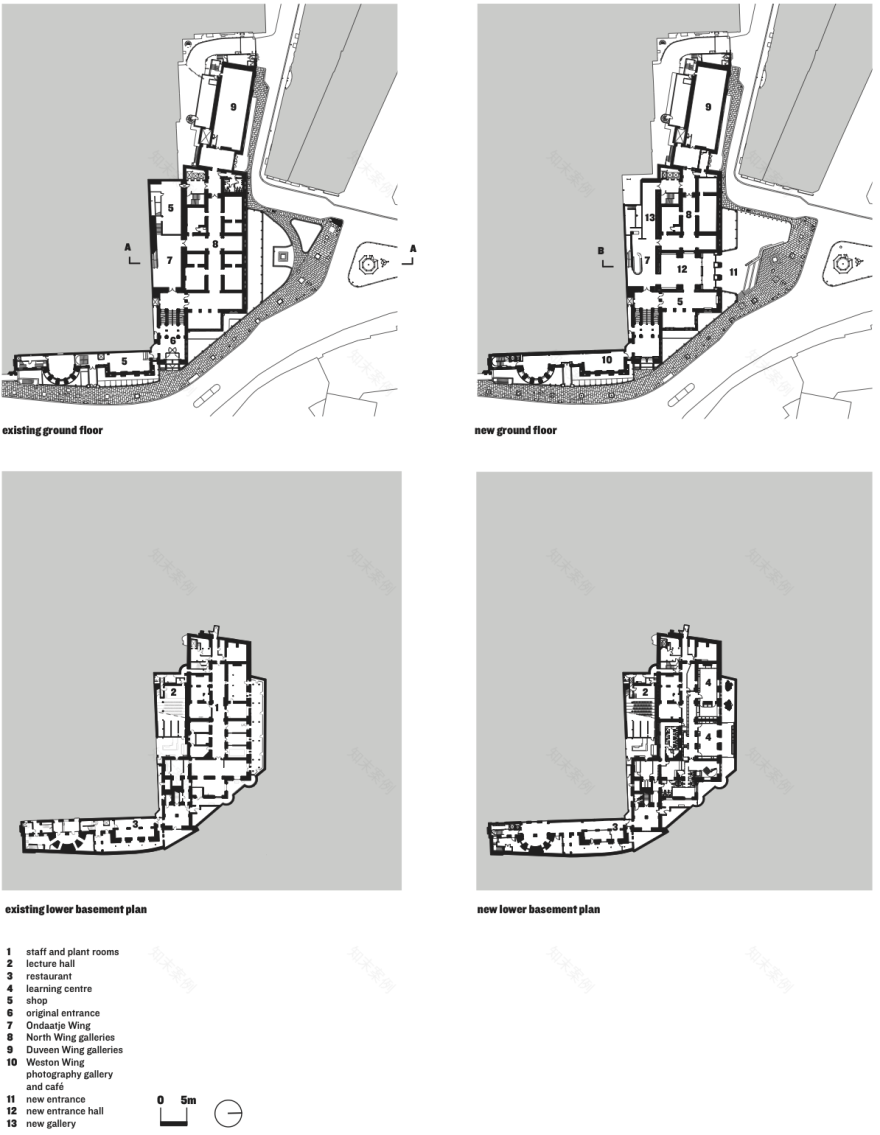
The architects’ first exercise was to examine the entrance sequences of the city’s national museums and galleries. All encompassed large public spaces or courtyards in which people could assemble, mingle and linger. Conversely, the NPG commanded just 20m
The solution was to create a larger and more inviting new main entrance on the long north side by transforming three existing windows into doorways. These open out into a new public square, consigning the dead lawns to history. Twenty years ago, such audacious appropriation of original fabric might have provoked pearl‑clutching from heritage bodies, but times change. The cuts in the stonework are clearly legible, to be read as subtle expressions of the remodelling process, while the bases of each door are marked by an exaggerated chamfer, a detail favoured by Ewan Christian and reinterpreted by the architects throughout the scheme as a kind of convivial conversation across time.

Like a historical piece of city, the new square is civically
. There are some topographical stairs, a sinuous stone bench (abstracted from the double curve of Charing Cross Road) and an expanse of gently sloping paving that radiates out in a giant fantail from the new entrance. Where it meets the gallery, the square acts as a bridge across the double‑height void below, enabling light to penetrate the new learning centre at lower ground level. The original Victorian railings were rerouted and the statue of Henry Irvine retained and relocated, freed from the fearful symmetry of his original location.
Pared down to these basic elements, the square feels effortless and unselfconscious, as if it has always been there, though it went through numerous nuanced iterations. The bench and paving are made of adamantine granite to withstand the rigours of metropolitan use around the clock as well as a municipal maintenance regime. The land belongs to Westminster City Council and though the new square is, in some ways, a gift to London from the NPG, it must be cared for by the council in the long term.
The ground plane had to resolve a height difference of 600mm from pavement to entrance, but visitors have a choice of two types of stair, while the almost imperceptible incline of the paved section enables easy step‑free access to the door. Previously, disabled visitors were ignominiously shunted around from the original eastern entrance (which is still in use) to access a step‑free entrance at the far end of the gallery’s north side. In the first three months after the reopening, the number of disabled visitors more than tripled.
‘The project has the feel of corsets being unlaced and of windows being thrown open after a long, dark winter’
Lined with Portland stone wainscoting, the new entrance hall is also conceived as a fluid and informal public space. ‘It is like the lobby of a train station’, says Fobert. ‘I really did not want it to feel like a gallery.’ People can drift in and sit down without necessarily going any further into the building. A cluster of busts arranged at head height on marble plinths now greets visitors, like a group of cocktail party guests assembled from history: Sybil Thorndike and Jacob Epstein, the Countess of Derby next to Nelson Mandela. A new shop occupies the gallery’s staggered north‑east corner, taking advantage of the now unblocked windows, another simple move that palpably enlivens the building facade and interior, dispelling the hermetic Victorian gloom.
The entrance hall connects through to the long slot of the Ondaatje Wing, part of the modern wing designed by Dixon Jones, which opened in 2000, the last time the NPG was subject to a major remodelling. From here, an escalator rises to connect with the circuit of refurbished galleries. Within the Ondaatje Wing, a new gallery space has been created in what was previously the bookshop, featuring representations of contemporary ‘history makers’, a curatorial strategy that dips into the swirling currents of fame and emerges with a clutch of strange bedfellows from Prince William and Kate Middleton to Anna Wintour and Ed Sheeran.
Overall, the project has the feel of corsets being unlaced and of windows being thrown open after a long, dark winter. Clearly, the solution to how the NPG could evolve, both as an institution and as a piece of architecture, lay in reframing: of its collection, building and how it engaged with the public and the public realm. From school parties to party‑goers, people now throng around the new square at all hours, sitting, chatting, scrolling, eating and drinking. ‘This is the centre of a capital city’, says Fobert. ‘And what you need is public space in a way that public space was understood in cities for a long time. It is about open space and a place to sit. And a place where things happen.’
南京喵熊网络科技有限公司 苏ICP备18050492号-4知末 © 2018—2020 . All photos and trademark graphics are copyrighted by their owners.增值电信业务经营许可证(ICP)苏B2-20201444 苏公网安备 32011302321234号
苏公网安备 32011302321234号客服
消息
收藏
下载
最近