

创作上传
VIP
收藏下载
登录 | 注册有礼
查看完整案例

收藏

下载

分享
Brick by bricolage: Usquare Feder university buildings in Brussels, Belgium by EVR Architecten, BC Architects & Studies and Callebaut Architecten
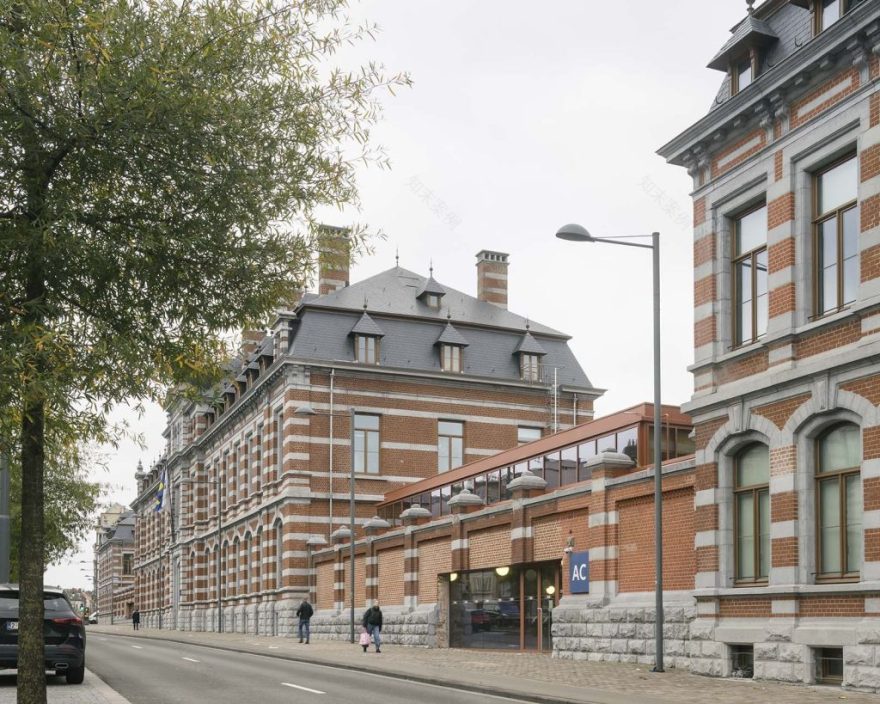
The original Gendarmerie, built in 1908, stretches out symmetrically from
a grand central volume along Boulevard Général Jacques in Brussels

Visitors from neighbouring Etterbeek station enter the site via a staircase, accompanied by a new brick volume holding a lift . A portion of the existing building was demolished to make way for the intervention – a rare case of demolition on the site

The former garage to the north-east of the long building has been augmented with a double‑height timber structure poking above the original roof line

A glazed facade
has been added beyond the existing brick facade, facing the inner courtyard

Many of the original features of the building’s central volume have been restored, including decorative balustrades
and floors

In new offices, the walls have been coated in a clay plaster that also contains hemp and cork, specially developed by the architects for the project

The plywood structures that furnish new apartments for researchers can be dismantled and reused

The volume at the south-western end of the building has similarly been stripped back to its skeleton

A seminar room has been constructed out of hempcrete and a study room built above it

A glass and timber screen has been installed behind the original brick facade

A brick mini-tower holds
a staircase that takes visitors back to street level. The small ‘turret’ mirrors its counterpart
at the other end of the building. The structures behave as modest ‘city gates’ to a large campus that is still in the process
of transformation
The transformation of a police barracks by EVR Architecten, BC Architects & Studies and Callebaut Architecten in Brussels is a lesson in recycling and reuse
At the end of the 19th century, King Leopold II –
or the king builder – reshaped Belgium and Brussels, often using stolen capital from ‘his’ personal colony of Congo. Paris served as the example, and Belgian monuments became ‘counterfeits of France’, as Baudelaire recorded in 1866 in his manuscript
. In Ixelles, a municipality to the south‑east of Brussels’ city centre, Leopold II dreamt of creating a Champ de Mars – a city district where the national army and the security forces could be housed and educated. A cavalry and artillery barracks, an arsenal and a military station all arose around a large training field. In 1908, the final piece of this quarter was built: the Royal Gendarmerie School, to prepare new members of this paramilitary police corps.
The school occupies four hectares. It is an impressive, fully walled complex with neo‑Renaissance facades and additions from the 1950s and 1970s. During the Second World War, the barracks were mistakenly bombed by the Allies, and then partly restored. Some parts of the outer brick wall on the north side were replaced by heavy metal railings when a five‑storey block was built in the 1970s. The
– an enclave for married officers – in the north‑east corner of the site has remained more or less intact. The Gendarmerie – or Rijkswacht in Dutch – was dissolved in 2001 following scandals, errors of communication and poorly conducted investigations, and replaced by the Federal Police of Belgium and the Local Police. The Federal Police took over the buildings in Ixelles, but announced its departure in 2015.
‘The intense process of dismantling turned the site into a kind of local mine’
At that moment, the two universities of Brussels stepped in, the Dutch and English‑speaking Vrije Universiteit Brussel (VUB) as well as the French‑speaking Université Libre de Bruxelles (ULB). In fact, the large military training field nearby, from the late 19th century, had already been converted, since the 1970s, into a campus for both institutions. Together with the Brussels‑Capital Region, and with a little help from European funding, they are now working together to transform the site of the Royal Gendarmerie School, too, into a new urban block. The first phase of this plan has just been completed – including research spaces, fabrication labs, offices and short‑term residences for the two universities; future phases are set to include family homes, social housing, student flats, an events hall and a sustainable food market.
As part of this first phase, a team composed of the offices of EVR Architecten, BC Architects & Studies and Callebaut Architecten tackled the renovation and redevelopment of several connected buildings at the front of the site, along the Boulevard Général Jacques, with the addition of new volumes extending the historical complex. EVR Architecten were, at the beginning of the century, one of the first Belgian offices to focus on ecological, ‘passive’ building, achieving thermal comfort with minimal heating and cooling. The younger office of BC Architects & Studies started in 2009 and is known for reusing and recycling building materials. Callebaut Architecten specialises in heritage restoration. Together, the three teams aimed to make the project as circular as possible, minimising the flow of incoming and outgoing materials.

However, in order to improve access to the fortress‑like site, one building to the north‑east of the long site had to be demolished; a wide staircase (with a lift in a small brick volume) now welcomes the many commuters coming from the nearby train station of Etterbeek down to the rear of the site, which is lower than street level. Of the existing single-storey former garage, integrated between the grand and symmetrical central volume and corner building to the south-west, only the concrete skeleton and facades were preserved. A glass screen has been constructed facing the inner courtyard, one metre behind the existing facade, from which all window frames were removed. The facades of the single-storey counterpart on the north-eastern side of the central volume were similarly preserved, also with a glass screen constructed facing the inner courtyard, this time in front of the existing brick facade. A wooden structure was added on top of the existing columns and a glass entrance has been installed on the street side.
This intense process of dismantling turned the site into a kind of local mine, with the assistance of the technical expertise of certification agency Seco and Brussels‑based practice Rotor, which specialises in material reuse. The materials present on site have been maximally recovered: almost 1,000m
of a granite floor was created by grinding down 150 window sills; 210 double‑glazed windows were reused. A total of 150m
of ceramics, 150 radiators, 30 urinals, 20 sinks, 150 door fittings and two fire ladders were removed from the old buildings, cleaned and put back into use. Reuse was not always possible, however; one type of brick had to be rejected because it was not considered frost‑resistant according to contemporary regulations, even though the material had been functioning properly for almost a hundred years.

Some newly introduced materials were also necessary; these are biobased, such as clay plasters – made with soil not from the site itself but from another project nearby – and walls made out of hempcrete. The clay plaster, with fractions of hemp and cork, was specifically developed by BC to meet acoustic requirements in the offices. In the apartments for visiting researchers, as well as in the lecture room, the walls are constructed from plywood panels in a wooden framework, which can be easily dismantled using a screwdriver. This project is a valuable case study for anyone interested in reuse and recycling – it is an essay in how not to demolish a building.
The collaborating architects have joined forces on this project based on their respective expertise: by insulating offices as separate volumes within the old building envelope; by reusing and recycling materials, building elements and equipment as much as possible; and by valuing old buildings without unnecessarily fetishising them. The progressive and critical nature of these operations is evident in the misunderstandings and resistance they occasionally provoked from the clients and contractors, for whom the project was in many ways a learning process. The standard for the future phases of the site development has, in a sense, been set.

Beyond ecological and material questions, however, other objectives do remain valid and important. Placing offices, meeting and reading rooms as a free‑standing box in an existing structure – the box‑in‑box system – is surely an efficient way to insulate them, and the architects chose this option intentionally. It does, however, also mean that users cannot open a window to let in fresh air (a problem, paradoxically, which high‑tech and mechanically ventilated architecture also has). The two‑ and sometimes three‑layered glass facades create a metre‑thick membrane; they offer acoustic and thermal benefits, but also a strict division between inside and outside, and public and private. The social objective of architecture to mix programmes and people, and to involve the street in the interior (and vice versa), is therefore not prioritised.
Similarly, the project does not prioritise a semiotic or cultural richness – a visual pride that highlights and communicates the programme within, with or without the pompous historicity and charge of the barracks of yesteryear. This extension should ensure, after all, the public presence of the two universities in the city of Brussels. One could argue that its new‑found, composite appearance is not all that exciting: the new glass facades with red‑brown frames look a touch generic and neo‑functionalist. A lot of pressure, in terms of presence, therefore falls on two new brick turrets – a large one marking the new public stairs to the north‑east and a smaller one to the south‑west containing a small staircase and functioning as a back entrance. Their performance as city gates for this new district could be called subtle or weak, depending on how one looks at it, and what one expects.
The question, finally, can also be asked whether all the bricolage and reuse that, admirably, characterises this renovation and extension could not have been expressed in a more self‑confident, more formal and – yes – a more beautiful and poetic way, instead of, in most cases, carrying out what could also be achieved with more standard materials. In part, this is a consequence of the limited budget (using plywood, for example, that does not need many layers of veneer), although it was also a deliberate decision of the architects. ‘We have tried to maintain one atmosphere for the entire project,’ Bart Verstappen of EVR Architecten explains, ‘in order to make the interventions clear without aiming for the typical contrast between old and new.’ In a few cases, the non‑traditional provenance of building materials also leads to surprising collages and artful results, such as the recycled window sills turned into terrazzo flooring, in the mezzanine of the entrance hall. Perhaps this is the way we have to do architecture now – by acknowledging that we can no longer have it all, if we ever could.
南京喵熊网络科技有限公司 苏ICP备18050492号-4知末 © 2018—2020 . All photos and trademark graphics are copyrighted by their owners.增值电信业务经营许可证(ICP)苏B2-20201444 苏公网安备 32011302321234号
苏公网安备 32011302321234号客服
消息
收藏
下载
最近