

创作上传
VIP
收藏下载
登录 | 注册有礼
查看完整案例

收藏

下载

分享
Møllendal West
What would a housing model look like if it was based on the social conscience of the co operative housing movement and the original purpose of Husbanken, and adapted to a modern society with its economy and political climate?
Runner up Runner up Runner up Runner up Runner up Runner up Runner up Runner up Runner up Runner up Runner up
The premise of this proposal is the conviction that the current housingshortage and concomitant rise in house prices is in part caused by a lack ofinnovation within the housing sector in Norway. The municipality, commercialdevelopers and local cooperative housing associations are unable tomeet the actual housing demand.
We would like to investigate the potential ofa societal housing model which would to some extent relive the pressure onthese actors whilst at the same time be present as a not-for profit alternative ina competitive and commercial housing market.
Our proposal seeks to question the fundamental principles of ’conventional’property development, and sets out to investigate whether an alternative modelwhere the commercial developer is subtracted from the equation is viable and more able to respond to current issues.
What would a housing model look like if it was based on the social conscience of the co operative housing movement and the original purpose of Husbanken, and adapted to a modern society with its economy and political climate?
Can we use this model as a tool to better integrate the disadvantaged in the housing market, and provide affordable and accessible homes for families in the establishing phase?
Norwegian postwar housing policy is based on a tripartite responsibility where; 1) The state controls policy and economic measures in part through Husbanken 2) The municipality has the responsibility for general planning, for plot policies and for the disadvantaged in the housing market 3) The private actors cooperative housing associations, entrepreneurs, developers and individuals - have the responsibility for planning, building, owning and managing housing units.
Initially, Norwegian building co-operatives were set up to provide for an equal social distribution of affordable and adequate housing, and this was achieved with relatively low public expenditure. The associations were considered primary implementing instruments in a long-term housing strategy. During the 1970s and 1980s, the housing market was liberalised, and a rightto-buy scheme was instigated. The government would no longer regulate house prices, and people who had previously bought affordable cooperative housing now had the opportunity to profit from sale.
The role of the cooperative housing association has changed significantly over the past 30 years, now operating in a free and unrestricted market, competingwith other businesses in all areas. The same can be said for Husbanken, which now operates as a welfare agency providing financial support for the disadvantaged in the housing market, the total number of which was approximately 150000 households per 2014.

Investor purchase constraints
Homes for sale with discounted prices
“Shared ownership" homesupply increase
Public investment refocusing from Housing Benefit to new home building
Use Møllendal as a testing ground for designing and developinga mixed-use project with substantial involvement and input from the users
Encourage people to engage with architecture on a micro level in a collective effort to make change on a larger scale
Establish a flexible and repeatable housing model for groups of people building together as cooperatives
Provide individuals and families with a chance to acquire their own home at affordable rates

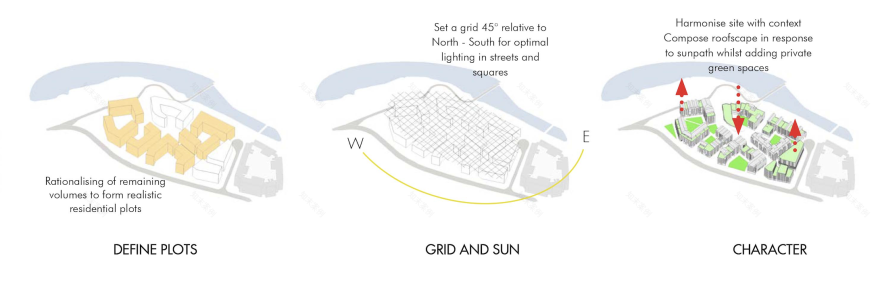
The project Møllendal West gains distinction with its proposal on developing a non-profit housing strategy in Bergen that challenges the traditional property development in Norway. The premise of the proposal is the conviction that the current housing shortage and rise in prices is partly due to lack of innovation. The project studies the desire of the population as well as existing economic, financial and political models of development and counteracts the current situation by suggesting implementation of a cooperative housing model.
The urban scheme suggests a density somewhere between the city and suburbia by mixing two typologies. While neither the typology nor the urban plan is remarkable, the project is seen as a strong comment on how to build a neighbourhood in a fast growing city. In this sense, the proposal is complimentary to the winning proposal that pinpoints important aspects to consider for the municipality when developing Grønneviksøren as a pilot project.
The aspects of landownership and the possibility of public leasing of the land to private housing co-operatives to achieve more affordable housing near the city centre has not been discussed in the municipal plan. In this sense, the project raises a relevant political discussion that could inform the process of developing the Europan site or other municipally owned sites in the city.
: Paul Motley (GB) – architect
: Arne Bassoe-Eriksen (NO), Chris Scaplehorn (GB), Robin Søndergaard (NO) – students in architecture
75 Grove Street, EH3 8FG, Edinburgh – Great-Britain

P. Motley, A. Bassøe-Eriksen, C. Scaplehorn and R. Søndergaard
We were all working in offices in London after having studied together and saw an exciting opportunity in the theme and sites of Europan 13, confronting our perception of challenges in architecture today.
The premise of this proposal is the conviction that the current housing shortage and concomitant rise in house prices is in part caused by a lack of innovation within the housing sector in Norway. The municipality, commercial developers and local co-operative housing associations are unable to meet the actual housing demand. We would like to investigate the potential of a societal housing model, which would to some extent relive the pressure on these actors whilst at the same time be present as a not-for-profit alternative in a competitive and commercial housing market.

Our response is a model that suggests a way of financing, organizing and implementing a not-for-profit organisation, facilitating for co-operative housebuilding on the project site. In this sense, the aim has been to utilize the potential of Møllendal as a Europan site to propose a pilot with the capacity to become a regional housebuilding tool.
Our experience from living in London has made us aware of the brutal consequences of the commercial developers’ quest to maximise profit. Bergen is not at this stage yet, but the city is undergoing fast-paced changes and we believe that it is important for architects, the municipality and developers to find new ways to build for the future. The various precedents we used informed us to a large extent through the way that they were conceived and operate as places, and less in the way they appear as final buildings. Important here were projects like Vauban in Freiburg, BedZED in Hackbridge and Odhams Walk in Central London (an inner-city estate where the residents take an active role in shaping their community).

Sites in close proximity to the city centre are usually desirable and expensive and so by separating land value from building value – i.e. residents of a site are leaseholders only – these sites can be made affordable and accommodate for homeowners with a variety of social backgrounds, income and disadvantages.
This is our first entry and awarded project. It is definitely a confidence boost and it is great to know that the ideas we put forward in our proposal are appreciated by the jury and the municipality. However, considering that the Europan competition holds a fairly low profile in the UK and that we are a UK-based team, it will be interesting to see if anything more comes from of it.
南京喵熊网络科技有限公司 苏ICP备18050492号-4知末 © 2018—2020 . All photos and trademark graphics are copyrighted by their owners.增值电信业务经营许可证(ICP)苏B2-20201444 苏公网安备 32011302321234号
苏公网安备 32011302321234号客服
消息
收藏
下载
最近