

创作上传
VIP
收藏下载
登录 | 注册有礼
查看完整案例

收藏

下载

分享
Reciprocal House by Gianni Botsford Architects in London, UK
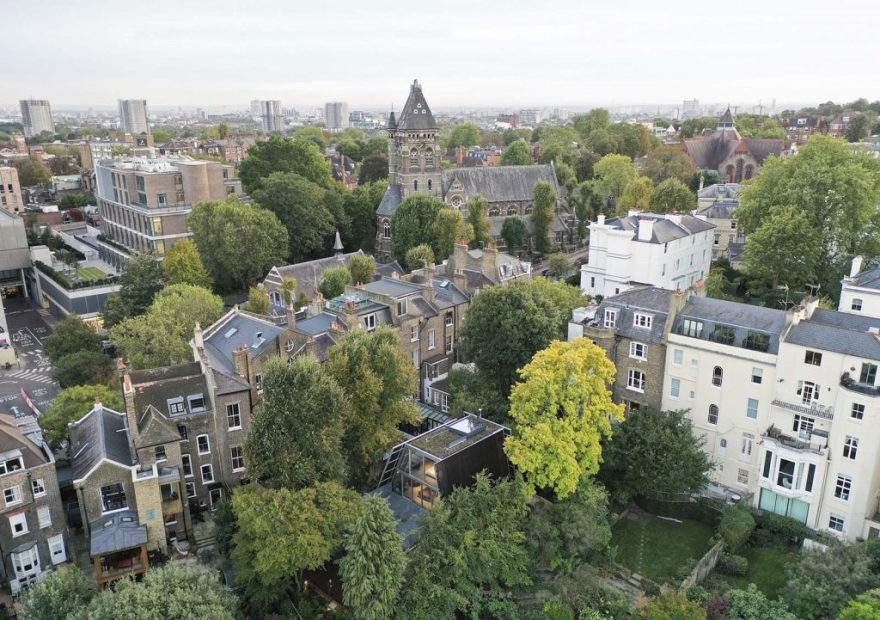
Reciprocal House by Gianni Botsford Architects, a home in London’s Hampstead, is an extension of an extension

Gianni Botsford’s team demolished the old coach house, which was tucked into a narrow lane behind a Hampstead pub, and provided a new building onto which the existing Foster Associates extension attaches
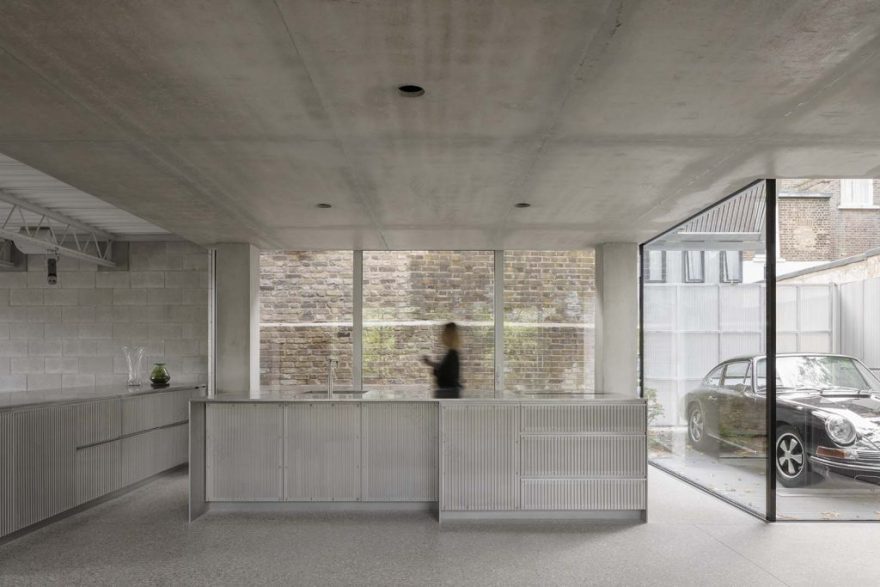
On the ground-floor level, the suture between old and new is handled deftly

The Foster Associates extension, with its distinctive latticework beams and exposed blockwork walls, has been retained

Meanwhile, an all-aluminium spiral staircase connects a new lower ground floor and two additional storeys above
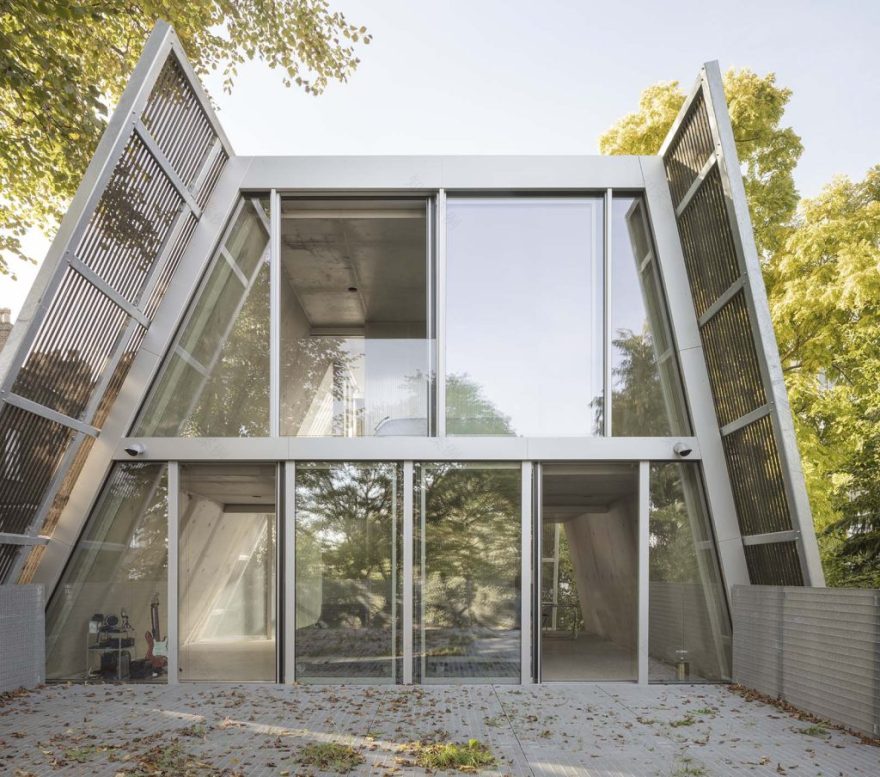

The house’s angled, oversailing planes of perforated anodised aluminium are a
nod to the mansard profile of the original coach house, and are tinted brown to blend in with the surrounding trees

Elsewhere, specific
items from the original extension reappear, such as Rupert Oliver’s Leaf Chair
A new host structure for an early extension by Foster Associates, Gianni Botsford Architects’ Hampstead home traverses multiple layers of architectural history
This project was commended in the 2024 AR House awards. Read about the full shortlist
In 1967, after the demise of Team 4, Norman Foster set up Foster Associates with Wendy Cheesman, soon joined by Michael Hopkins. One of the practice’s first projects was the remodelling of a 19th‑century coach house tucked behind the carriage archway of a pub in Hampstead’s South End Green, north London. Here, with the assistance of project architect Patty Hopkins, Foster lent an airy glass vestibule against the old walls to the south and sent out an audaciously modern single‑storey extension to the east. In keeping with the spirit of the project, the Victorian cottage itself was ‘modernism‑ised’ by Foster Associates inside and out, with new metal framed windows and de‑ornamentation of detailing. The house was completed in 1968 and went on to be lived in and by all accounts enjoyed by the original newspaper editor client for the best part of half a century.
At the time of this project, Foster was also working on designs for the world’s first inflatable office building for an early computer tech company in Hemel Hempstead. He was yet to meet Buckminster Fuller – or face the American mentor’s famous question, ‘How much does your building weigh, Mr Foster?’ But clearly legible in the garden extension’s exposed latticework beams, raw blockwork flank walls and floor‑to‑ceiling sliding windows are the lineages of Team 4’s noble shed for Reliance Controls and the concrete, steel and glass house in Cornwall, Creek Vean (both 1965). In turn, the project’s influence is traceable in the even more daring and totally see‑through glass architecture of the Hopkins’ own house round the corner, completed in 1976 – not to mention the possibly millions of open‑plan, bifold‑doored kitchen extensions constructed since.
Fast forward to 2015, and the extended coach house was sold to a design enthusiast looking for a project, who appointed London‑based Gianni Botsford Architects after competitive interviews with 10 or so practices. ‘I think we were the only ones who did not arrive with a solution,’ explains Gianni Botsford, whose practice has a track record of creating unexpected and expressive architecture in urban backland settings such as this, surrounded by other people’s bucolic gardens.
‘Botsford has forged a concrete‑boned counterweight to Foster’s featherlight extension’
Retaining the Foster pavilion was always part of the plan, but Botsford’s feasibility studies and maquettes went on to explore a range of associated options, including building upwards from the extension and full or partial retention of the original coach house and lean‑to. In the end, the decision fell in favour of demolishing the lean-to structure and creating an entirely new host structure for the little‑known but historically important early Foster project – perhaps not the easiest of architectural propositions.
In a strikingly contrasting spirit, Botsford’s approach to Reciprocal House owes more to psychogeography than to Foster’s systems thinking, taking as it does the starting point of close observation of the experiential qualities of this particular hidden enclave of Hampstead, as well as memories of what went here before. The concrete‑boned counterweight to Foster’s featherlight extension forged by Botsford echoes the mansard roof form of the Victorian coach house – as well as the lines of Foster’s lean‑to – and is adroitly angled in response to tree canopies, outward views and dozens of potentially overlooking windows. The new whole is anchored deeply in the earth, perhaps for the next 100 years.
‘It was a little bit jarring,’ comments Botsford of the original not‑quite flow between old cottage and Eames‑inflected open‑plan salon. Now, in contrast, a flipped and newly open kitchen and dining zone extends directly from a repositioned entrance, separated from the salon only by a run of kitchen counter and a weir of three concrete steps. Apart from the remaining exposed blockwork walls of the Foster extension, the new ground‑floor envelope is almost entirely glazed, allowing the surrounding old garden boundary walls and fences, and crowding shrubs and trees, to read as the space’s enclosure – bringing textured and shadowy depth of saturated colour to Botsford’s recessive, almost ghostly, materiality of fair‑faced concrete, aluminium and glass. A terrazzo‑like floor screed employing the same local London aggregate as the shuttered concrete of the house provides a uniting ground plane throughout the house. As well as re‑laying and insulating Foster Associates’ original floor slab, conservation work to the 1968 extension included adding insulation to the roof deck, replacing the original single‑glazed windows with a Schuco system and reinforcing the exposed lattice beams to bring them up to code.

Originally completed by Foster Associates for the journalist and editor Ron Hall in 1968, the first renovation consisted of a lean-to vestibule and single-storey extension (below) to an existing 19th-century coach house (above)

The two upper floors of the new house stand on the ‘table legs’ of four square‑section perimeter columns, supporting the slab from which the upper 150mm poured concrete walls fold protectively in, as if capturing a moment of boxing up (or unboxing). Below ground, a snug new basement level of auxiliary living space has been sunk 3m into the earth. This rooted space, with its blockwork‑lined walls referencing Foster’s above, is lit by daylight borrowed from lightwells and the mesh surface of the ground‑floor car port.
With no corridors and an absence of conventional doors or partition walls, Reciprocal House relies on well‑judged spatial zoning for hierarchy and privacy, assisted by banks of bespoke storage and fittings fashioned in finely perforated and therefore not fully opaque aluminium. Bathrooms and cloakrooms, also odes to aluminium, are stacked by the house entrance to the west of the site – a service slice separated via a generous ‘front of house’ buffer zone of vertical circulation from the increasing seclusion of east‑facing bedrooms and the garden depths of the living space.

Hole‑punched through the sum of the two living and two bedroom levels is a circular void through which an all‑aluminium staircase spirals towards a giant disc of sky. At basement level, the house’s single curtain of felted wool can be employed to circumnavigate the stair footing for acoustic and visual separation. Usually these days, a stair such as this would be craned into position as a single sculptural piece, but here access restrictions dictated design for assembly on‑site, a fact now celebrated in rivets that express the human graft of sequential assembly.
As well as providing daylight, the rain sensor‑controlled lantern is central to Reciprocal House’s passive environmental strategy, balancing stack‑effect ventilation, thermal‑mass heat sinking and heat recovery, with the atmospheric shift that accompanies the opening or closing of oculus instantly palpable. Despite being in some ways the antithesis of systemised architecture, Reciprocal House is undeniably a finely tuned machine for living in, with its electric glass (fed by a low‑volt current to retain its transparency), automatic blinds and mechanised sliding doors all providing privacy at the flick of a switch. I think Norman Foster would approve.
‘Reciprocal House is undeniably a finely tuned machine for living in’
To the outside world – or at least as glimpsed through the archway on the street or perhaps from neighbouring windows, Reciprocal House presents something of an architectural brain teaser, a total one‑off, calling to mind a chatter of associations including mannerism, constructivism, even deconstructivism. The house’s angled, oversailing planes of perforated anodised aluminium, tinted in recessive brown to match the trunks of adjacent trees, read as part‑sheltering, part‑flamboyant. In fact, the expressive sails (or shields or veils depending on your mindset) serve a dual purpose as rainscreen cladding for the house’s mansard concrete sections and as brise‑soleil for its lean‑to glazing, apparently flying in the face of high‑tech’s orthogonal rationality yet at the same time paying homage to it.
How much does your building weigh, Mr Botsford? Probably a fair bit. But for all the monolithic concrete, moiréd aluminium and gizmos, the enduring impression of Reciprocal House remains one of otherworldly dappled light, tree canopies and birdsong.
南京喵熊网络科技有限公司 苏ICP备18050492号-4知末 © 2018—2020 . All photos and trademark graphics are copyrighted by their owners.增值电信业务经营许可证(ICP)苏B2-20201444 苏公网安备 32011302321234号
苏公网安备 32011302321234号客服
消息
收藏
下载
最近