

创作上传
VIP
收藏下载
登录 | 注册有礼
查看完整案例

收藏

下载

分享
Portfolio: Alessandra Covini, Studio Ossidiana

Led by Alessandra Covini and Giovanni Bellotti, Studio Ossidiana experiments with new types of public spaces and materials that welcome humans and non‑humans alike
Alessandra Covini was shortlisted for the Moira Gemmill Prize for Emerging Architecture 2023. Find out more about the W Awards
ublic spaces are often limited to rows of trees or benches,’ explains Alessandra Covini, founding partner of Rotterdam‑based practice Studio Ossidiana. She is frustrated with the ‘mildness’ of our urban realms. In contrast, Amsterdam Allegories, a speculative project from 2018 and one of the first undertaken with partner Giovanni Bellotti, reimagines public spaces as somewhere where people are active participants in, rather than passive consumers of, their cities. Taking the form of a network of 21 floating islands, the project was inspired by, among other things, the duo’s historical research into Amsterdam’s private floating gardens of centuries past. Owned by rich merchants, these spaces were only accessible by boat and open to those who had a key. Covini describes the gardens – which were lavish in their baroque style, with pagodas, pavilions and sometimes even orangeries – as ‘dystopian’, and yet she was fascinated by the ways that they activated the city’s water.
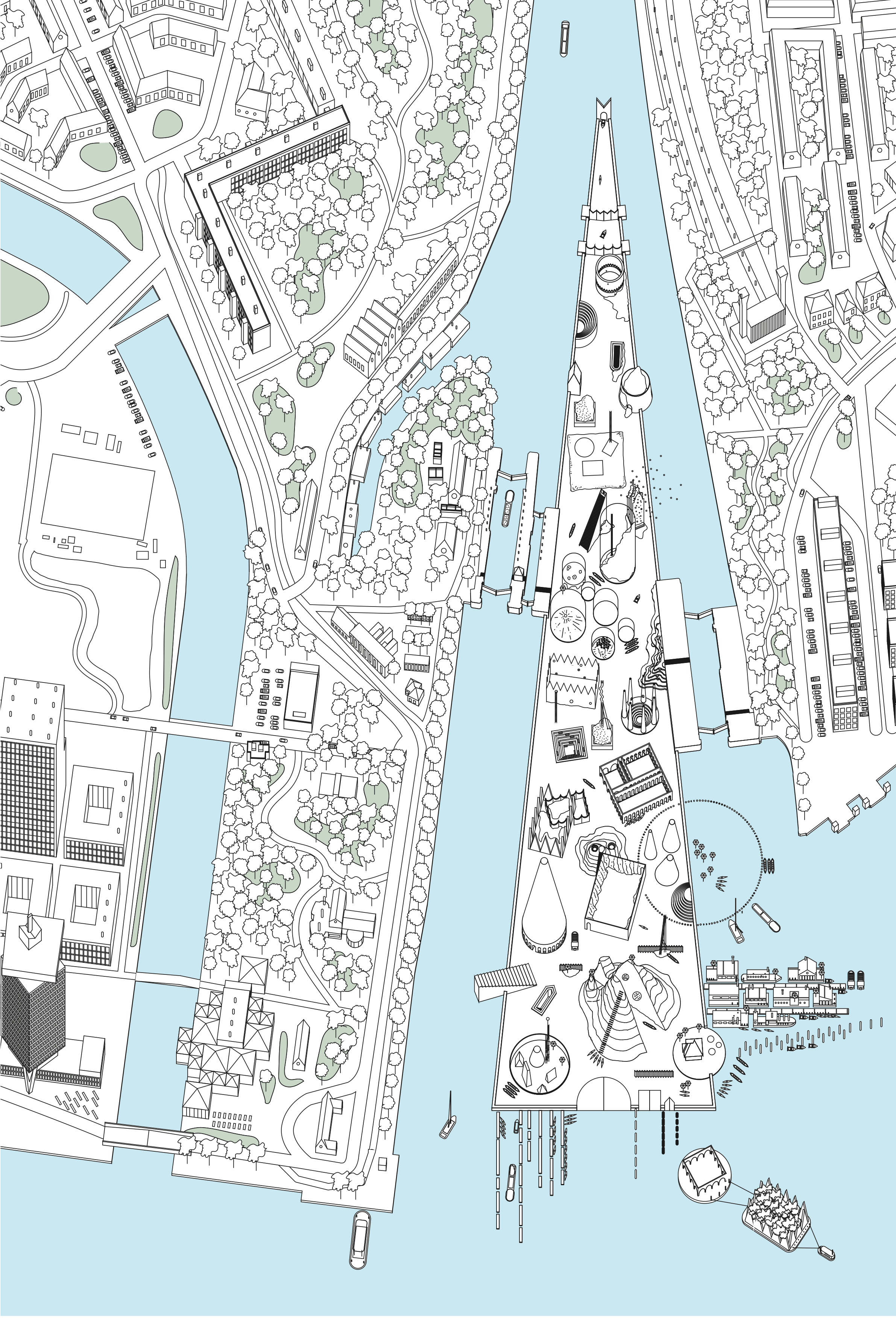

A carefully crafted scale model of Studio Ossidiana’s Amsterdam Allegories project included miniature islands arranged on a large triangular table. The project won the prestigious Prix de Rome in 2018 and has appeared in numerous museums and biennales
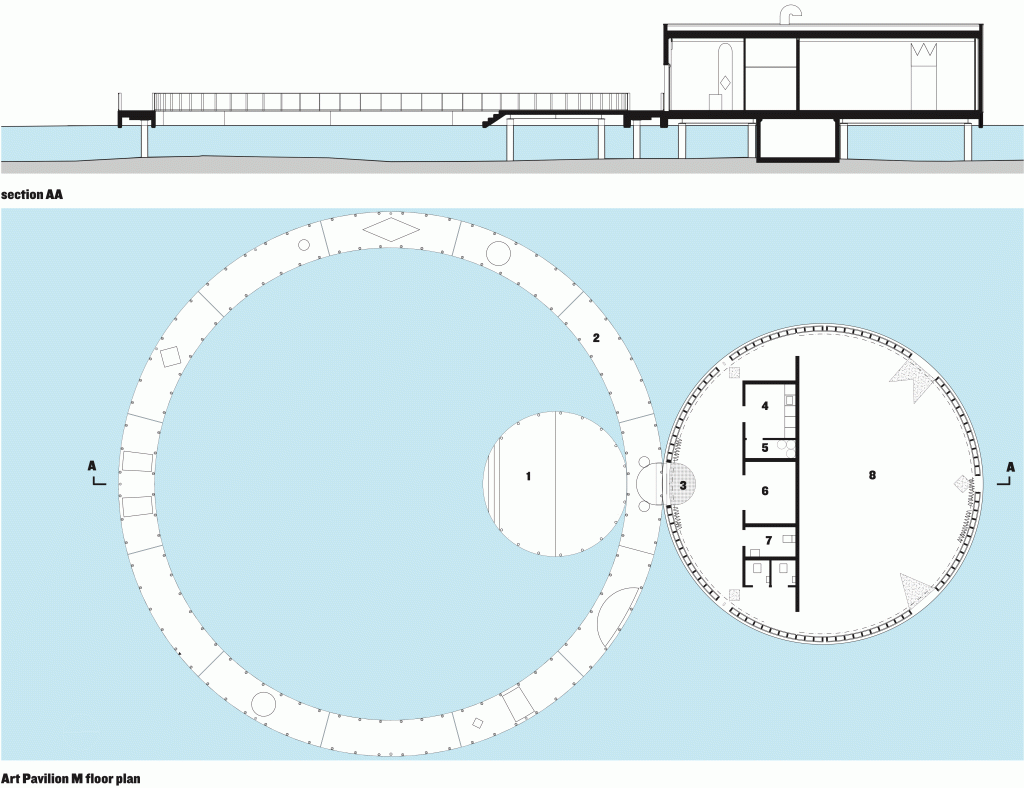
The studio has continued to test the architectural and social potential of water in its ever‑growing body of work. Formative themes of experimental public space and floating structures, which emerged in Amsterdam Allegories, ripple through their projects, which straddle architecture, urban planning, design and landscape. Art Pavilion M, for example, is a ‘public gesture’ consisting of an outdoor structure that sits on Weerwater in the Dutch city of Almere. Completed for the Floriade Expo in 2022, it allows visitors to use the external spaces, even outside opening hours. The ringed ‘port’ acts as a walkway, with a space in its centre where people can swim, undertake water‑based farming or install floating artworks. The stepped ‘stage’ facilitates performances or serves as a place to sit, and the ‘pavilion’ is where exhibitions are hosted. Covini believes that water has untapped potential as a ‘democratic space’, but that society has ‘standardised’ its relationship to water, a relationship that their floating structures resist.
‘The moving garden was conceived as a hub for conversations and debates centring on the very water that held visitors afloat’
By creating spaces that allow the public to build closer relationships with liquid worlds, Studio Ossidiana asks us to think more deeply about how bodies of water impact our lives, how they have shaped our cities and why they are integral to ecosystems and the planet. Throughout the Istanbul Design Biennial in 2021, the barge‑garden of Büyükada Songlines was towed by a tugboat along Turkey’s Bosporus strait, visiting different islands (including Büyükada, after which it was named). The moving garden was conceived as a hub for conversations and debates centring on the very water that held visitors afloat, and used ‘water as a narrative device’. The programme that was curated for Büyükada Songlines invited visitors to engage with topics such as the depletion of fish, the evolving migration patterns of birds, coral transplanting and the conservation of forests.
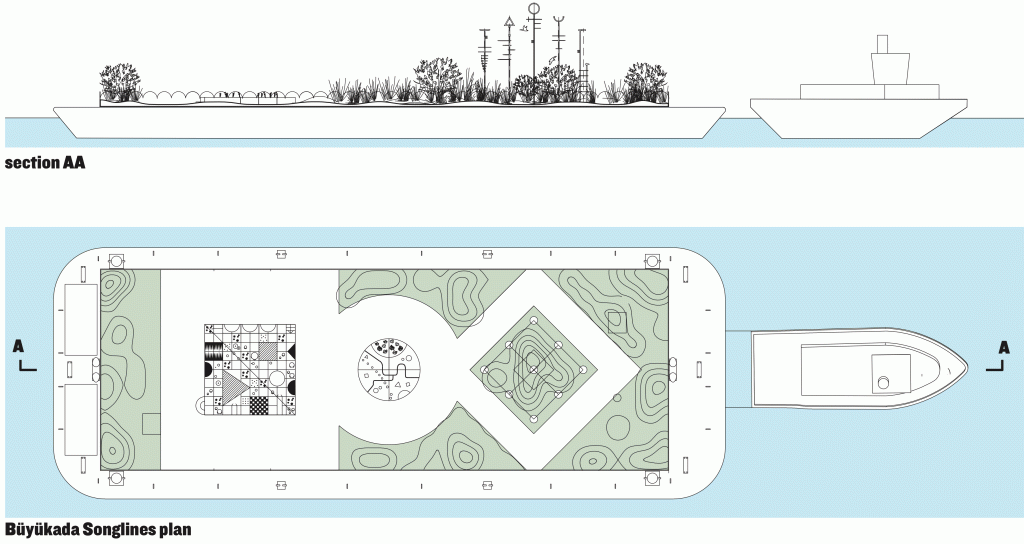

The nomadic floating garden of Büyükada Songlines, produced for the Istanbul Design Biennial in 2021, ‘belongs to a tradition of stories told on water’, from Homer to Ursula K Le Guin. The barge was a site for conversations about ecologies and politics. Components of the barge are now installed on the island of Büyükada
Hands‑on experimentation and prototyping with real materials are ingrained in the studio’s process; the barge’s cast concrete furniture encourages birds and humans to use the space together, with seeds and shells embedded in the concrete for feathered visitors to snack upon and board games such as backgammon cast into the flat surfaces of benches for people to play. Soils from different local islands were also cast into the cement following research into local ecologies. Likewise, the ‘surf and turf terrazzo’ they developed for Art Pavilion M casts regionally specific organic materials, including shells, grains and clay pebbles, into its mixture. Resembling a fossil‑filled rock or delicious terrine, the material tells the story of the agricultural history of Almere, which shifted from sea to land‑based harvesting as the planned city was built and former waterways were filled in with sand and structures. Sections of the terrazzo contain different materials and illustrate what is harvested at different points throughout the year.
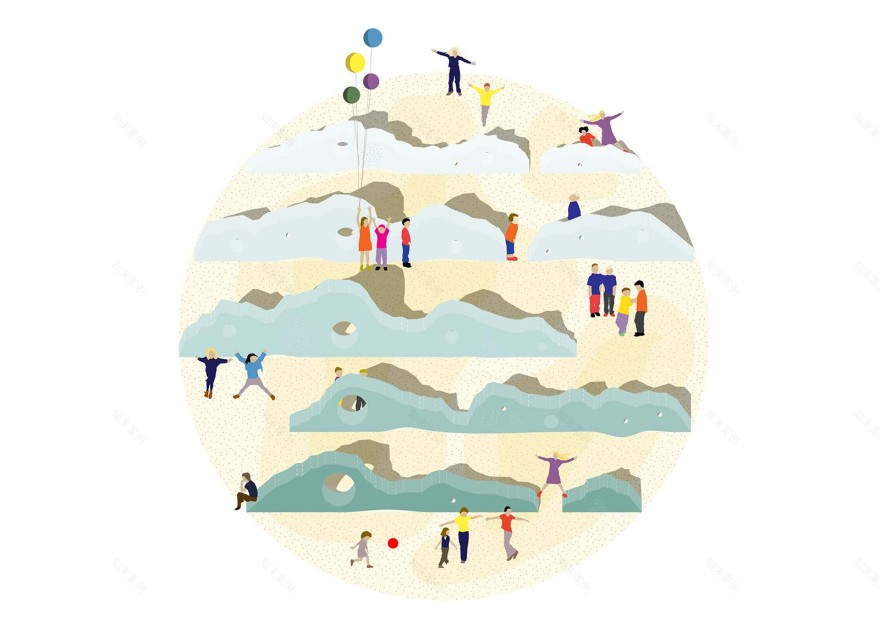
The Horismos playground at a primary school in Vleuten, the Netherlands, is a place for play and discovery – at the scale of a child
As well as seed‑embedded concrete, the Büyükada Songlines barge included tall geometric perches for migratory birds to rest upon, surrounded by edible plants such as grape trees, mint and sage. Other organisms such as insects and mycelium could also hitch a ride. The project challenges our relationship with non‑humans, questions how our built environments strengthen or dismantle these relationships, and recognises that the spaces we design for humans are inevitably used by others too. The barge continues to live on in a new location, with all the components installed on the island of Büyükada after the biennial came to a close.

The play sculptures are realised in turquoise concrete, characteristic of the studio’s playful, pastel-coloured material palette
Studio Ossidiana’s work is a comment on how we must recalibrate our relationships with non‑human beings: particularly birds. The studio is fascinated by the symbolism of these winged creatures and the meanings that humans ascribe to them. ‘Birds are often represented as the connection between the Earth and sky, Earth and paradise,’ Covini explains. ‘On the other hand, they are what we eat, which resists this poetic or sentimental relationship and is more crude and sad.’ Because of the vast variety of ways humans have historically approached birds, there is a rich history of built structures that mediate our relationship with them – cages, bird baths, spikes on drainpipes, aviaries, chicken coops, traps and many more. The Pigeon Tower, a resting and feeding place for pigeons constructed as part of the Venice Biennale 2021, sweetly resembled the species in question – with semi‑circular metal panelling that mimicked feathers, cartoon‑like pink feet and a beak – but also referenced pigeons being kept captive and used by humans throughout history for their meat and to produce fertiliser. The studio is also currently compiling a book, to be published later this year, which discusses their research into birdcages and the architectural structures that have mediated this interspecies relationship.
‘Studio Ossidiana’s work is a comment on how we must recalibrate our relationships with non‑human beings’
‘It is said that our language comes from the imitation of birds,’ explains Covini. This idea, she says, offers ‘a moment of connection that you never expect to have with a species that is so far away in terms of evolution.’ This communication is something that fascinates the studio and prompts them to ask: ‘what is the vocabulary of this exchange?’ One way that this vocabulary has manifested is in Furniture for a Human and a Parrot, designed in the Covid‑19 lockdowns when they were spending more time with Coco, their Amazona Oratrix parrot. The project is a series of hybrid bird and human furniture – a chair meshes with a perch, a stool sits under a climbing ladder and a table has shallow hollows for bird food carved into its surface. This furniture lovingly reveals how we can design differently and more sensitively encourage interspecies connection and shared ownership of spaces.
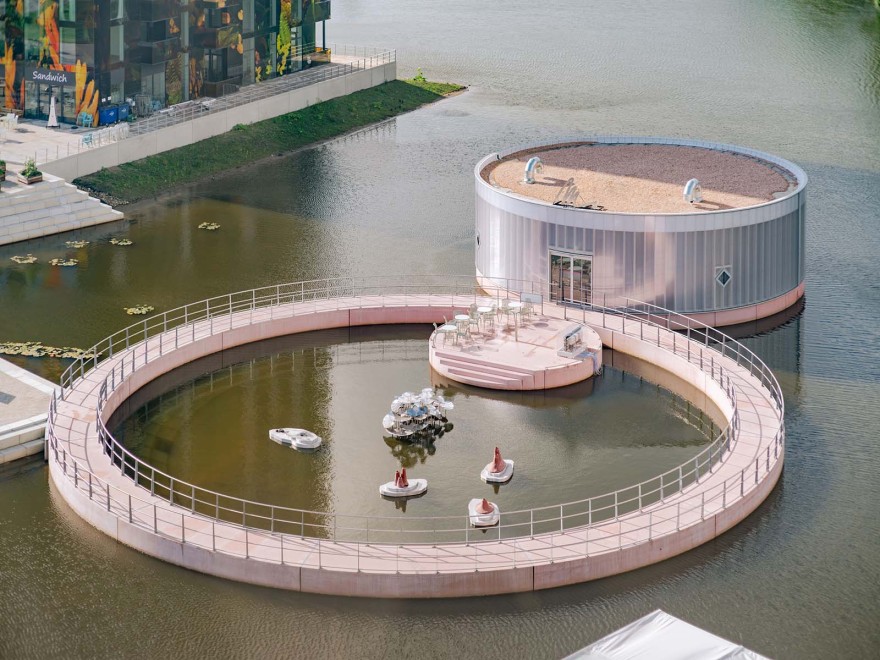
Art Pavilion M was commissioned to last ten years, but Studio Ossidiana, with architect Klaas van der Molen from Goldsmith Company, have designed the structure to be modular, which will allow it to be transported and live on elsewhere
The studio’s bounty of ideas, references, facts and stories are interwoven into their projects, which allow you to uncover them if you look closely. The spaces are joyous, generous and playful even without the knowledge of all that went into them. ‘It’s more about making discoveries,’ Covini explains. ‘This aspect of finding the unexpected in buildings and cities and having to make connections is important because unexpected encounters are really lacking in public space.’

The pavilion’s ‘surf and turf’ terrazzo is made with the shells of edible animals
The public spaces that Studio Ossidiana have operated in thus far have almost exclusively been for museums and biennales, which allow more risk‑taking and creative licence. One exception is Horismos, an abstract sculptural playground for a primary school in Vleuten
completed in 2020. They worked with an architectural concrete fabrication company called Tomaello, with whom they still work frequently to push boundaries and to translate their models into pieces of architecture.

Starting in September 2022, Studio Ossidiana held a series of workshops with their students from Willem de Kooning Academy’s Master Interior Architecture: Research + Design (MIARD). Students cast a chess board and bowls of straw into a platform shared by humans, birds and cows at the Ca’ del Biondo farm in Cremona, Italy
In the future, Studio Ossidiana hope to create experimental public spaces on a bigger scale and in more permanent ways, though this will require entering competitions, which Covini believes is ‘a crazy and exploitative way of working. We think architects should stop doing them.’ Regardless, the studio has more public space installations in the pipeline, at various scales and levels of permanency. They also have more research to do, more to teach, more to write, more materials to test and experiment with. They have more to be fascinated by and more stories to uncover, more models to cast and more plans to put into motion.
南京喵熊网络科技有限公司 苏ICP备18050492号-4知末 © 2018—2020 . All photos and trademark graphics are copyrighted by their owners.增值电信业务经营许可证(ICP)苏B2-20201444 苏公网安备 32011302321234号
苏公网安备 32011302321234号客服
消息
收藏
下载
最近