

创作上传
VIP
收藏下载
登录 | 注册有礼
查看完整案例

收藏

下载

分享
Customs House in Manama, Bahrain by Studio Anne Holtrop

Manama’s Customs House and its adjoining square used to be within a few metres from the water, greeting merchants and visitors upon arrival


Over time, land has been reclaimed, the site has welcomed new uses, and the building has now been transformed into the city’s post office

The building’s white concrete walls were cast at 800mm and hammered down to 750mm by hand

Studio Anne Holtrop renovated the existing building – the coral stone walls’ smooth plaster contrasts with the rough surfaces of the most recent extension – and introduced aluminium furniture in both private and public workspaces
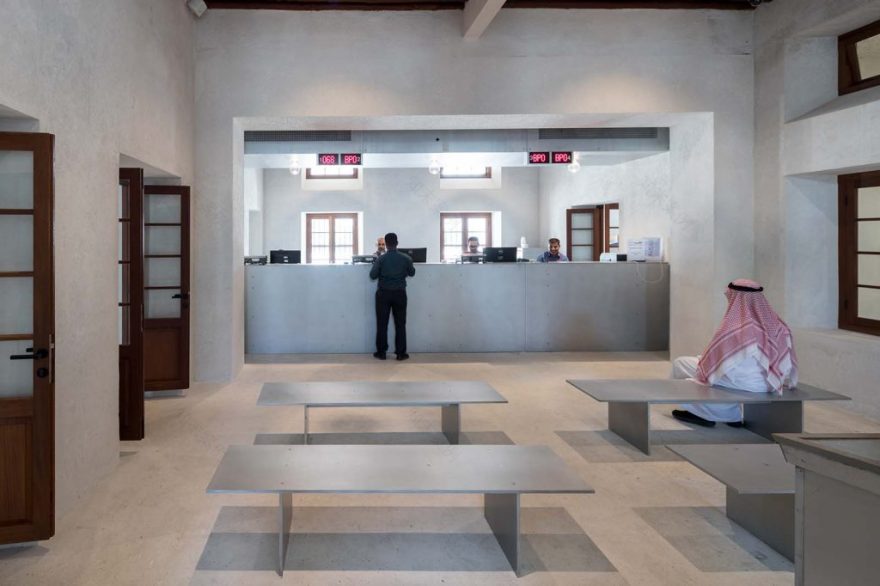

The extension also differentiates itself by the use of curved geometries, softening the heaviness of its materiality, as in the ground floor staircase
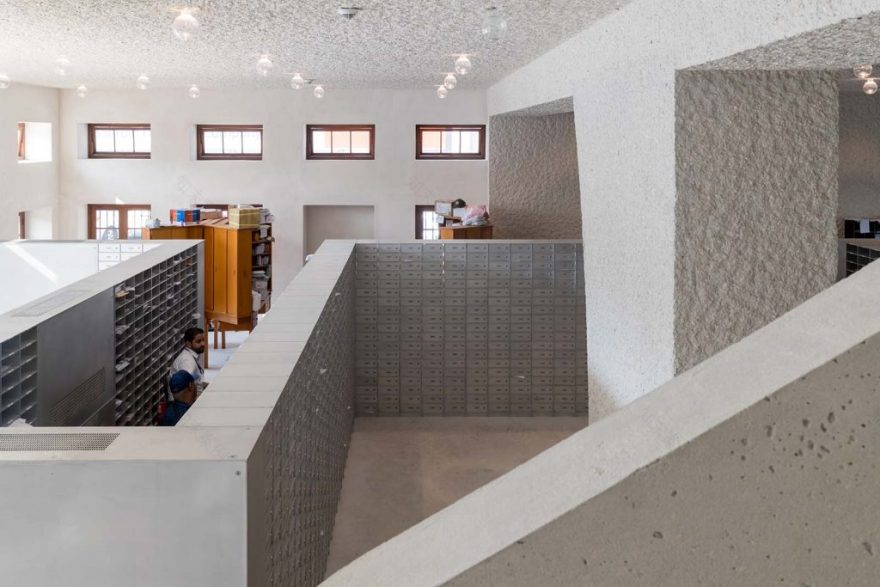
Gentle nuances in the treatment of textures and shades give a sense of the building’s superimposed layers

The extension’s interior is orchestrated by the elegant lines of just a few prominent elements: the sculpted staircase and sturdy column from the ground floor leading up to the scalloped ceiling of the upper level

The hand-hammered concrete of the extension is reminiscent of some of Bahrain’s earlier material finishes: the rough plaster that was commonplace in the first half of the 20th century as well as the lumpy aggregate-plaster mixture that became popular afterwards
Studio Anne Holtrop’s conversion of the former Customs House into a post office traces the history of Bahrain’s urban development
approach Bahrain by boat required skirting the reefs around the islands, past shoals of fish glittering in the sunlight at low tide, moving past half-exposed ridges between blue-green waves and skimming past strands of rock: an errant outcropping or abrasive coral stone recently quarried from the reef carefully avoided. The boat would either wend its way towards the harbour of Bahrain’s capital, Manama, or passengers would board a smaller vessel to approach the shore at high tide. Merchants tended to disembark several hundred metres away in the intertidal zone, either walking through soft mud and sand past algae and snails to the shore, or riding a donkey cart, crusted with salt and flecks of mud, sitting alongside bags of rice, teak wood or bundles of rush and bamboo. Once on dry land, a visitor would enter the Customs House, a small white structure made of coral stone; they would pay their taxes and head into Manama, crossing Customs Square through to the market.
This would have been a typical arrival experience into Bahrain at the turn of the 20th century, and until the 1950s. When arriving to Bahrain before the advent of air travel, the city gradually unfolded in front of you, making the Manama waterfront, and Customs Square in particular, a subject of design intent. As reclamation disconnected it from the waterfront and oil-related growth spurred the shifting of the port elsewhere, the site’s economic importance waned, but its cultural significance only grew with time. Over the past 90 years, Bahrain has had three iterations of the Customs House, until its 2019 transformation into a post office by Studio Anne Holtrop.
The first iteration was built in 1917, at a time when administrative tasks such as customs revenue collection, which had previously been handled by Indian merchants, became the responsibility of British personnel newly appointed to the Bahraini government. It was followed by warehouses, various sheds, a trolley line and a series of reclamation works and then a government road. British presence had existed in the Gulf since the 17th century, and after ousting the other imperial powers, Britain’s interest in policing the region fell in line with its goal of protecting trade routes to India and expanding economic interests within the larger Indian sphere of influence. Bahrain was made a British protectorate in the 19th century; stability and access to trade with Europe via India created new markets for Bahrain’s pearls, the island nation’s primary export.
In 1926, Charles Belgrave became advisor to the ruling family of Bahrain; he soon led the organisation of the courts and police, and oversaw the construction of schools, hospitals and a series of political and infrastructural efforts to modernise the country. As Bahrain’s development accelerated with the discovery of oil in 1932, Belgrave’s projects grew in ambition. He initiated a series of government projects that were designed by British or Indian engineers, constructed by a mix of Persian, Indian and local labourers, and supervised by the superintendent of the Land Registration Department, Khan Sahib Mohammad Khalil – until a separate Public Works Department was created in 1938 to oversee the construction of public projects. The design of the Customs Square and Bab Al Bahrain (‘the Gateway to Bahrain’) area was the most ambitious of these projects. Customs revenue made up almost the entirety of government revenue prior to the discovery of oil, and still more than half in the following decade, and the Customs House was the government’s first organised department. Belgrave insisted on a larger urban vision for the entry to Bahrain and an architectural sense of propriety.
In 1937 Belgrave oversaw the construction of the Customs House east of the pier. It was a two-storey edifice, with a southern facade composed of seven bays: five central loggias with wooden balustrades flanked by two enclosed bays. The building combined local materials and techniques with others found elsewhere in the British Empire. The walls were made of coral stone, plaster and
The Customs House was complemented with a circular garden and fountain, ensuring one-way motor traffic and improving the appearance of the square. Belgrave’s vision for the square was further enhanced by the Bab Al Bahrain gatehouse built on the opposite side of the square, covering the existing market and concealing the seeming disorganisation of the souq. The Bab Al Bahrain development also comprised a series of buildings on the edge of the market, including a police station and a new post office, and new developments sprang up on the waterfront, including the oil company offices and The British Bank of the Middle East. A visitor’s first impression of Bahrain a few years after the Second World War was that of a modernising capital.

The site of the Customs House photographed in 1915
After Bahrain’s independence in 1971, Manama embarked on a series of reclamation projects, expanding the capital and introducing planned portions of the city to its existing fabric. A newly independent nation needed to accommodate its various ministries and government buildings as well as new businesses and banks; the increased oil wealth of the region (particularly post 1973) and the influx of businesses after the Lebanese Civil War further encouraged growth. Manama was expanding rapidly, the older part of its waterfront increasingly abandoned for more prime locations, and the Customs Square reimagined. Bab Al Bahrain was given a heritage role rather than being purely institutional, its pseudo‑modern 1949 elevation was adorned with Arabic features, and the Customs House was converted into the Land Registration Department for a period in the 1970s (the customs offices had moved to Mina Salman). A few refurbishments were undertaken over the years and when the building was then converted into the Manama Post Office in the early 1980s, a concrete annexe was added in the north‑west corner, the interiors were covered in plaster and concrete, and the sagging
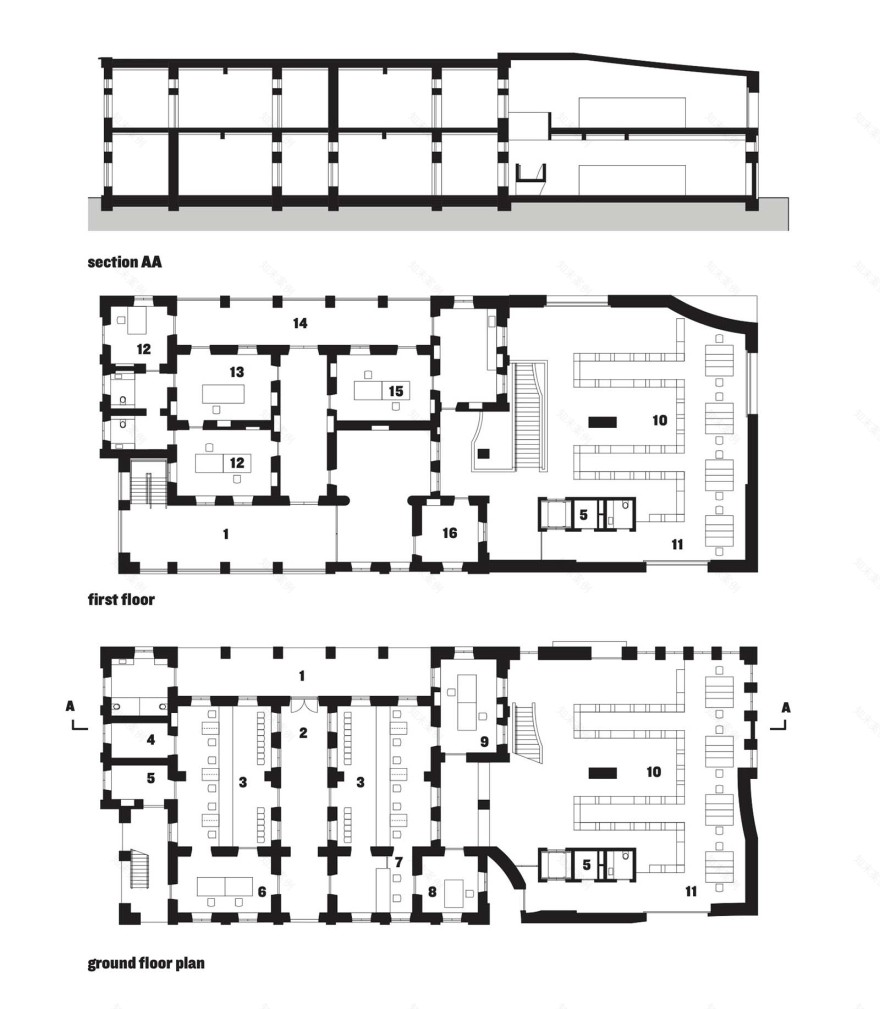
Once the building was stripped back, Studio Anne Holtrop was commissioned to continue the restoration work initiated by BACA and to design a new extension for the post office, accommodating sorting rooms and mail boxes. Made of hand-hammered white concrete, the new two-storey volume sits partly on the first (kept) annexe and extends to the back where the demolished extension once stood. Its scalloped forms slope towards the southern facade, with a single chimney shaft sitting on the otherwise completely solid roof. The appearance of the hand-hammered concrete, cast at 800mm and hammered down to 750mm, bears a resemblance to the rough plastered buildings of the first half of the 20th century, as well as the popcorn aggregate-plaster mixture which was fashionable from the 1950s to the ’70s in newer parts of Manama.
The loggias were opened once again, reverting to the original plan by removing the internal concrete blockwork partitions. In the original building, a central corridor with a historic display is flanked by two rooms for the public where counters for postal workers are placed. The upper floor of the older wing contains offices for staff. The timber joists and
and joists were reintroduced as a soffit rather than a structural element. Placing the package units on the roof of the older wings leaves the roof of the new wing bare of all services, enabling the sloping curvature and the autonomy of the extension as an object, read in contrast to the older structure. Several wooden post office desks were found in storage, varnished and repaired, and Holtrop designed additional furniture, including desks and mail boxes made from aluminium. The building was completed in 2019, and with it the post office has returned to the Customs House.
The Customs House represents several milestones in the history of Bahrain. It carries the notion of arrival and, in its early history, it was a key part of the official face of the island. More than a landmark upon entering the territory, the Customs House was also representative of the arrival of modern governance under increasing British intervention. After independence, the various iterations of Customs Square and the elevations of the buildings on the square highlight the changing attitudes towards preservation on the island nation, flitting between different notions of identity, culture and progress.
The Customs House is also the embodiment of a question of authorship: who does the Customs House represent and who is it projecting its identity towards? As opposed to Bab Al Bahrain, which now bears a distinctly new facade, the latest iteration of the Customs House is in part a faithful return to the original facade, while Studio Anne Holtrop’s addition also contributes an element of novelty. The addition heralds the third iteration of the Customs House as a cultural and historic landmark, rather than a logistical building or an important government office.
Today, Manama’s new post office sits a long way away from the shoreline. Its location hardly recalls the smell of the sea; the docking boats can no longer be heard bumping against one another along the quay.
The sense of arrival to this once crucial part of Bahrain’s identity and economy has been reimagined as the point of entry for a visitor to the older part of Manama, bearing witness to another phase in the reimagining of the former waterfront.

南京喵熊网络科技有限公司 苏ICP备18050492号-4知末 © 2018—2020 . All photos and trademark graphics are copyrighted by their owners.增值电信业务经营许可证(ICP)苏B2-20201444 苏公网安备 32011302321234号
苏公网安备 32011302321234号客服
消息
收藏
下载
最近