

创作上传
VIP
收藏下载
登录 | 注册有礼
查看完整案例

收藏

下载

分享
这是一个室内设计项目,地点位于西安市汉长安城遗址保护区的南部。原建筑主体结构为钢构,平面呈矩形,南北长,东西短。由紧挨着的一高一低两个体量组成,北高南低,均是双坡屋面。低的为一层,是一个完整的大空间;高的为两层,与低体量相接的部分是一个9米高的通高空间。
This is an interior design project located at the southern edge of the Han Chang’an City National Archaeological Park in Xi’an. The original building features a steel frame structure with a rectangular plan, elongated north-south and shorter east-west. It is composed of two immediately adjacent volumes of differing heights: The lower southern volume is a single-story, forming a large, undivided space, while the taller northern volume spans two stories, incorporating a 9-meter-high double-height space at its junction with the lower volume.
▼通高空间,Double-Height Space ©OnEarthStudio
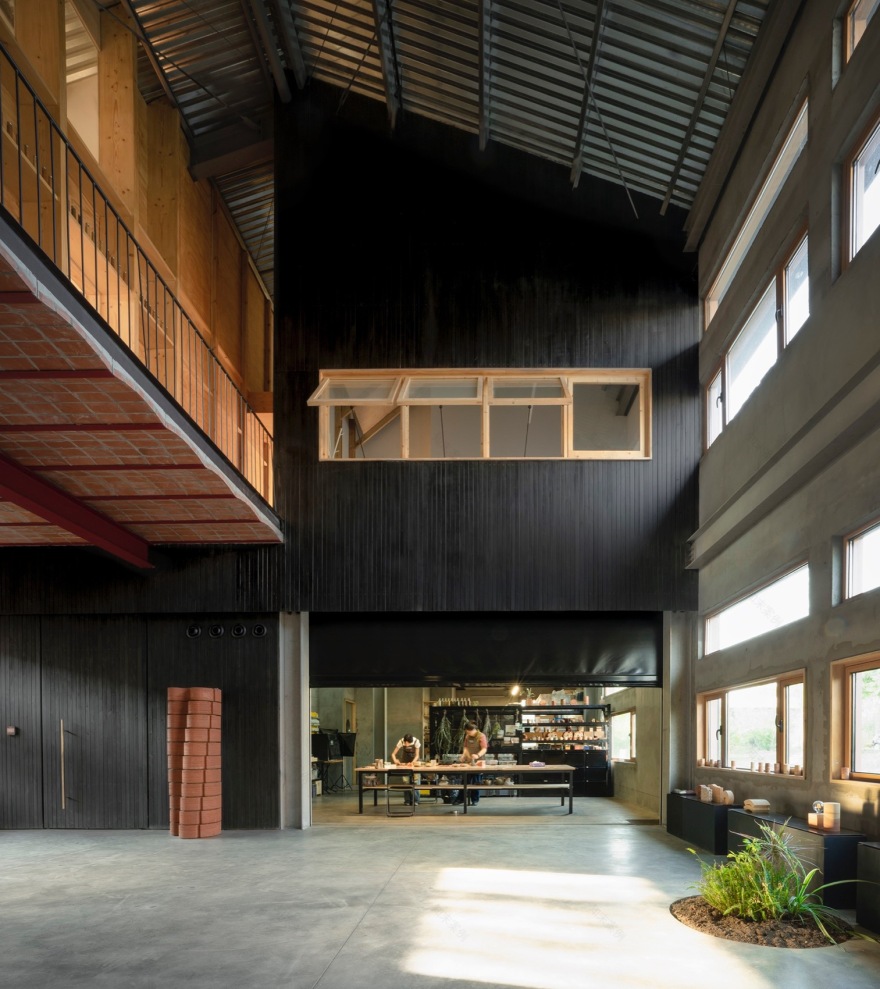
该建筑改造完成后将作为我们工作室在西安的研究与实验中心。内部空间的划分基于工作室的功能需求,分为了展示、实验与办公三部分。根据公共程度,这三部分又可划为两个区域:展示空间在一层,占据南侧的整个体量,平时对外开放,是街区公共空间在室内的延续。实验与办公空间相对私密,分置在北侧体量的一层与二层。通高空间是这两个区域共有的边界,自然地成为了设计中关键的空间节点。▼改造前室内空间,Interior Space Before Renovation ©OnEarthStudio

The internal spatial organization is driven by functional requirements, divided into three zones: exhibition, experimentation, and office. These are further grouped into two areas based on public accessibility: the exhibition space, occupying the entire southern volume on the ground floor, is designed to be regularly open to the public, acting as a deliberate indoor extension of the neighborhood’s public realm. The relatively private experimentation and office spaces are distributed across the ground and upper levels of the northern volume. The double-height space, serving as a shared boundary between these two areas, naturally emerging as a pivotal spatial nexus in the design.
▼展厅望向加建,View from the Exhibition Hall towards the Addition ©OnEarthStudio

▼砖拱楼板,Brick Vault Floor ©OnEarthStudio

边界空间
The Boundary Space
就着这个通高的边界空间,我们在二层置入了两个新的体量:一个是将通高区域沿屋脊线划出一半,加建了一间会议室和一个面向通高空间的开敞连廊;另一个是间小办公室,置于通高空间的北侧,隔开公共区域与开敞办公区。它们一起构成了这个边界空间的真实界面。会议室的外墙以实木做了格架,构件与格子的尺度都较常规书架大出许多,以便回应通高空间的超高尺度。格架顶层设玻璃,让自然光线穿过会议室抵达屋脊深处最暗的区域。开敞连廊作为过渡,南端伸向展厅的上空,北端插入办公区。
▼剖透视图,Sectional Perspective ©OnEarthStudio

Within this double-height boundary space, we introduced two new volumes on the upper level: One is a meeting room and an open corridor facing the void; The other is a small office positioned at the northern edge of the double-height space, separating the public zone from the open office area. The exterior of the meeting room features a solid wood grid frame. Its members and openings are scaled much larger than a conventional bookcase, a gesture that responds to the grand scale of the double-height space. The top of the frame is glazed, allowing natural light to pass through the meeting room and illuminate the darkest area beneath the roof ridge.
▼通高空间,Double-Height Space ©OnEarthStudio


▼会议室,Meeting Room ©OnEarthStudio

▼二层廊,Second Floor Corridor ©OnEarthStudio


通高空间的北侧整面用黑色的木板条垂直通铺,作为其背后两层空间真正的外立面。立面一层并置了办公区的入口与进出实验室的PVC卷帘门;二层设置了水平向布置的四格上悬窗,在视线上建立办公室与展厅的连接。会议室与连廊作为私密区域的延伸,凌空进入公共区域,模糊公共与私密界限的同时,也丰富了这个边界的空间体验。
▼室内轴测图,Interior Axonometric Drawing ©OnEarthStudio

The north wall of the double-height space is clad in vertical black wood slats, serving as the facade for the two-story space behind it. On the ground floor, this facade juxtaposes the office entrance with a PVC rolling shutter door for the laboratory. On the second floor, a horizontal band of four top-hung windows establishes a visual connection between the office and the exhibition hall. The meeting room and corridor act as extensions of the private zone, seemingly floating into the public area. This design not only blurs the boundaries between public and private, but also enriches the spatial experience of this interface.
▼通高空间,Double-Height Space ©OnEarthStudio

▼办公区门,Office Area Door ©OnEarthStudio

▼办公区入口,Office Area Entrance ©OnEarthStudio


▼办公室,Office area©OnEarthStudio
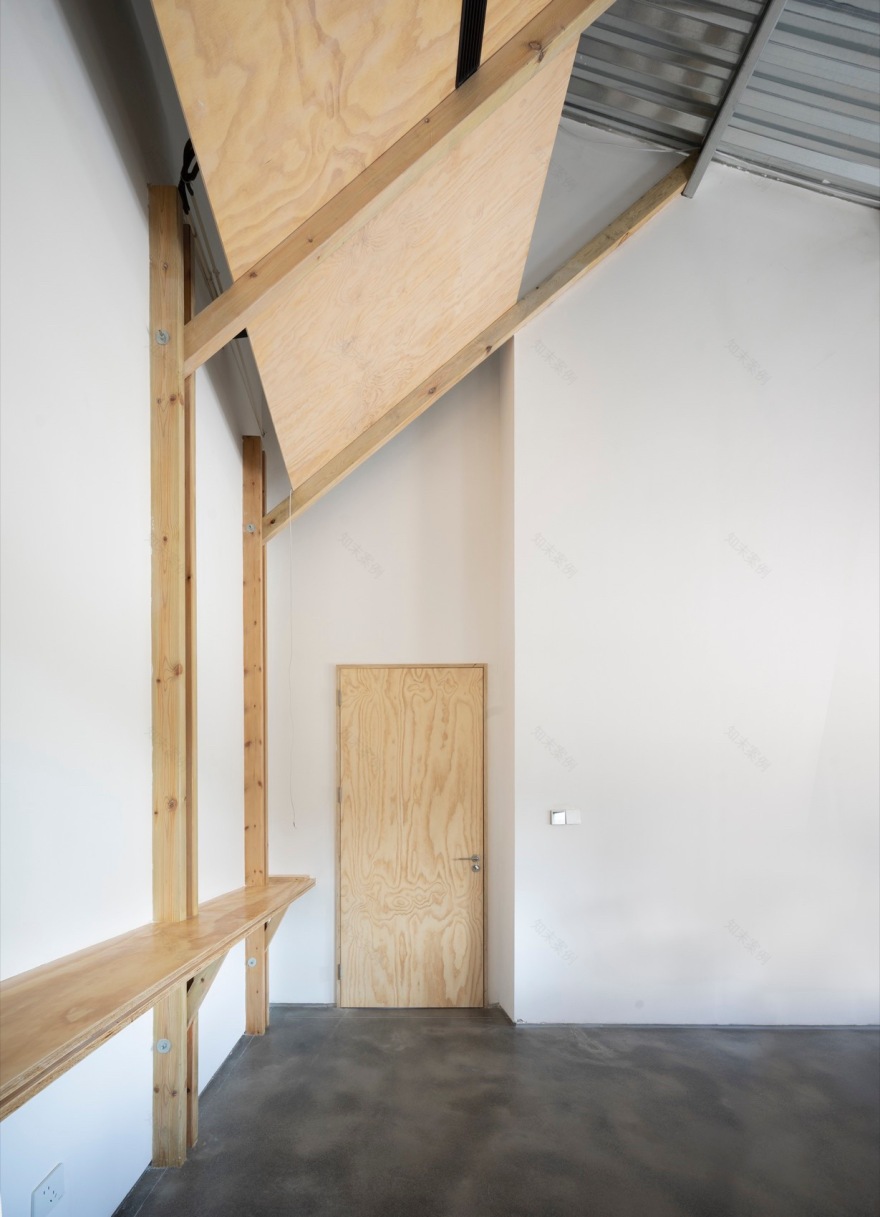

▼开敞办公区,Open Office Area ©OnEarthStudio

▼茶水间望向开敞办公区,View from the Pantry towards the Open Office Area ©OnEarthStudio

▼开敞办公区望向连廊,
View from the Open Office Area towards the Corridor ©OnEarthStudio

▼二层卫生间,Second Floor Restroom ©OnEarthStudio

从材料开始
Beginning with the Materials
各种空间体验终究要依托作为物质的具体材料来实现,这就让设计本身必须面对各种具体的现实问题。由于预算十分有限,设计前我们便自问:能用什么材料?能找到什么水平的工队?能对完成度控制到什么程度?这些问题动手前务必得有清晰的认知。首先材料的选择都是建材市场上常见的“大路货”:型钢、红砖、胶合板与木板条。其次对于无法预知的施工水平,设计之初我们就高度警惕所有无法保证基本完成度的构造与工艺:构造要尽可能简单直接,并使用常规工艺。
Ultimately, all spatial experiences rely on the tangible reality of materials, requiring the design to confrontspecific practical issues. With a very limited budget,material choices were all “commonplace” items readily available in the building materials market: structural steel, red brick, plywood, and timber slats. Furthermore, anticipatingunpredictable construction quality, we were highly vigilant from the outsetaboutany details or techniques that couldn’t guarantee a basic finish. This meant construction details had to be as simple and direct as possible, utilizing conventional methods.
▼展厅望向实验室,View from the Exhibition Hall towards the Laboratory ©OnEarthStudio

▼开敞茶水间,Open Pantry ©OnEarthStudio


原建筑除了地面的所有内表皮,我们基本都维持了现状,只新开了一大五小,六个窗洞。大窗开在西立面的二层,为了将窗外的四棵银杏映入室内,其余小窗用来满足必要的采光与通风。双坡屋顶的镀锌压型钢板材质能够“自带笔触”地反射室内外的光线与色彩,也原样保留。为了平衡原建筑内部钢材与水泥的灰冷,新介入的墙面材料主要用了暖黄的松木胶合板,不过其黄色略显甜腻,我们用了黑色与其并置。
With the exception of the floor, we preserved most of the building’s original interior surfaces. Into existing walls, we introduced six new window openings: one large and five small. The large window was strategically placed on the second floor of the west facade to frame a view of four ginkgo trees, while the smaller windows provide necessary natural light and ventilation. The corrugated galvanized steel of the pitched roof was also retained, valued for its inherent ability to reflect light and color from both inside and out with a distinctive, painterly quality. To balance the cool, gray tones of the original steel and concrete, warm-toned pine plywood was the primary material chosen for new interventions. However, to temper a yellow hue that felt slightly saccharine, we juxtaposed it with black elements to balance it.
▼二层廊,Second Floor Corridor ©OnEarthStudio


▼圆窗洞,Circular Window Opening ©OnEarthStudio

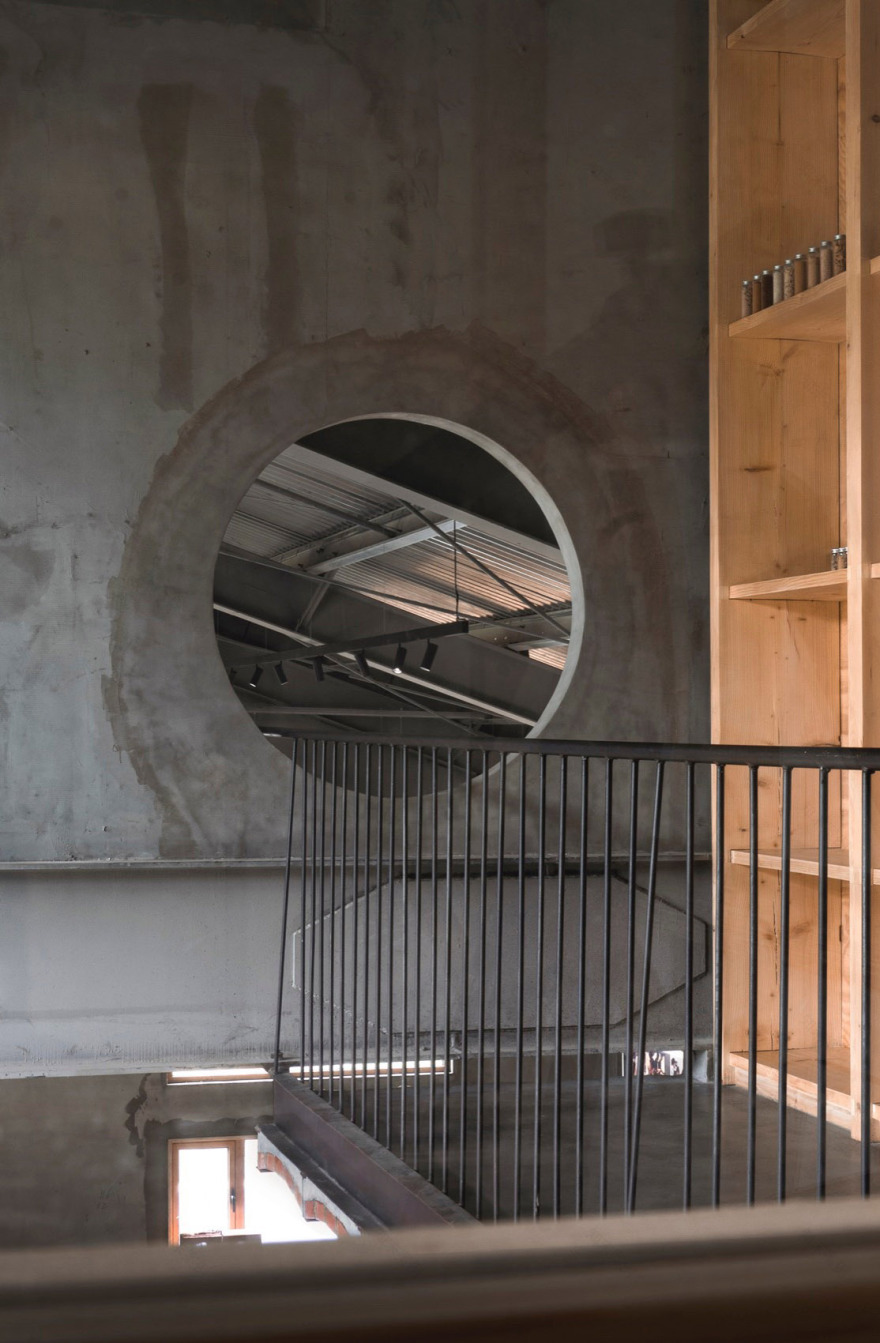
▼楼梯间,Stairwell ©OnEarthStudio


▼楼梯间细部,Stairwell details©OnEarthStudio


▼墙板细节,Wall Panel Detail ©OnEarthStudio

加泰罗尼亚拱
Catalan Vault
这些基于现实问题的低技策略之中,当然也包含着建筑师尝试新挑战的习惯与愿望。以加建的会议室楼板为例,我们选择了一种型钢肋砖拱券(加泰罗尼亚拱)的方式来建造。十根120x85mm的H型钢,间距630mm排列作为楼板的骨架,型钢间用红砖砌拱券后,上部浇灌混凝土填充。人类以砖砌筑拱的历史非常悠久,在我国西北地区一直都有用土砖做拱券箍窑洞的建造传统。但传统箍窑的做法中,砖通常为立砌,结构厚度较大,为了缩减厚度,同时也为更省砖,我们选择了平砌的方式,也就是标准的加泰罗尼亚拱。
Within these low-tech strategies,born frompractical constraints, layarchitect’s habitual desire to embracenew challenges. Take the added meeting room floor slab, for example: we chose to construct it using a structural steel-ribbed brick vault (Catalan vault). Ten H-shaped steel beams (120x85mm), spaced 630mm apart, formed the skeleton, withred bricks laid in vaults between them,topped withaconcrete infill. The history of brick vaulting is ancient, with a tradition in Northwest China of constructing gu yao (箍窑)vaulted cave dwellings using earth bricks. However, in traditional gu yaoconstruction, the bricks are usually laid upright, resulting in a thicker structure. To reduce the thickness and conserve bricks, we chose to lay them flat—the standard Catalan vault method.
▼砖拱楼板,Brick Vault Floor ©OnEarthStudio


原理没问题,材料也很简单,但到底怎么砌,这边没人做过,只能自己想办法。我们设计制做了一个可滑移的小型拱券木模板,模板边缘靠U型夹与H型钢的翼板固定,每砌完一板即可以H型钢为轨道顺移砌筑下一板。我们亲自试砌了头两板,安全可靠后转由工人操作完成。楼板朝向通高空间的边缘用一根槽钢与十根型钢密肋端部焊接作为嵌固,并在两端与原建筑钢结构连接。槽钢同时也是现浇混凝土的收边模板,另外也为连廊的金属栏杆固定提供了焊接面。整个新楼板被一根H型钢大梁和一根直径14cm的实心钢柱托起。所有的材料与结构都以直给的方式呈现,相映成趣,构成了戏剧性的结果。
▼施工中的加泰罗尼亚拱,Catalan Vault under Construction ©OnEarthStudio

While the principle was sound and the materials simple, the technique was unfamiliar to local builders, forcing us to devise our own method. We designed and fabricated a small, movable wooden formwork for the vaults. Its edges were secured to the H-beam flanges with U-clamps, allowing the formwork to slide along the beams as a track to build the next section after one was completed. We personally laid the first two sections to ensure the process was safe and reliable before turning it over to the workers. The edge of the slab facing the double-height space was fixed by welding a channel beam to the ends of the ten H-beams, which in turn was connected to the original building’s steel structure at both ends. This channel beam also served as edge formwork for the cast-in-place concrete and provided a surface for welding the corridor’s metal railings. The entire new slab is supported by a large H-beam and a solid steel column (14cm diameter).
▼砖拱楼板,Brick Vault Floor ©OnEarthStudio

▼新楼板与原钢梁连接细部
Connection Detail of New Floor Slab to Original Steel Beam ©OnEarthStudio

项目中可做可不做的内容被我们果断放弃,这种克制反而使设计更专注于坦诚地表现材料与建造本身。虽然笨拙而用力,但也是逻辑与直觉自然而然相平衡的结果。有时将建筑降级,理解为“构筑物”进行操作,反而会使结果更加简明纯粹。作为物的材料自己会作表达,“造物”得当就能流露出质朴的力量与诗意,正如刘家琨先生所说“建筑学就是操作物质,直到把物质操作得沁出精神”。
We decisively omitted any elements deemed non-essential. This restraint allowed the design to focus more intently on honestly expressing the materials and construction. Though perhaps appearing clumsy and laborious, it was a natural balance of logic and intuition. Materials, as physical things, express themselves, and when “crafting” is done appropriately, a raw power and poetry emerge. As architect Liu Jiakun observed,“Architecture is about manipulating matter until the spirit emerges from it.”
▼金属叉竿细节,Window Stay Detail ©OnEarthStudio


▼首层平面图,Ground Floor Plan ©OnEarthStudio

▼二层平面图,First Floor Plan ©OnEarthStudio

▼剖面构造详图,Section Detail ©OnEarthStudio

设计机构: 土上工作室
项目完成年份: 2024
建筑面积: 465㎡
地点:中国西安
主创设计师:蒋蔚
设计团队:顾倩倩,张靖唯
结构设计: 周铁钢、梁增飞
摄影:土上工作室
Architecture design:OnEarthStudio
Year: 2024
Area:465 m²
Location: Xi’an, China
Lead Architect:Jiang Wei
Design Team:Gu Qianqian, Zhang Jingwei
Structural Design:Zhou Tiegang, Liang Zengfei
Photography:OnEarthStudio
南京喵熊网络科技有限公司 苏ICP备18050492号-4知末 © 2018—2020 . All photos and trademark graphics are copyrighted by their owners.增值电信业务经营许可证(ICP)苏B2-20201444 苏公网安备 32011302321234号
苏公网安备 32011302321234号客服
消息
收藏
下载
最近