

创作上传
VIP
收藏下载
登录 | 注册有礼
查看完整案例

收藏

下载

分享
生态文明时代是当代环境美学的背景。在生态文明时代出现的生态文明审美观强调美中具有一种重要性质,文明与生态共生。这种审美观将自然环境中的生命性提升到生态公正的高度,尊重动植物自身的审美权利,将生态平衡看作自然环境美的核心,重视最具生态性的荒野之美。
——摘自武汉大学陈望衡教授.《再论环境美学的当代使命》
The era of ecological civilization is the backdrop for contemporary environmental aesthetics. The ecological civilization aesthetic that emerged in this era emphasizes an important quality in beauty: the coexistence of civilization and ecology. This aesthetic elevates the vitality in the natural environment to the height of ecological justice, respects the aesthetic rights of animals and plants themselves, regards ecological balance as the core of natural environmental beauty, and values the beauty of wilderness, which is the most ecological.
——Excerpted from Professor Chen Wangheng of Wuhan University,《Re-discussing the Contemporary Mission of Environmental Aesthetics》
▼航拍夜晚的公园,Aerial Photography of the Park at Night ©火丁小岛摄影工作室
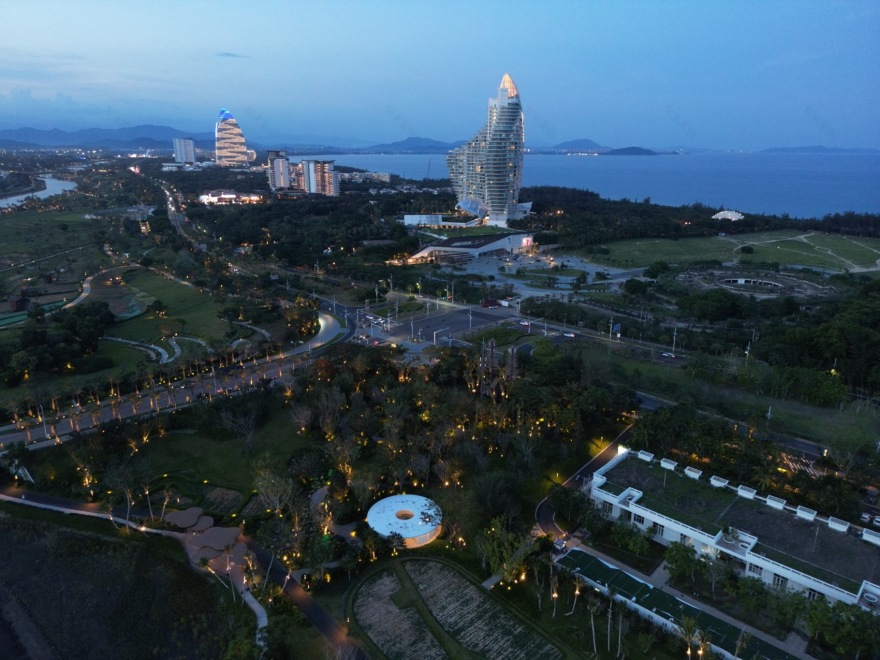
从人工淡水河到海岸线桥头堡
From the artificial freshwater river to the coastal gateway
项目位于三亚市海棠区海棠北路以西,海棠河沿线两岸,北起龙江路,南至江林路。海棠河水系综合治理二期工程涵盖海棠河除一期范围外的全段,全长约10.1公里。花境范围包括阔叶浅溪、龙江路、运动公园节点,总面积约6000㎡。
The project is located west of Haitang North Road in Haitang District, Sanya City, along both banks of the Haitang River, starting from Longjiang Road in the north and ending at Jianglin Road in the south. The Phase II Comprehensive Improvement Project of the Haitang River Water System covers the entire section of the Haitang River excluding the Phase I area, with a total length of approximately 10.1 kilometers. The flower border scope includes the Broad-leaved Shallow Stream, Longjiang Road, and the Sports Park node, with a total area of approximately 6,000 square meters.
▼海棠河水系综合治理工程示意图,A Schematic Diagram of the Comprehensive Management Project for the Haitang River Water System” ©LOLA

▼海棠河水系综合治理工程功能区划分,Functional Zone Division of the Comprehensive Management Project for the Haitang River Water System ©LOLA

该标段整体愿景围绕“国家海岸,文明内河”展开,打造面向全球的热带风情生态水系综合治理典范。其中阔叶浅溪部分,是作为生态公园的核心展示段——热带奇迹,集中展示最具热带特征的阔叶植物群落。
The overall vision of this section revolves around “National Coast, Civilized Inland River”, aiming to create a world-oriented model of comprehensive management of tropical-style ecological water systems. Among them, the Broad-leaved Shallow Stream section serves as the core exhibition segment of the ecological park – “Tropical Miracle”, which focuses on displaying the most tropical-characteristic broad-leaved plant,communities.
▼航拍傍晚的海棠河生态公园,Aerial Photography of the Park at Night ©火丁小岛摄影工作室

海南岛,作为中国唯一的热带海岛,其雨林生态系统在全球生物多样性保护中占据重要地位。传统植物景观设计往往局限于物种展示,而本项目旨在超越单一观赏功能,以科学叙事和沉浸式体验为核心,构建一座兼具生态教育、科研示范与国际旅游吸引力的热带雨林活体博物馆。
于是我们重构了设计逻辑,提出“北纬18°生态秀场”这一概念,希望不仅再现雨林奇观,更揭示其背后的生态智慧,使游客在游憩过程中自然理解海南生境的独特价值,从而打造一张具有国际影响力的“海南雨林文化名片”。
Hainan Island, as China’s only tropical island, its rainforest ecosystem holds an important position in global biodiversity conservation. Traditional plant landscape design is often limited to species display, while this project aims to go beyond a single ornamental function, focusing on scientific narrative and immersive experience to build a living tropical rainforest museum that integrates ecological education, scientific research demonstration, and international tourism appeal.
The design logic was thus reconstructed, and the concept of “18°N Ecological Showcase” was proposed. It is hoped that this concept will not only recreate the wonders of the rainforest but also reveal the ecological wisdom behind it, enabling visitors to naturally understand the unique value of Hainan’s habitat during their recreation, thereby creating an internationally influential “Hainan Rainforest Cultural CallingCard”.
▼海棠河生态公园入口,Entrance to Haitang River Ecological Park ©火丁小岛摄影工作室

北纬18°生态秀场
“18°N Ecological Showcase”
作为独特的大陆性岛屿热带雨林,海南岛屹立于南海之中,物种被彼此分开独立演化,形成具有大陆基因,又有岛屿特征的演化结果。中部高,四周低,有着环形阶梯状地形结构,这使得海南热带雨林拥有高山云雾林特征、热带山地雨林特征及热带低地雨林等不同的雨林类型。雨林中的植物生存竞争异常激烈,产生许多雨林独特的景观,如“垂直层片结构”、“林窗效应”、“空中花园”等,以叶的变化来应对和适应光环境的变化。
As a unique continental island tropical rainforest, Hainan Island stands in the South China Sea. Its species have evolved independently, separated from each other, resulting in evolutionary outcomes that possess both continental genes and island characteristics. The island features a ring-shaped stepped topographic structure with high central areas and low四周, which gives rise to different rainforest types in Hainan, such as alpine cloud forest, tropical montane rainforest, and tropical lowland rainforest. The competition for survival among plants in the rainforest is extremely fierce, leading to many unique rainforest landscapes, such as “vertical layer structure”, “forest gap effect”, and “hanging garden”, where plants adapt to changes in light environment through leaf variations.
核心生态现象的科学转译:
The Scientific Translation of Core Ecological Phenomena:
垂直层片结构:雨林的立体战争
热带雨林的垂直分层是物种竞争光资源的直接体现。我们以“阔叶浅溪”为原型,构建四层生态景观:
乔木层(冠层):雨树、椰子等高大树种形成绿色穹顶,
亚乔木层:笔筒树、粘叶豆等中型乔木构成过渡带,结合绞杀榕现象展示种间竞争。
灌木层:蕨类、鸢尾、球根海棠等耐阴植物模拟林下弱光环境,地被层铺设翠云草,形成蓝绿色“生态地毯”。
枯落物层:通过腐木分解实验展示真菌与微生物的分解作用,诠释物质循环机制。
Vertical Layer Structure: The Three-Dimensional Battle of the Rainforest
The vertical stratification of tropical rainforests is a direct manifestation of species competing for light resources. Using the “Broadleaf Stream” as a prototype, we have constructed a four-layer ecological landscape:
Arboreal Layer (Canopy): Tall tree species such as Rain Tree (Samanea saman) and coconut trees form a green dome.
Sub-arboreal Layer: Medium-sized trees like Brush Pot Tree (Sphaeropteris lepifera) and Schizolobium parahyba create a transitional zone, with the strangler fig phenomenon illustrating interspecies competition.
Shrub Layer: Shade-tolerant plants such as ferns, irises, and tuberous begonias simulate the low-light understory environment, while the ground layer is covered with Selaginella uncinata, forming a blue-green “ecological carpet.”
Litter Layer: A rotten wood decomposition experiment demonstrates the decomposition role of fungi and microorganisms, explaining material cycling mechanisms.
▼垂直层片结构植物解析,Analysis of Vertical Stratification Structure of Plants ©天华园艺
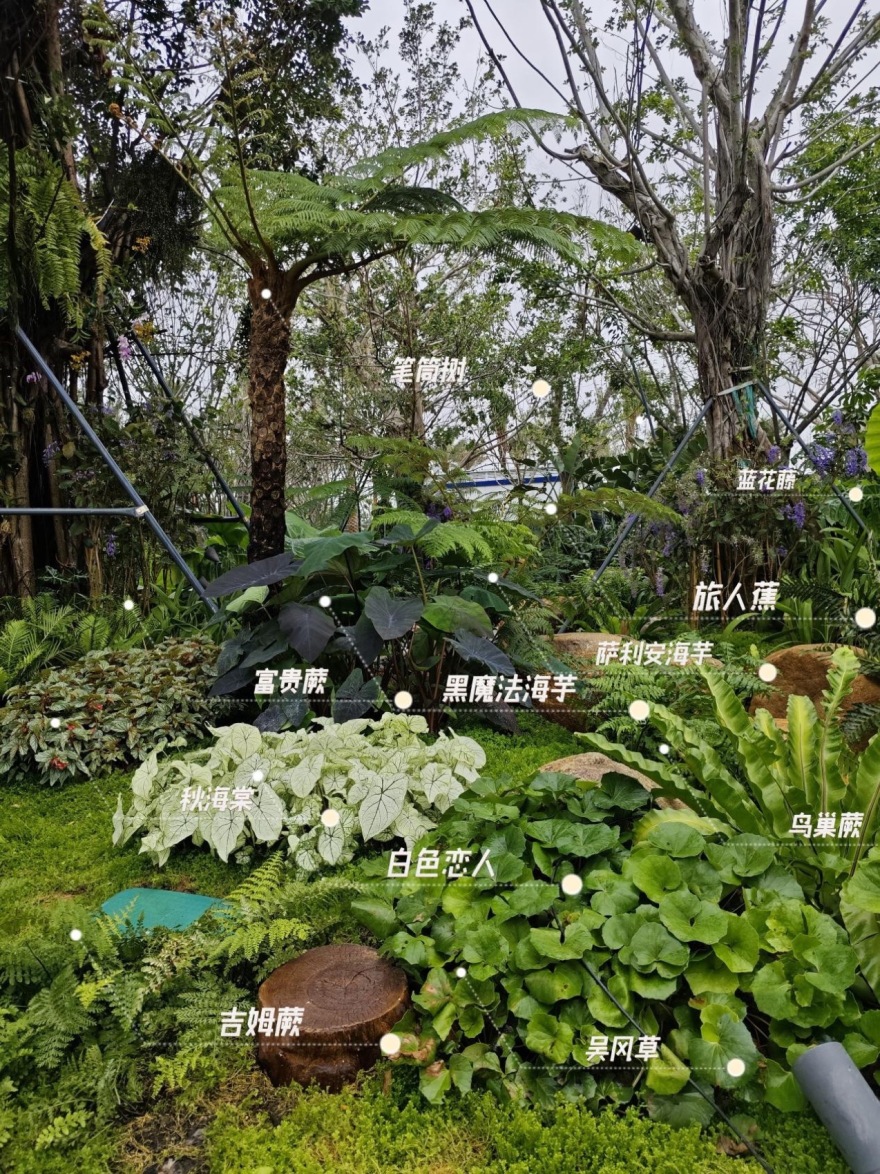
▼垂直层片结构,Vertical Stratification Structure ©天华园艺
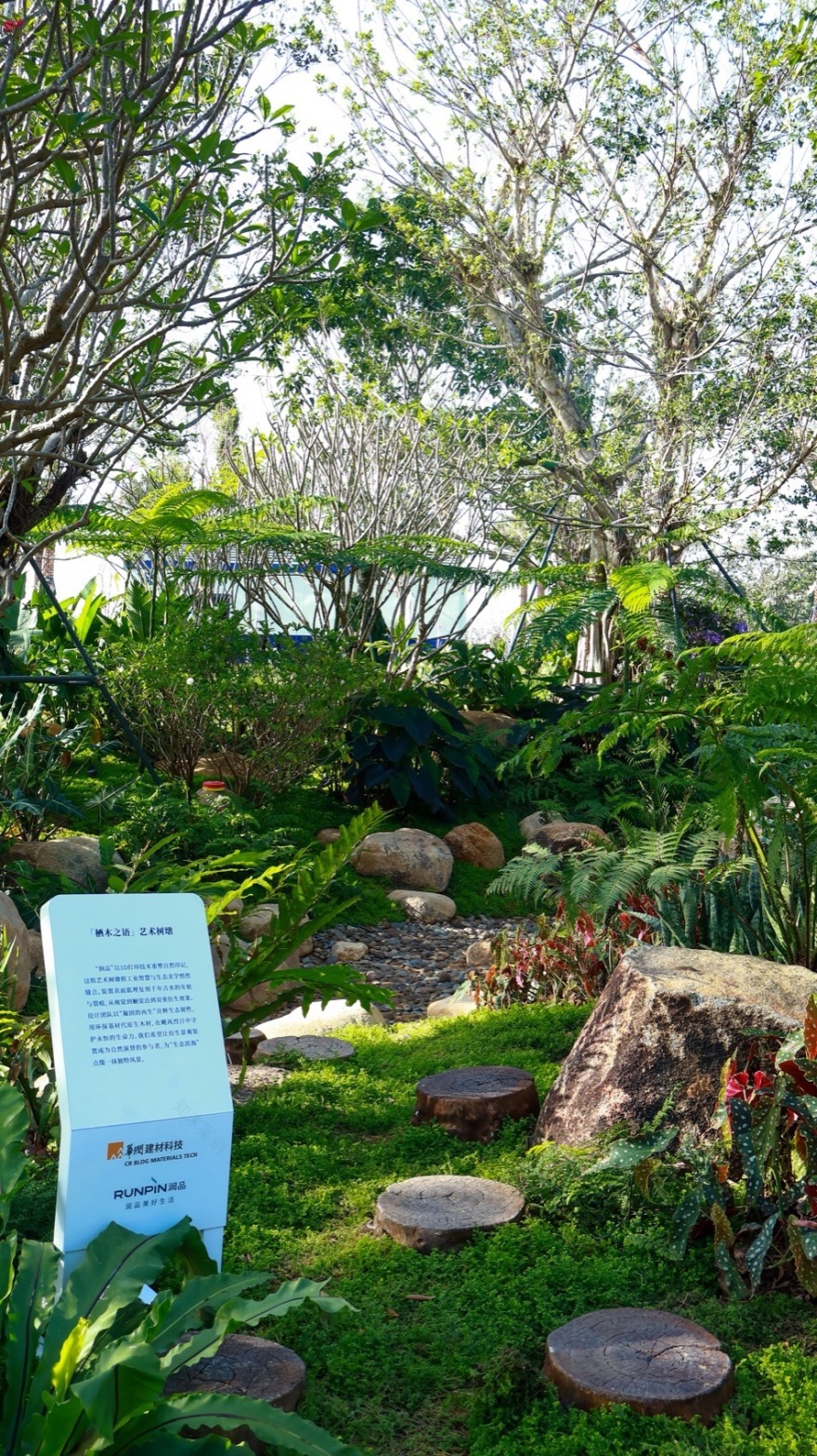
▼亚乔木层和灌木层解析,Sub-arboreal Layer&shrub layer ©火丁小岛摄影工作室

▼水雾下的灌木层,shrub layer in the mist ©火丁小岛摄影工作室
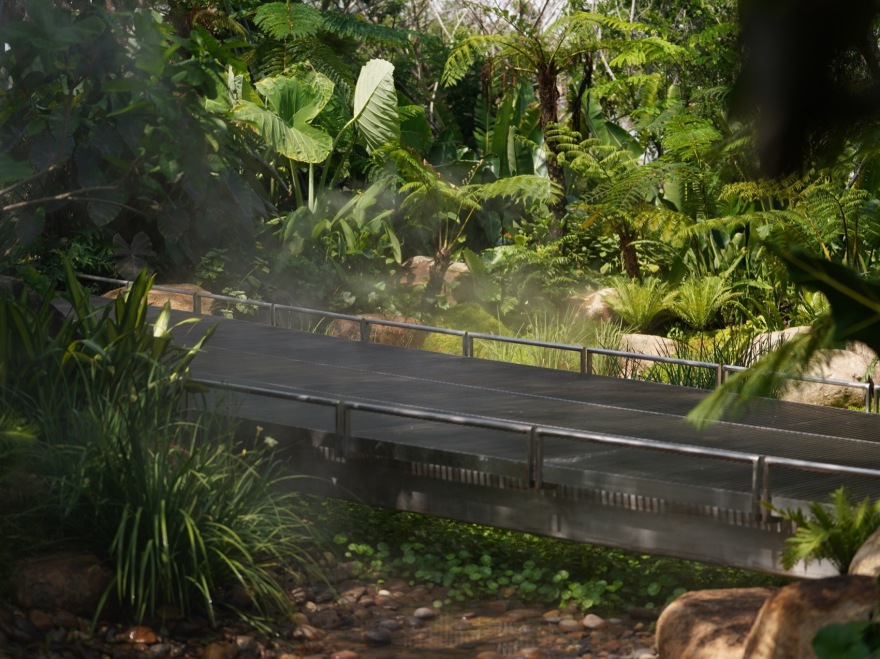
▼水雾下的灌木层,shrub layer in the mist ©火丁小岛摄影工作室

▼灌木层与枯落物层,Shrub Layer&Litter Layer ©火丁小岛摄影工作室

林窗效应与空中花园:缝隙中的生命奇迹
Forest Gap Effect and Hanging Gardens: Miracles of Life in the Gaps
林窗是雨林更新的关键动力,倒木形成的空隙为附生植物提供生存机遇。
设计策略——
倒木奇迹:以枯木为原型,内部嵌入灌溉系统,树体种植凤梨、丝苇、兰花、蕨类等附生植物,通过时间的演变和预处理,模拟雨林的真实情况;
科学叙事:通过对比林窗内外微环境数据,直观说明先锋物种与耐阴植物的适应性差异。
Forest gaps are a key driver of rainforest regeneration, as the spaces created by fallen trees provide survival opportunities for epiphytic plants.
Design Strategy—
Log Miracle: Using deadwood as a prototype, an irrigation system is embedded inside, and epiphytes such as bromeliads, Rhipsalis, orchids, and ferns are planted on the tree body. Through temporal evolution and pretreatment, the real situation of the rainforest is simulated.
Scientific Narrative: By comparing microenvironmental data inside and outside the forest gap, the adaptive differences between pioneer species and shade-tolerant plants are intuitively illustrated.
▼枯树上的植物解析,Analysis of Plants on Dead Trees ©火丁小岛摄影工作室

▼倒下的枯树上长满了植物,The fallen dead tree covered with plants ©天华园艺
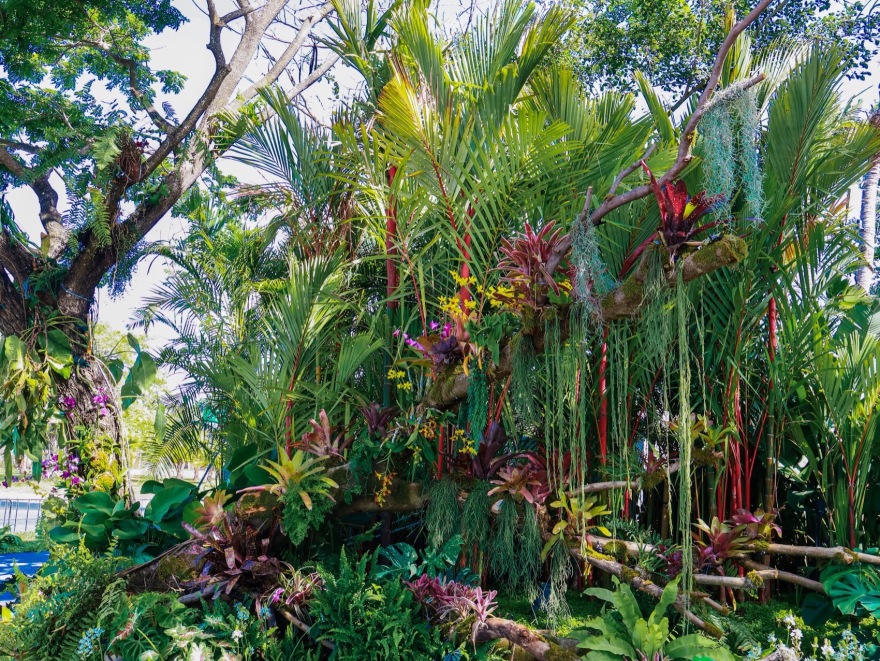
▼倒下的枯树上长满了植物,The fallen dead tree covered with plants ©火丁小岛摄影工作室

▼倒下的枯树上长满了植物,The hanging garden on the rain tree ©火丁小岛摄影工作室

▼雨树上的空中花园,The hanging garden on the rain tree ©火丁小岛摄影工作室

▼雨树上的空中花园,The fallen dead tree covered with plants ©火丁小岛摄影工作室

▼正在搭建空中养护系统的设计师,The designer building the aerial maintenance system ©天华园艺

▼提前在树干底部打造灌溉系统,The irrigation system is building in advance at the base of the tree trunk ©天华园艺

▼空中花园底层灌溉系统搭建,Construction of the Underlying Irrigation System for the Hanging Garden©天华园艺

叶片的环境适应:从雨林到河口的生存策略
Leaf Environmental Adaptation: Survival Strategies from Rainforests to Estuaries
叶片形态是植物对光环境的直接响应。沿滨河段路口设计“光适应实验带”:
阴生区(模拟低地雨林):大型薄叶植物(海芋、象耳芋、龟背竹等)展示高效的光捕获能力。
阳生区(模拟河口湿地):厚蜡质叶片(紫背竹芋)与反光植物(蕉类)减少水分蒸发。
归根结底,这就是自然中植物叶片对阳光需求的变化而产生的进化。在弱光下,叶片面积大而薄;在强光条件下生长的叶片则较小而厚。
Leaf morphology is a direct response of plants to light environments. A “Light Adaptation Experimental Zone” is designed along the riverside intersection:
Shade Zone (Simulating Lowland Rainforests): Large, thin-leaved plants (such asAlocasia, elephant ear taro, andMonstera deliciosa) demonstrate efficient light-capturing capabilities.
Sunny Zone (Simulating Estuarine Wetlands): Thick, waxy leaves (Stromanthe sanguinea) and reflective plants (banana species) reduce water evaporation.
Ultimately, this reflects the evolution of plant leaves in nature in response to varying sunlight requirements. In low light, leaves are large and thin; in intense light, leaves are smaller and thicker.
▼阴生区大型薄叶植物解析,The large thin-leaved plants in the shade area ©火丁小岛摄影工作室

▼阳生区厚叶植物,The thick-leaved plants in the sunlit area ©火丁小岛摄影工作室

▼阳生区反光蕉类植物,The reflective banana plants in the sunlit area ©火丁小岛摄影工作室

▼提供遮荫的圆叶轴榈大道,the shade-providing Licuala grandis avenue ©火丁小岛摄影工作室

▼提供遮荫的圆叶轴榈大道,the shade-providing Licuala grandis avenue ©火丁小岛摄影工作室

▼受海风侵蚀的猩红椰林,the scarlet coconut palm forest eroded by sea breeze ©火丁小岛摄影工作室

▼受海风侵蚀的猩红椰林,the scarlet coconut palm forest eroded by sea breeze ©火丁小岛摄影工作室
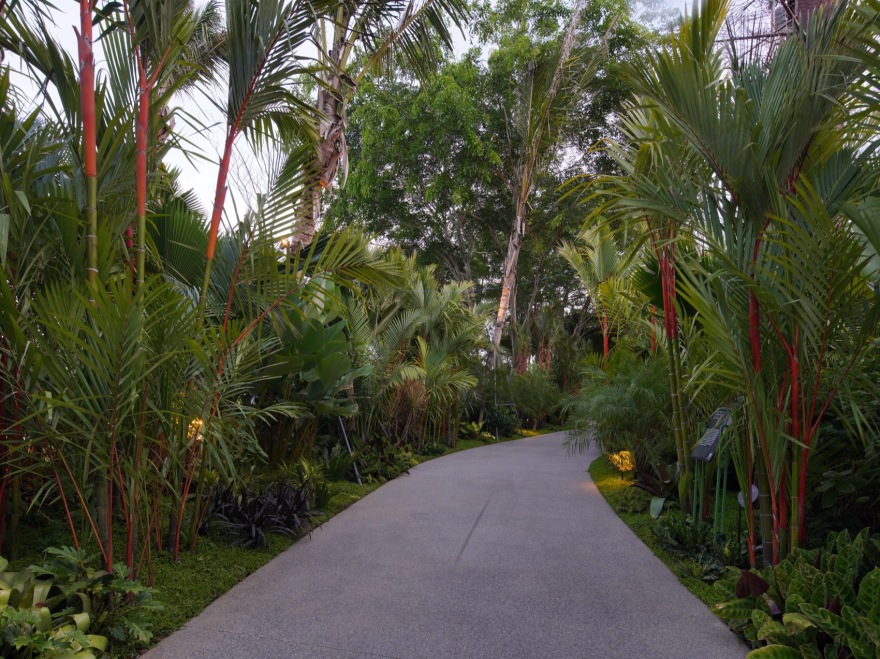
“海棠河生态公园”不仅是一座公园,更是一部演绎热带雨林生命史诗的活态教科书。在“落叶浅溪”,倒木的腐朽、叶片的进化、层片的竞争,共同构成一场无声却壮丽的生态戏剧。我们以科学为脚本,以景观为舞台,让每一位游客在漫步中读懂海南雨林的生存智慧——而这,正是向世界讲述中国生态故事的最佳方式。
“Haitang River Ecological Park” is not just a park, but a living textbook that Interprets the epic of tropical rainforest life. In the “Fallen Leaf Stream”, the decay of fallen wood, the evolution of leaves, and the competition of layers together form a silent yet magnificent ecological drama. With science as the script and landscape as the stage, we allow every visitor to understand the survival wisdom of Hainan’s rainforest while strolling—and this is the best way to tell China’s ecological story to the world.
▼海棠河生态公园共生区入口,The entrance to the Symbiosis Zone of Haitang River Ecological Park ©火丁小岛摄影工作室

▼海棠河生态公园共生区展示,The Exhibition of the Symbiosis Zone in Haitang River Ecological Park ©火丁小岛摄影工作室

▼海棠河生态公园共生区展示,The Exhibition of the Symbiosis Zone in Haitang River Ecological Park ©火丁小岛摄影工作室
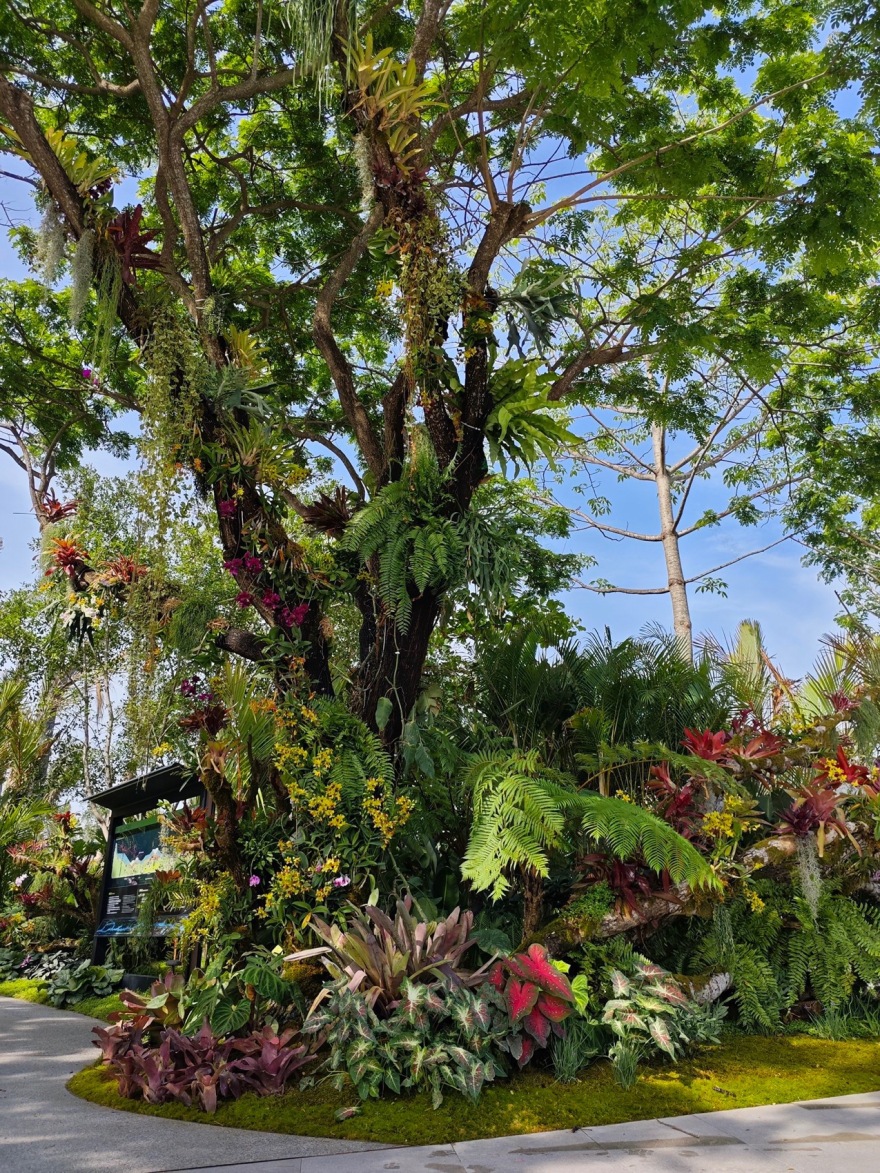
▼海棠河生态公园共生区展示,The Exhibition of the Symbiosis Zone in Haitang River Ecological Park ©火丁小岛摄影工作室

地址:海南省三亚市海棠湾
面积:项目总面积约135公顷(不含水域),花境面积6000平方米
业主单位:华润置地有限公司、三亚市海棠区住房和城乡建设局
代建单位:深圳市润置城市建设管理有限公司
设计单位:LOLA景观建筑设计事务所
花境单位:重庆天华园艺有限公司(胡春梅 邹雍雪 郑奕 杜强 张格 张杨 彭志伟 陈建)
施工图单位:广州普邦园林股份有限公司
园林单位:中国建筑第五工程局有限公司,上海景域园林建设发展有限公司
灯光单位:汉都设计顾问(深圳)有限公司
标识单位:沈阳市易邦七彩企业营销策划有限公司
生态顾问:上海智节建筑设计咨询有限公司 |健住社
Address: Haitang Bay, Sanya City, Hainan Province
Area: The total project area is approximately 135 hectares (excluding water areas), with a flower border area of 6,000 square meters
Client Units: China Resources Land Limited, Housing and Urban-Rural Development Bureau of Haitang District, Sanya City
Construction Management Unit: Shenzhen Runzhi Urban Construction Management Co., Ltd.
Design Unit: LOLA Landscape Architecture Studio
Flower Border Unit: Chongqing Tianhua Horticulture Co., Ltd. (Hu Chunmei, Zou Yongxue, Zheng Yi, Du Qiang, Zhang Ge, Zhang Yang, Peng Zhiwei, Chen Jian)
Construction Drawing Unit: Guangzhou Pubang Landscape Architecture Co., Ltd.
Landscaping Units: China Construction Fifth Engineering Bureau Co., Ltd., Shanghai Jingyu Landscape Construction and Development Co., Ltd.
Lighting Unit: Hando Design Consultants (Shenzhen) Co., Ltd.
Signage Unit: Shenyang Yibang Qicai Enterprise Marketing Planning Co., Ltd.
Ecological Consultants: Shanghai Zhijie Architectural Design Consulting Co., Ltd. | Jianzhu She


南京喵熊网络科技有限公司 苏ICP备18050492号-4知末 © 2018—2020 . All photos and trademark graphics are copyrighted by their owners.增值电信业务经营许可证(ICP)苏B2-20201444 苏公网安备 32011302321234号
苏公网安备 32011302321234号客服
消息
收藏
下载
最近