

创作上传
VIP
收藏下载
登录 | 注册有礼
查看完整案例

收藏

下载

分享
密斯·凡·德·罗基金会呈现由建筑师兼艺术家 Xevi Bayona(Bayona Studio)创作的艺术装置《La Padrina与家居物件的记忆》,于密斯·凡·德·罗馆(Mies van der Rohe Pavilion)展出。本次装置名为《La Padrina》,指的是这些如今悬挂在展馆天花板上的物件的原主人。Josefina Camó Valls,昵称 Pepi,是 Xevi Bayona的姑妈与教母,自幼随父亲迁居Olot,父亲当时搬去当地从事圣像绘画工作。Josefina是一名刺绣工匠,终身未婚。她出生于1927年,正值密斯馆设计之时。96年后,她离世,留下了关于她生活的记忆和她生活物件中所蕴含的“家居性”(domesticity)的见证。
The Fundació Mies van der Rohe presents “La Padrina and the belongings of domesticity” an artistic intervention at the Mies van der Rohe Pavilion by the architect and artist Xevi Bayona from Bayona Studio. The intervention is titled La Padrina in reference to the person to whom all the objects now furnishing the ceiling of the Pavilion once belonged. Josefina Camó Valls, known as Pepi, was the aunt and godmother of Xevi Bayona and lived in Olot from a young age, after her father moved there to paint saints. She was an embroiderer by profession and remained single throughout her life. She was born in 1927, approximately when the Pavilion was being designed, and 96 years later, she left behind the memory of her life and the testimony of her domesticity in each of her belongings.
▼悬挂在展馆天花板上的物件,all the objects now furnishing the ceiling of the Pavilion ©Adrià Goula


如今,这些物品——超过20件,如床、灯、衣架、桌椅等——被安置于密斯馆屋顶之上,仿佛是卡尔维诺笔下《看不见的城市》的一部分。艺术家将这些来自Olot一座普通住宅的家具重新安置进展馆内部,这一动作既具诗意又具挑衅意味,激发我们思考“家”的意义、空间与记忆之间的关联。面对这一截然不同的语境,问题呼之欲出:密斯馆是否也拥有属于它的“家居性”?
▼概念拼贴,concept collage ©Bayona Studio

Now, these objects—more than 20 pieces—such as a bed, a lamp, a coat rack or a table and chair set, will rest on the roof of the Pavilion as if they were part of an invisible city from Italo Calvino. The artist’s gesture of relocating the objects that furnish a conventional home in Olot into the Pavilion’s interior is a poetic and provocative act that invites reflection on domesticity, space and memory. Faced with this radical change of context, one unavoidable question arises: What kind of domesticity can the Pavilion possess?
▼被安置于屋顶天花上的家具,furnitures rest on the roof of the Pavilion ©Adrià Goula

Xevi Bayona 解释道:“建筑能使空间具备居住的‘家感’,而真正让空间变得‘家常’的,是居住者本身。他们依赖随身物件——家具、器物等私人所有之物——将灵魂倾注其中,以保存自身世界的某个片段。”
“Architecture can render space domestic for habitation. It is precisely the inhabitant who, in making it domestic, relies on belongings—personal possessions in the form of furniture and objects into which they pour their soul, to preserve a fragment of their world”, explains Xevi Bayona
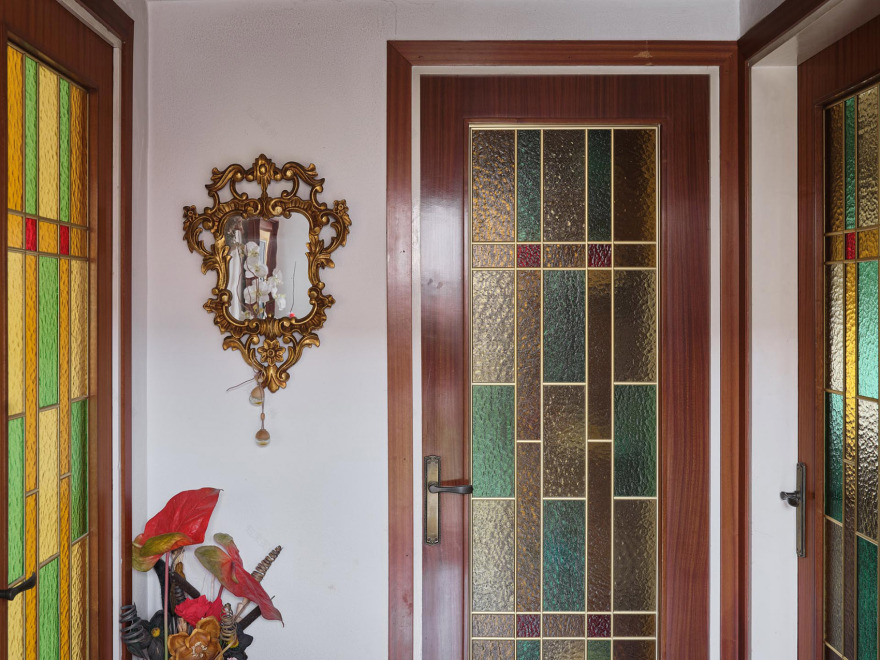
▼天花板上家具原主人的家,home of the original owner of the furniture on the ceiling ©Adrià Goula


▼饱含主人记忆的家具陈列,furniture display full of owner’s memories ©Adrià Goula


通过将日常物件置入空旷无物的建筑空间中,艺术家构建出一条水平线般的视觉引导装置,在象征意义上分割了上下两个世界:天与地、白色地面与洞石天花、水面与云毯、实与虚。某种意义上,这是一种短暂却对称的“重居”行为,使物件得以栖居于密斯馆之中。
Through the juxtaposition of everyday objects within an empty and bare space, a composition is created that guides the gaze along a horizontal line which symbolically divides the world above and the world below, the sky and the earth, the white floor and the travertine ceiling, water as a porch and clouds as carpet, fullness and emptiness. In short, a temporary relocation to inhabit the Pavilion symmetrically.
▼在象征意义上分割了上下两个世界,a horizontal line which symbolically divides the world above and the world below ©Adrià Goula


本次装置如同一次对比与对照的实验,以隐喻的语言探索生命、死亡、记忆与身份等普世主题。围绕“祖母”这一人物与其家居物件展开的集合体,讲述着一个属于个体、亦属于我们的“家”的故事。
The proposal presents itself as an exercise in comparison and contrast, employing the language of metaphor to explore universal themes such as life, death, memory and identity. A compendium built around the figure of la padrina and the belongings that shaped her domesticity.
▼隐喻探索生命、死亡、记忆与身份等普世主题,the language of metaphor to explore universal themes such as life, death, memory and identity ©Adrià Goula

南京喵熊网络科技有限公司 苏ICP备18050492号-4知末 © 2018—2020 . All photos and trademark graphics are copyrighted by their owners.增值电信业务经营许可证(ICP)苏B2-20201444 苏公网安备 32011302321234号
苏公网安备 32011302321234号客服
消息
收藏
下载
最近