

创作上传
VIP
收藏下载
登录 | 注册有礼
查看完整案例

收藏

下载

分享
城市规划背景
Urban-planning situation
20世纪初,柏林的东港(Osthafen)曾是全市规模最大的工业港口之一。为了货物运输与储存,这里沿施普雷河的Stralauer Allee街(位于奥伯鲍姆桥与特雷普托公园之间)兴建了三层行政楼(内设食堂)、仓储及库房建筑,塑造了港区河岸线的景观。如今,这里已被现代办公与住宅建筑所补充完善。媒体、时尚及创意企业纷纷在“MediaSpree”周边落户,将这一独特地段纳入版图。
At the beginning of the 20th century Berlin’s Osthafen (East Harbour) was one of the largest industrial harbours in the city. Intended for transportation and storage of goods, a three-storey administration building with a canteen and storage buildings and warehouses shaped the Spree embankment along Stralauer Allee between Oberbaumbruecke (Oberbaum Bridge) and Treptower Park. Today the picture is completed by modern office and residential buildings. Media, fashion, and creative firms have discovered this exclusive area around the ‘MediaSpree’ for themselves.
▼城市环境,urban environment© HG Esch

2000年代初,TCHOBAN VOSS Architekten为东港片区的新建与改造制定了总体规划,将历史建筑融入其中。TCHOBAN VOSS先后完成了nhow Berlin酒店(其铝板反光悬挑体映射施普雷河波光)以及可口可乐总部大楼和“The White”住宅楼(造型让人联想到邮轮与游艇)。
In the early 2000s,TCHOBAN VOSS Architekten set out a master plan for new construction and further development of the Osthafen area, incorporating the historical buildings. TCHOBAN VOSS oversaw the construction of the hotel nhow Berlin – notable for its highly reflective, aluminium-clad cantilever mirroring the glittering water of the Spree – along with a striking headquarters building for Coca-Cola and The White, a dynamic residential building whose architecture evokes associations with cruise ships and yachts.
▼项目概览,overall of the project© HG Esch


▼沿河立面,facade along the river© HG Esch
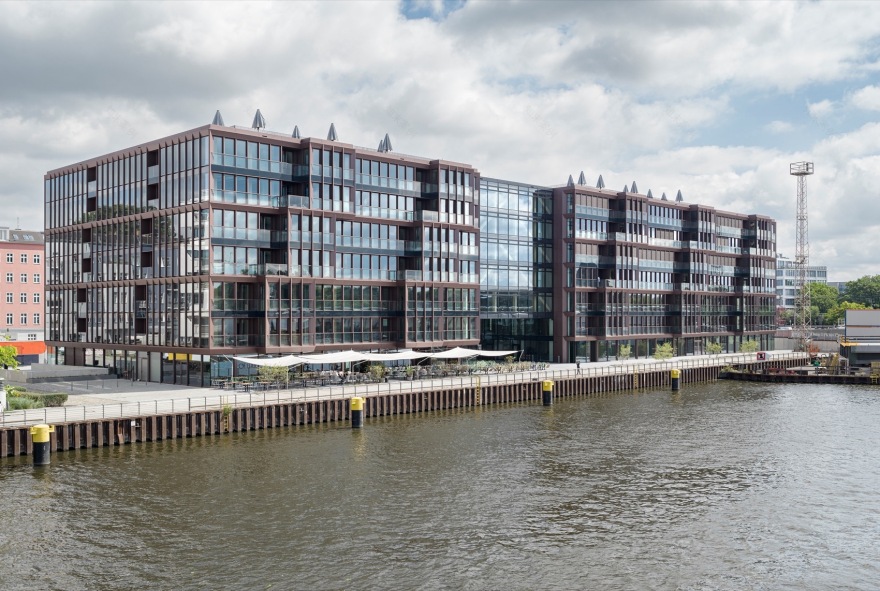
该区域最东端的地块——位于Stralauer Allee 15-16、面积13,400平方米——在Dockyard项目启动前还是唯一的未开发用地。如今,这里建成了一座采用混合木结构的现代七层办公综合体,并配有地下停车场,兼顾可持续性与节能节材。东港最东端的新建筑与其西邻的高度差呼应了西端沿岸较高的历史建筑群——包括老蛋品冷库、受保护的“Spreespeicher”仓储楼及nhow Berlin音乐与生活方式酒店。
The eastern end of this area consists of what was, until the start of the Dockyard project, the last undeveloped plot (Stralauer Allee 15-16) with an area of 13,400 sqm. Here a modern seven-storey office complex with underground parking has been built using the hybrid timber method of sustainable and climate- and resourcefriendly construction. The way that the building at the east end of the East Harbour area rises slightly above its neighbour corresponds with the slightly higher buildings at the west end of the promenade – the historical egg cold-storage warehouse, the listed ‘Spreespeicher’ (Spree storage building), and the nhow Berlin music and lifestyle hotel.
▼沿河立面,facade along the river© HG Esch


建筑设计与施工
Construction
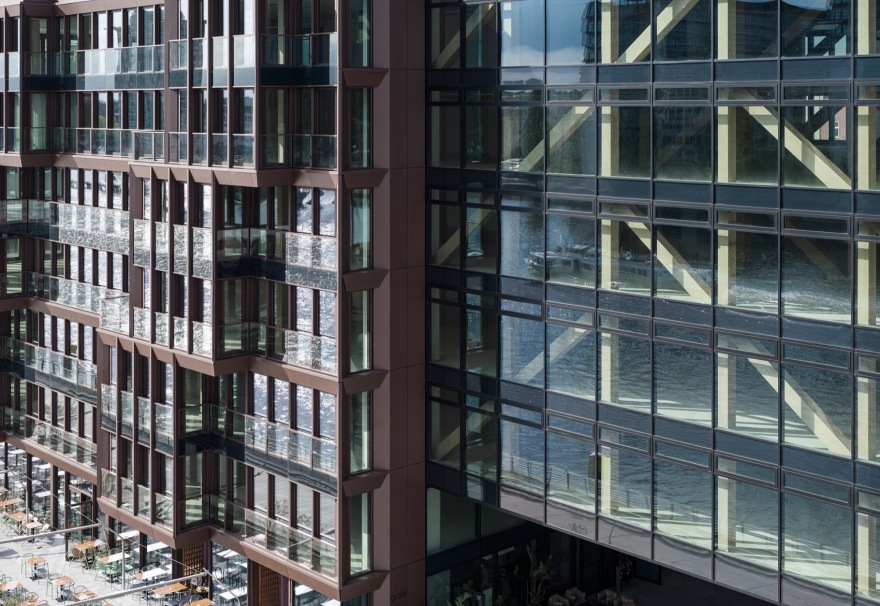
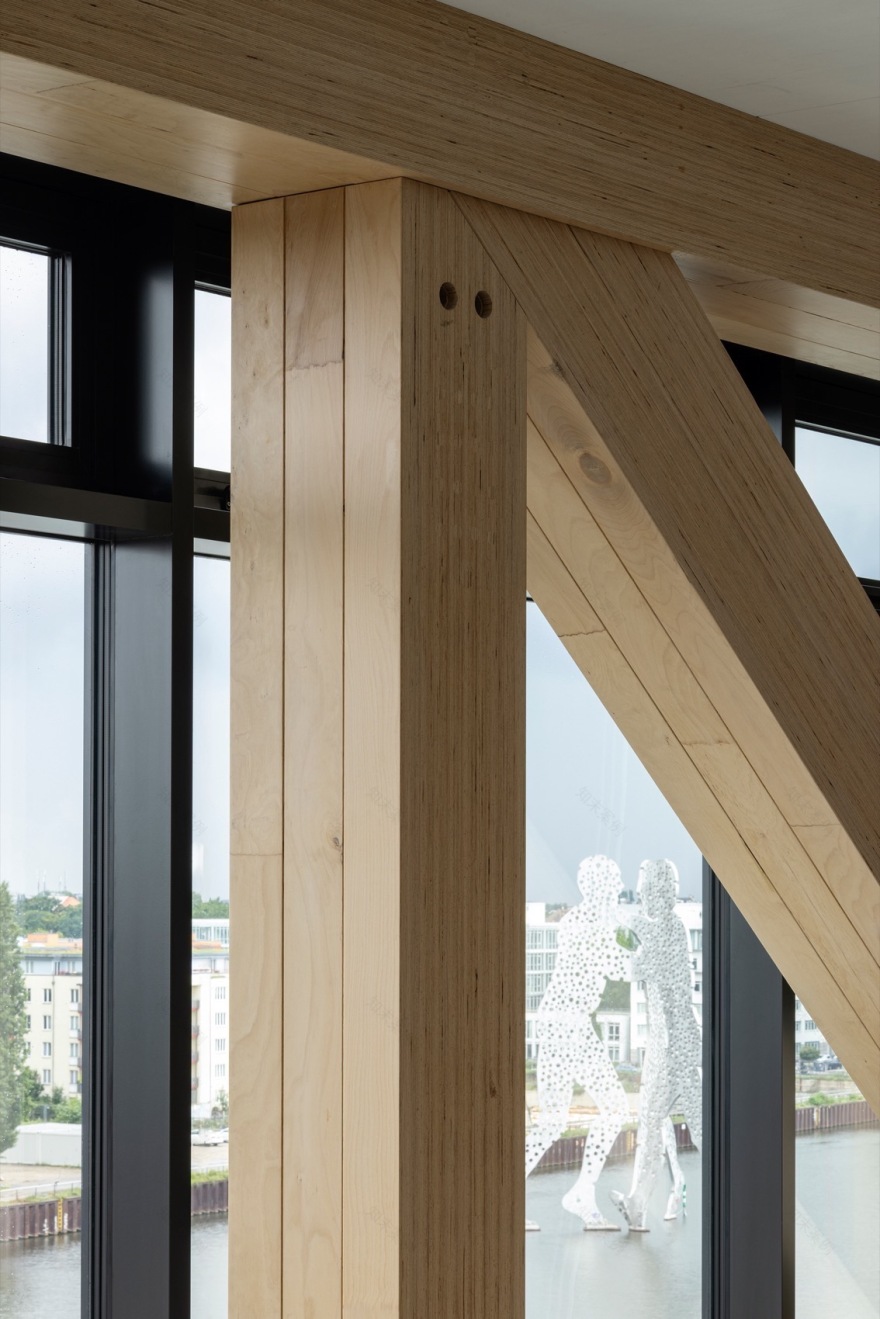
Dockyard项目由一座方形与一座长方形建筑组成,中间以一条玻璃连廊相接,连廊内可见由可持续榉木打造的桁架结构。连廊底部两层为空旷无柱的开放通道,一侧可眺望克罗伊茨贝格方向的施普雷河景,另一侧则望向Stralauer Allee的历史街区。通道天花覆有缟玛瑙黑色镜面不锈钢板,映射出流动反射——向滨水区地理位置致敬。
The Dockyard project comprises a square and a rectangular building, between which is a glazed linking structure with visible trusswork made from sustainable construction beech. The bottom two storeys of the linking structure function as an open, pillar-free passageway allowing views of the Spree in the direction of Kreuzberg on one side and of the historical development on Stralauer Allee on the other. The ceiling of the passageway is fitted with mirrored stainless steel sheets in Onyx Black, which create flowing reflections – a tribute to the location of the ensemble directly on the water.
▼滨水区,waterfront© HG Esch


▼街景,street view© HG Esch

建筑主体为可持续混合木承重结构,将木材与混凝土优势结合。Dockyard采用框架结构,以实现最大化的空间灵活性。在两栋主楼中,从一层以上(含一层)起,楼板均为木-混凝土组合结构;在连廊部分,则从二层至六层采用该结构。混合楼板区域使用了DELTABEAM® Green组合梁。五层连廊部分完全无需钢梁承重,斜向桁架布局为不同区域之间形成了通道。地下室与首层的楼板则全部为钢筋混凝土。
The sustainable hybrid-timber load-bearing structure, a well-thought-out combination of timber and concrete, makes optimal use of the advantages of both materials. The Dockyard project was designed as a skeleton frame for maximally flexible use of space. The ceilings are a timber-concrete composite structure from the first floor upwards in the two main parts of the building and from the second to the sixth floors in the linking structure. DELTABEAM® Green composite beams were used in the area of the hybrid ceilings. The load-bearing structure of the five-storey link manages entirely without steel beams. The diagonal trusses are positioned to create passageways between the individual areas. The ceilings of the basement and ground floor are entirely of reinforced concrete.
▼街景,street view© HG Esch

▼外观,exterior view© HG Esch

▼外观,exterior view© HG Esch


屋顶进行了大面积绿化。两栋楼的屋顶均设有带座椅的观景露台,可眺望克罗伊茨贝格Wrangelkiez社区方向的施普雷河景。两处露台由一座跨越连廊的步桥连接,可通过楼梯或两部无障碍玻璃电梯抵达。两栋楼的底层入口均为三层通高门廊,最高净高达6.90米,使部分双层挑空的大堂开阔明亮、气势十足。主入口位于北侧、面向Stralauer Allee。水平交通通过两处楼梯核心与无障碍电梯实现。地下室为停车场,总共81个车位,其中9个为无障碍车位;所有车位均配备电动充电桩。
The roofs have been extensively planted with greenery. On both parts of the building roof terraces with seating offer panoramic views of the Spree in the direction of the Wrangelkiez (Wrangel neighbourhood) in Kreuzberg. The two roof terraces are linked by a footbridge above the bridging structure. Access to them is by a staircase or, for barrier-free access, by two glass elevators. Both parts of the building have their own ground-floor entrances in the form of three-storey portals. A clear height of up to 6.90 metres makes the partly two-storey lobbies bright and immediately impressive. Entrance to the buildings is from the north side of the complex, which faces Stralauer Allee. Horizontal access is via two staircase cores and barrier-free elevators. The basement contains an underground car park with a total of 81 parking spaces, of which nine are barrier-free. Electric charging stations are provided for all parking places.
▼屋顶进行了大面积绿化,the roofs have been extensively planted with greenery© HG Esch


▼连廊灰空间,gray space© HG Esch


▼镜面,mirror© HG Esch

立面设计
Façade design
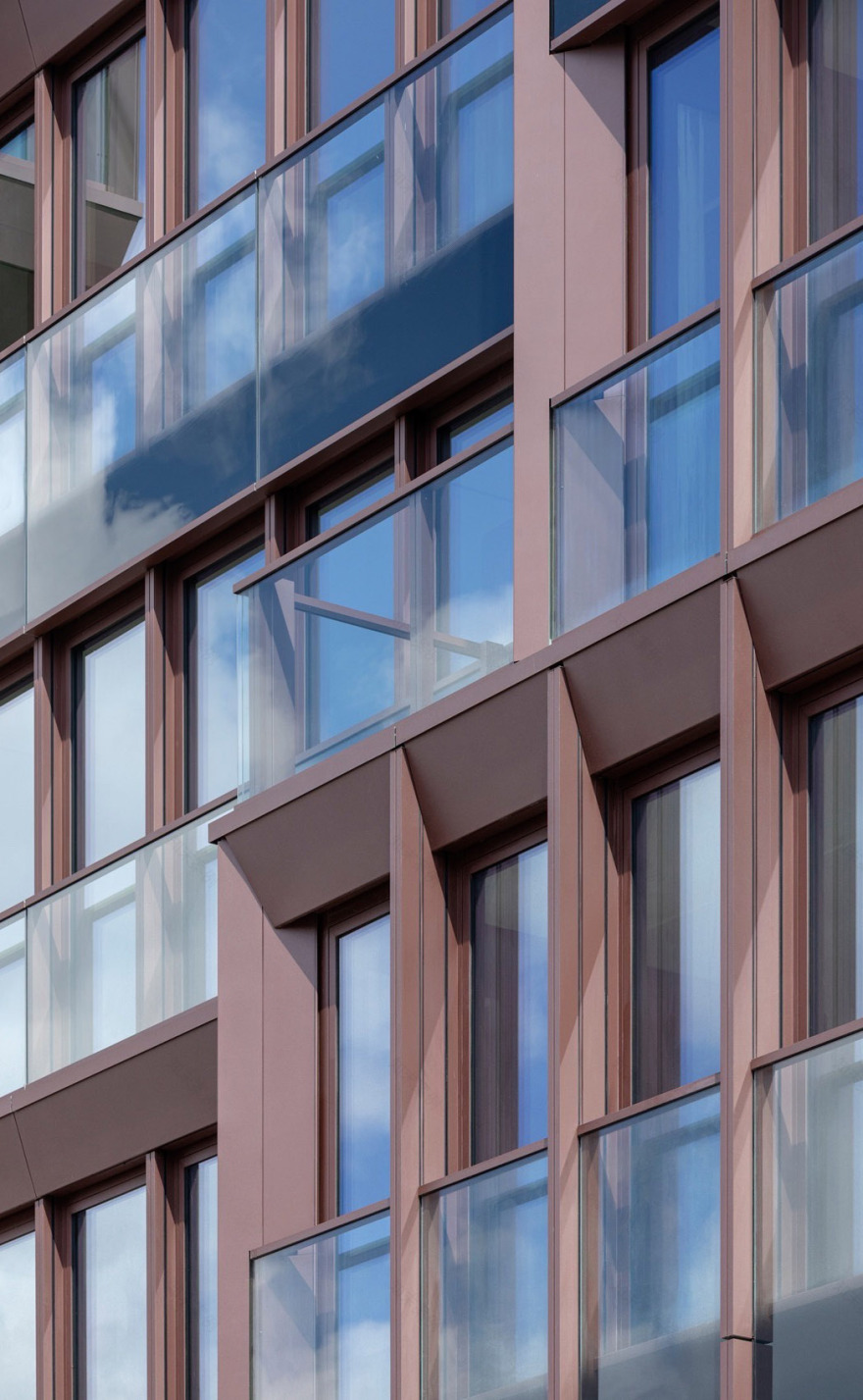
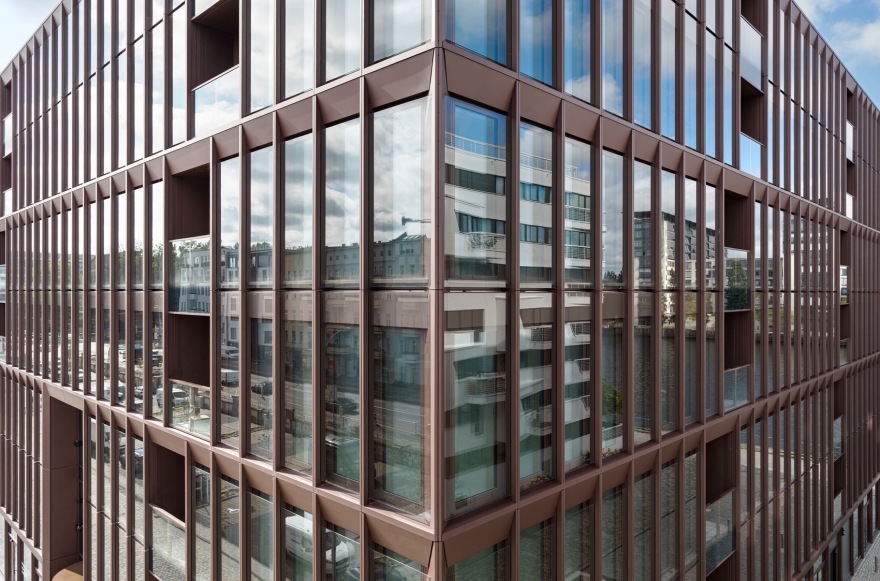
一至六层的主立面采用单元式玻璃幕墙,并以双层高度的檐口与壁柱条形成网格划分。大面积玻璃保证了室内充足采光,以弥补建筑进深对自然光的影响,从而最大限度减少人工照明的使用。朝南、面向施普雷河的立面通过每隔两层错位布置的凸窗来分隔,并支撑外伸阳台。西、北、东三侧的玻璃立面则设有部分内凹的廊台,同样以两层为一个错位节奏。非透明立面部分覆以悬挂式折叠铝板,使立面表情更具层次。一至六层办公楼层的立面在每两层处设有连续的水平檐口分隔;竖向壁柱条则沿每一伸缩轴布置。连廊部分采用大规格竖框横梁玻璃幕墙,在楼板与建筑侧面交接处配置了印花玻璃面板。
The main façades from the first to the sixth floors are glass unitized façades with a two-storey grid of cornices and pilaster strips. The extensive glass surfaces ensure optimal illumination to compensate for the building’s depth and thus minimize the use of artificial lighting. The south façades overlooking the Spree are articulated by projecting bay windows that are offset every two floors and support balconies. The glass façades on the west, north, and east sides have partly recessed loggias, which are likewise offset every two floors. The opaque façade surfaces are clad with suspended, folded aluminium sheets, additionally articulating the façades. The façades of the first to sixth office storeys are horizontally divided by continuous cornices every two floors. Vertical pilaster 3 / 4 strips run along each expansion axis. The façades of the bridging structure have large-format mullion-transom glazing. There are printed glass panels where the ceilings touch the sides of the building.
▼立面,facade© HG Esch

▼上部立面,facade of upper part© HG Esch

▼立面细部,details of the facade© HG Esch


▼立面细部,details of the facade© HG Esch


功能布局
Use
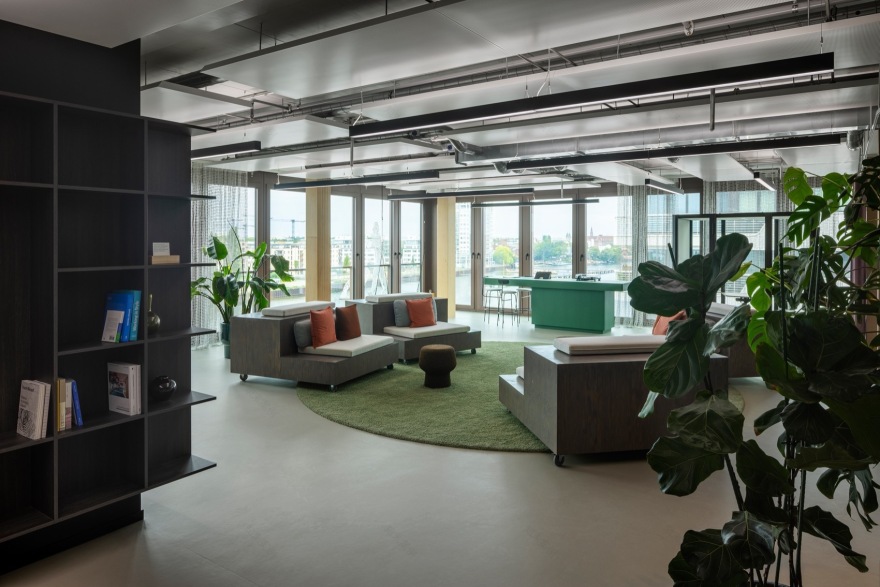
两栋建筑均用于办公功能,办公区位于一至六层。所选平面模数允许将开放式空间灵活划分为小型独立办公室或大开间办公区,以满足不同需求,完全符合当代办公建筑标准。西楼底层将设餐饮区,东楼底层则为会议区,配备可灵活调整的研讨空间。沿施普雷河滨步道一侧,还规划了带座椅的绿化户外空间,营造开放而宜人的交流环境。
Both parts of the building are intended for use as office spaces. The office areas are on the first to the sixth floors. The layout grid selected allows the open space area to be flexibly divided into individual small offices or openplan offices to suit specific needs; it meets all the requirements for a contemporary office building. The ground floor of the west office building will additionally contain catering areas, while the ground floor of the east office building will have a conference area with flexible seminar spaces. Also planned are invitingly greened outside areas with seating overlooking the promenade along the Spree.
▼接待台,reception© HG Esch

▼大厅,lobby© HG Esch

室内与艺术
Interior and art
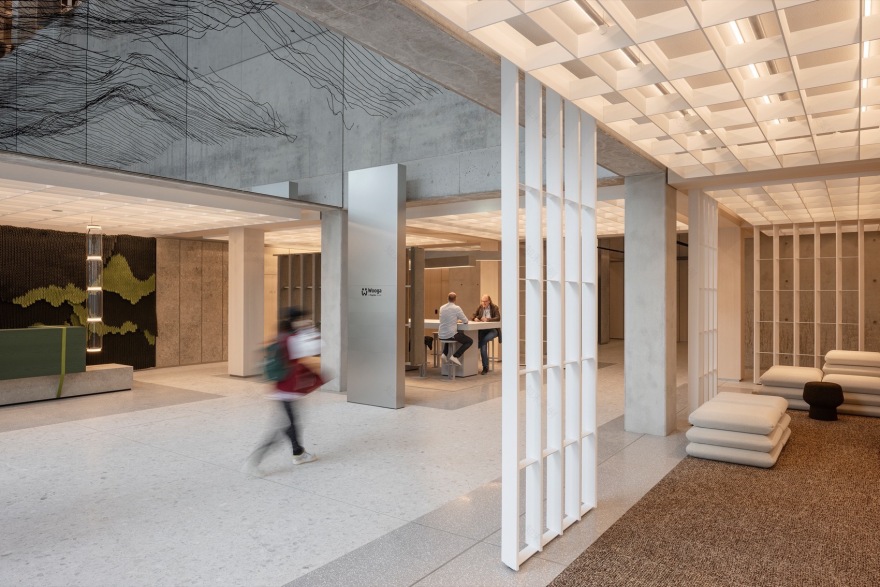
大堂、营销展示区及导视系统由 Ippolito Fleitz Group 设计。大堂天花下的艺术装置由 Julius von Bismarck 创作,名为 “Die Luft muss man sich wegdenken”(意为“必须将空气从想象中移除”)。前台背后的尼龙艺术装置由韩国艺术家 Kwangho Lee 制作。建筑群外的“变压器楼”(Transformator House)墙面上还展示了艺术家 Katrin Bremermann 的图形作品。
The lobbies, the marketings suite and the signage system were designed by Ippolito Fleitz Group. The art installation under the ceilings of the lobbies was created by Julius von Bismarck and is entitled ‘Die Luft muss man sich wegdenken’ (‘One Must Think Away the Air’). The nylon art objects behind the reception desks are made by the Korean artist Kwangho Lee. Another work of art can be found on the walls of the Transformator House outside the building complex, a graphic by Katrin Bremermann.
▼电梯厅,elevator hall© HG Esch

▼电梯厅,elevator hall© HG Esch


▼办公空间,office area© HG Esch
可持续性
Sustainability
在规划阶段,减少CO₂排放以应对气候变化是业主与建筑师共同关注的重点。通过在项目早期即选择可持续材料,实现了CO₂的节约。柱、桁架及楼板中使用木材,帮助Dockyard优化其生态足迹。桁架与梁所用的结构榉木取自可持续林业的本地原材料,并获得PEFC认证。其重量比钢筋混凝土轻66%,且具备卓越的CO₂储存能力——据制造商数据,每立方米可储存1,171公斤CO₂。楼板采用由PEFC认证的软木(以云杉为主)制成的交叉层压木(CLT)。与实心结构类似,CLT与钢筋混凝土结合后可承受高荷载,并具有隔音与隔热效果,同时具备防火性能。木构件在工厂预制成系统组件,便于快速安装。木材不仅可储存CO₂,还是一种气候中性的建材;此外,其透湿性使其可根据季节隔热或蓄热,从而营造舒适的室内环境,无需额外防潮层。
The fight against climate change through reduction of CO₂ emissions was during planning a focus of attention for both the client and the architects. Selection of sustainable materials made it possible to save CO₂ at an early stage in the project. The use of timber in the columns, trusses, and ceilings helps Dockyard optimize its ecological footprint. The construction beech used in trusses and beams utilizes regional raw materials from sustainable forestry and is PEFC-certified. It weighs 66% less than reinforced concrete and has outstanding CO₂-storage capability – 1.171 kg CO₂ per cbm, according to its manufacturer. The ceilings use cross-laminated timber (CLT) made from PEFCcertified softwood (mainly spruce). Like solid types of construction, the CLT in its combination with reinforced concrete can bear high loads, has an acoustic- and thermal-insulating effect, and is firesafe. The timber elements were prefabricated as system components and can therefore be installed quickly. Wood stores CO₂ and is a climate-neutral building material. In addition, it has vapour-permeable qualities and contributes to a comfortable indoor climate because heat is insulated or stored depending on the time of year and there is no need for additional vapour barriers.
▼木结构,wooden structure© HG Esch


混合结构充分利用所用材料的能源优势,例如再生混凝土。混凝土因其高热容量,在夏季升温缓慢,从而减少制冷能耗;而当混凝土被更可持续的材料替代时,低CO₂排放进一步改善了生态平衡。所用的DELTA BEAM® Green复合梁超过95%由再生钢制成,项目共使用了800吨“绿色”钢材。建筑的可持续性不仅在于其建造,还取决于其运行是否可持续。为在不使用化石燃料的情况下实现运营净零排放,Dockyard依赖太阳能、地热及环境空气等绿色可再生能源。其中,德国最大冰蓄能系统之一是其综合能源方案中的核心且高效部分。
The hybrid construction utilises the energy benefits of the materials used, such as recycled concrete. Due to its high thermal mass, concrete heats up only slowly during the summer months – which reduces the energy needed for cooling the building. And where concrete has been replaced with this markedly more sustainable material, there is an improved ecological balance thanks to low CO₂ emissions. The DELTABEAM® Green compound beams are more than 95% made of recycled steel. Altogether, 800 tonnes of ‘green’ steel were used. A building is only sustainable if its operation is also sustainable. To achieve net-zero operation without the use of fossil fuels, Dockyard relies for its energy supply on green, regenerative energy sources such as solar, geothermal, and ambient air. One of the largest ice stores in Germany is a central and efficient part in this integrated energy concept.
▼电梯,elevator© HG Esch

▼设备,equipment© HG Esch


这一系统利用了Osthafen废弃的货运隧道,保留了其“灰色能源”,并通过功能转化对建筑的生态与能源平衡作出积极贡献。水在结冰时释放能量,这一容量达160万升的冰罐可在冬季供暖、夏季制冷,并存储多余热量,甚至全年供应生活热水。Dockyard屋顶设有1,250平方米的太阳能混合集热器与300平方米的光伏组件,用于发电与供热。所发电力还可为建筑的冷热循环提供能量以驱动热泵。多种能源形式的结合,形成了创新的能源体系,使这一办公综合体的整体运营符合LEED Zero Carbon的气候中性要求。
For this one of Osthafen’s disused freight tunnels has been put to good use. The preservation of grey energy through the tunnel’s conversion to a new function makes a positive contribution to the building’s ecological and energy balance. Water releases energy as it freezes. The 1.6-million-litre ice container can accordingly be used in winter for heating and in summer for cooling the building and as temporary storage for excess building heat. Hot water can even be produced the whole year round. On the roof of Dockyard, there are 1,250 sqm of solar hybrid collectors and 300 sqm of photovoltaic modules, which are used not only to generate heat but also electricity. The electricity generated is, among other things, used in the building’s heating and cooling circuit to operate the heat pumps. The combination of all these sources results in an innovative energy concept which keeps the entire operation of this office facility climate-neutral in accordance with requirements for LEED Zero Carbon.
▼太阳能电池板,solar panel© HG Esch

认证
Certifications
该项目已获得WiredScore铂金级认证,正在申请LEED铂金级认证,同时LEED Zero Carbon、BEG 55 EE与Well铂金级认证也在筹备中。
The project is WiredScore Platinum certified. LEED Platinum certification is being sought, and LEED Zero Carbon, BEG 55 EE and Well Platinum are also in preparation.
▼草图,sketch©TCHOBAN VOSS Architekten

▼总平面图,master plan©TCHOBAN VOSS Architekten

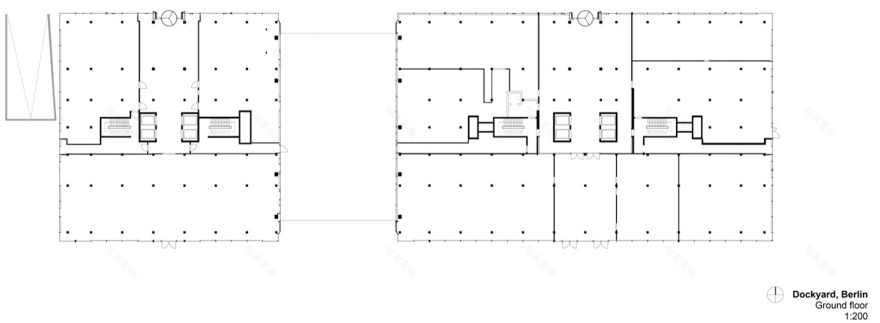
▼底层平面图,ground floor plan©TCHOBAN VOSS Architekten
▼标准层平面图,regular floor plan©TCHOBAN VOSS Architekten

▼屋顶平面图,roof plan©TCHOBAN VOSS Architekten
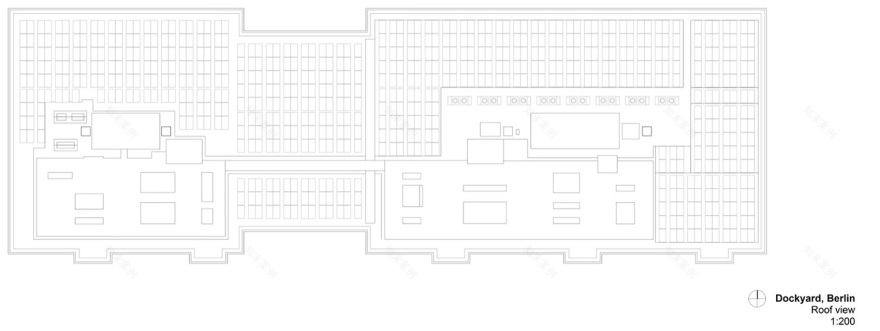
▼立面图,elevations©TCHOBAN VOSS Architekten

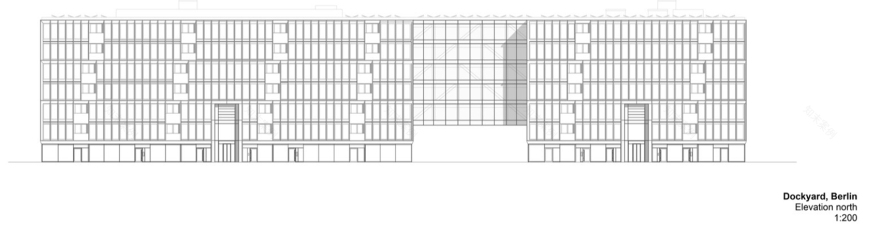
▼剖面图,sections©TCHOBAN VOSS Architekten


Address: Stralauer Allee 15-16, 10245 Berlin
Developer: PECAN Development, Berlin
Plot size: 13,400 sqm
Building footprint: 5,100 sqm
Gross floor area: 32,141 sqm
Building volume: 140,000 cbm
SOI: 0.36
FSI: 2.39
Completion: July 2025
Service stages: 1-5
Architect: Sergei Tchoban
Project partner: Axel Binder
Team: Valeria Kashirina, Agustina Pascotto, Alina Safiullina, Fabiana Pedretti, Giorgi Mjavanadze, Maximilian Pauen, Teymur Osmanov, Anna Okorokova, Severin Burr, Lev Chestakov, René Hoch
General contractor: hagenauer GmbH, Immenstadt
Static engineering: service stages 1-5: Bollinger + Grohmann Ingenieure, Frankfurt am Main
Static engineering (timber framework): LP 5: SJB Kempter Fitze AG, Frauenfeld, Switzerland
Structural physics: Krebs + Kiefer Ingenieure GmbH, Dresden
Interior design (lobbies, marketing suite) and signage system: Ippolito Fleitz Group GmbH, Stuttgart/Berlin
Façade design: Ingenieurbuero Franke GmbH & Co. KG, Glienicke
Fire safety: pde Integrale Planung GmbH, Berlin
Fire-safety inspector: Dr. Ing. Huismann, Krebs + Kiefer Ingenieure GmbH, Berlin
Hybrid timber structures: ELiTE Holzbau GmbH, Herzfelde
Construction beech: Pollmeier Massivholz GmbH & Co. KG, Amt Creuzburg Glass facade, windows, doors, sun protection: Metallbau Windeck GmbH, Kloster Lehnin District Rietz
Timber (CLT: Cross-laminated Timber): Binderholz Deutschland Vertriebs GmbH, Oberrot DELTABEAM® composite beams: Peikko Deutschland GmbH, Waldeck
LEED-Certification: Hoinka GmbH, Sindelfingen
Art installation (lobbies): Die Luft muss man sich wegdenken (One Must Think Away the Air), 2025, Julius von Bismarck, Berlin
Nylon wire art object (lobbies): Obsession Series, 2025, Kwangho Lee, Seoul
Graphic art (Transformer-House): Katrin Bremermann, Berlin
Photographer: HG Esch
南京喵熊网络科技有限公司 苏ICP备18050492号-4知末 © 2018—2020 . All photos and trademark graphics are copyrighted by their owners.增值电信业务经营许可证(ICP)苏B2-20201444 苏公网安备 32011302321234号
苏公网安备 32011302321234号客服
消息
收藏
下载
最近