

创作上传
VIP
收藏下载
登录 | 注册有礼
查看完整案例

收藏

下载

分享
这座928平方英尺的景观亭坐落在奥斯汀市中心附近的水域之上。项目位于一片距离周边社区约50英尺的悬崖底部,对岸是一片自然保护区。项目四周环绕着河岸边的大树,而这片僻静的水道仅能由独木舟和皮划艇通行。
Nestled across the water from a nature preserve, this 928-square-foot project sits just minutes from downtown Austin. At the bottom of a bluff, fifty feet below the surrounding neighborhood, the project is sheltered by large trees along the secluded waterway that is only navigable by canoes and kayaks.
▼项目概览,the overview of the project © Leonid Furmansky

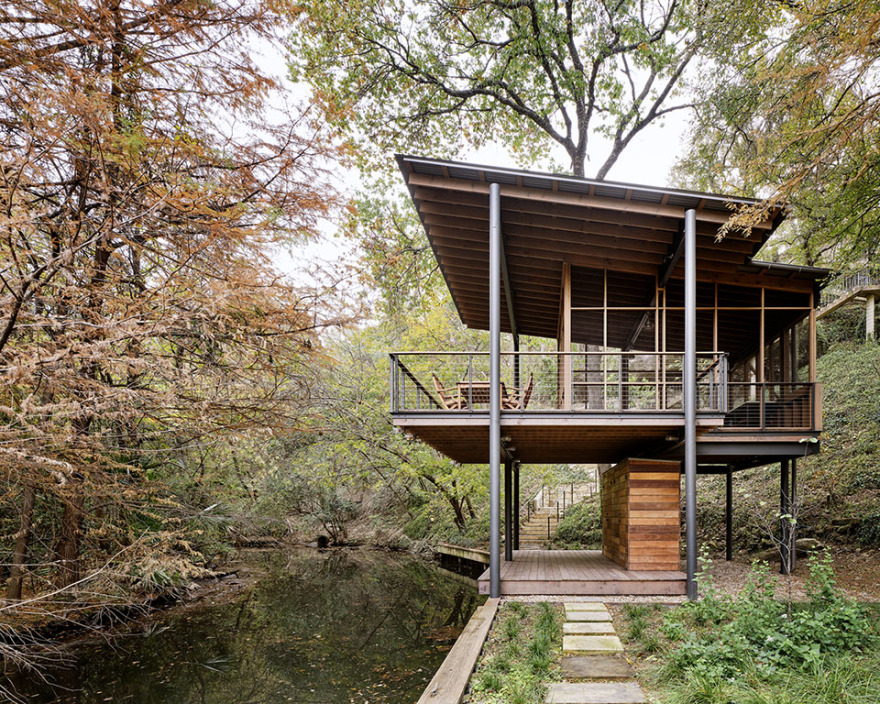
前往景观亭需要沿着一条长长的楼梯而下,途经天然石洞,最终进入湿地栖息地。项目设计理念是打造一处高架平台,让业主能够真正置身于自然之中:平台漂浮于水面之上,可眺望树间景致与湿地溪流。带纱网的门廊为休闲与观鸟提供了受保护的空间,平台下方的区域则作为船只下水处,方便通向岸边。该项目的结构在不增加任何额外占地的前提下,扩展了业主住宅的生活空间。
Reaching the site is a journey descending an extensive staircase passing through a natural stone grotto down into the wetland habitat. Conceived as an elevated platform to allow the owners to inhabit nature; the platform floats over the water providing views into the trees and down the slough. While the screened porch is a protected space for lounging and birdwatching, the area below the platform serves as a boat launch and provides access to the shoreline. The structure expands the living area of the Owner’s home without adding any additional conditioned square footage.
▼二层平台空间,the higher-level deck space © Leonid Furmansky


该场地充满挑战。由于项目位于环境敏感的湿地,仅能通过小船或狭长且陡峭的楼梯抵达,而楼梯并不适合作为施工通道。为了减少对湿地的影响,设计团队制定了策略:将可驻留空间抬升至二层,并通过桥梁进入。这既减少了地面层的施工量,也让到访者者获得一个观察当地动植物的制高点。新结构甚至在夜晚成为了猫头鹰在水边捕猎时的栖息地。
The site presented many challenges. The project sits on an environmentally sensitive wetland that is only accessible by small boat or via a long tight staircase that was unsuitable for construction access. To decrease the impact on the wetlands the design team developed a strategy to lift the habitable spaces of the project to a second level and provide access via bridge. This minimized construction at the ground plane while giving the occupants a perch from which to observe local flora and fauna. The new structure has even become a roost for owls in the evening as they hunt along the water’s edge.
▼桥梁,the bridge © Leonid Furmansky

▼桥梁鸟瞰,aerial view of the bridge © Shane Lynham

▼狭长且陡峭的楼梯,a long tight staircase © Shane Lynham

除了提供舒适的观鸟高台,业主还希望建筑坚固耐用、具备韧性。此前场地上的原有建筑曾遭遇洪水:在长时间降雨期间,这一带的湿地溪流容易泛滥。业主希望新建筑能承受不可避免的洪水侵袭,并且最大限度减少对周边栖息地与生态系统的影响。为此,业主要求设计团队提出一种与场地和谐共生、在最终设计与施工方法上都能将影响降至最低的方案。项目目标包括缩小占地面积、降低对水道的干扰,并通过重复利用现有的钢桩上部结构来减少施工影响。
In addition to a comfortable perch for birdwatching, the owners desired a durable and resilient structure. The previous structure on the site had experienced flooding, common along the slough during long periods of rain. The Owners wanted to build a structure that would be able to withstand the inevitable flooding and that had a minimal impact on the habitat and ecosystems of the surrounding site. The owner challenged the design team to develop a design that would exist in harmony with the site and minimize its impact in terms of the final design and construction methods. Project goals included reducing the footprint, minimizing the impact on the waterway, and limiting construction impacts by re-using the existing superstructure of steel piers.
▼与场地和谐共生,exist in harmony with the site © Leonid Furmansky


最大的设计挑战在于如何在尽量减少场地干扰的前提下,利用并重新诠释现有结构,同时满足业主目标,并让新建筑与自然环境融为一体。通过利用并延伸原有桩基,设计团队为二层木结构搭建了框架。材料与饰面既需具备应对洪水的耐候性,又要营造轻盈通透、可融入环境的空间。所有材料必须通过小型驳船运送至场地,这更凸显了选择耐用材料以及采用永续、稳健的设计与建造策略的重要性。下层平台的占地极小,使本地植被得以重新占据湿地区域。取代原有建筑的新的架高码头,也促成了自然水文的恢复。
The biggest design challenge was taking the existing structure and reappropriating it to minimize site impacts while meeting the owners’ goals in a cohesive design that integrates into its natural setting. By using and extending the existing piers, a framework for the secondary wood structure was created. Materials and finishes were chosen to not only be resilient in flooding situations, a program requirement, but to create a light airy structure that dissolves into its environment. All materials had to be brought to the site via a small barge, emphasizing the importance of not only durable materials but also timeless and resilient design & construction strategies. The minimal area of the lower-level deck allows native plantings to reclaim the natural wetland area. The replacement of the existing structure with this new elevated dock has also allowed for the restoration of natural hydrology.
▼占地极小的下层平台,minimal area of the lower-level deck © Leonid Furmansky


▼一层平面图,lower floor plan © Leonid Furmansky

▼二层平面图,upper floor plan © Leonid Furmansky

▼剖面图,section plan © Leonid Furmansky

FKA design team
Troy Miller, Principal
Philip Keil, Principal
Gary Furman, Principal
Maanasa Nathan, Project Manager
Dawson Williams, Project Manager
Project Team
Architecture: Furman & Keil Architects
Contractor: Crowell Builders
Landscape: Word + Carr Design Group
Permit Consultant: Rick Rasberry of Lake Austin Boat Dock & Shoreline Permits
Structural Engineer: Duffy Engineering
Lighting: Studio Lumina
Photography
Leonid Furmansky
Brands / Products
1.Ceiling Fans: Modern Fan. Co.
2.Cladding/Decking: Ipe
3.Flooring/Roofing: Douglas fir
4.Door Hardware: Baldwin
5.Lighting Control: Lutron
6.Paints/Stains: Benjamin Moore Arbor Coat, Sherwin-Williams
7.Pavers: Lueders limestone
8.Refrigerator: Summit
南京喵熊网络科技有限公司 苏ICP备18050492号-4知末 © 2018—2020 . All photos and trademark graphics are copyrighted by their owners.增值电信业务经营许可证(ICP)苏B2-20201444 苏公网安备 32011302321234号
苏公网安备 32011302321234号客服
消息
收藏
下载
最近