

创作上传
VIP
收藏下载
登录 | 注册有礼
查看完整案例

收藏

下载

分享
位于墨西哥城西缘的 INFONAVIT Santa Fe住宅区,由 AMASA Estudio负责的项目,是2024年一系列改造行动中所面对的最复杂场景之一。该住宅区具有特殊条件:因建于峡谷地带,建筑坐落在陡峭的地形上,显著的高差严重阻碍了连通性与可达性。
Located on the western edge of Mexico City, the project developed by AMASA Estudio in the INFONAVIT Santa Fe Housing Complex faced one of the most complex contexts among the series of interventions carried out in 2024. This housing complex presents a particular condition: having been built over a ravine area, the buildings are set on steep topography, with significant elevation changes that hinder both connectivity and accessibility.
▼项目鸟瞰,Aerial view of the project©Zaickz Moz
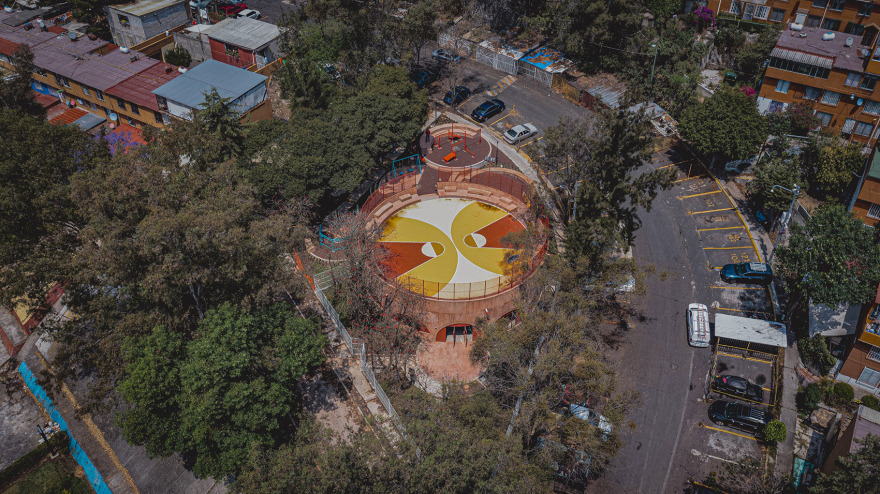
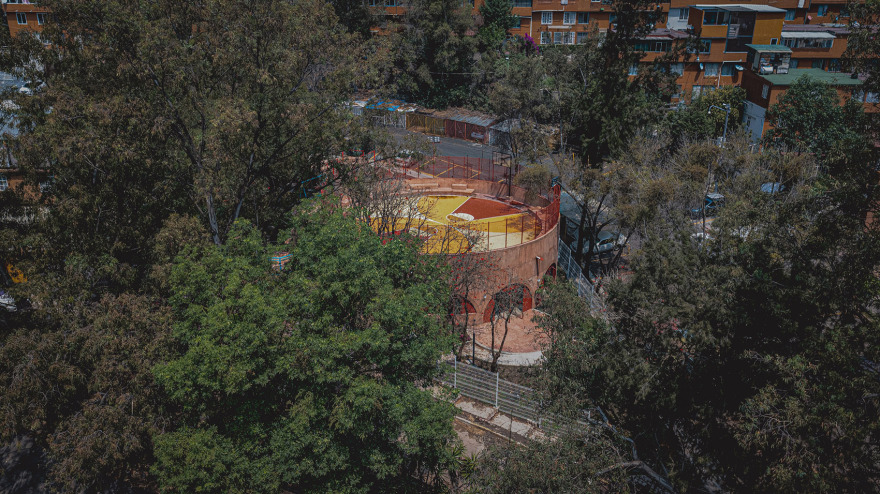
本次改造场地位于住宅区南缘,两条不同标高的街道在此交汇。场地呈三角形,宛如一块“剩余角落”,并与一处位于六米以下的公共体育中心相邻,由此界定了一个格外复杂的地块。加之该地长期处于弃置状态,形成了一个极易受侵害的环境,表现为物理损坏、邻里使用受限,以及愈加严重的不安全感。
The intervention area is located on the southern edge of the housing complex, at the meeting point of two streets at different levels. Its triangular shape—resembling a leftover corner—and its adjacency to a public sports center —which sits more than six meters below— define a particularly complex site. This condition, combined with the site’s historic abandonment, created a highly vulnerable environment marked by physical deterioration, limited neighborhood use, and a heightened perception of insecurity.
▼项目鸟瞰,Aerial view of the project©Gerardo Reyes Bustamante

被改造的具体空间曾是一片破败的篮球场。其地势破碎、出入困难,基础设施陈旧,几乎无人使用。同时,来自外部人群的持续通行——他们通过一条连接东西两端的重要街道穿行此地——进一步强化了风险感,尤其是在夜间。面对这一局面,INFONAVIT委托展开全面的改造计划。方案包括建设一座230平方米的多功能厅,修复几近废弃的儿童游乐区,新增一处街健运动区,并重建尚有零星使用的运动场。
The specific space that was intervened had previously been occupied by a deteriorated basketball court. It sat on fragmented terrain, was difficult to access, and had obsolete infrastructure. Its use was virtually nonexistent, and the constant flow of people from outside the housing complex—coming from a street that connects two key points from east to west—reinforced the sense of risk, particularly at night. In response to this scenario, INFONAVIT commissioned a comprehensive intervention to recover the area. The plan included the construction of a 230 m² multipurpose hall, the rehabilitation of nearly dismantled children’s play areas, the addition of a calisthenics zone, and the restoration of the sports court, which remained the only space still in occasional use.
▼项目鸟瞰,Aerial view of the project©Gerardo Reyes Bustamante

地形条件带来了一系列显著的技术挑战:雨水径流引导不畅、频繁滑坡、低洼地段积水与淤泥,以及大量不允许砍伐的植被。场地被桉树、松树和火焰木环绕,其保留情况直接制约了新设施的布局与设计。此外,原有的篮球场建在压实不良的填土之上,缺乏排水系统,导致混凝土板开裂、边坡不稳,进而影响道路和停放车辆的安全。
The site’s topography presented a series of significant technical challenges: poorly channeled rainwater runoff, frequent landslides, water and mud accumulation in lower areas, and abundant vegetation which, fortunately for the design concept, could not be cut down. The site was surrounded by eucalyptus, pine, and colorín trees, whose preservation conditioned the placement and design of the new facilities. Additionally, the original basketball court had been built as a concrete slab over poorly compacted fill and lacked proper drainage infrastructure, resulting in cracks and unstable slopes that affected roadways and parked vehicles.
▼改造后的游乐场,the playground after renovation©Zaickz Moz

在这些约束下,AMASA Estudio提出了一种明确的设计手法:在场地中央置入一个圆形体量,精准顺应地形,同时尽可能保留绿色空间。这一形式策略回应了场地的主要难题。首先,三角形地块和六米的高差几乎无法容纳招标所要求的建筑面积,而不破坏现有植被或影响周边空间功能。
Faced with these constraints, AMASA Estudio proposed a clear gesture: a circular volume located at the center of the site that precisely adapts to the topography while preserving as much green space as possible. This formal strategy addressed the site’s main challenges. First, the triangular shape of the lot and its six - meter slope made it nearly impossible to accommodate the construction area required by the tender without compromising existing vegetation or disrupting the functionality of surrounding spaces.
▼场地中央置入的圆形体量,a circular volume located at the center of the site©Zaickz Moz

若采用常规形态建筑,势必形成视线死角,降低可见性,并迫使流线绕行其外围,因为建筑的角点会触碰场地边界。相比之下,圆形体量不仅保留了树木,减少了建筑占地,还能将建筑功能分布在层叠的露台上,融入景观,并从场地的不同点便捷抵达。从位于场地低处的主入口开始,一条上升的路径串联起多功能厅、游乐区与位于建筑屋顶的新篮球场。该篮球场亦可直接由场地最高处进入,从而加强了空间的连续性与与周边环境的融合。
A regular-shaped building would have created blind corners, reduced visibility, and forced circulation around its perimeter, as the building’s vertices would touch the boundaries of the intervention area. In contrast, the circular form made it possible to preserve the trees, reduce the construction footprint, and distribute the architectural program across staggered terraces, integrated into the landscape and accessible from various points on the site. From the main entrance—located at the lower part of the site—an ascending path connects the multipurpose hall, play areas, and the new basketball court, which sits on the building’s roof. This court can also be accessed directly from the highest point of the site, reinforcing spatial continuity and integration with the surroundings.
▼屋顶的新篮球场,the new basketball court, which sits on the building’s roof ©Zaickz Moz

▼游乐区,the playground©Zaickz Moz

除了技术上的高效性,圆形几何也为场地赋予了新的叙事:区域不再被视作支离破碎的峡谷,而是成为一个连续的螺旋形公园,在其中,建筑与公共空间相互交织。这一设计决策生成了完整的步行流线系统,激发日常使用并强化公共归属感。
Beyond its technical efficiency, the circular geometry also enabled the creation of a new narrative for the site: instead of a fragmented ravine, the area is now perceived as a continuous, spiraling park where architecture and public space intertwine. This design decision generated an integrated pedestrian circulation system that encourages everyday use and collective ownership.
▼形成完整的步行流线系统,generated an integrated pedestrian circulation system©Zaickz Moz


项目最关键的决策之一是调整建筑选址。原本的规划位置上分布着火焰木,这类树木极易因根系扰动而受损。为了避免其消失,团队对场地布置和坡度处理进行了调整。正因这一修改,所有树木得以保留,既有植被自然融入设计。值得注意的是,火焰木为落叶树,其在摄影阶段正处于花期,区域显现“枯干”景象,而后又恢复叶片,符合自然周期。
One of the project’s most significant decisions was the relocation of the building, which was originally planned for an area where colorín trees were found. These trees, highly sensitive to root disturbance, required adjustments in site placement and grading to prevent their loss. Thanks to this modification, no trees were cut down, and the pre-existing vegetation was naturally integrated into the design. It’s worth noting that the colorín trees, being deciduous, were photographed during a flowering stage that gave the area a “dry” appearance—though they later regained their foliage as part of their natural cycle.
▼既有植被自然融入设计,the pre-existing vegetation was naturally integrated into the design©Zaickz Moz

从施工角度来看,这是四个改造项目中最复杂且最昂贵的一个。工程需应对大规模土方作业、顺应坡度的地基处理,以及 2024 年雨季施工的后勤挑战。场地既有的地形与受损的基础设施,使实施难度极大。由于地块位于两条坡道街道交汇处,设计设置了两口渗井,位于地势自然汇水的节点。该方案有效导引并过滤地表径流,缓解了场地长期以来的滑坡与积水问题。值得强调的是,在竣工后,项目顺利经受住了2025年雨季的考验——这是墨西哥城近二十年来最为猛烈的一次——充分验证了设计决策在极端场地与气候条件下的有效性。
From a construction standpoint, this was the most complex and costly of the four interventions, due to the earthworks, foundations adapted to the slope, and logistical challenges of building during the 2024 rainy season. The project was carried out on a site with demanding topography and deteriorated preexisting infrastructure, posing a significant challenge for implementation. Since the lot is located at the intersection of two sloped streets, the design included two absorption wells, strategically placed where the terrain channels rainwater. This solution efficiently directed and filtered surface runoff, mitigating the site’s historical issues with landslides and flooding. It’s worth highlighting that, after completion, the project successfully endured the 2025 rainy season—one of the most intense in Mexico City in the past two decades—confirming the effectiveness of the design decisions under extreme site and weather conditions.
▼既有植被自然融入设计,the pre-existing vegetation was naturally integrated into the design©Zaickz Moz


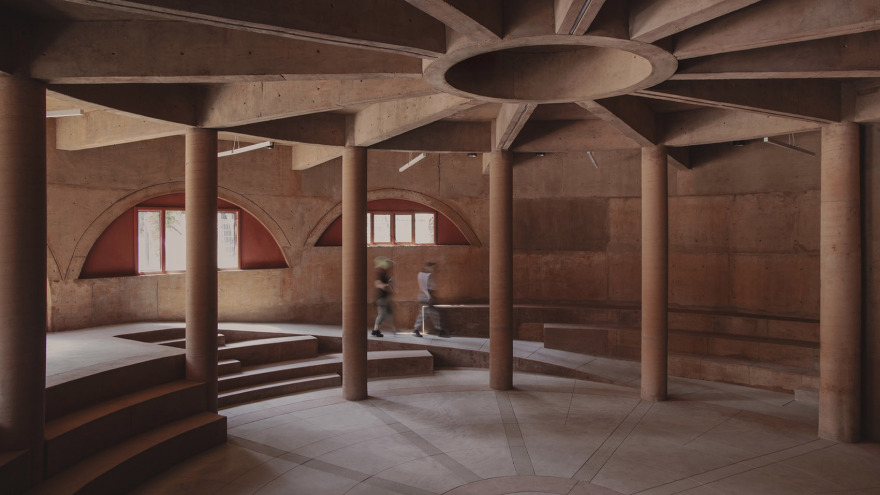
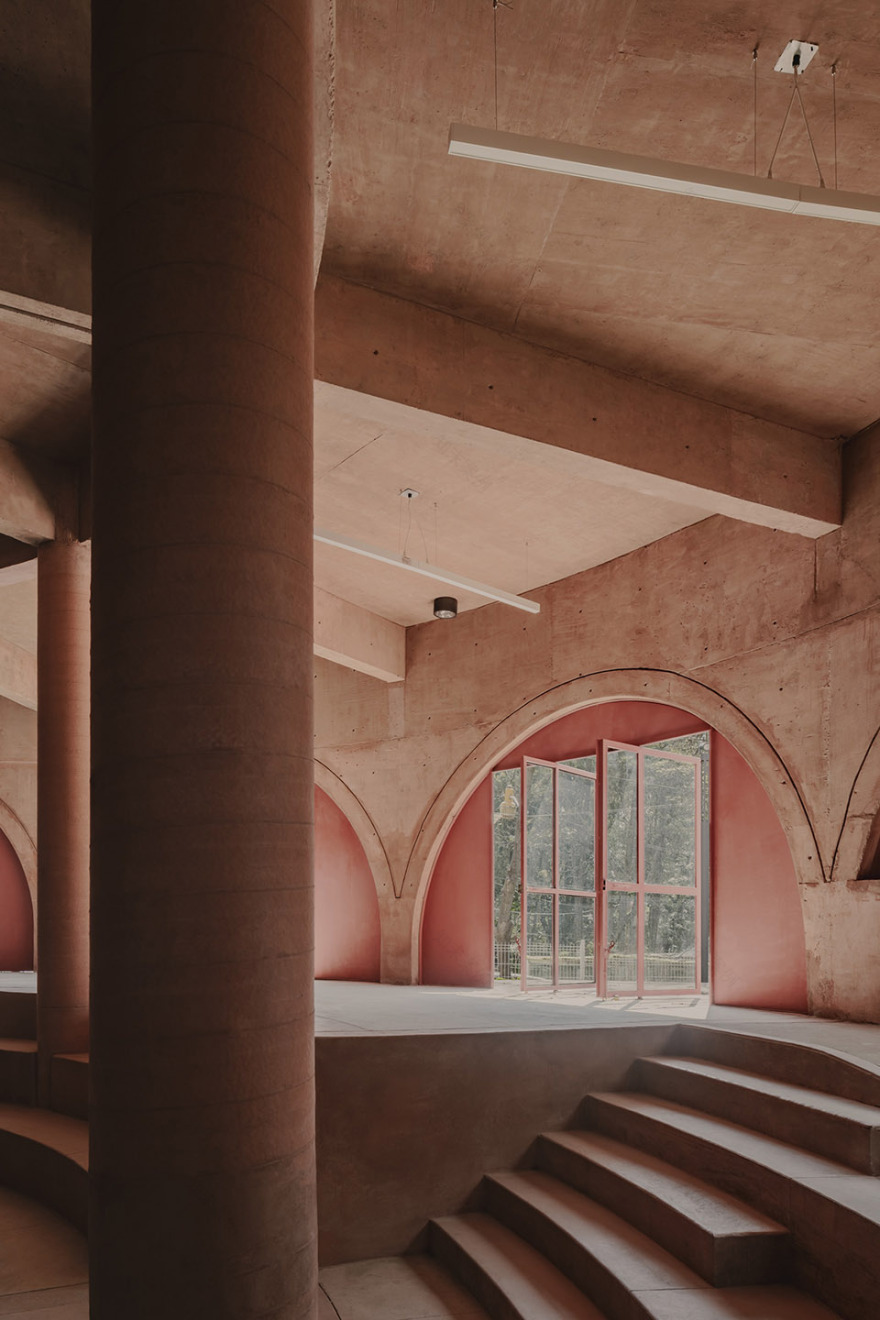
圆柱形建筑内部是一座可灵活分隔的多功能厅,可作为单一空间,也可划分为两个房间。这种灵活性得益于结构系统:混凝土柱呈放射状布置,支撑放射状梁,梁集中于中央的受压环。该环既向外传递荷载,又支撑着现场着色的双层混凝土板,这一结构既是屋顶,又为上方的运动场提供承托。施工公司Desarrolladora de Ideas y Espacios(Alberto Cejudo)、AMASA Estudio与结构工程团队的紧密协作至关重要。项目在施工过程中需逐一解决大量技术难题。尽管预算极为有限,团队仍交付了一个复杂而精准的成果。▼结构轴测图,structure axonometric©AMASA Estudio

Inside the cylindrical building is a multipurpose hall that can function as a single space or be divided into two rooms. This flexibility is made possible by a structural system of concrete columns arranged radially, supporting a set of radial beams that converge into a central compression ring. This element not only distributes the load outward but also supports a double concrete slab—pigmented on-site—which serves as both the roof and the structural base for the sports court above. Close coordination between the construction company —Desarrolladora de Ideas y Espacios (Alberto Cejudo)—, AMASA Estudio, and the structural engineers was essential to making this project viable, as it required addressing numerous technical challenges throughout the construction process. Despite working with a very limited budget, the team succeeded in delivering a complex, precise, and effective result.
▼可灵活分隔的多功能厅,a multipurpose hall©Zaickz Moz
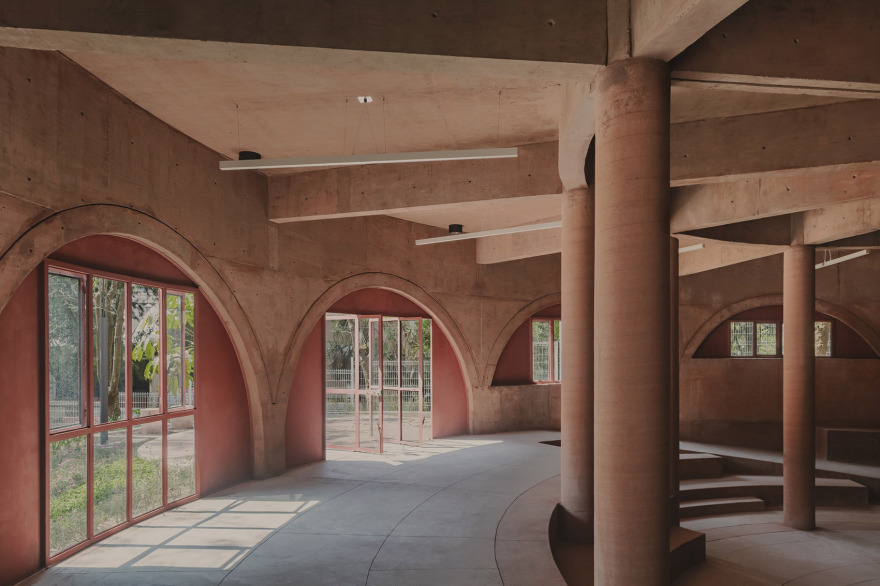
▼混凝土柱呈放射状布置,a structural system of concrete columns arranged radially©Zaickz Moz


▼混凝土柱呈放射状布置,a structural system of concrete columns arranged radially©Zaickz Moz


UH INFONAVIT Santa Fe项目表明,即便在地形陡峭、资源有限的艰难城市环境中,敏锐的设计策略也能重塑被遗忘的空间。通过回应场地的建筑设计、对植被的保护,以及与景观对话的路径营造,这一改造将边缘化地带转变为一个活跃、安全且可达的公园——一个属于聚会、游戏与社区生活的公共场所。
The project at UH INFONAVIT Santa Fe demonstrates that even in difficult urban contexts—with steep topography and limited resources—a sensitive design strategy can reframe forgotten spaces. Through architecture that responds to the site, preserves its vegetation, and builds pathways in dialogue with the landscape, this intervention transforms a marginalized zone into an active, safe, and accessible park—intended for gathering, play, and community life.
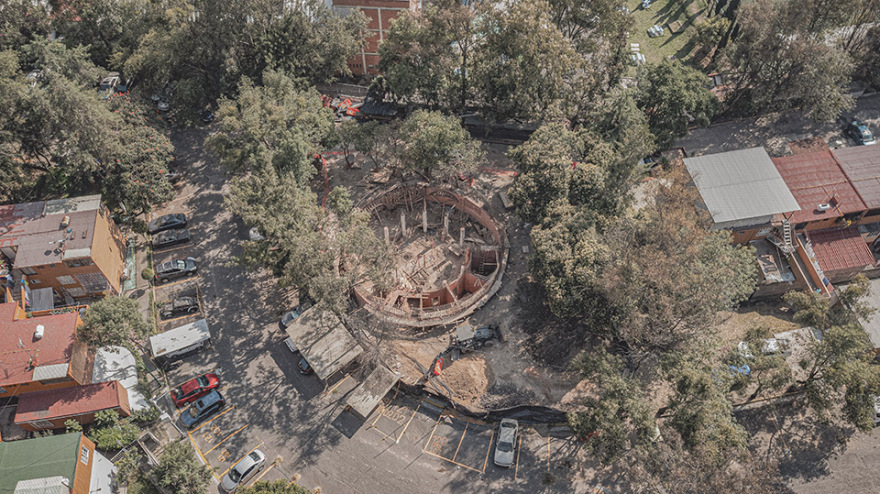
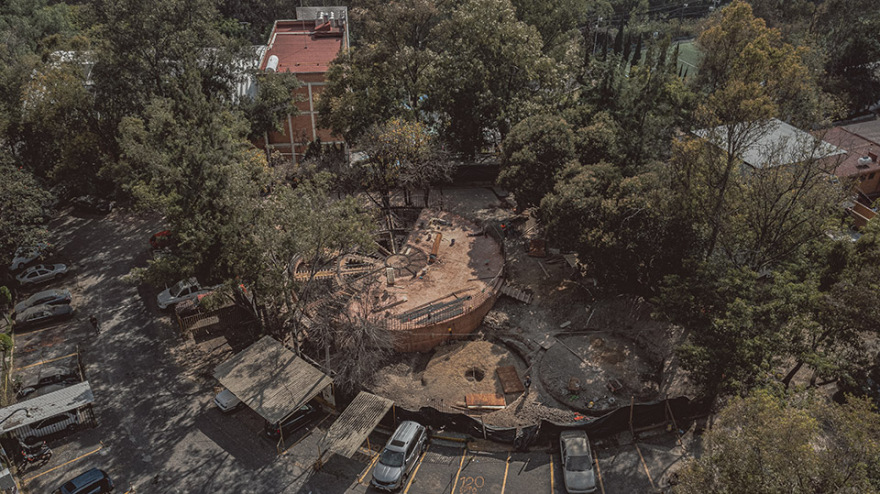
▼施工过程,construction progress©AMASA Estudio

▼一层平面,ground floor plan©AMASA Estudio

▼二层平面,first floor plan©AMASA Estudio

▼立面,elevation©AMASA Estudio


▼剖面,section©AMASA Estudio


Project Name UH INFONAVIT Santa Fe
Architecture officeAMASA Estudio, Andrea López + Agustín Pereyra
UsePublic
LocationCiudad de México
StatusBuilt
Year2025
ArchitectsAndrea López, Agustín Pereyra
ClientINFONAVIT
ConstructionDesarrolladora de Ideas y espacios, Alberto Cejudo
Structural EngineerJuan Felipe Heredia
EngineeringGermán Muñoz
LightingGabriel Briseño
LandscapeMaritza Hernandez
TeamRoxana León, Jose Luis Flores, Gerardo Reyes, Yanahi Flaviel
PhotographerZaickz Moz, Gerardo Reyes Bustamante



南京喵熊网络科技有限公司 苏ICP备18050492号-4知末 © 2018—2020 . All photos and trademark graphics are copyrighted by their owners.增值电信业务经营许可证(ICP)苏B2-20201444 苏公网安备 32011302321234号
苏公网安备 32011302321234号客服
消息
收藏
下载
最近