

创作上传
VIP
收藏下载
登录 | 注册有礼
查看完整案例

收藏

下载

分享

Preface
当一位设计师为自己打造一处度假屋,他会怎样取舍与表达? 首发探访了设计师吴滨的安吉度假屋,他在其中创造了一场黑白“两重奏”的空间实验:一层是明亮流动的“白”,汇聚自然山野的阳光与绿意;另一层则是沉稳静谧的“黑”,引向内观与自我。两种反差在这里和谐共存,平衡成一处精心雕琢的底护所。
When a designer creates a vacation home for himself, what choices and expressions does he make? This first look at designer Wu Bin’s Anji vacation home reveals a spatial experiment in a black-and-white "duo": one layer features a bright, flowing "white," capturing the sunlight and greenery of the natural mountains; the other, a calm, tranquil "black," invites introspection and self-reflection. These two contrasts coexist harmoniously, forming a meticulously crafted haven.
“安吉”,得自《诗经》“安且吉兮”,其名中自有一份与世无争的安然之意。自上海出发,不过一程之遥,便可由繁华入清寂——山林静穆,风声低回,翠色漫延。
"Anji," derived from the Book of Songs verse "An Qie Ji Xi," embodies a sense of peace and tranquility, detached from worldly affairs. Just a short journey from Shanghai, one can escape bustling bustle into tranquility—the stillness of the mountains, the whisper of the wind, and the expanse of verdant greenery.
“生于上海,早年的水墨修习已让我与山水园林结下深情”,吴滨抵达安吉时,那份灵气使他顿生归属,于是决意在此营造一处重返自然的“第二居所”——古人谓之“结庐”。
"Born in Shanghai, my early years practicing ink painting instilled in me a deep love for landscapes and gardens." Upon arriving in Anji, Wu Bin felt a sense of belonging, inspired by the aura of the place and determined to create a "second home"—a place the ancients called "Jie Lu"—to reconnect with nature.


吴滨曾与朋友打趣道:“住在上海的老洋房,永远觉得是阴天,直到你走出门才发现其实是晴天。”市区老洋房采光不佳,他对于光和空间的关系格外敏感,正因如此,安吉度假屋对于光的把控成为了一层设计的重中之重。
Wu Bin once joked with a friend, ’Living in an old western-style house in Shanghai always feels cloudy until you step out and realize it’s actually sunny.’ Old western-style houses in the city have poor lighting, and he is particularly sensitive to the relationship between light and space. Therefore, the control of light in Anji vacation homes has become a top priority in the design of the first floor.
山谷中,光自带一种治愈的能量。因此,吴滨将空间尽可能打开,将自然的光引入,让自然的能量真正饱满地充盈在空间里。
In the valley, light carries a healing energy. Therefore, Wu Bin opens up the space as much as possible, introducing natural light and allowing the energy of nature to truly fill the space.
“这个家,是光的收集器。”这座房子朝东,晨光最先到达,午后便悄然退场。中午以后,屋内光线渐渐隐去,只留下窗外连绵的山景。为了让光在一天之中有更丰富的层次,吴滨用软件模拟日行轨迹,进行了精确的光照计算,在不同方位布置天窗与开口,并在棚顶开下了若干孔洞,让阳光在正午垂直而下,午后又会迎来西面的斜阳。日照就会在不同的时间段交织成一个循序展开的光影舞台。
This house is a collector of light. "The house faces east, and the morning light arrives first before quietly leaving in the afternoon. After noon, the light inside gradually faded away, leaving only the continuous mountain scenery outside the window. In order to provide richer layers of light throughout the day, Wu Bin used software to simulate the daily trajectory and performed precise lighting calculations. Skylights and openings were arranged in different directions, and several holes were opened on the roof of the shed to allow sunlight to fall vertically at noon, followed by a slanting sun from the west in the afternoon. The sunshine will interweave into a sequentially unfolding light and shadow stage at different time periods.


迈入这座入口低调的度假屋,右侧是吴滨精心打造的苔藓小庭院,由砂砾与绿植围合而成,并不急着揭示屋内,而是一种含蓄的引导。对吴滨而言,这里不仅是一处居所,更是一种从都市抽身、让身心真正安静下来的生活方式。
因此,他始终强调节奏的重要性,构建视觉动线的背后,让人与空间的相处更为和谐。
我们在全新开辟的玄关稍作停顿,顶部的开窗制造了挑高与光线的间奏。
Stepping into this low-key entrance vacation home, to the right is a carefully crafted moss courtyard by Wu Bin, surrounded by gravel and green plants, not eager to reveal the interior, but rather a subtle guide. For Wu Bin, this is not only a residence, but also a way of life that allows him to escape from the city and truly calm his body and mind. Therefore, he always emphasizes the importance of rhythm, behind the construction of visual flow, making the interaction between people and space more harmonious. We paused briefly at the newly opened foyer, where the window at the top created a contrast between height and light.


室内一层的空间开阔通透,动线极为流畅——客厅、露台、厨房与书房连成一体,客厅的落地玻璃窗完全可以推开,视线随之被引向远处的自然山景,视觉与气息都与山林紧密相连。吴滨打破了原本房屋封闭的布局,尽可能地将实墙替换为玻璃,如今每一面墙、每一处开窗,都在邀请自然光和空气流动,营造出一种“豁然开朗”的感受。
The indoor space on the first floor is spacious and transparent, with extremely smooth flow - the living room, terrace, kitchen, and study are connected into one. The floor to ceiling glass windows in the living room can be completely pushed open, and the view is directed towards the distant natural mountain scenery. The visual and atmospheric aspects are closely connected to the mountains and forests. Wu Bin broke the original closed layout of the house and replaced the solid walls with glass as much as possible. Now, every wall and window is inviting natural light and air flow, creating a feeling of "sudden enlightenment".


米白色自然纹理的大理石,经细致打磨后呈现出温润的光泽,通铺于整个空间。客厅中央的白色沙发安然伫立,仿佛一块留白的画布,将周围的光影与呼吸都纳入其中。
客厅一侧,以整面原石砌筑的墙体回应着当地山居的记忆。
用设计去呈现山居的建造方式,需要如工艺美术般的耐心与精细,如同绘画,层层铺陈,直至呈现出最恰如其分的形态与力量。
The marble with a natural grain of off white color, after careful polishing, presents a warm luster and is spread throughout the entire space. The white sofa in the center of the living room stands calmly, like a blank canvas that incorporates the surrounding light, shadow, and breath. On one side of the living room, a wall made entirely of raw stone responds to the memories of the local mountain dwelling. To present the construction method of mountain dwellings through design, it requires patience and precision like arts and crafts, like painting, layer by layer, until the most appropriate form and strength are presented.

大尺度的L型露台与客厅几乎无缝相连,吴滨将露台设定为一个及时更新的家中“艺廊”,摆放着造型简洁的座椅、收藏与雕塑。他在顶棚同样开设天光口,“原来天空太多,画面就散了。”房檐压低了天际线,也重塑了山景的层次,在夏季多雨的江南气候里,创造出尤为从容的灰空间。
The large-scale L-shaped terrace is seamlessly connected to the living room, and Wu Bin has set the terrace as a timely updated "art gallery" in his home, with simple shaped chairs, collections, and sculptures. He also set up a skylight on the ceiling, saying, ’There were too many skies, so the picture was scattered.’ The eaves lowered the skyline and reshaped the level of the mountain scenery, creating a particularly calm gray space in the rainy climate of Jiangnan in summer.
回到室内,嵌入石墙之中的壁炉静静地燃烧着吴滨自挑选的松木,火光与木香让氛围格外温馨,烧松木的独特香气充盈着空间,将一种深远的山林气息带进屋内,一切充满了时间的痕迹与生活的细腻。
Returning indoors, the fireplace embedded in the stone wall quietly burned the pine wood selected by Wu Bin. The firelight and wood fragrance made the atmosphere particularly warm, and the unique aroma of burning pine wood filled the space, bringing a profound forest atmosphere into the room. Everything was filled with the traces of time and the delicacy of life.


通往负一层的楼梯,贴着⼭体更近,被吴滨设计成一条刻意收窄的小径。狭窄的通道尺度让脚步不自觉地放慢,墙面与光线的变化逐渐隔绝了楼上的明亮的氛围。楼梯入口处还安了一扇深色小铁门,像一道心理暗示——前方是一个更加静谧而向内的空间。
The staircase leading to the basement level, closer to the mountain body, was designed by Wu Bin as a deliberately narrowed path. The narrow passage scale makes footsteps unconsciously slow down, and the changes in walls and light gradually isolate the bright atmosphere upstairs. There is also a dark iron door installed at the entrance of the stairs, like a psychological suggestion - there is a quieter and inward space ahead.
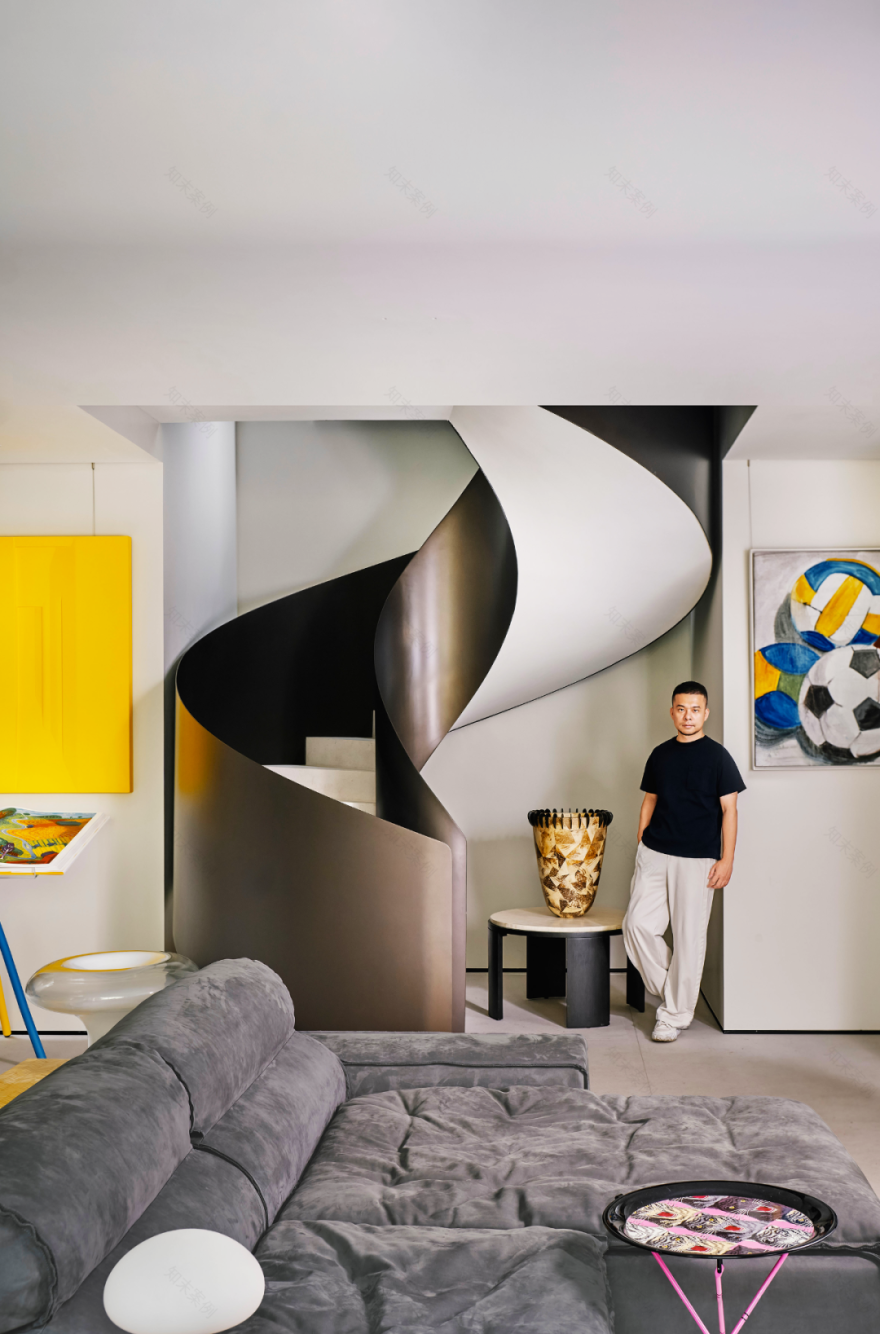
“我平时其实是一个很宅的人。”吴滨笑道,虽然他享受社交带来的愉悦感,但更多时候他喜欢独处。负一层正是属于他的自我空间——黑色与沉稳的色调成为主导,光线被刻意压低,这里被用作画室、茶室与会客厅。
I’m actually a very introverted person, "Wu Bin smiled. Although he enjoys the pleasure of socializing, he prefers to be alone more often. The negative layer is his own personal space - dominated by black and steady tones, the light is deliberately lowered, and it is used as an art studio, tea room, and reception room.

负一层的设计亮点一定是“内观盒”般的茶室。吴滨将茶室设计成一个幽暗的木盒,敞开时连接着整层空间,需要独处时,两扇门又可以完全合拢,屏蔽了外部的声音与视觉,仅留下一个压低的横窗,仿佛中式园林中的借景之法——有些风景宜宽幅展开,有些只需一隅点到即可。光线从下方射进来,映照着窗外脚边充满生机的苔藓山石与枝叶。在茶室可以独自泡茶、点雪茄、与友人交流会面、静思冥想,成为真正的精神归处。设计不仅是空间形态,更承载了生活的精神仪式。
The highlight of the design on the negative first floor must be the "inner observation box" like tea room. Wu Bin designed the tea room as a dark wooden box, which connects the entire space when open. When alone, the two doors can be completely closed, blocking external sound and vision, leaving only a low horizontal window, like the borrowing method in Chinese gardens - some landscapes should be unfolded wide, while others only need to be clicked on in a corner. The light came in from below, reflecting the vibrant moss, rocks, and branches outside the window. In the tea room, one can brew tea alone, light cigars, communicate and meet with friends, meditate, and become a true spiritual sanctuary. Design is not only a spatial form, but also carries the spiritual ceremony of life.


客厅由沙发模组共同构成了一个可以随意切换状态的“生活场”——没有主次之分,也不设明确的功能边界。吴滨为这个空间特意设计了一组可随需求自由组合的沙发形态,使其与不同的生活场景自然契合。后方的长桌上,他常静坐挥毫水墨——早年的研习已将笔墨的灵性深深镌刻在他的设计中,化作一种流淌于空间之内的韵律。
The living room is composed of sofa modules that together form a "living space" that can switch states freely - there is no distinction between primary and secondary, nor is there a clear functional boundary. Wu Bin specially designed a set of sofa shapes that can be freely combined according to the needs of this space, making it naturally fit with different living scenes. On the long table behind him, he often sits still and brushes his brush with ink - his early studies have deeply engraved the spirituality of ink in his designs, transforming it into a rhythm flowing within the space.

负一层亦是吴滨多年来的艺术收藏地,他不过度追求名头,也不刻意讲求门派统一,而是以“是否能融入空间”为准则。正对壁炉的画作如同一本被翻开的书籍,它出自中央美院艺术家杨新收之手,一幅象征白昼,一幅象征黑夜。吴滨特地为这件作品定制了画框,“我喜欢收藏我熟悉的艺术家的作品,会有一种亲切感和连接感。”有些旅行中偶遇的器物,甚至是某次在山里捡到的石头,吴滨会带回度假屋,“哪怕这些物件很小,都是我的一段记忆。”
The negative layer has also been Wu Bin’s art collection site for many years. He does not excessively pursue fame, nor does he deliberately emphasize the unity of sects, but rather takes "whether it can fit into the space" as the criterion. The painting facing the fireplace is like an opened book, created by Yang Xinshou, an artist from the Central Academy of Fine Arts. One painting symbolizes daylight and the other symbolizes darkness. Wu Bin specially customized a frame for this artwork, saying, "I like to collect works from artists I am familiar with, which gives me a sense of familiarity and connection." Some objects I encounter during travel, even stones I found in the mountains, Wu Bin will bring back to his vacation home. "Even if these objects are small, they are memories for me"

画室面向峡谷,整扇门可以完全敞开,使户外、廊道与室内形成一个整体,黑色的木质廊道与泳池和自然景观通透连接,“⼤夏天我喜欢在地下⼀层呆着,这里更阴凉,有种洞穴的感觉。月光特别好的时候,我会坐在沙发上,看松树的影子落在山谷里。”从入山小径的仪式感,到茶室的内观盒,再到泡池的柔软,艺术收藏的文化厚度,最后是画室与自然的通透连接,构筑了一个身心安放的静谧庇护所。
The studio faces the canyon, and the entire door can be fully opened, forming a whole between the outdoor, corridor, and indoor areas. The black wooden corridor connects seamlessly with the swimming pool and natural landscape. "In the summer, I like to stay on the underground level, which is more shaded and has a cave like feeling. When the moonlight is particularly good, I will sit on the sofa and watch the shadow of the pine tree fall into the valley." From the ceremonial feeling of the mountain path, to the inner observation box of the tea room, to the softness of the soaking pool, the cultural thickness of art collection, and finally, the transparent connection between the studio and nature, it has built a peaceful shelter for both body and mind.


在设计这个度假屋之初,吴滨就将它视作一个完整的生命体——建筑改造、室内、景观与艺术收藏彼此交织,缺一不可。“设计师从建筑改造到室内,再到景观与艺术品顾问,很关键的是统筹对于⽣活美学的理解,空间是⼀个整体,每个要素都不可或缺。”因此,户外庭院的石块高低、树木的种类与位置,在设计初期就已经被勾勒成一幅完整的轮廓图。
At the beginning of designing this vacation home, Wu Bin regarded it as a complete living organism - architectural renovation, interior, landscape, and art collection are intertwined and indispensable. From architectural renovation to interior design, and then to landscape and art consultants, it is crucial for designers to coordinate their understanding of life aesthetics. Space is a whole, and every element is indispensable. Therefore, the height of stones and the types and positions of trees in outdoor courtyards are already outlined as a complete outline in the early stages of design.

院子的正中央,伫立着一棵他格外喜爱的红松。安吉朝东的地势,会让秋冬的庭院略显阴冷,而红松的树皮泛着暖红色,衬着四季常青的枝叶,让整个空间多了一分热烈的气息。
“它很像我们中国古画⾥⾮常遒劲的这种出枝的感觉,因为我⼩时候画画就是最喜欢的宋画,我坐在这张画桌上,抬眼看到的就是⼀个超尺度的横宽,像⼀个⻓卷⾥⾯出现⼀颗我特别喜欢的松,映衬着远处的远⼭,这是我觉得很美好的⼀个画⾯。”
In the center of the courtyard stands a red pine tree that he particularly loves. The terrain facing east in Anji makes the courtyard slightly chilly in autumn and winter, while the bark of the red pine trees is warm red, complemented by the evergreen branches and leaves throughout the year, adding a touch of warmth to the entire space. It is very similar to the strong and vigorous feeling of our ancient Chinese paintings, because when I was a child, painting was my favorite Song painting. Sitting on this painting table, I looked up and saw a super scale horizontal width, like a scroll with a pine tree that I particularly like, reflecting the distant mountains. This is a beautiful painting that I think is very beautiful


吴滨提到富春山居图,包括江南文人像是吴昌硕、 赵孟頫,他们在江南一带的生活状态,对于山野与 自然的感受,是他认为中国文人隐居的一种境界。
Wu Bin mentioned the Dwelling in Fuchun Mountain, including Jiangnan literati such as Wu Changshuo and Zhao Mengfu. Their living conditions in the Jiangnan area and their feelings towards the mountains and nature are what he believes to be a state of seclusion for Chinese literati.
在他看来,理想的山居应当有三个层次:先“可望其景”,再“可游其间”,最终“可居其中”。在城市与自然之间往返的状态,给生活呼吸和延展的余地。
In his view, the ideal mountain dwelling should have three levels: first, ’to have a view of it’, then ’to be able to swim in it’, and finally ’to be able to live in it’. The state of traveling back and forth between the city and nature provides room for breathing and extension in life.


近几年,吴滨与无间设计的风格也更加地“松弛”,吴滨认为这与他的个人状态密不可分,同时大环境的变化,让人们愈发向往一种更安定、更从容的生活。与此同时,人们的审美观念也在悄然转变,不再追求过度堆砌的奢华,而更看重设计表达的精准与内涵。
In recent years, the style of Wu Bin and Infernal Design has become more relaxed, which Wu Bin believes is closely related to his personal state. At the same time, changes in the overall environment have made people increasingly yearn for a more stable and relaxed life. At the same time, people’s aesthetic concepts are quietly changing, no longer pursuing excessive luxury, but placing more emphasis on the precision and connotation of design expression.
“我们所说精致可能是⼀种精确,它其实是⼀种设计的控制能⼒。”安吉度假屋虽然呈现很松弛的状态,但实则经过一番精心雕琢,“它并不是真的是很随意,因为⼀旦随意,⽓就漏掉了”,而眼前的空间会让人感受到⽓场是收住的,但是进入后又会迅速放松下来,这种微妙的平衡,正考验着设计师对尺度、光线、结构乃至情绪的精准把控。
What we call delicacy may be a kind of precision, but it is actually a design control ability. "Although Anji Holiday Home presents a relaxed state, it has been carefully crafted." It is not really very casual, because once it is casual, the air leaks out. "The space in front of us will make people feel that the air field is contained, but it will quickly relax after entering. This subtle balance is testing the designer’s precise control over scale, light, structure, and even emotions.
作品亦如此,我们并不会去追求第一眼的张扬和刻意的装饰。让人感觉舒服的设计,是能够在长久的相处中仍然生出力量的,可以在内敛与张力之间达到平衡,这是我理解的一种好设计。
The same goes for works. We don’t pursue flashy and deliberate decoration at first glance. A design that makes people feel comfortable can still generate strength in long-term interaction, achieving a balance between introversion and tension. This is what I understand as a good design
从事室内设计以来,吴滨曾经尝试将上海独有的Art Deco语言融入作品,希望在风格中找到与自身经历的共鸣。对他而言,空间不仅是感知内在与外界的媒介,更承载着文化原型的秩序与形态。从最初的摸索到后来的“摩登东方”,他的设计语言在个人经验与文化语境的细微碰撞中逐渐成形——既要扎根于“菰蒲深处”,也要借回忆与对历史的重新学习捉摸出形态的变化、位移与再构建。或许正因为心里那份传统文化的积淀和始终眷恋,他才能在喧嚣的时代里保持一份宁静与从容,使隐逸的传统在当下发生了更加深刻的转折与更新。
Since engaging in interior design, Wu Bin has attempted to integrate Shanghai’s unique Art Deco language into his works, hoping to find resonance with his own experiences in style. For him, space is not only a medium for perceiving the inner and outer world, but also carries the order and form of cultural prototypes. From the initial exploration to the later "Modern East", his design language gradually took shape through the subtle collision of personal experience and cultural context - rooted not only in the "depths of Shupu", but also through memory and re learning of history to grasp the changes, displacement, and reconstruction of form. Perhaps it is precisely because of the accumulation of traditional culture in his heart and his constant attachment that he can maintain a sense of tranquility and composure in the noisy era, causing a deeper turning point and renewal of the tradition of seclusion in the present.

古代的文人们都喜欢在山中隐居,“当你面对自然,会有一种能量的吸收的感觉,特别宁静的感觉。置身天地之间,你会感觉到人其实是渺小的,没有什么事情是特别重要的。”
Ancient literati liked to live in seclusion in the mountains. "When you face nature, there is a feeling of energy absorption, a particularly peaceful feeling. Standing between heaven and earth, you will feel that people are actually small, and nothing is particularly important
这片理想山居,不仅是空间的体现,更是对生活哲学的阐释,是现代人回归自然、身心平衡的理想之所。空间与自然共同形成的场域会将人轻轻托住,让人明白,生活原来可以如此简单而丰盈。
This ideal mountain dwelling is not only a reflection of space, but also an interpretation of life philosophy, and an ideal place for modern people to return to nature and achieve physical and mental balance. The field formed by space and nature together will gently support people, making them understand that life can be so simple and abundant.


设计总监&无间创始人 吴滨

项目主创团队


延伸阅读

▲设计师傅厚民的香港新家
▲设计师黄全的上海新家

▲设计师戴昆的上海新家

▲设计师孙建亚的上海新家
南京喵熊网络科技有限公司 苏ICP备18050492号-4知末 © 2018—2020 . All photos and trademark graphics are copyrighted by their owners.增值电信业务经营许可证(ICP)苏B2-20201444 苏公网安备 32011302321234号
苏公网安备 32011302321234号客服
消息
收藏
下载
最近