

创作上传
VIP
收藏下载
登录 | 注册有礼
查看完整案例

收藏

下载

分享


出品人:向玲 / Producer: Xiang Ling
编辑:石安,亓慧,庞任飞,张笑然,高天旗 / Editor: Shi An, Qi Hui, Pang Renfei, Zhang Xiaoran, Gao Tianqi
________
何为“小隐”
About Archermit
小隐建筑这个名字取“小隐隐于野,大隐隐于市”。我们所理解的“小”是一种务实的人生态度,即无论多大或者多重要的事情,都是从小事情开始。同时小与我们现在做的很多项目道理相同,都是从无到有的一个过程。在实际设计中,无论是多大的空间还是场景,都是由人的尺度和大大小小的场景最终组合而成。
The name ‘Archermit’ is taken from ‘Those who seek small retreats live in nature; those who seek true detachment live within society’. What we understand by ‘small’ is a pragmatic attitude towards life, i.e. no matter how big or how important something is, we always start with something small. Similarly, many of our current projects reflect the concept of ‘small’ — a journey from nothingness to existence. In actual design, no matter how big the space or scene is, it is made up of human scale and the final combination of large and small scenes.
▼小隐建筑创始人潘友才,Founder of Archermit: Youcai Pan© 小隐建筑

▼小隐建筑合伙人杨喆&陈仁振,C0-founder of Archermit: Zhe Yang and Renzhen Chen© 小隐建筑

▼小隐建筑日常工作环境,Daily working environment of Archermit© 小隐建筑

快速城市化深刻地改变了我们的距离感和时间感,在这一宏观背景下,人们对生存状态产生了共同的回应。而在微观层面,小尺度空间对生活质量提出了更高的要求和期待。随着时代的发展,人们愈发敏锐地察觉到环境中细微的缺陷或魅力,生活中的“小”被无限放大。因此,我们需要重新思考如何在不同空间环境中作出有效的应对和策略选择。
Rapid urbanization has profoundly reshaped our perception of distance and time. Against this broader backdrop, people have formed shared responses to their living conditions. On a micro level, small-scale spaces now demand higher standards and expectations for quality of life. As time progresses, people have become increasingly sensitive to the subtle flaws or hidden charm in their surroundings — the ‘small’ in daily life is magnified. Therefore, it is necessary to rethink how we formulate effective strategies and responses within diverse spatial contexts.
▼小隐建筑团队日常工作场景,Office daily scenarios of Archermit© 小隐建筑

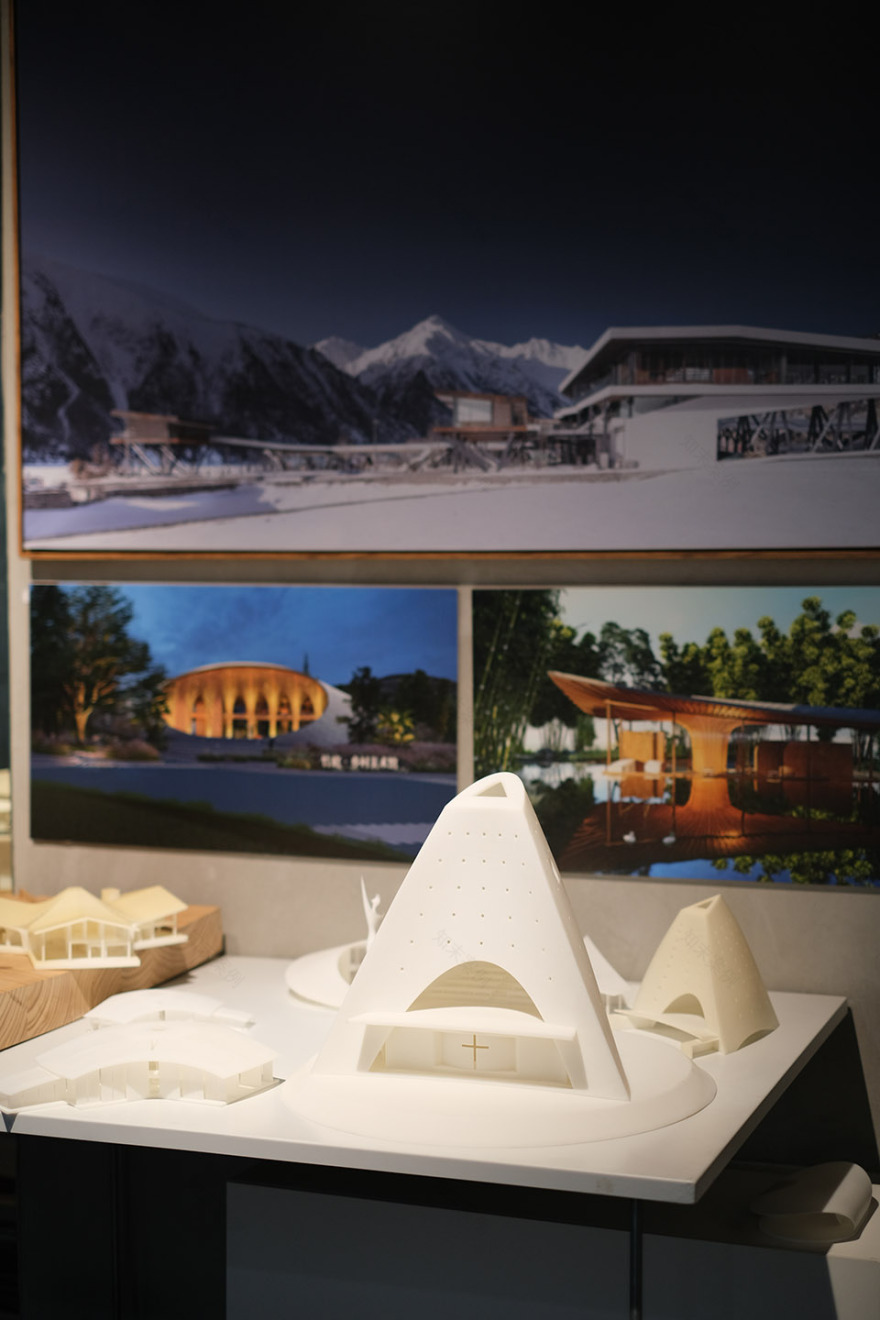
▼小隐建筑作品模型,Models of Archermit’s works© 小隐建筑

我们小隐建筑的Logo很好地诠释了我们对“大小”尺度关系的思考。Logo中的“⼩”字被置于画面中央,并以缩小的形式呈现。放大之后,可以看到其字形的细微变化,例如两侧的弧线,既可联想到建筑的屋顶,也可能象征自然中的山形或地貌。这些形态暗示着我们在设计中对自然与建构的融合理解。同时,Logo在不同尺度与场景下的应用,也展现了“大小”之间的张力与转化关系。“隐”字则代表了我们的设计追求与大自然和周边环境建立良好关系,使建筑更好地融入到自然环境或者自然中。
‘Archermit’ logo offers a thoughtful reflection on the relationship between scales—‘small’ and ‘large.’The character “小” (small) is placed at the center of the composition in a reduced size. When enlarged, subtle refinements in the character become visible—for instance, the curved lines on either side can be interpreted as architectural roof forms or symbolic of natural elements such as mountains or landscapes. These shapes suggest our integrated understanding of nature and construction in design. Moreover, the logo’s adaptability across different scales and contexts reveals the tension and transformation between ‘small’ and ‘large.’ The character “隐” (hidden) embodies our design philosophy of building harmonious relationships with nature and the surrounding environment—allowing architecture to blend seamlessly into its context.
▼小隐建筑工作室logo,logo of Archermit ©魁KUIdesign


意象建筑论
Imagery architecture
意象建筑的来源|Origin of imagery architecture
意象建筑希望通过对“造物之源”的研究探索,将适用主义和美学平衡这一概念变得容易理解和掌握。构建具有普适性和广泛适应性的建筑形象语言,让建筑同文字一样,被大众更容易地理解和解读。进而解决我们在实际工作中与非专业业主沟通困难的问题。
Imagery Architecture aims to make the concept of balancing functionalism and aesthetics more understandable and accessible by exploring the “origins of creation.” We strive to develop an architectural language of imagery that is universal and highly adaptable—allowing architecture, like written language, to be easily understood and interpreted by the general public. This approach ultimately helps us overcome the communication challenges we often face when working with non-professional clients in practice.
▼对意象建筑的研究 – 3M*3M*3M 茶室,Study of Imagery architecture© 小隐建筑

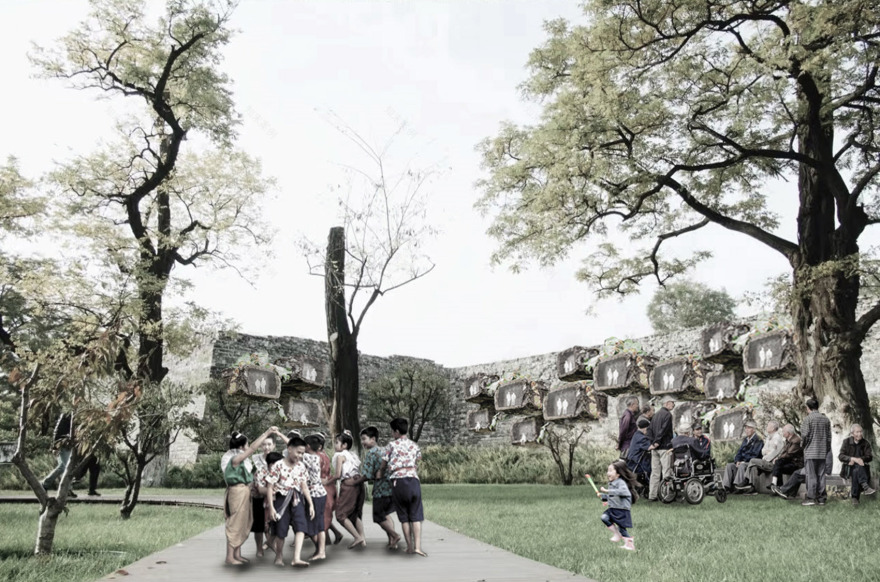

“意象建筑”的核心思想深受中国传统哲学思想的影响,尤其体现于儒、道、佛三家的思想融合之中。儒家强调人与社会的和谐。道家则关注人与自然的关系。佛家更注重与自我和解的精神状态。我们认为,建筑的终极目标,正是调和建筑与社会、自然以及人的关系。当这种多重关系被妥善处理时,便可进入一种“⼩隐”的状态——这正是意象建筑的核心思想所在。而在实践中,如何寻找“意象”成为我们方法论的关键。我们的设计方法深受古代文人诗画创作方式的启发,讲求从自然中汲取灵感与感悟。我们也希望通过类似的感性路径,将建筑作为一种诗意的回应,将情感转化为空间语言。
The core philosophy of Imagery Architecture is deeply rooted in traditional Chinese thought, drawing especially from the integration of Confucianism, Daoism, and Buddhism. Confucianism emphasizes harmony between individuals and society. Daoism focuses on the relationship between humans and nature. Buddhism values the inner reconciliation of the self. We believe the ultimate goal of architecture is to harmonize the relationships among architecture, society, nature, and the individual. When these multiple dimensions are properly balanced, one can enter a state of “Archermit”—a condition of quiet retreat and subtle presence, which lies at the heart of Imagery Architecture. In practice, the quest for imagery becomes a key part of our methodology. Our design process is inspired by the poetic and pictorial traditions of ancient Chinese literati, who sought spiritual resonance with nature. In a similar way, we aim to create architecture as a poetic response—transforming emotional insight into spatial expression.
▼小隐建筑部分代表作品,Collage of Archermit’s works© 小隐建筑

在我们的方法论中,意象的来源分为两大类:一类是自然意象,即山、水、林、石等自然界本就存在的元素;另一类是人文意象,包括人为创造的器物、建筑、路径等。此外,还有一些看不见、摸不着却深刻影响空间体验的感知性要素,如光影、风声、气味等。这些构成了我们理解与营造空间的基础,也是我们在设计中努力调和人与自然、感知与物理之间关系的核心路径。
In our methodology, the sources of imagery fall into two primary categories. The first is natural imagery—elements that inherently exist in nature, such as mountains, water, forests, and stones. The second is cultural imagery, which includes man-made creations such as artifacts, architecture, and pathways. In addition to these tangible references, we also value intangible and sensory elements—light and shadow, the sound of wind, scents—that deeply shape one’s spatial experience. Together, these dimensions form the foundation for how we understand and create space. They also represent our core approach to harmonizing the relationship between human and nature, perception and the physical world.
▼四川安岳柠檬园,Sichuan Anyue Lemon orchards© 小隐建筑

我们总结了几个方法论,第一是以建筑功能为切入点,从与之相关的行业、产业、企业、产品、技术等显著特征手段挖掘我们想要的“象源”。我们将这些灵感统称为“象源”。以我们在四川安岳的一个项目为例,项目场地被大片农田环绕,种植着黄豆、稻谷等农作物,周边还有柠檬园和荷塘。我们从这些在地元素中提取灵感,进行了富有地域感和自然意象的设计。
We have developed several methodological approaches. The first begins with architectural function as the point of departure, seeking out the desired imagery source—what we call “The origin of imagery”—through distinctive features of related industries, enterprises, products, technologies, and broader contexts. As an example, in a project we undertook near Anyue, on the outskirts of Chengdu, the site was surrounded by expansive farmland cultivating soybeans, rice, and other crops, alongside lemon orchards and lotus ponds. We drew inspiration from these local elements, translating them into a design rich in regional identity and natural imagery.
▼四川安岳柠檬园,Sichuan Anyue Lemon orchards© 小隐建筑

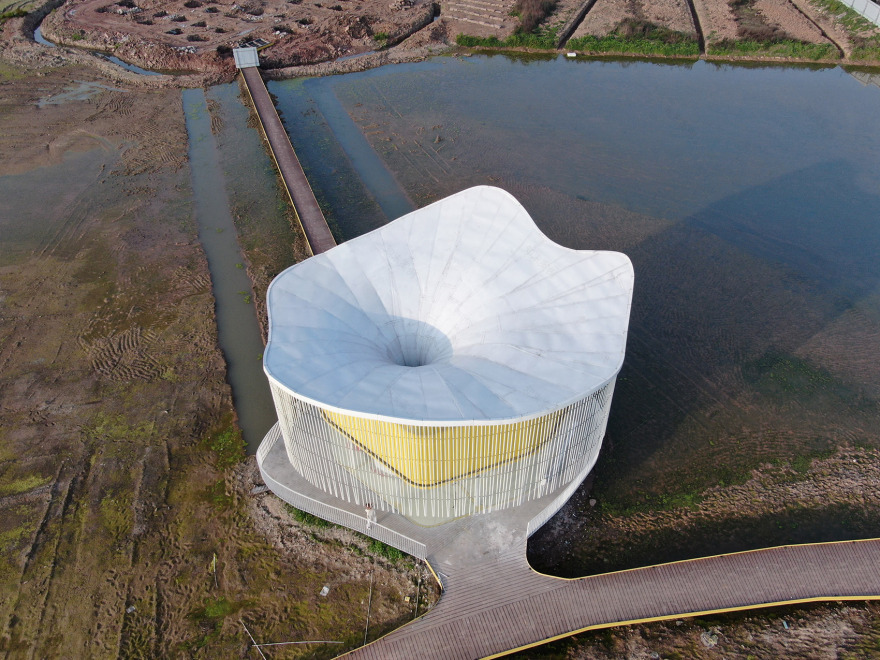
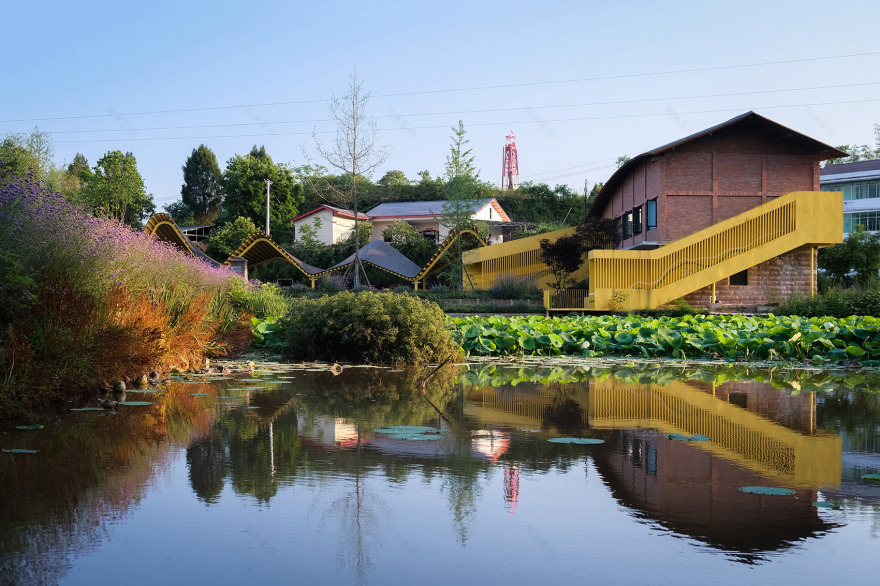
例如,我们用豆芽的形态构建了一个观景台,与田野景观自然融合。荷塘边生长着细小的铜钱草,我们便以其为灵感,用仿生方式设计了其中一栋建筑,从造型到结构都呼应铜钱草的构造特征。建筑外部设置了类似驱蚊灯的帘状风铃装置,随风发声,根据风力的变化呈现不同的音响效果,赋予建筑以感知与互动的能力。此外,该建筑在色彩搭配上也取自周边的柠檬园,我们选用了明快的柠檬色作为主色调,使建筑在自然环境中既协调又富有辨识度。
For example, we created a viewing platform inspired by the form of bean sprouts, allowing it to blend naturally into the surrounding farmland landscape. Along the lotus pond, pennywort grows delicately along the edges. Drawing inspiration from this plant, we designed one of the buildings using biomimicry—its form and structure echo the botanical characteristics of pennywort. On the exterior, we installed a curtain-like wind chime device reminiscent of mosquito-repelling lamps. These elements produce sound as they sway in the wind, generating different acoustic effects depending on wind strength, thus giving the architecture a sensory and interactive dimension. In terms of color, the building draws from the nearby lemon orchards—we adopted a bright lemon yellow as the main tone, making the structure both harmoniously integrated with its environment and visually distinctive.
▼四川安岳柠檬园,Sichuan Anyue Lemon orchards© 小隐建筑

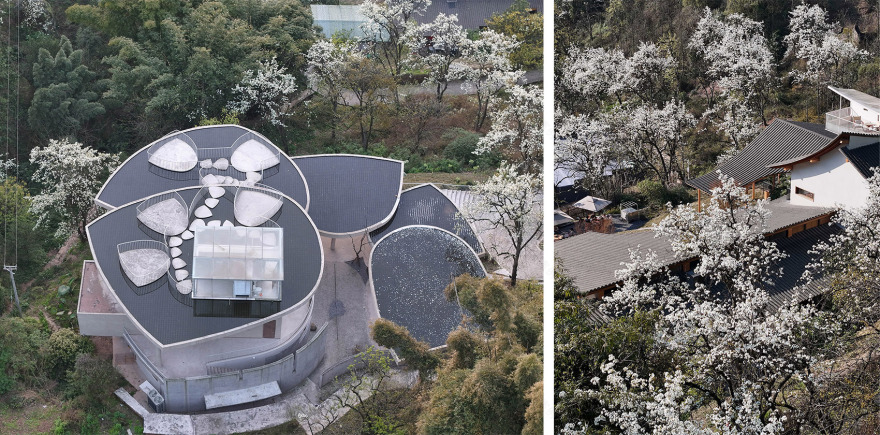
第二种是根据当地地理特征,以建筑周围环境和地理特征为切入点,如地形、气候、植被、水文等等。这些因素可以为“象胚”提供具体的物质和空间元素,并与周围环境相融合。例如在泸州的梨花村·不在山林项目中,我们结合当地盛开的梨花与山中巨石的自然特征,提取花瓣与石头的元素进行创作,营造出具有地方意象的建筑语言。而在海口,最初让人联想到的往往是椰子、海螺、沙滩等热带意象,但我们更关注的是鲜为人知却极具特征的“海口火山公园”。因此,在海口的项目中,我们结合火山地貌与海洋元素,一方面用火山的意象打造了一座美术馆,另一方面则以海螺为灵感,设计了另外一个坐落于公园内的建筑体。
The second approach begins with the local geographical context, drawing inspiration from environmental and physical features such as topography, climate, vegetation, and hydrology. These elements provide tangible material and spatial references for shaping what we call the “imagery embryo”, allowing the architecture to merge naturally with its surroundings. For instance, in our “BUZZY SUNNY” project in Pear Blossom Village, Luzhou, we drew from the natural features of blooming pear blossoms and massive mountain stones. By extracting and combining the forms of petals and rocks, we created a regional architectural language rich in local imagery. In Haikou, while the most immediate associations are often coconuts, seashells, and beaches—classic tropical imagery—we turned our attention to the lesser-known but distinctive Haikou Volcano Park. As a result, one of the architectural forms in the project is a museum inspired by volcanic formations, while another building, located within the park, takes the spiral geometry of a seashell as its conceptual origin.
▼泸州梨花村·不在山林,BUZZY SUNNY in Pear Blossom Village© 小隐建筑
▼不在山林·山谷石窑,BUZZY SUNNY in Mountain valley© 形在空间

▼海口火山公园,Haikou Volcano Park© 小隐建筑


其它则是与地域文化或者建筑技术层面相关。例如在平武的民宿酒店项目中,我们更多地参考了当地的传统民居形式。由于平武地处羌族、藏族与汉族文化的交汇地带,我们在设计中对民居形态进行了简化,同时融合了川西四合院的空间组织方式,以回应多元文化背景。花前月下观景台项目在成都彭州磁峰镇,旁边是一座拥有千年历史的金城窑遗址,因此我们运用了制作白瓷的工艺及瓷片拼贴的方式,通过铝板进行现代呈现。紧邻的另一个村落桂花镇至今仍保留着传统土陶制作技艺,拥有几十家手工土陶作坊。为此,我们在建筑的外墙、屋顶、地面以及室内艺术装置中大量运用了红陶片元素,既作为建筑材料,也作为一种文化展示。以上便是我们寻找“象源”的四个主要出处。
The third approach draws from regional culture and architectural techniques. For instance, in our Plum villa project in Pingwu, we referenced the traditional residential forms of the region. As Pingwu lies at the intersection of Qiang, Tibetan, and Han cultures, we simplified vernacular architectural forms while integrating the courtyard organization typical of Western Sichuan dwellings, in response to the area’s multicultural context. In the “Under the Moonlight” viewing platform project in Cifeng Town, Pengzhou (Chengdu), the site is adjacent to the historic Jincheng Kiln Ruins, which has over a thousand years of history. Drawing from the local tradition of porcelain making, we translated ceramic craftsmanship and tile mosaic techniques into a contemporary expression using aluminum panels. In the nearby Guihua Town, traditional earthenware techniques are still preserved today, with dozens of workshops engaged in handmade pottery. Accordingly, we made extensive use of red earthenware tiles on the façades, roofs, floors, and even in interior art installations—serving both as building material and a medium of cultural representation. These examples illustrate the four main sources from which we derive our “The origin of imagery”
▼器物之间与赋象见意:四川平武·梅宿之言,Artifacts and endowing forms, perceiving ideas: Pingwu, Sichuan – Plum villa©存在建筑
点击这里查看更多,Click HERE for details


意象建筑的层次|Layersof imagery architecture
关于意象建筑,我们将其分为三个层次。第一层是直观层面,大多数人可以一眼看到并理解。第二层是文化投射层面,我们希望借由建筑表达某种传统文化内容,带有象征性或隐喻的文化指向。第三层是情感触发层面,观者在建筑中看到一两个特定场景后,能够产生深刻印象,并联想到自身经历与情感,从而引发个人化的情感共鸣。
In our understanding of Imagery Architecture, we define it in three distinct layers: The first layer is the intuitive level—what most people can see and grasp at a glance. The second layer involves cultural projection—where we aim to express traditional cultural content through architectural form, often carrying symbolic or metaphorical meanings. The third layer is about emotional activation—when viewers encounter specific scenes within the architecture, it triggers deep impressions and evokes personal memories or feelings, leading to an individualized emotional resonance.
▼石家庄安德生命纪念公园·云镜,Shijiazhuang Ander Memorial Park ·Cloud Mirror©存在建筑
点击这里查看更多,Click HERE for details
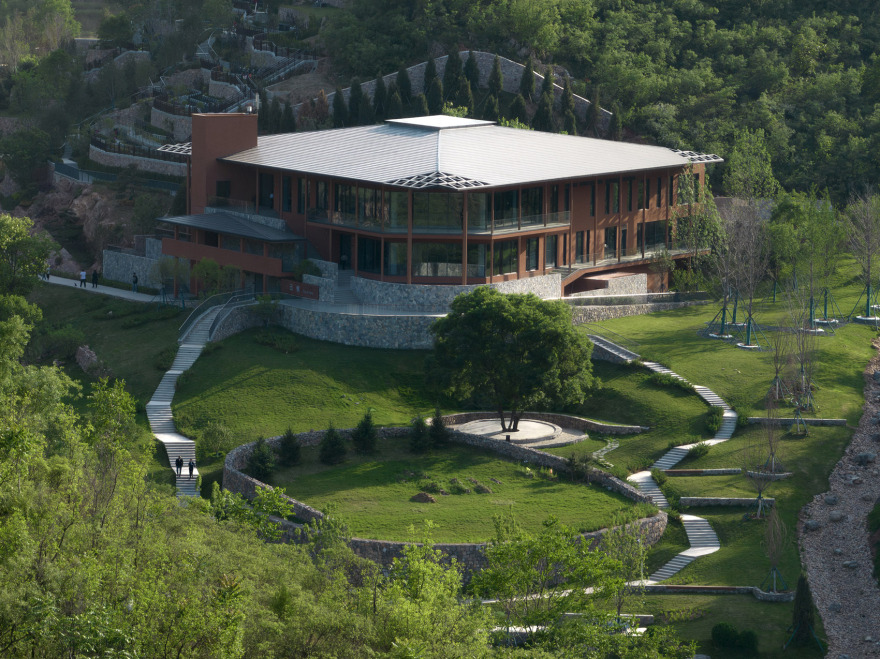
石家庄安德生命纪念公园是一个与死亡话题相关的建筑,作为墓园的服务中心,它承载了特殊的空间情感和文化意义。我们在设计中引入了“星空”意象,但它与此前彭州项目中所呈现的自然星空不同,蕴含了大量中国传统风水的观念。中国古人通过观察日月星辰,总结出如二十八星宿等星象体系,并进一步发展出堪舆学中选址、医学、五行八卦等风水理论。我们希望借此表达两个核心意象:日与月的循环,以及“星宿”与“光”的象征。
Shijiazhuang Ander Memorial Park · Cloud Mirror is an architectural project that engages with the theme of death. As a service center within a cemetery, it carries a unique emotional and cultural weight. In this design, we introduced the imagery of the starry sky, but unlike the natural starry sky used in our earlier Pengzhou project, this one is imbued with profound references to traditional Chinese feng shui cosmology. In ancient China, people observed the movements of the sun, moon, and stars—developing complex astronomical systems such as the Twenty-Eight Lunar Mansions. These systems later evolved into feng shui theories that influenced site selection, medicine, the Five Elements, and the Bagua. Through this reference, we aimed to evoke two core symbolic meanings: the cyclical rhythm of the sun and moon, and the association of constellations and light as metaphors for guidance and continuity.
▼石家庄安德生命纪念公园·云镜,Shijiazhuang Ander Memorial Park ·Cloud Mirror©存在建筑
点击这里查看更多,Click HERE for details

设计中提取了两个基础元素:三角形与圆形。三角形源自对星星形态的抽象(如五角星、六角星等的拆解),用于构建整个屋顶的结构与几何逻辑;圆形则用于地面水景、入口大门,象征天体与循环。同时,为了唤起“星光”的感受,我们通过镂空与光影的策略,在空间中营造出一种既神圣又安静的氛围。最终,通过这些元素的排列组合、对称与复制,建筑表达了我们对中国传统星宿体系与风水思想的理解与转化。
The design draws upon two fundamental geometric elements: the triangle and the circle. The triangle is abstracted from the form of stars—such as the deconstructed shapes of five - pointed and six - pointed stars—and is used to construct the structural and geometric logic of the entire roof. The circle, on the other hand, appears in the reflecting pool and the entrance gate, symbolizing celestial bodies and cyclical order. To evoke a sense of starlight, we applied perforation techniques and a strategic use of light and shadow to create an atmosphere that is both sacred and serene. Through the composition, symmetry, and repetition of these elements, the architecture embodies our interpretation and transformation of traditional Chinese concepts such as the Constellations and feng shui cosmology.
▼石家庄安德生命纪念公园·云镜鸟瞰,Aerial view of Shijiazhuang Ander Memorial Park ·Cloud Mirror©存在建筑


进入安德生命纪念公园,首先映入眼帘的是一个圆形门洞。圆形象征“阴阳”中的“圆满”与“轮回”,门的内外也被赋予了不同的象征意义:门外是人世,门内则是逝者所归之境。我们将这扇门视作一道象征性的“天门”,寓意着从人间通往天上。为此,我们在门口设计了如云朵般的装置,暗示穿越此门即踏入仙境般的场景。门内布局也延续了中国传统关于“天境”的想象。例如入口后的水池,象征天界的瑶池。园区整体依风水而布置:两山环抱、一水在前,中轴线上是一棵繁茂的大树,仿佛一颗悬空的绿色“明珠”。这正与“二龙戏珠”等风水意象相呼应。到了夜晚,云朵装饰在灯光的映照下更加清晰,整座建筑与景观共同营造出跨越世俗、通向另一个世界的仪式感与精神感受。
Upon entering the Shijiazhuang Ander Memorial Park, visitors first encounter a circular gateway. The circle symbolizes wholeness and cyclical rebirth in the yin-yang cosmology. This threshold carries dual symbolic meanings: the outside represents the realm of the living, while the inside leads to the domain of the departed. We conceived this gateway as a symbolic “Heaven’s Gate,” representing the passage from the mortal world to the celestial realm. To reinforce this metaphor, we designed cloud-like installations around the entrance, evoking a dreamlike transition into an ethereal landscape. The spatial arrangement within the gate continues the traditional Chinese imagination of a heavenly realm. For instance, a reflecting pool just beyond the entrance symbolizes the mythical Jade Pond of the celestial world. The overall layout of the park follows feng shui principles: two hills embracing the site, a body of water in front, and a flourishing tree at the center of the main axis—like a suspended green pearl. This echoes traditional feng shui imagery such as “Two Dragons Playing with a Pearl.” At night, the cloud installations become even more distinct under the glow of soft lighting, and the architecture and landscape together evoke a powerful sense of ritual and transcendence—a spatial and spiritual journey beyond the secular world.
▼时空之门与云朵装置,Space-time Gate and cloud device© 存在建筑

关于光影的设计,中部核心区域从地下一层贯通至最顶层,通过一个采光中庭将空间串联起来。阳光从顶部天窗射入,穿过三角形的开口,直达地下最深处。设计不仅引入了自然采光,更寄托着对“通天”意象的表达。尤其在每天中午1点至2点之间,阳光直射而下,光束从天窗倾泻而入,在地面上形成如同碎星般的光影,象征一种新的“人造星空”。为了强化这种文化意象,我们还在中庭设置了一些装置,如“落叶归根”,以表达生命循环与归宿的观念。在建筑二层,光线透过半透明玻璃砖进入室内,折射出细腻而多变的光影,营造出宁静而富有精神性的氛围。在后院,正午的阳光洒在水面上,再反射到建筑表面,随着风的吹动,水波纹与屋顶、玻璃交织出流动的动态光影,让整个空间显得格外灵动与神秘。
The core of the building features a vertically open atrium that runs from the underground level all the way to the roof, connecting the entire interior through a central lightwell. Natural sunlight enters from a skylight at the top, passes through triangular openings, and reaches all the way to the lowest level underground. Beyond introducing daylight, this spatial sequence carries a symbolic expression of “reaching the heavens.” Particularly between 1:00 and 2:00 PM, sunlight pours straight through the skylight, casting radiant beams that scatter into shimmering patterns on the floor—a new kind of manmade starry sky. To reinforce this symbolic imagery, we introduced poetic installations in the atrium, such as one named “Falling Leaves Return to Their Roots”, conveying ideas of life cycles and spiritual return. On the second floor, light filters through translucent glass bricks, refracting into delicate and ever-changing patterns—creating a tranquil, contemplative atmosphere. In the rear courtyard, at noon, sunlight reflects off the surface of the water and bounces back onto the building façades. As the wind stirs the water, the rippling reflections interact with the roof and glass, producing dynamic and shifting light patterns that render the entire space vivid, flowing, and mysterious.
▼中庭被阳光照亮的落叶归根装置与采光天窗三角光影,The atrium is illuminated by the sun© 存在建筑

▼天光点亮追思厅小院,The sky lights up the small courtyard of the Hall of Remembrance© 存在建筑

作为设计者,我们希望通过材质、色彩、造型等元素的组合,激发观者在自身经历、文化背景与情绪基础上的自由联想与理解。
“As designers, we seek to combine material, color, and form in ways that stimulate free associations and personal interpretations—rooted in the viewer’s own experiences, cultural background, and emotional state.”
意象建筑与具象建筑有着本质的区别。我们的目标并不是让所有人得出相同的理解,而是通过建筑进行引导。作为设计者,我们希望通过材质、色彩、造型等元素的组合,激发观者在自身经历、文化背景与情绪基础上的自由联想与理解。我们在设计中有意保留大量留白,为不同使用者提供开放性的解读空间。这种“意象”的呈现方式,不是对某种形象的直白模仿,而是一种情境的营造和感知的触发。
Imagery Architecture is fundamentally different from figurative or representational architecture. Our aim is not to lead everyone to the same interpretation, but rather to use architecture as a medium of guidance. As designers, we seek to combine material, color, and form in ways that stimulate free associations and personal interpretations—rooted in the viewer’s own experiences, cultural background, and emotional state. We intentionally preserve ambiguity and openness in our design, leaving room for multiple readings by different users. The expression of “imagery” in this context is not a literal imitation of any specific object or symbol, but rather the evocation of atmosphere and the triggering of perception.
▼服务中心的静思后院丰富的光影,The quiet backyard of the service center is rich in light and shadow © 存在建筑

▼泄入天光的追思厅,Hall of remembrance© 存在建筑

▼云镜夜景,Night view © 存在建筑

来自中国传统诗画的启发
Inspiration of traditional Chinese poetry and painting
我们创作的许多项目都受到中国传统诗画的启发,旨在构建一系列具有文化意象的场景,通过空间语言传达特定的文化表达。我们常将建筑类比为文字,认为它具有与传统汉字相似的表现力与象征性,借此营造出富有意境的文化图景。
Many of our projects are inspired by traditional Chinese poetry and painting, with the aim of constructing a series of culturally evocative scenes that convey specific meanings through spatial language. We often draw analogies between architecture and written language, believing that architecture—like Chinese characters—possesses expressive and symbolic potential. Through this lens, we seek to create spatial narratives imbued with cultural imagery and poetic atmosphere.
▼竹枝书院,Bamboo Branch Academy©存在建筑
点击这里查看更多,Click HERE for details

“在设计初期,我们通常会与使用者或公众建立一种文化上的共识,再以此为基础展开具体的空间构建。”
In the early stages of a project, we often seek to establish a shared cultural understanding with users or the public. This shared foundation then becomes the basis for developing the specific architectural and spatial forms.
诗词歌赋和绘画作品往往能够准确表达人们对于场景的想象与内涵,这种文化表达方式也与我们在设计中所追求的空间意象高度契合。在设计初期,我们通常会与使用者或公众建立一种文化上的共识,再以此为基础展开具体的空间构建。
Traditional poetry and painting often convey vivid imagery and nuanced interpretations of scenes, offering a rich mode of cultural expression that closely aligns with the spatial imagery we pursue in design. In the early stages of a project, we often seek to establish a shared cultural understanding with users or the public. This shared foundation then becomes the basis for developing the specific architectural and spatial forms.
▼竹林七乐意象,Chineseacademy in the forest ©靳金斗-竹林七贤
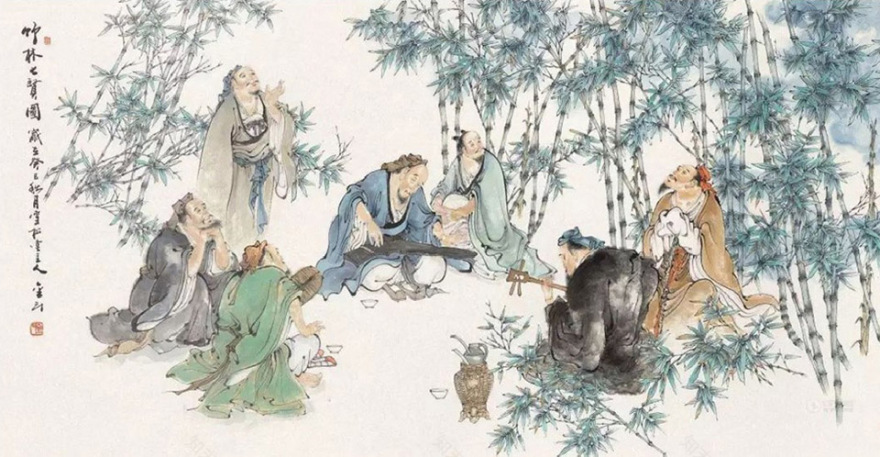
例如我们的“竹枝书院”项目,它融合了书院、禅修、古典音乐与咖啡等复合功能,因此我们希望找到一个既能承载“书”与“音乐”意象,又与中国传统文化紧密相连。经过查阅资料,我们发现“竹枝词”这一词牌名正好契合。它源于唐代诗人刘禹锡在任夔(kuí)州刺史时,基于当地民歌改编而成,具有地域性与文化深度。我们认为“竹枝书院”不仅呼应了项目的功能与气质,也延续了中国传统诗意文化在当代建筑中的表达。
In our “Bamboo Branch Academy” project, the program combines multiple functions—academy, meditation, classical music, and café. We sought a name and image that could encompass both literary and musical connotations while maintaining a strong connection to traditional Chinese culture. Through our research, we discovered the poetic term “Zhuzhici”, which resonated perfectly with our intentions. This was a type of lyric poetry adapted from local folk songs by Liu Yuxi, a Tang Dynasty poet who served as the governor of Kui Prefecture. The form carries both regional specificity and rich cultural depth. We believe the name “Bamboo Branch Academy” not only reflects the project’s functions and atmosphere, but also continues the poetic tradition of Chinese cultural expression within a contemporary architectural context.
▼竹枝书院,Bamboo Branch Academy©存在建筑 点击这里查看更多,Click HERE for details

此外,在项目初期采风时,我们于二月前往现场,发现周围遍布的竹林,正值新竹笋破土而出,银白色的竹笋从浓密的老竹林中钻出,漫山遍野,令人印象深刻。这一场景不仅具有鲜明的季节特征,也唤起了我们对“竹”这一意象的情感共鸣。项目地毗邻著名的蜀南竹海,也是电影《卧虎藏龙》的取景地。考虑到这一背景,我们决定以“竹枝”为核心意象,融合竹林的文化与自然属性进行创作。我们还参考了《竹林七贤图》这幅古画,画中七位文士在竹林中写字、弹琴、饮酒、交谈,展现出人与自然交融的闲适生活状态。这正好契合我们希望在建筑和环境中呈现的多样化使用场景。因此,我们基于这些感知与意象构建了一系列虚拟场景,并在此基础上结合传统川南建筑的特点衍生出多种建筑形式与空间构成,试图以现代建筑语言回应传统文化所蕴含的精神意境。
During our initial site visit in February, we were struck by the bamboo groves surrounding the project. It was the season when new bamboo shoots were just emerging—silver-white shoots breaking through the earth amid dense old bamboo forests, spreading across the hillsides. This vivid seasonal scene left a deep impression on us, evoking an emotional resonance with the imagery of bamboo. The project is located near the renowned Southern Sichuan Bamboo Sea, famously used as a filming location for Crouching Tiger, Hidden Dragon. Taking this natural and cultural context into account, we decided to adopt “bamboo branches” as the project’s core imagery—blending the cultural symbolism and natural qualities of the bamboo forest into the design. We also drew inspiration from the classical painting “Seven Sages of the Bamboo Grove”, which depicts seven literati writing, playing music, drinking, and conversing within a bamboo forest—portraying a serene lifestyle in harmony with nature. This imagery aligned with the kind of multi-sensory, multifunctional environment we hoped to create in both the architecture and landscape. Based on these impressions and symbolic associations, we constructed a series of conceptual scenes and developed multiple architectural forms and spatial compositions informed by the characteristics of traditional Southern Sichuan dwellings. Through this process, we aimed to translate traditional cultural spirit into a contemporary architectural language.
▼竹林书院意象,Chineseacademy in the forest ©仇英-竹林七贤

▼竹枝书院乡土氛围,a rich local flavor©存在建筑

▼禅修书院夜景,night view©存在建筑


小隐的“自然观”
“View of Nature”
我们理解的自然与意象建筑理论密切相关。我们将自然分为两部分,一是人造自然,二是天然存在的自然。中国人更多地讲究顺应自然,因此我们提倡天人合一、道法自然等概念。我们最终希望达到自然融合的状态,应对不同的自然环境。我们更倾向于因地制宜、随机应变,并给出合适的应对策略。
Our understanding of nature is closely intertwined with the theory of Imagery Architecture. We distinguish between two forms of nature: constructed (or artificial) nature and inherent (or untouched) nature. In Chinese philosophy, there is a strong emphasis on harmonizing with nature—concepts such as the unity of heaven and man (天人合一) and following the way of nature (道法自然) are foundational. Ultimately, we aim to achieve a state of natural integration, responding thoughtfully to varying environmental conditions. Rather than imposing uniform solutions, we advocate for contextual adaptation and situational flexibility, providing strategies that are both appropriate and site - specific.
▼龙门山·卧云台,Longmenshan Town · Woyun Platform© 秋语
点击这里查看更多,Click HERE for details

“在意象建筑理论中,有一个核心观点就是建筑的适用性,即建筑放在这个地方,至少绝大部分人认为它是合适的。”
A core principle in Imagery Architecture is the concept of architectural suitability—the idea that a building, when placed in a specific context, is perceived by most people as appropriate.
在意象建筑理论中,有一个核心观点就是建筑的适用性,即建筑放在这个地方,至少绝大部分人认为它是合适的。从它与当地的关联性和建筑周边自然环境的融合性来讲,大家能够达成共识并且符合要求。另外一个要求是符合大家的生活习惯,大家愿意使用和参与其中,我们认为它才是真正适用的建筑。
A core principle in Imagery Architecture is the concept of architectural suitability—the idea that a building, when placed in a specific context, is perceived by most people as appropriate. This suitability is measured by how well the architecture relates to its local context and integrates with the surrounding natural environment. When such harmony is achieved, a sense of consensus and cultural resonance emerges. Another important dimension of suitability is the building’s alignment with local lifestyles and habits—whether people are willing to use it, engage with it, and feel a sense of belonging within it. Only when both contextual relevance and user participation are present do we consider a building to be truly suitable.
▼乡村会客厅,Village Parlor© 秋语

龙门山·卧云台项目位于成都郊区彭州,地理与成都市区截然不同,拥有壮美的山水景观。我们在多次实地考察中发现,当地常年云雾缭绕,呈现出独特的自然氛围。该区域的地质形态源于远古冰川漂砾的地质运动,因此我们在设计中也尝试融入这类自然演化的痕迹。该项目承担着双重功能:一是作为国家大熊猫公园的门户区域,二是承担熊猫香山景区展示中心的职责。由于项目与熊猫生态息息相关,我们在设计中引入了与熊猫密切关联的元素,如竹林意象等,强调自然栖息与生态保护的主题。
Longmenshan Town · Woyun Platform project is located in Pengzhou, on the outskirts of Chengdu, and stands in stark contrast to the urban context of the city with its majestic mountain and water landscapes. Through multiple site visits, we observed that the area is shrouded in mist year-round, creating a distinctive and immersive natural atmosphere. The local geological formation is shaped by ancient glacial moraine movements, and we sought to incorporate these traces of natural evolution into the architectural design. The project serves a dual purpose: first, as a gateway area to the National Giant Panda Park; and second, as the exhibition center for the Xiangshan Panda Scenic Area. Given its strong connection to panda ecology, the design introduces elements closely associated with pandas—such as bamboo forest imagery—to emphasize themes of natural habitat and ecological preservation.
▼龙门山·卧云台,Longmenshan Town · Woyun Platform© 存在建筑

此外,项目地夜晚可见满天繁星,这在受到光污染的成都市区已十分罕见。天然星空成为我们设计中“人工自然”与“人造自然”思考的起点。我们希望无论晴雨,来访者都能感受到这片星空的浪漫与真实。最终我们采用参数化设计的冲孔铝板,打造了一个可穿越的“人造星空顶”,将自然的感动转化为可持续存在的建筑体验。
At night, the site reveals a brilliant canopy of stars—a rarity in the light-polluted urban context of Chengdu. This natural starry sky became the starting point for our exploration of “artificial nature” versus “constructed nature” within the design. We hoped that, regardless of weather—rain or shine—visitors would still be able to experience the romance and authenticity of the stars. In the end, we created a BIM designed perforated aluminum canopy, forming a walkable “artificial starry dome” that transforms the emotional impact of nature into a permanent architectural experience.
▼打造了一个可穿越的“人造星空顶”,forming a walkable “artificial starry dome” ©bpi
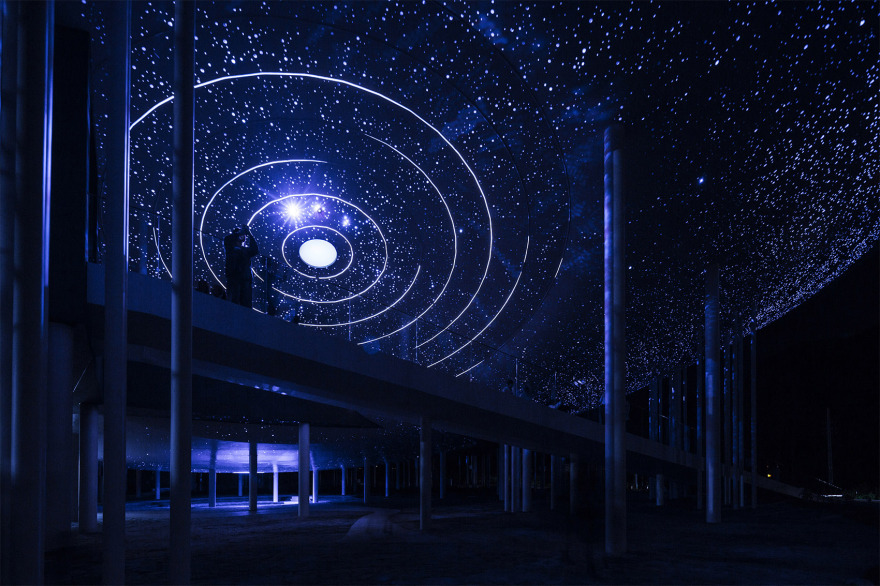

在项目启动前,我们曾深入走访周边村庄,向村民了解他们对未来场地功能的期待。许多村民表达出一个共同诉求:他们希望能拥有一个类似城市中标志性地标的开放性公共空间。村里缺乏大型公共配套场所,也没有可以自由聚集的室外空间。他们希望这里不仅是展示中心,更是一个能让大家日常休憩、活动、交往的“新中心”,如同久远的村口的大树。基于此,我们说服业主采纳“漂浮建筑”的概念,将建筑整体架空,形成一个约3000平方米的开放底层空间。这个架空广场可自由穿行、聚会、玩耍,成为周边多个村庄共享的公共场所。项目落成后,夏日傍晚,这里成为村民饭后常来之地,甚至更远村庄的居民也会步行前来,孩子们在架空层下尽情奔跑,真正实现了“乡村共享空间”的愿景。
Before the project officially began, we conducted in-depth visits to nearby villages to understand the residents’ expectations for the future site. Many villagers expressed a common desire: they hoped for an open public space akin to a civic landmark in the city. Their village lacked large-scale public infrastructure and open areas for communal gathering. They envisioned the site not only as an exhibition center, but also as a “new center”—a place for everyday rest, activity, and interaction, much like the old village tree at the entrance that once served as a communal hub. In response, we convinced the client to adopt the concept of a “floating building”, elevating the entire structure to create a 3,000-square-meter open ground level. This lifted plaza allows for free movement, gathering, and play—forming a shared public space for multiple surrounding villages. Since completion, the space has become a popular destination on summer evenings. Villagers gather after dinner, and even residents from farther villages walk here. Children run freely under the lifted structure—realizing the vision of a “shared rural space” rooted in collective memory and contemporary need.
▼露台,Terrace© ICYWORKS

▼卧云台中游玩的村民,Villagers on the platform©秋语

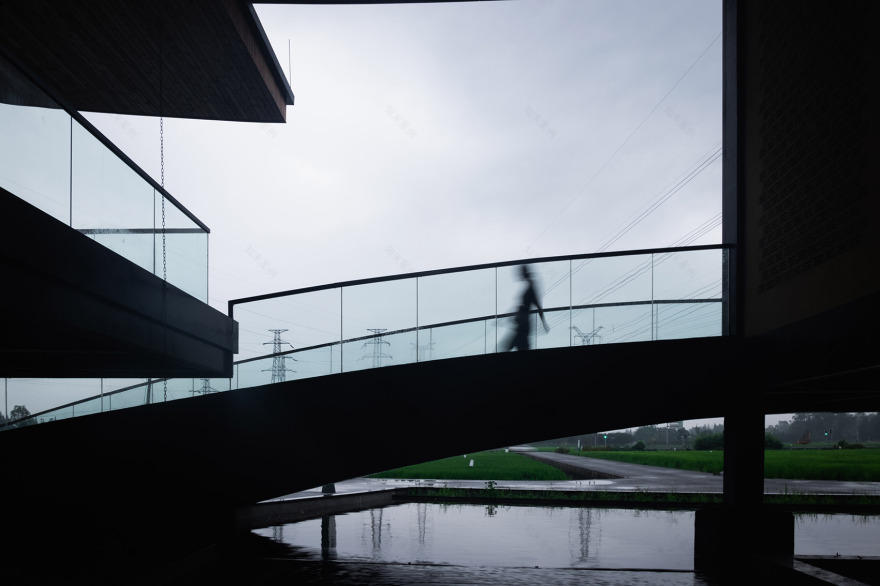
这是我们提出的另一种“自然观”理解:建筑既可以融入自然,也可以从自然中跳脱出来,形成独立的表达。大自然中存在两种美的关系:一种是整体的绿意连绵,另一种则是某一处鲜花在绿叶中脱颖而出,显得格外动人。我们将这种观察带入设计中:比如宜宾项目强调的是“绿叶与绿叶之间”的协调与连续,而彭州项目更像是一朵“鲜花”在绿叶中的点缀,强调对比与突出。这就是我们所理解的自然与建筑的不同融合方式。
This represents another dimension of our understanding of nature: Architecture can either blend into nature or stand apart from it, forming an independent expression. In nature, there are two types of beauty: one lies in the continuity of green, where everything harmoniously extends; the other lies in a single blossom that stands out among green leaves—captivating precisely because of its contrast. We carry this observation into our design thinking. For example, in our Yibin project, we emphasized the harmony and continuity between “green and green”, allowing the architecture to merge seamlessly with its surroundings. In contrast, the Pengzhou project was conceived more like a flower among leaves—a striking accent that stands out against its natural backdrop, emphasizing contrast and distinction. These represent two different strategies for integrating architecture with nature, both valid and meaningful in their own right.
▼中国好粮油展示中心,China Grain Oil Exhibition Center©小隐建筑©大花猫
点击这里查看更多,Click HERE for details


▼屋顶景观平台,sightseeing platform on the roof©大花猫
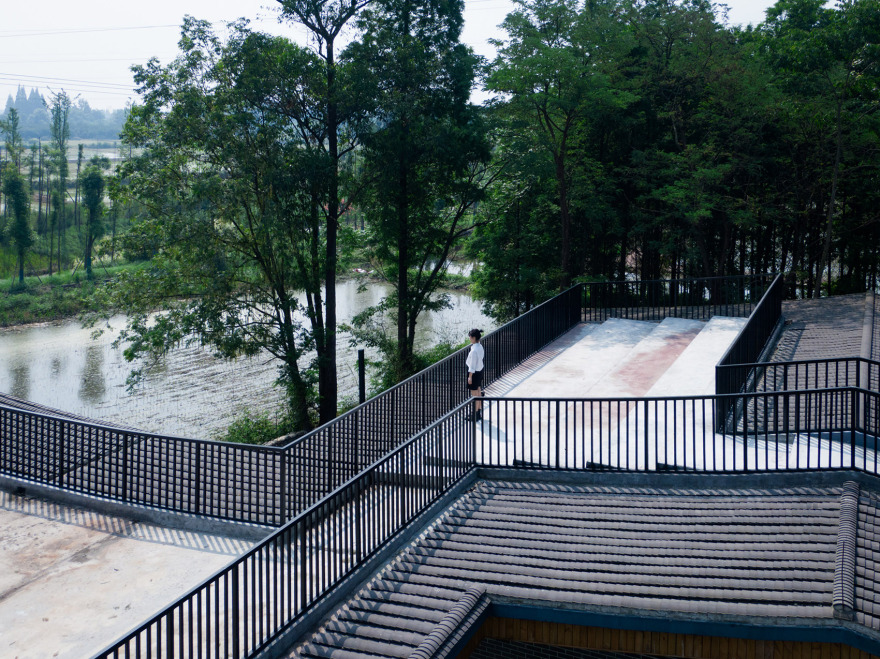
▼入口廊桥,corridor bridge at the entrance©大花猫
___________
关注“在地性”
Pay attention to “locality”
平武项目位于川北,地处山水之间,是以羌族为主的少数民族聚居地。相比之下,泸州项目位于川南,以汉族为主,地理环境、民族构成和生活习惯均有显著差异。川北地势更偏向高原,气候条件也与川南不同。
在平武,我们从产业角度切入,我们希望建筑能作为媒介,推动地方产业发展、改善社区生态,实现更广义的可持续性。平武项目周边遍布青梅,是煮酒酿造中常用的原材料。在多次采风过程中,我们深入了解当地关于青梅加工的传统工艺:家家户户几乎都有青梅烘炕,采用竹编蒸笼将采摘后的青梅逐层码放,通过层叠与火烘的方式进行加工。这一做法体现了地方文化与手工艺的深度融合,也是我们设计的重要灵感来源。整个建筑形态不仅借鉴了羌族民居中典型的碉楼形象,也像是烘制青梅的器具——下方如火炉,上方逐层叠加,形成层层“炕”的意象。材料与形态也呼应当地气候特征。平武降雨量少、气候干燥,羌族传统建筑多采用倒梯形结构和平屋顶,以便晒粮、纳凉或在屋顶上喝茶、聊天。我们延续了这一特征,使酒店屋顶不仅成为地域文化的延续,也为住客提供了夜晚休憩、品酒或咖啡的空间。考虑到造价限制,建筑材料在工艺上做了调整。例如,原羌族民居常用的毛石砌墙,我们以毛石贴片方式还原其质感,以降低成本。夯土墙面也采用仿夯土漆处理,传达材料的厚重感与在地性,同时兼顾施工效率与预算控制。
The Pingwu project is located in northern Sichuan, nestled between mountains and rivers. It is home to a majority Qiang ethnic community, in contrast to the Luzhou project in southern Sichuan, which is predominantly Han Chinese. The two regions differ significantly in geography, ethnic composition, and daily lifestyle. Northern Sichuan tends toward a highland terrain, with a markedly different climate compared to the humid south.
In Pingwu, we approached the design from an industrial perspective, hoping that architecture could serve as a catalyst for local industry, improve the community’s ecological fabric, and realize a broader vision of sustainability. The area is known for its abundance of green plums, a key ingredient in traditional plum wine brewing. During our field studies, we learned about local traditional plum processing techniques: families use bamboo steamers to stack the harvested plums layer by layer, drying them with heat from below. This method reflects a deep integration of craft and culture, and became a core inspiration for our design. The overall architectural form draws from both the typical “Diaolou”(碉楼) and the shape of a plum-drying hearth: the base resembles a hearth, while the upper levels are layered like stacked trays, evoking the imagery of a steaming apparatus.
Materials and form were also adapted to suit the local dry climate. Due to low rainfall and arid conditions, Qiang vernacular architecture often features inverted trapezoidal walls and flat roofs—used for drying grain, cooling, and communal rooftop gatherings. We carried this logic into our design, allowing the hotel rooftop to serve as a space for guests to rest, drink, or socialize under the night sky. Given the budget constraints, material strategies were also adapted: Traditional rough stone masonry was reinterpreted using stone veneers to reduce cost while preserving texture. Rammed earth walls were recreated with rammed-earth-effect paint, conveying the material’s thickness and locality, while balancing construction efficiency and budget control.
▼器物之间与赋象见意:四川平武·梅宿之言,Artifacts and endowing forms, perceiving ideas: Pingwu, Sichuan – Plum villa©存在建筑
点击这里查看更多,Click HERE for details
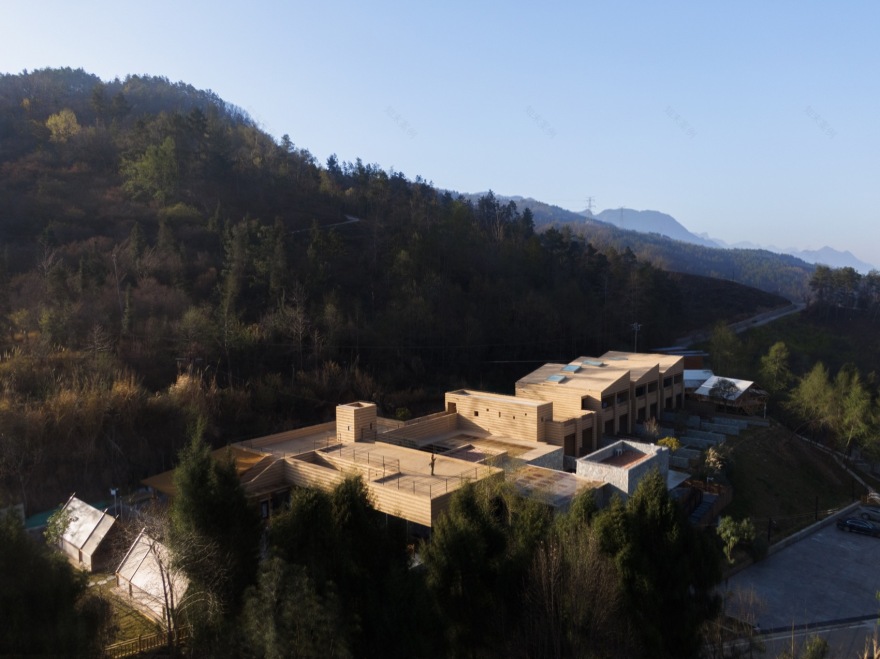

▼源于当地人文的几何体象源,Geometric imagery sources originate from daily life© 小隐建筑

▼梅宿主入口的毛石墙,Rough stone veneer wall at the main entrance© 存在建筑

▼朴素的仿夯土几何体建筑,Plain and concise geometric forms with rammed earth paint© 存在建筑

▼带天窗和落地窗的客房,Skylights and floor-to-ceiling Windows in the room©存在建筑

泸州项目所处位置与平武不同,坐落于万亩茶园之中,自然环境优美。川南的气候多雨,川南民居也与川北截然不同,常见坡屋顶及大挑檐的设计。我们的建筑因此更多地从川南传统民居中汲取灵感,与其建立关系。项目所在地名为“红岩村”,因地表遍布红色砂岩而得名,建筑背后的丹山亦由红岩构成。因此我们在设计中大量引入红岩元素,例如庭院中布置了多块本地采集的红色砂岩巨石,既回应了地貌特征,也增强了场地的识别度。茶园的核心作物是茶叶,其“芽”的形态成为我们屋顶设计的灵感来源。建筑屋面以两片“茶叶”裂开中间挑出观景台的方式呈现,构成独特的体量关系。这一设计不仅回应了茶文化,也为游客提供了一个独特的观景体验。
Unlike the Pingwu project, the Luzhou project is situated within a vast tea plantation, surrounded by lush natural scenery. Southern Sichuan experiences frequent rainfall, and the vernacular architecture differs significantly from that of the north—characterized by pitched roofs and large overhangs. Accordingly, our design drew inspiration from the local residential typology of southern Sichuan, establishing a strong contextual relationship. The site is located in a village called Hongyan (“Red Rock”), named after the reddish sandstone that dominates the terrain. The mountain backdrop is also composed of the same red stone. In response, we incorporated red sandstone elements throughout the design. For example, several large, locally sourced red boulders were placed within the courtyard—both to echo the geological character and to enhance the identity of the site. The core agricultural product of the plantation is tea, and the form of a tea bud became the inspiration for our roof design. The roof volume is composed of two “tea leaves” peeled open, creating a central observation platform. This not only reflects the cultural symbolism of tea but also offers visitors a unique viewing experience from within the architecture.
▼山岫·隐于泸州茶田乡野间的避世民宿,Mountain Retreat©存在建筑
点击这里查看更多,Click HERE for details

▼浓雾中的山岫,Mountain Retreat in the fog©存在建筑

▼山林掩映的山岫,Mountain Retreat hide in the trees©形在空间
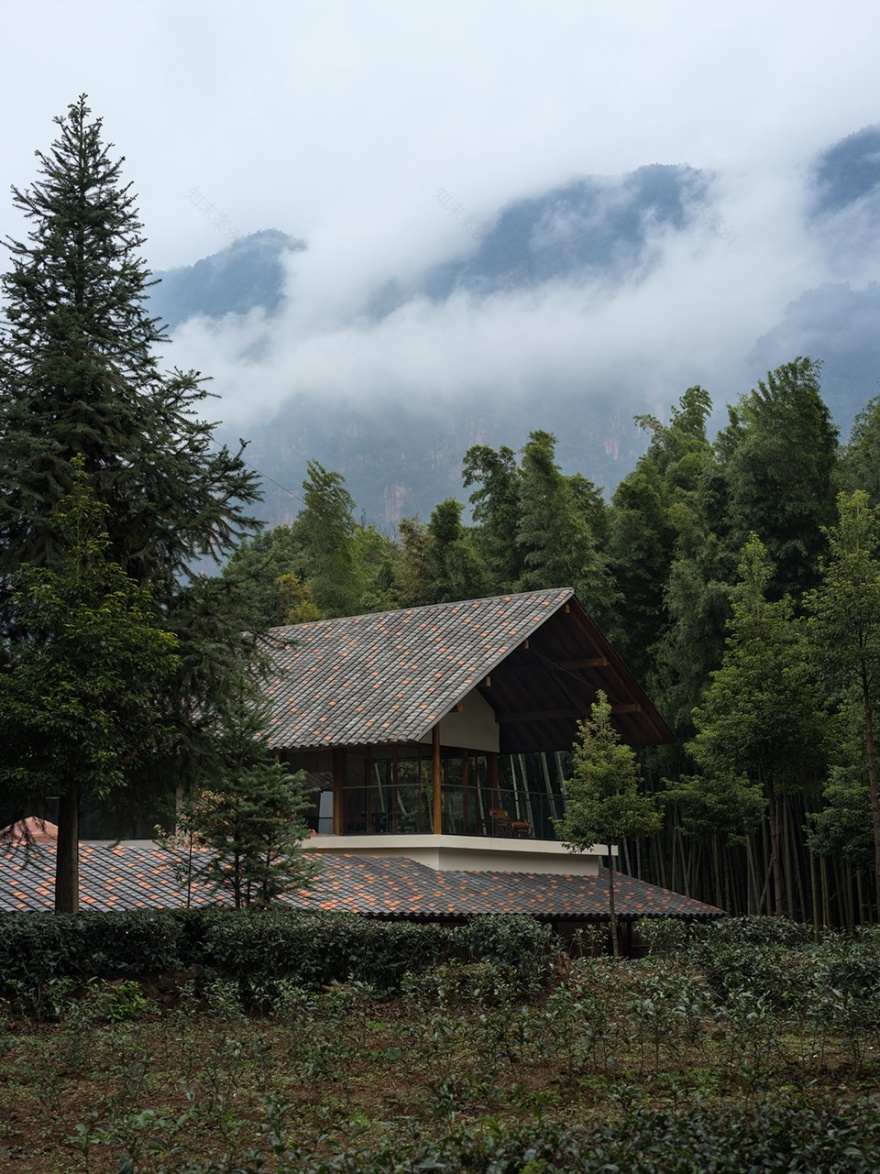

▼山岫接待厅窗景,view form the reception hall window©形在空间

▼一楼带庭院的客房,guest room with courtyard©形在空间

▼夜幕中茶田远望山岫,Mountain Retreat at night©存在建筑

___________
对材料的研究
Research on materials
竹材|Bamboo
我们对竹子材料进行了多年的研究。早在2018年“竹枝书院”项目中,我们就计划采用竹结构,但当时国内竹结构工程技术尚不成熟,因此采用了钢结构结合木结构与原竹的方式呈现。2022年,世园会项目与崇州美术馆项目同时推进,两个项目都希望以纯竹结构呈现。考虑到建成时间较早且体量较小,我们将世园会项目作为初次实践,尝试采用工程竹与原竹结合的结构形式,验证其是否能达到预期效果。
We have conducted years of research on bamboo as a building material. As early as 2018, in the Bamboo Branch Academy project, we had planned to use a bamboo structure. However, at the time, bamboo construction technologies in China were still in their infancy. As a result, we adopted a hybrid approach that combined steel structure, timber components, and raw bamboo elements. In 2022, we began working on two projects simultaneously: the World Horticultural Expo Pavilion and the Chongzhou Art Museum—both of which aimed to use entirely bamboo structures. Given that the Expo Pavilion had a smaller scale and an earlier construction schedule, we selected it as a pilot experiment. In this case, we tested a composite structural system that integrated engineered bamboo and raw bamboo, to assess whether the material could meet our expectations in terms of performance and aesthetics.
▼崇州·竹艺村游客中心,Chongzhou – Bamboo Craft Village Visitor Center©存在建筑 © 小隐建筑
点击这里查看更多,Click HERE for details


▼竹编形式的吊顶,Suspended ceiling © 存在建筑

▼傍晚景色,Project in evening © 存在建筑

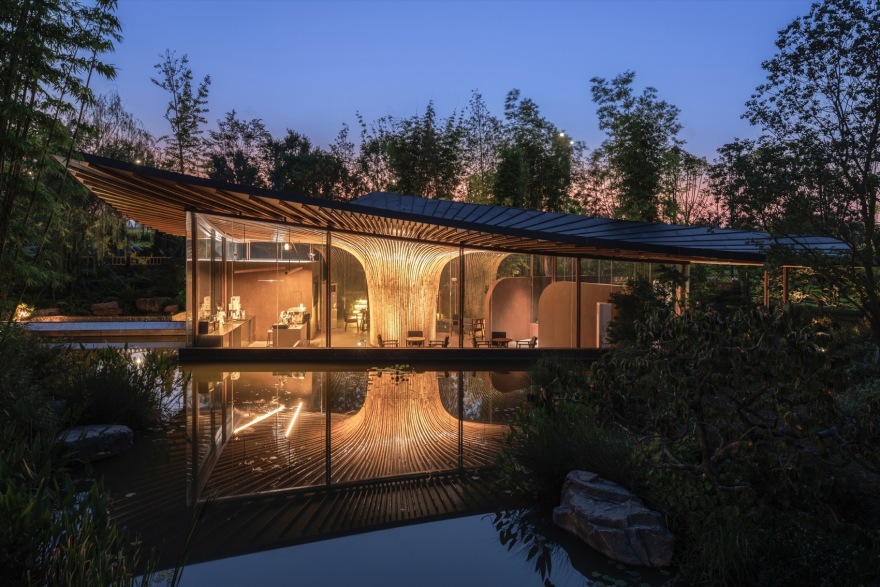
在成都世园会兴城展园项目中,我们在主结构设计上投入了大量心思。起初我们选择了工程竹结构,因为它的性能接近木结构,且在柔韧性上优于木材。竹子本身是纤维材料,具备较好的柔韧性。在屋面设计中,我们采用了工程竹网架结构的表现方式,同时通过辅助的圆竹结构(竹竿)来呈现细节。但由于工期和造价限制,最终竹结构改成了钢结构。为了还原竹结构的视觉和感受,我们对钢结构细节进行了特殊处理,比如将方形钢柱拆分成四根小圆管组合,模拟竹子的形态。室内部分则大量使用了原竹作为装饰材料,但这些竹材并不承担结构受力,仅起到装饰美化和文化传达的作用。
In the 2024 Chengdu International Horticultural Expo – Xingcheng Exhibition Garden project, We devoted significant effort to the design of the primary structural system. Initially, we chose engineered bamboo as the main structure due to its comparable performance to timber and superior flexibility. As a fibrous material, bamboo inherently possesses excellent tensile and bending properties. For the roof, we envisioned an engineered bamboo space frame, supplemented with round bamboo poles to express finer structural and aesthetic details. However, due to time constraints and budget limitations, we eventually had to replace the bamboo structure with steel. To preserve the visual and tactile experience of the original bamboo concept, we applied special treatments to the steel components—for example, breaking down square steel columns into bundles of four smaller round pipes to simulate the segmented form of bamboo. In the interior, raw bamboo was extensively used as a decorative material. While these bamboo elements are non-structural, they play an important role in enhancing atmosphere and conveying cultural symbolism.
▼2024成都世园会兴城展园,The 2024 Chengdu International Horticultural Expo – Xingcheng Exhibition Garden©存在建筑
点击这里查看更多,Click HERE for details


▼主体结构与原竹结构,main structure and bamboo structure© 小隐建筑


▼室内竹结构,Interior bamboo structure© 存在建筑

▼夜景,Night view© 存在建筑
同期进行的崇州美术馆项目是一个政府主导的农业相关工程,要求建筑能够充分体现中国传统农耕文化的精髓,并传达川西林盘的地域特色。更为重要的是,该项目位于国家级非遗“道明竹艺村”,竹艺村专注于竹编技艺与工艺的传承,他们希望将这一传统手工艺完整融入建筑设计中。我们的首要任务是理解并体现中国传统农耕文化的核心诉求。中国数千年的农业文明中,最重要的便是“二十四节气”。
The Chongzhou Art Museum, developed concurrently, is a government-led project tied to local agriculture. The building was expected to fully embody the essence of traditional Chinese agrarian culture while expressing the regional identity of the Western Sichuan Linpan landscape. More importantly, the site is located in the Daoming Bamboo Weaving Village, a nationally recognized Intangible Cultural Heritage site dedicated to the preservation of traditional bamboo weaving crafts. The client expressed a strong desire for the integration of bamboo craftsmanship into the architectural design in an authentic and holistic way. Our primary task was to understand and respond to the core values of traditional Chinese farming culture. Within China’s agricultural civilization spanning thousands of years, perhaps the most profound and structured cultural system is the “Twenty-Four Solar Terms.”
▼竹庭·乡村美术馆,Zhuting Rural Art Museum© 小隐建筑


▼竹庭·乡村美术馆剖面,Zhuting Rural Art Museum section© 小隐建筑

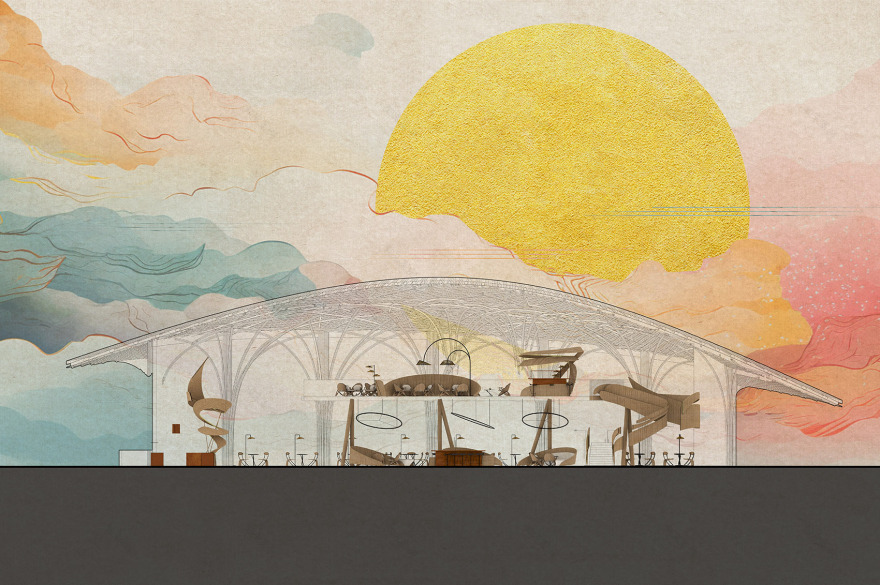
我们认为“观天象”在农耕文化中具有极其重要的意义,它是几千年来指导农事活动的核心手段,“二十四节气”便是观天象所得到的重要成果。因此,在本项目中,日、月、星辰被视为最关键的设计意象。我们将这些自然元素转化为建筑语言,设计从以下几个层面展开:首先,是太阳与月亮的象征,我们将“日月”意象与川西民居的瓦屋面结合,两个圆形构成一个巨大的环形屋顶。这一设计既呼应了地域文化,又能直观呈现太阳和月亮的形象。其次,川西民居传统的方形院落被我们转化为圆形的内院,并嵌入竹编结构元素,通过单元拆解,最终构成整个建筑体系。
We believe that “observing celestial phenomena” holds profound importance in traditional agricultural culture—it has served as the fundamental method for guiding agricultural activities over thousands of years. The Twenty-Four Solar Terms are one of the most significant outcomes of this practice. Accordingly, in this project, the sun, moon, and stars were conceived as the primary design imagery. These natural elements were transformed into architectural language across several layers: First, to symbolize the sun and moon, we combined the imagery of celestial bodies with the tiled roofs of traditional Western Sichuan dwellings. Two circular roof forms merge into a monumental ring-shaped canopy, simultaneously referencing local vernacular architecture and representing the sun and moon in a direct and symbolic way. Second, the square courtyard—a typical feature of Western Sichuan houses—was reinterpreted as a circular inner courtyard. Within it, we embedded woven bamboo structural elements, which were further deconstructed into modular units, ultimately forming the basis of the entire architectural system.
▼竹庭·乡村美术馆,Zhuting Rural Art Museum© 小隐建筑


在该美术馆项目中,竹子被应用于多重结构体系的构建。我们采用了三重结构方式来呈现竹在建筑中的多样性和表现力:第一重为主结构,采用工程胶合竹作为主要受力构件,结构隐藏于整体体系之中,承担建筑的基本荷载;第二重为辅助结构,应对屋檐大尺度悬挑的需求,采用原竹结构进行受力支撑;第三重为装饰结构,以竹编形式强化空间的文化意象和视觉效果。整体结构系统由内至外层层递进,使得整个建筑空间看起来如同置身一个巨大的“竹编容器”,室内外空间都延续了这种编织语言。
In the Chongzhou Art Museum, bamboo was applied across multiple structural systems, showcasing its versatility and expressive potential in architecture. We adopted a three-tiered structural strategy to articulate different layers of bamboo usage: Primary Structure: Engineered laminated bamboo was used as the main load-bearing framework. This structural layer is concealed within the architectural envelope and carries the building’s fundamental loads. Secondary Structure: To accommodate the large roof overhangs, we employed raw bamboo as a visible support system. This auxiliary layer provides structural reinforcement where needed. Tertiary Structure: As a decorative system, we used woven bamboo screens to reinforce cultural imagery and enhance the spatial atmosphere. These three layers progress from inside to outside, forming a unified architectural system that makes the entire building feel like a woven bamboo vessel. The weaving language is extended seamlessly across both interior and exterior spaces, creating a coherent and immersive spatial experience.
▼竹庭·乡村美术馆,Zhuting Rural Art Museum© 小隐建筑


该项目对竹材性能提出了极高要求,尤其在防火性能方面,传统原竹难以满足,这也是当前竹结构在国内尚未广泛推广的重要原因。为此,我们与浙江竹境竹业科技有限公司展开合作,专门攻克竹材防火难题。尽管该公司此前已进行半年左右的研究,但始终缺乏实际落地的契机。此次美术馆项目为其提供了高标准实践平台,最终促使他们在三个月内实现技术突破,使所用竹材达到国家B1级防火标准。这项成果不仅满足了本项目的使用需求,也为未来中国原竹结构的建筑应用提供了更多可能。如果这一技术实现开源或推广,未来将有望推动原竹建筑在全国范围的广泛建设与实践。
This project imposed exceptionally high performance requirements on bamboo, particularly regarding fire resistance—a key limitation that has hindered the widespread adoption of bamboo structures in China. To address this, we collaborated with Zhejiang Zhujing Bamboo Technology Co., Ltd. to tackle the fireproofing challenges of natural bamboo. Although the company had been conducting research for about six months, they had not yet found a suitable opportunity for real-world implementation. The Chongzhou Art Museum offered a high-standard testing ground, prompting a major technical breakthrough: within three months, the team successfully upgraded the bamboo material to meet the B1-Level Fire Retardant Standards. This outcome not only satisfied the performance requirements of the museum project, but also paved the way for the broader architectural application of raw bamboo in China. Should this technology become open-source or more widely disseminated, it holds great potential to catalyze the large-scale development of bamboo architecture nationwide.
▼竹庭·乡村美术馆施工照片,Construction photo of Zhuting Rural Art Museum© 小隐建筑


聚碳酸酯板|Polycarbonate
我们目前专注于小而精的建筑实践,项目体量普遍较小。我们倾向于在材料选择上保持尽可能的统一,以应对造价控制与施工可行性等现实问题。不同项目在构造方式上虽有所区别,但材料系统尽量简洁、清晰。我们尤其重视材料成本,面对半永久性或临时性空间和建筑体时,会根据功能性质与实际需求制定相应的材料策略。聚碳酸酯板是我们自2019年开始重点关注的一种材料。为此我们投入了大量时间与精力进行系统研究,并于2020年在成都麓湖举办了一场展览,展出的装置使用了不同规格、构造方式以及不同特性的聚碳酸酯板材料,作为一种实验性的呈现。
Currently, we focus on small-scale yet refined architectural practices, with most of our projects being relatively compact in size. We tend to maintain a unified material palette whenever possible, in response to practical constraints such as budget control and construction feasibility. Although the construction methods vary from project to project, the material systems are kept as concise and straightforward as possible. We place particular emphasis on cost-effectiveness, and for semi-permanent or temporary buildings and spaces, we develop tailored material strategies based on functional characteristics and actual needs. One material we have been particularly focused on since 2019 is polycarbonate panels. We have invested considerable time and effort into systematic research of this material, culminating in a 2020 exhibition held in Chengdu’s Luxelakes. The exhibition featured a series of installations exploring various types, structural systems, and performance characteristics of polycarbonate panels—serving as an experimental showcase of its architectural potential.
▼西南独立建筑师跨界联展 – 混沌意象,Southwest Independent Architects Group Exhibition——Chaotic Image© 小隐建筑 点击这里查看更多,Click HERE for details
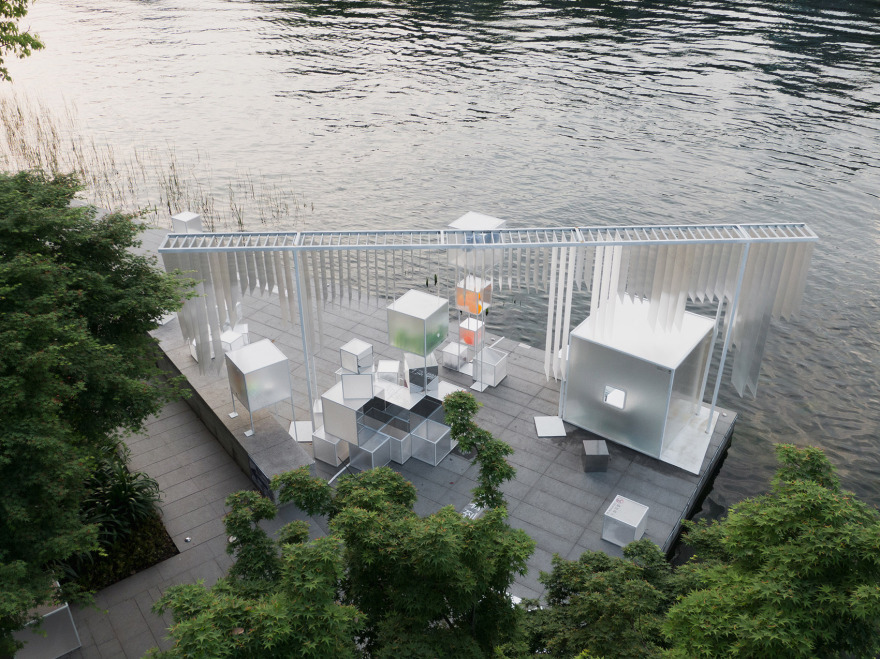
通过灯光与材料结合,聚碳酸酯板呈现出多种视觉效果,涵盖了不同的透明度、表面纹理及结构类型。例如白天展现出清透、磨砂、波纹、朦胧等多样的视觉质感;夜晚则通过灯光组合,进一步强化了材料的多样呈现。在这一系列研究基础上,我们在青龙湖项目中实现了更大尺度的建筑实践。新建的建筑中,一栋采用了全阳光板屋顶,结合精巧的钢结构,营造出类似“亭子”的空间感;另一栋则用于农业水培植物栽培,对光线要求较高。为了避免夏季强烈日照对植物生长产生影响,例如光照过强引起高温和蒸发速度过快,我们根据功能需求,采用不同聚碳酸酯板的组合材料来调控光照条件,实现遮阳、透光与温控的综合平衡。
Through the combination of lighting and material, polycarbonate panels reveal a variety of visual effects, encompassing different levels of transparency, surface textures, and structural types. During the day, the material presents diverse visual qualities such as clarity, frost, ripples, and haze. At night, these effects are further enhanced through the use of artificial lighting, emphasizing the material’s versatility and expressive potential. Building on this series of experiments, we implemented a larger-scale architectural application in the Qinglong Lake project. In the new construction, one of the buildings features an entirely polycarbonate panel roof, paired with a delicate steel structure to evoke the spatial sensation of a lightweight pavilion. Another building is designed for agricultural hydroponic cultivation, where controlled lighting is crucial. To address the intense summer sunlight—which can lead to overheating and rapid evaporation—we strategically combined different types of polycarbonate panels based on the programmatic needs. This allowed us to fine-tune the balance of shading, light transmission, and temperature regulation.
▼西南独立建筑师跨界联展 – 混沌意象,Southwest Independent Architects Group Exhibition——Chaotic Image© 小隐建筑
点击这里查看更多,Click HERE for details


虽然该装置呈现出丰富的视觉效果,其结构和技术逻辑却非常简单。阳光板具有良好的折射特性,我们通过6块不同种类的阳光板叠合使用,在仅设置一条灯带的情况下,通过多面折射在空间中形成立体光效。每个“灯盒”都基于相同逻辑构成,凸显了材料本身的性能优势。红砖在我们的项目中使用相对较少,但在本项目中得以大量采用,主要是因为场地原为养猪场,拆迁过程中回收了大量红砖。我们将这些旧砖用于铺设地面和局部外墙装饰,实现资源的再利用。
Although the installation delivers a rich visual experience, its structural and technical logic is remarkably simple. Polycarbonate panels offer excellent refractive properties. By layering six different types of panels together and placing just a single strip of lighting, we achieved a three-dimensional light effect through multi-surface refraction. Each light box follows the same construction logic, highlighting the performance potential of the material itself. Red bricks, which are rarely used in our other projects, were employed extensively here. The site was formerly a pig farm, and a large number of bricks were recovered during demolition. We reused these old bricks for paving the ground and decorating parts of the external walls, embodying a strategy of resource reuse.
▼青龙湖·漂浮种子,Qinglong Lake · Floating Seeds© 小隐建筑


“我们对材料的研究,核心目的在于推动和激活当地产业的发展。”
Our core intent behind material research is to stimulate and support the development of local industries.
我们对材料的研究,核心目的在于推动和激活当地产业的发展。虽然此前提到的两个材料案例源于我们的兴趣探索,但更多时候,我们希望通过建筑项目带动地区的产业升级。例如我们曾在彭州推进一个项目,投入了大量精力进行相关材料研究,遗憾的是,项目最终因用地问题未能落地。该项目周边的桂花村是当地知名的土陶产地,至今仍保留着七八十家手工作坊,专门从事传统土陶制品的生产,主要产品以廉价花盆为主,整体产业化程度较低。我们希望借助这一项目推动当地土陶产业从基础日用品制造向更具工艺性和艺术性的方向转型,同时尝试引导其进入工程材料领域。
Our core intent behind material research is to stimulate and support the development of local industries.While the two previously mentioned material cases stemmed from our personal curiosity and exploratory interests, more often, we aim to leverage architectural projects to drive regional industrial upgrading. For example, in Pengzhou, we once initiated a project that involved extensive research on related materials. Unfortunately, due to land use issues, the project was never realized. The surrounding Guihua Village is a well-known center for traditional earthenware, home to 70–80 small workshops still engaged in producing handmade pottery—mostly low-cost flower pots. The overall level of industrialization remains low. Through this project, we hoped to promote a transition from basic household goods to products with greater craftsmanship and artistic value, while also exploring pathways for earthenware to enter the field of construction materials.
▼彭州市龙门山湔江河谷生态旅游区,Pengzhou Longmenshan River Valley Ecological Tourism Zone© 小隐建筑
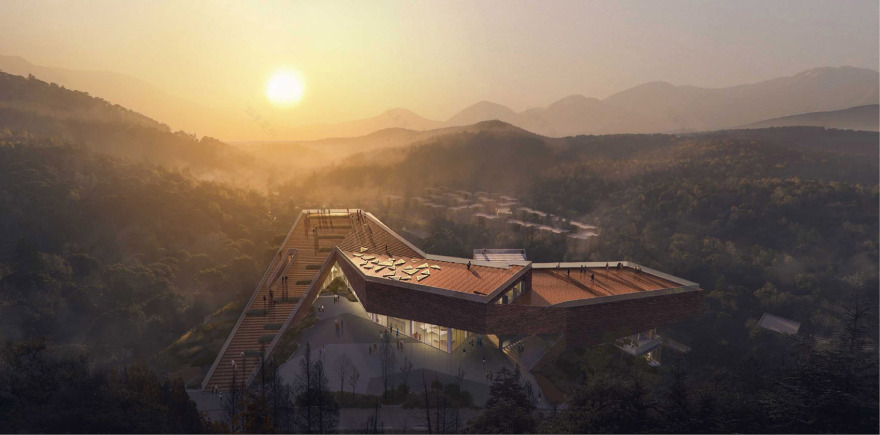

我们的设想是将土陶工艺融入整个建筑体系,通过建筑设计与地方产业形成积极联动,推动其文化和产业的双重升级。由于该建筑对材料用量需求较大,我们与当地规模最大的龙窑合作,共同研发各类手工陶板,并顺利完成了相关样品的制作。虽然后来项目没有落地,但是这次研发活动还是给了龙窑一些启发,在整个村落中率先实现了转型升级。他们已不再单纯从事花卉园艺相关的产品,而是专注于手工艺术陶的创作与生产,成为目前当地发展最为成熟的企业。此外,他们还开设了陶艺研学课程,面向成都市区的中小学生开放,提供包括土陶、白陶等传统工艺体验,这也在一定程度上推动了村庄手工业的活化与传承。
Our vision was to integrate earthenware craftsmanship into the entire architectural system, fostering a positive synergy between architectural design and the local industry to promote both cultural and industrial upgrading. Given the large material requirements of the proposed building, we collaborated with the largest local dragon kiln, jointly developing various types of handmade ceramic panels, and successfully produced prototype samples. Although the project was ultimately not realized, this research and development process inspired the kiln operators and enabled them to become the first in the village to undergo industrial transformation. They have since moved away from producing only gardening products and have shifted focus toward the creation and production of artisanal ceramics, making them one of the most mature enterprises in the region today. In addition, they have launched ceramic education programs for primary and secondary school students from Chengdu, offering hands-on experiences with traditional crafts such as earthenware and white ceramics. This initiative has also contributed to the revitalization and preservation of village-based craftsmanship.
▼彭州市龙门山湔江河谷生态旅游区,Pengzhou Longmenshan River Valley Ecological Tourism Zone © 小隐建筑

疯狂而大胆的造梦行动
Crazy and bold dream-making
怒江项目对西藏昌都地区的旅游业带来了显著的促进和发展。该项目地处西藏高原,环境相当恶劣,我们在选址阶段便意识到其建成的可能性极低,因此在设计初期采取了非常大胆的策略,最大限度地回应“72拐”道路的极端条件。
The Nujiang River 72 Turns project has significantly boosted tourism development in the Chamdo region of Tibet. Located on the Tibetan Plateau, the site presents harsh environmental conditions. From the site selection stage, we realized that the likelihood of completing the project was extremely low. Therefore, we adopted a bold design strategy from the outset — one that responded as fully as possible to the extreme conditions of the “72 Turns” mountain road.
▼西藏·怒江72拐大峡谷景区,Nujiang River 72 Turns Canyon Scenic Area , Tibet© 存在建筑
点击这里查看更多,Click HERE for details


▼高空玻璃观景台鸟瞰,Aerial view from the high-altitude glass observation deck © (上图:存在建筑,下图:Chill Shine丘文三映)


▼高空玻璃观景台鸟瞰和跨江高空玻璃吊桥,Aerial view from the high-altitude glass observation deck and Glass suspension bridge across the river©Chill Shine丘文三映

在明确项目要落地建设之后,我们邀请了来自西南交通大学等高校与科研机构的桥梁结构专家和教授共同参与,从结构计算到施工方案组织进行深入研究论证。例如在施工环节,由于西藏地区缺乏内地常见的大型工程机械支持,加之地形限制,运输和吊装受到极大制约。以“天路72拐”所在山道为例,连续的回头弯道限制了13米以上的超长货车通行,而项目所在地又恰好处于怒江峡谷最具代表性的地段——老虎嘴——其高度限制更导致4–5米以上的车辆难以通过,造成大型吊装机械无法进场。
Once the decision was made to proceed with construction, we invited bridge structure experts and professors from institutions such as Southwest Jiaotong University to participate in the project. Together, we conducted in-depth studies and verifications covering structural calculations and construction planning. For example, during the construction phase, the lack of large-scale engineering equipment commonly found in inland China—combined with the region’s challenging terrain—imposed severe constraints on transportation and lifting operations. Take the “72 Turns of the Sky Road” as an example: its continuous hairpin bends make it impossible for trucks longer than 13 meters to pass. The project site sits at one of the most iconic sections of the Nujiang Canyon—Tiger’s Mouth—where the height clearance further restricts the passage of vehicles taller than 4–5 meters. As a result, large hoisting machinery could not be brought to the site.
▼怒江大峡谷老虎嘴,Nujiang Grand Canyon Tiger Mouth © 小隐建筑

此外,项目所在地属热河谷峡谷地貌,夏季午后常有强风突袭,尤其在下午2点左右风力骤增。由于平台结构悬空,我们被要求进行风洞实验,以确保平台在极端气候下的结构安全。经过多方联系与筛选,找到了四川唯一具备此类实验能力的单位——西南交通大学,成功协助我们完成了必要的风洞模拟与分析。这成为项目设计推进中的关键节点,为后续施工方案的可行性提供了重要支撑。
In addition, the project site is located in a hot river valley with canyon landforms, where sudden strong winds often occur in the afternoons during summer—especially around 2:00 PM, when wind intensity rapidly increases. Given the platform’s cantilevered structure, we were required to conduct wind tunnel testing to ensure its structural safety under extreme weather conditions. After extensive research and screening, we identified the only institution in Sichuan capable of performing such experiments—Southwest Jiaotong University—which successfully supported us in completing the necessary wind tunnel simulations and analysis. This became a critical milestone in the project’s design development and provided essential support for the feasibility of the subsequent construction plan.
▼钢结构大悬挑的观景台,Steel structure cantilevered observation deck ©Chill Shine丘文三映

▼钢结构大悬挑的观景台,Steel structure cantilevered observation deck © 存在建筑

▼连接两岸的高空玻璃吊桥,A high-altitude glass suspension bridge connecting the two banks ©Chill Shine丘文三映

▼步步惊心挑战桥及观景台夜景,Challenge Bridge andThe Milky Way over the Nujiang River Zipline©存在建筑


项目最艰难的部分其实在于后期的施工过程。2018年底,我们初次踏勘项目现场时,仍是一片原始状态。工人测绘阶段的作业就极为艰难:许多悬崖峭壁根本无法下到地面进行测量,几年前的无人机性能不及如今,因风力过大频繁坠落,无法提供辅助。最终只能通过绳索将工人吊到指定位置进行放线测绘。由于早期资料严重不准确,必须人工重新测量所有点位,再将数据反馈给设计团队,重新调整标高,确保精准建造。
The most challenging part of the project actually lay in the later stages of construction. When we first conducted a site survey at the end of 2018, the area remained in a completely untouched, natural state. Even the initial surveying work was extremely difficult: many of the cliffs were completely inaccessible from the ground for measurement. At the time, drones were not as advanced as they are today—frequent crashes due to strong winds rendered them unreliable for support. In the end, workers had to be suspended by ropes to reach designated locations for line-setting and measurements. Because the early-stage data was highly inaccurate, every point had to be re-measured manually. The data was then sent back to the design team to recalibrate elevations, ensuring precise construction.
▼工人在悬崖上测量放线,Workers measuring and setting out lines on the cliff © 小隐建筑

测绘完成后,进入第二阶段——打桩施工。整个项目以桩基础为主,最深桩达25米。地质条件极其复杂,底层全为坚硬岩石,且岩层变化大、结构不稳定。因为大型机械无法抵达,因此打桩过程主要依赖人力和传统设备。采用的 “水磨钻”的传统打桩方式,仅靠一台小型机器,钻头直径110mm。打桩并非一气呵成,而是在外圈逐圈破碎岩石:先旋转松动石块,再由工人进入直径1.5-1.8米孔桩内将石块绑上绳索,一块块吊出。整个打桩过程持续了7至8个月,期间共更换了13批施工队伍,基础部分才最终完成。整个过程异常艰辛与危险,这段经历,不仅是对工程技术的考验,更是一场对人力意志和耐力的挑战。
After the surveying work was completed, the project moved into its second phase—pile foundation construction. The entire project was based on pile foundations, with the deepest reaching 25 meters. The geological conditions were extremely complex: the subsoil consisted entirely of hard rock, with highly variable and unstable strata. Since large machinery couldn’t access the site, the piling process relied mainly on manual labor and traditional equipment. The construction employed a traditional “water-cooled drill” technique, using a small machine with a drill bit diameter of just 110 mm. The piling process wasn’t continuous; instead, it involved gradually breaking the rock layer by layer from the outer edge inward. First, the rock was loosened through rotation. Then, workers had to enter the narrow pile shaft—1.5 to 1.8 meters in diameter—to tie up the loosened stones and haul them out one by one. The entire piling process lasted seven to eight months, during which 13 different construction teams were replaced before the foundation work was finally completed. It was an extraordinarily grueling and hazardous process—a test not only of engineering technique but also of human willpower and endurance.
▼桩基础的施工,Construction of pile foundation © 小隐建筑
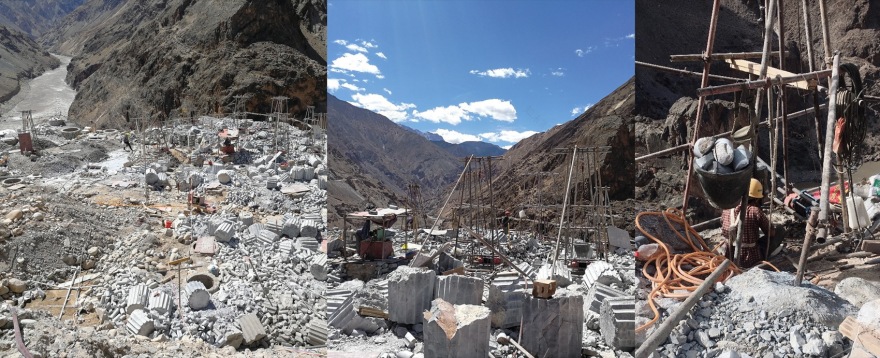
运输材料也是极其艰难的任务。起初,我们采用最原始的方式:先通过土法架设临时钢索,再将小型挖土机和部分物料运送到江对岸。后来安装了人工滑索,人员和物资运输效率才逐渐提升。项目每一个环节几乎都面临极高难度。由于地域交通的限制,浇筑混凝土这件稀松平常之事在怒江也变得异常艰难。距离项目地最近的混凝土搅拌站在八宿县城,相隔40多公里,车程约1个小时。由于搅拌车无法到达怒江南岸,搅拌车载重太重,也无法通过货运滑索过江。为此在怒江上搭建了一座约150米长的钢索便桥,在便桥上铺设混凝土输送专用管道,将混凝土打到对岸。由于管道过长,混凝土输送过程经常发生堵管的情况。一旦堵管则必须在一小时内立即疏通,否则混凝土凝固,就得重新铺设新的输送管道。另外由于搅拌站距离太远,搅拌车运输过程耗费时间久,跨江的输送也非常复杂,所以每一车混凝土都需要争分夺秒,合理安排好整个运输和浇筑流程,稍有不慎延误时间,一车混凝土就报废了。
Transporting materials was an extremely arduous task. Initially, we used the most primitive method: constructing a temporary steel cable system by hand to transport a small excavator and some materials across the river. Later, a manual zipline system was installed, gradually improving the efficiency of personnel and material transport. Every aspect of this project faced extraordinary challenges. Due to transportation constraints in the area, even something as routine as pouring concrete became exceptionally difficult in Nujiang. The nearest concrete mixing plant was located in Baxoi County, over 40 kilometers away—about an hour’s drive. However, the mixing trucks couldn’t reach the south bank of the Nujiang River, and their heavy load made it impossible to use the cargo zipline to cross. To solve this, we built a 150-meter-long steel cable suspension bridge over the river, laying dedicated concrete delivery pipes on the bridge to pump concrete to the opposite bank. Because of the long pipe length, blockages frequently occurred during pumping. If not cleared within one hour, the concrete would set, and new delivery pipes would need to be laid. Additionally, given the long distance from the mixing station and the complicated cross-river transport process, every load of concrete had to be delivered and poured with extreme precision and careful scheduling. Any slight delay could render an entire truckload of concrete useless.
▼材料转运,Material transfer © 小隐建筑
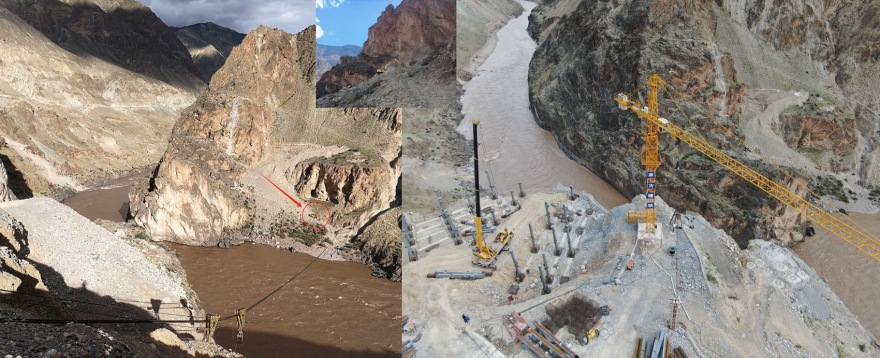

▼川藏公路和景区对比·吊桥,Comparison between Sichuan-Tibet Highway and scenic spots · Suspension bridge ©小隐建筑

“我们希望所有来到此地的游客,不仅能感受到震撼的自然景观,也能了解川藏公路建设的历史,以及参与本项目施工的工人所付出的巨大努力与牺牲。”
Our hope is that every visitor to this place not only feels the awe of the natural landscape but also learns about the history of the Sichuan–Tibet Highway’s construction and the tremendous efforts and sacrifices made by the workers.
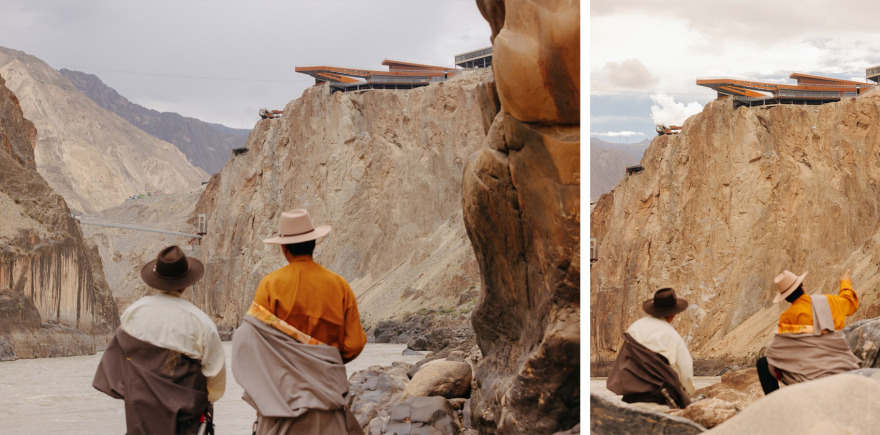
怒江72拐大峡谷景区的设计、建造和游客的游玩体验,都展示了极大的挑战精神,是对创造川藏公路伟大奇迹的一次致敬。所有的设计灵感都来自这条魔幻的景观大道。为了实现项目初衷,我们在项目中自费策划并实施了相关展示内容。一方面,希望重现当年修建川藏公路的军人奋斗历程;另一方面,借助该场地,再现那段艰苦卓绝的施工情境。我们希望所有来到此地的游客,不仅能感受到震撼的自然景观,也能了解川藏公路建设的历史,以及参与本项目施工的工人所付出的巨大努力与牺牲。如今,原本用于工人高危通行的简易滑索设施,已转化为游客可体验的项目。这些设施和布置,真实还原了那些建设岁月的艰辛。
The design, construction, and visitor experience of the Nujiang River 72 Turns Canyon Scenic Area demonstrate a remarkable spirit of challenge and serve as a tribute to the great miracle of the Sichuan–Tibet Highway. All the design inspiration comes from this magical scenic road. To realize the project’s original vision, we independently funded and implemented related exhibition components. On one hand, we aimed to recreate the arduous journey of the soldiers who built the Sichuan–Tibet Highway; on the other, we wanted to replicate the harsh construction conditions of that era on-site. Our hope is that every visitor to this place not only feels the awe of the natural landscape but also learns about the history of the Sichuan–Tibet Highway’s construction and the tremendous efforts and sacrifices made by the workers who participated in this project. Today, the simple zipline once used by workers to navigate dangerous terrain has been transformed into an experiential attraction for visitors. These facilities and installations authentically reproduce the hardships of those monumental construction years.
▼怒江下游悬崖边远眺观景台,The viewing platform on the cliff of the lower reaches of Nujiang River © 存在建筑
许多人质疑我们在西藏开展项目是否会破坏当地环境,实际上,该项目的选址正是我们团队在现场综合考察后慎重决定的。项目背后还规划了约600亩果园。一方面旨在改善生态环境、增加绿色植被;另一方面,也希望为当地旅游发展注入更多内容。游客除了游览观景台与栈道,也可参与采摘或购买本地水果。西藏高海拔地区的日照条件极佳,出产的水果品质可媲美海南或攀枝花等地,而且当地果树基本不施农药、不施化肥,真正实现了绿色无公害。六年来,原本的荒坡已逐渐转化为一片绿色果林。
Many people have questioned whether our project in Tibet might harm the local environment. In reality, the site was carefully selected by our team after a comprehensive on-site assessment. Behind the project, a 600-mu (approximately 40-hectare) orchard has also been planned. On one hand, the orchard aims to improve the ecological environment and increase green vegetation; on the other, it is intended to enrich the local tourism experience. In addition to visiting the viewing platform and boardwalk, tourists can participate in fruit picking or purchase locally grown produce. Thanks to Tibet’s high-altitude environment and excellent sunlight conditions, the fruits produced here are of comparable quality to those from regions like Hainan or Panzhihua. Moreover, the local fruit trees are cultivated without pesticides or chemical fertilizers, truly achieving green and pollution-free farming. Over the past six years, what was once a barren slope has gradually been transformed into a thriving green orchard.
▼怒江南岸山顶的原生绿洲,The original oasis on the mountaintop on the south bank of Nu River © Chill Shine丘文三映

我们更希望,这样的建设不是破坏,而是一种对当地产业的赋能。我们做这个项目的初心,更多是从产业发展角度出发,而非单纯建造一个“建筑”。对于我们而言,建筑是作为设计者必须对自己作品负责的体现;但从更宏观的社会视角看,我们所理解的“可持续”与“绿色生态”并非停留在材料和技术层面,真正的绿色生态,是建筑能够为当地社会、经济和环境创造实际价值——为百姓带来实质利益和长远福祉。
What we truly hope is that such construction does not result in destruction, but rather serves to empower local industries. Our original intention behind this project was driven more by a desire to support industrial development than simply to build an “architectural object.” For us, architecture is a manifestation of the designer’s responsibility toward their work. But from a broader societal perspective, our understanding of “sustainability” and “green ecology” goes far beyond materials and technologies. True ecological sustainability lies in the ability of architecture to generate real value for the local society, economy, and environment — bringing tangible benefits and long-term well-being to the local people.
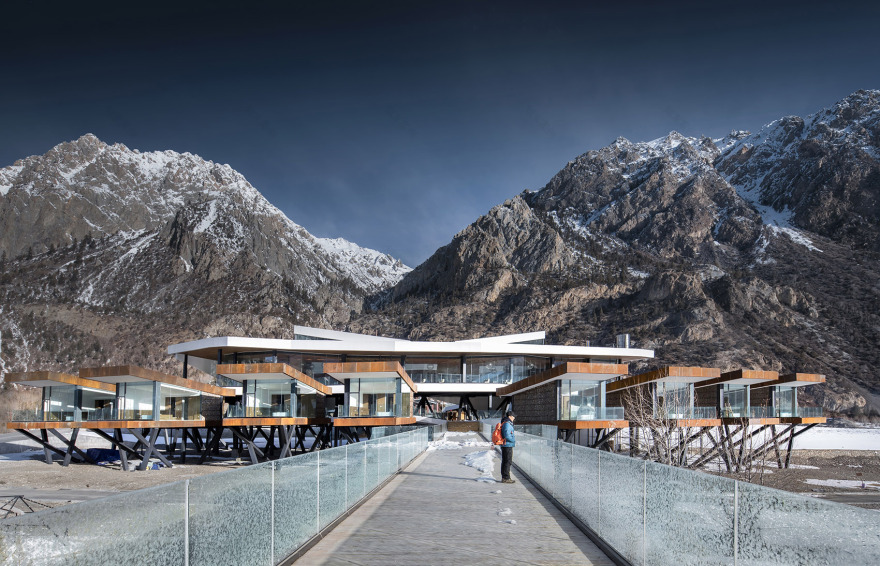
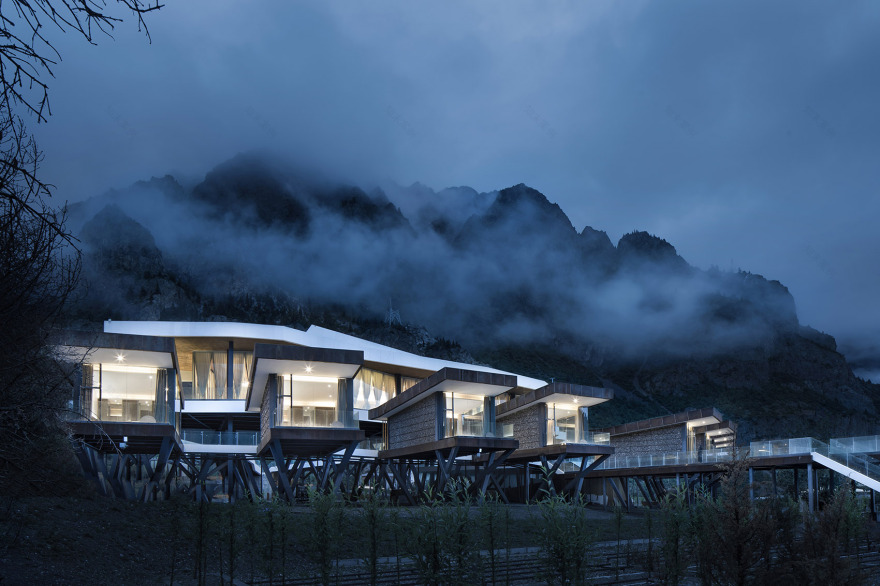
▼然乌湖国际自驾与房车营地,Ranwu Lake (Tibet) International Self-drive Tour and Recreational Vehicle Campsite© 存在建筑 点击这里查看更多,Click HERE for details
“慢工出细活”
“Slow work produces fine results”
中国有句谚语叫“慢工出细活”,这也是我们始终秉持的态度。一个项目若要真正做到高质量呈现,必然需要投入大量的时间、精力与协作。建筑的建造过程本身极为复杂,需要多个专业团队的通力配合,方能完成一个具备品质和深度的作品。在这一过程中,建筑师扮演的是统筹与协调的核心角色。因此,我们始终希望自己所参与设计的项目不仅仅停留在图纸层面,而是能够扎实落地,真正呈现出设计初衷。在建造过程中,我们也愿意深入参与,与各方保持密切沟通,积极推进项目的实现。
There’s a Chinese saying: “Good work takes time.” This reflects an attitude we have always upheld. For a project to be truly high in quality, it inevitably requires a substantial investment of time, energy, and collaboration. The process of construction is inherently complex and demands close cooperation among multiple professional teams to produce work of depth and excellence. In this process, the architect plays a central role in coordination and integration. That is why we have always hoped that the projects we design do not remain confined to drawings, but are realized with integrity and reflect the original design intent. During the construction phase, we are also willing to stay deeply involved — maintaining close communication with all parties and actively facilitating the project’s implementation.
▼施工阶段,Progress of construction© 小隐建筑

结合多年项目实施的经验与教训,我们于2022年正式提出了“施工预警手册”这一措施。“施工预警手册”实际上是一份项目施工过程中的操作指引。我们会针对每个项目中的关键效果或施工难点进行系统梳理,并分阶段提出预警建议。手册根据项目的整体建造流程进行编排,从设计到施工的每一个阶段,清晰地列出应关注的问题与对策。除了完整、详尽的施工图纸外,我们还额外提供这套辅助文件。每个项目的施工预警手册内容通常达到数百页,涵盖施工阶段的各类图纸、深化节点、注意事项等。
以崇州美术馆项目为例,从基础阶段开始就需处理大量复杂预埋与结构接口问题。我们会在手册中通过模型截图配合关键图纸,并附上文字说明,逐项指出在实际施工中可能出现的风险以及需重点把控的细节。这些内容往往是大部分项目在建造过程中都会面临的问题,一旦处理不当,就难以在后期弥补。因此,我们希望通过“预警机制”,在问题发生之前先于现场,提供明确预判和解决策略,以保障设计意图的落地与施工品质的可控性。
Drawing on years of experience and lessons from past projects, we officially introduced the “Construction Warning Manual” in 2022. This manual serves as an operational guide throughout the construction phase of each project. For every key design effect or construction challenge, we systematically identify and outline potential issues, offering stage-by-stage alerts and recommendations. Structured according to the overall construction process, the manual clearly lists critical concerns and corresponding strategies for every phase—from design development to on-site execution. In addition to comprehensive construction drawings, we provide this supplementary document, often running into several hundred pages. It includes annotated diagrams, detailed drawings, key construction nodes, and reminders for on-site attention. For instance, in the case of the Chongzhou Art Museum, complex embedded elements and structural interfaces required precise handling from the foundation stage onward. In the manual, we incorporated model screenshots alongside technical drawings, with written annotations highlighting potential construction risks and areas that demand extra scrutiny. These issues are common across many projects and, if mishandled, are difficult to rectify later. By implementing this “warning mechanism,” we aim to anticipate problems before they arise on site—providing clear forecasts and actionable guidance to ensure the design intent is faithfully realized and construction quality remains within our control.
▼施工阶段,Progress of construction© 小隐建筑

我们采用这一方式的原因主要有两个方面。一方面,从方案深化阶段开始,我们就同步推进“施工预警手册”的内容编写,将关键效果呈现与复杂节点设计纳入模板中。在施工图阶段,我们与施工图团队密切协作,确保问题在设计阶段就得到有效解决。同时也从施工角度出发,思考如何让工人更易于理解与操作,从而提升施工效率和还原度。另一方面,我们通过详尽的预警机制,力求在施工前将潜在问题提前暴露、预判与解决。这种机制是我们的建成项目在完成度和落地效果上都表现优异的关键因素之一。
There are two main reasons why we adopted this approach. First, we begin developing the “Construction Warning Manual” concurrently with the design development phase. Key visual effects and complex construction details are incorporated into a standardized template early on. During the construction documentation phase, we work closely with the technical drawing team to address potential issues within the design process itself. At the same time, we consider construction practicality—thinking from the workers’ perspective about how to make the design more understandable and executable, thereby improving both construction efficiency and fidelity to the original design. Second, through this comprehensive warning mechanism, we aim to proactively identify, anticipate, and resolve potential problems before construction begins. This system has proven to be one of the key reasons why our completed projects consistently demonstrate high levels of precision and quality in their built results.
▼施工阶段,Progress of construction© 小隐建筑

回顾与展望
Review and Prospect
回顾这几年,我们其实只专注于两件事。第一,我们始终认真对待每一个建筑实践项目,将其视作重要的建筑作品,力求在设计和建造过程中尽善尽美。第二,在项目实践之外,我们始终利用空余时间持续打磨和发展我们逐渐形成的建筑思想——“意象建筑”。经过多年探索,这一思想体系已趋于完整。今年我们已发表相关论文,若条件允许,未来也希望能出版专著,并在全国高校进行推广。我们希望提供一种全新的建筑视角与思考路径,探索如何高效且准确地达成建筑目标,并以中国建筑语境为基础,有效融合西方建筑理论,回应功能、文化与情感的多重需求。
Looking back over the past few years, we’ve actually focused on just two things. First, we have treated every architectural project with utmost seriousness—approaching each as a significant work, and striving for excellence in both design and construction. Second, beyond practice, we have continually devoted our spare time to refining and developing our evolving architectural thinking—”Imagery Architecture” After years of exploration, this conceptual framework has taken on a more complete form. Earlier this year, we published a related academic paper, and if conditions allow, we hope to publish a monograph in the future and promote it in universities across China. Our aim is to offer a new perspective and line of thinking in architecture—one that explores how to efficiently and precisely achieve architectural goals while grounding itself in the Chinese context. It seeks to integrate Western architectural theory in meaningful ways, responding simultaneously to function, culture, and emotion.
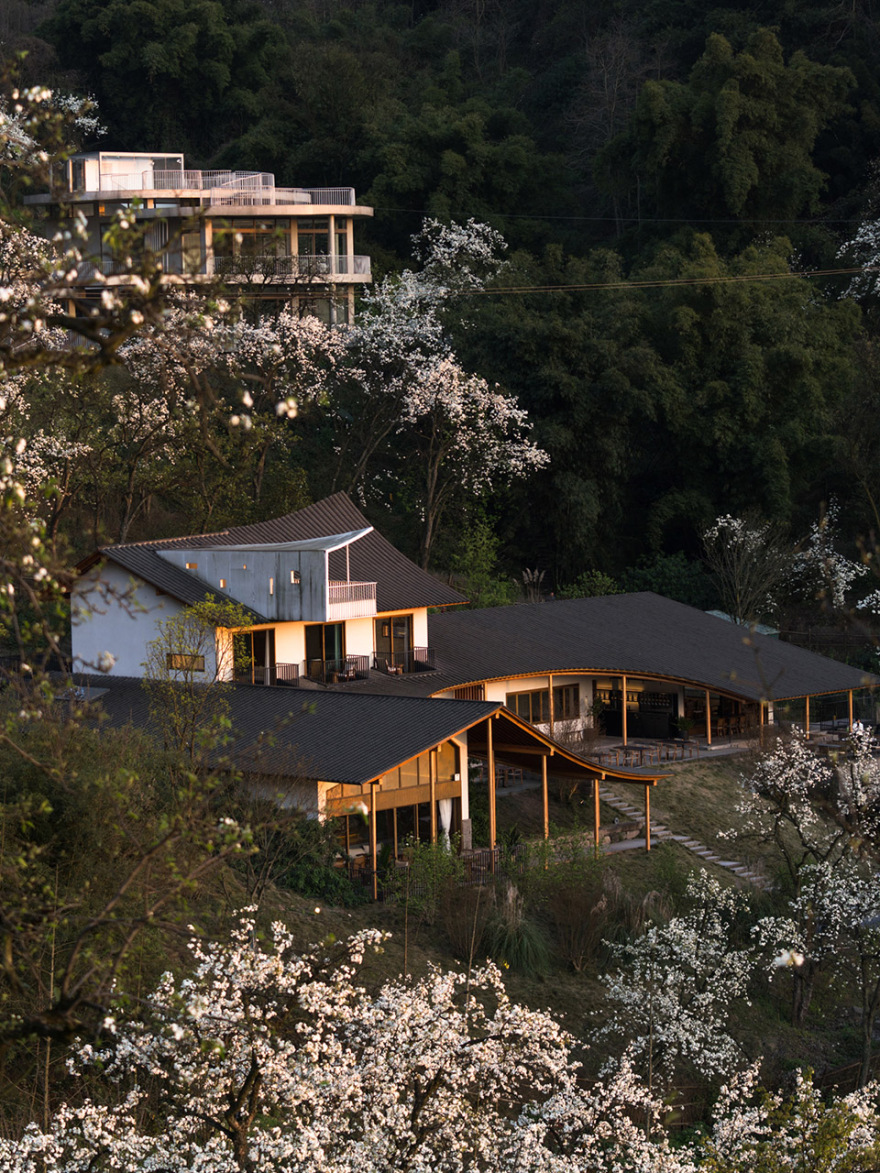
▼泸州·不在山林,Luzhou BUZZY SUNNY project© 小隐建筑

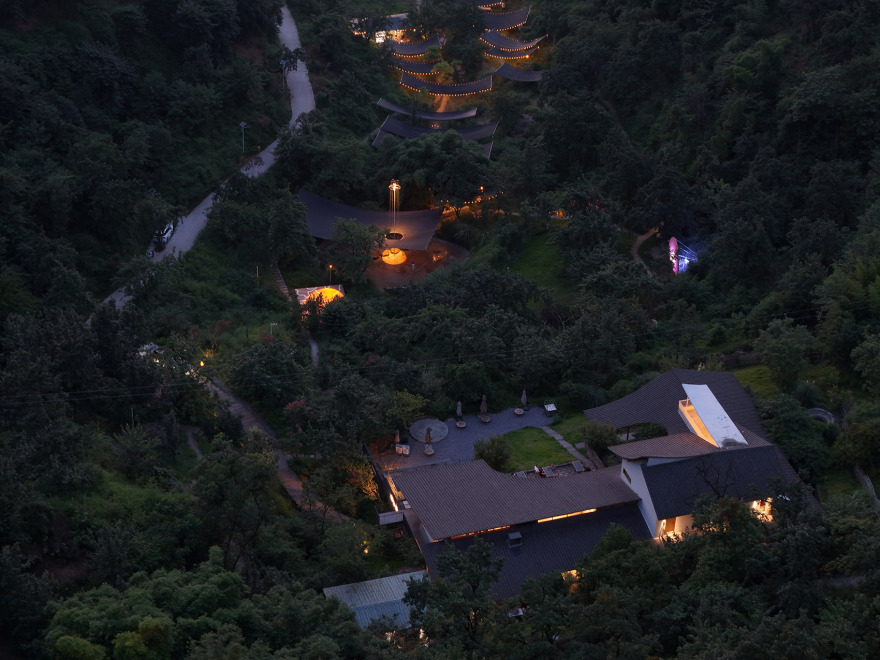
▼泸州·不在山林夜景,Luzhou BUZZY SUNNY project© 小隐建筑


▼室内空间,Interior space© 形在空间

▼泸州·不在山林,Luzhou BUZZY SUNNY project© 小隐建筑

▼泸州·不在山林运营活动,Luzhou BUZZY SUNNY project activities© 小隐建筑

从已完成项目的分布来看,我们大约有一半项目位于乡村地区。这既是我们主动的选择,也有一定的客观因素。在我们看来,乡村与城市最大的不同在于,乡村拥有更为宽松的建筑实践空间,给予我们在法规、体系、建造方式等方面更多的自由度和实验可能性。正是在乡村的这些项目实践中,我们逐渐从以往较为复杂的建筑思维中抽离出来,回归质朴与本真,进而尝试从建筑之外重新审视问题。这些经历也促使我们去做一些自己认为更有趣、更有价值的事情。
Roughly half of our completed projects are located in rural areas—a result of both conscious decision-making and certain objective circumstances. In our view, the key difference between rural and urban contexts lies in the greater flexibility rural settings offer for architectural practice. Compared to cities, villages provide more room for experimentation, with fewer constraints in terms of regulations, systems, and construction methods. It is through these rural projects that we gradually distanced ourselves from overly complex architectural thinking, returning to a sense of simplicity and authenticity. This shift has allowed us to look beyond architecture itself and reassess problems from new perspectives. These experiences have encouraged us to pursue what we find more meaningful and genuinely engaging.
▼跨越千年农耕生活的对谈:新都·百草香庐,Xindu • Herbal Fragrant Cottage ©DONG建筑影像
点击这里查看更多,Click HERE for details

▼建筑屋顶在场地内形成多个民居的效果,The roofs of the buildings create the effect of multiple residences within the site©DONG建筑影像


▼乡村秋色:安岳乾龙·罐子河村农才中心,An Yue Qianlong·Guanzihe Village Agricultural Talent Center ©小隐建筑
点击这里查看更多,Click HERE for details


我们会主动寻求应对的解决方案。泸州·不在山林项目便是典型的案例。出于多年深耕乡村设计实践的经验积累,我们希望从设计出发,进一步深入乡村本身,从现实问题中寻找解决方式,哪怕这些方式并不限于建筑或设计本身。在经历长时间观察与判断后,我们决定亲自介入乡村运营,在2024年国庆以后我们接管了泸州梨花村的项目,拥有了属于我们的小村子,并创立了“不在山林”这个乡村运营品牌。今年我们联合村里三位年长的村民,尝试以手工方式共同搭建一个竹制亭子。这项实验的初衷,正是源于我们多年来在乡村工作中不断观察并积累的问题。此次搭建亭子的目的在于展开一场关于“乡村建造逻辑”的实践实验。这个小型竹亭,总共花费仅2000多元,并由三位村民与我们共同完成整个亭子的搭建。材料方面,竹子从村里邻居老人那里购买,仅有少量铁丝等辅助材料购自村外超市,而该超市也位于泸州市区,未超出泸州范围。我们认为,如果一个项目能够以这样低成本、高参与度的方式真正带动乡村发展,那么这种模式是具有探索价值和发展潜力的。虽然此次只是一个小规模的实验,但它表明未来完全有可能通过提升本地建造比例、让资金更有效地留在村庄,让建筑活动得以持续,从而实现真正意义上的乡村振兴。
We actively seek responsive solutions, and the Luzhou “BUZZY SUNNY” project is a prime example. Drawing on years of experience in rural design practice, we aimed to go beyond architecture itself—using design as a starting point to engage directly with rural realities and seek solutions rooted in the everyday, even if those solutions lie outside the realm of architecture or design.
After a long period of observation and assessment, we decided to personally engage in rural operations. Following the National Day holiday in 2024, we officially took over the project in Pear Blossom Village, Luzhou, establishing a small village of our own and founding a rural operation brand called “BUZZY SUNNY”.This year, together with three elderly villagers, we built a small bamboo pavilion entirely by hand. The idea behind this experiment stemmed from years of fieldwork and accumulated questions about rural construction. The goal was to initiate a practical experiment into “rural construction logic.” The bamboo pavilion, with a total cost of just over 2,000 yuan, was built collaboratively with the villagers. The bamboo was sourced from a neighbor in the village, and only a small amount of iron wire and other auxiliary materials were purchased from a local supermarket in Luzhou city—never exceeding the region. We believe that if a project can truly stimulate rural development through such low - cost, high - participation means, then this model holds both exploratory value and future potential. While this is only a small - scale experiment, it suggests that rural revitalization may be truly achievable—by increasing local construction input and ensuring that capital remains in the village, allowing building activities to sustain themselves over time.
▼田野计划·瓣亭:不在山林,在梨花村,Field Project — Petal Pavilion: BUZZY SUNNY in Pear Blossom Village© 小隐建筑
点击这里查看更多,Click HERE for details

我们不再只追求设计的“实用价值”,而是更希望它能拥有“适用价值”——能够真正嵌入当地现实,并与人发生关系,实现共赢。
“We no longer only pursue the ‘practical value’ of the design, but also hope that it can have the ‘applicable value’ – can be truly embedded in the local reality, and have a relationship with the people to achieve a win-win situation.”
此外,我们还开拓了森林营地烤肉等运营活动,并聘请村中几位年满50多岁的阿姨参与协助,相当于为她们每月提供了稳定的工作机会。我们也负责片区内农田的经营管理。由于园区内设有餐厅、窑烤面包、民宿等,我们尽可能采用“就地取材”的方式,请当地村民协助种植蔬菜瓜果,实现互利合作。我们长期住进村里,与留守在村里的十几位六、七十岁的老人们一起拓展新项目、新场景,为他们带来微薄收入的同时,也陪他们重温了年轻时候的激昂岁月。在百年梨园中,我们拓展大量户外活动场地,植入大量艺术装置和活动,将原有的破败民居重塑成自然研学馆,希望通过一系列的“建筑”将这个村子变为泸州市区近郊的一个“青春社区”,恢复梨花村往日的活力。在这半年多真正深入乡村、与村民日常相处后,我们逐渐意识到:乡村社会的生活方式与城市存在根本差异,他们的生存逻辑、生活观念与我们大不相同。这种深入实践的经历,也促使我们重新审视“设计”在乡村中的实际价值:在乡村语境下,设计的真正作用是什么?它是否真的能如我们预期般带来改变?这些都是我们当前阶段持续思考的问题。
未来,我们希望通过持续的实践与深入研究,探索是否能借助“建筑”这一途径,真正为乡村社会带来改变。我们不再只追求设计的“实用价值”,而是更希望它能拥有“适用价值”——能够真正嵌入当地现实,并与人发生关系,实现共赢。
In addition, we have launched various operations such as forest camping and outdoor barbecues, hiring several women from the village—many in their fifties—to assist with daily tasks, effectively offering them stable monthly employment. We also manage the surrounding farmland. Given that the site includes a restaurant, wood-fired bakery, and guesthouses, we aim to “source locally” by working with villagers to grow fruits and vegetables, establishing a mutually beneficial partnership.
We have since moved into the village long-term, developing new spaces and programs alongside more than a dozen elderly residents in their sixties and seventies. While these new ventures bring them modest income, more importantly, they have rekindled memories of their energetic youth. In the century-old pear orchard, we introduced a wide array of outdoor activity zones and art installations, transforming dilapidated homes into a nature-based learning center. Through a series of “architectural interventions,” we aspire to turn the village into a “youthful community” on the outskirts of Luzhou—one that revives the vibrancy of Pear Blossom Village.
After more than six months of living in the countryside and sharing daily life with villagers, we’ve come to realize that rural life operates on fundamentally different rhythms from the city. Their survival logic and life values differ greatly from ours. This immersive experience has prompted us to critically reflect on the real value of “design” in a rural context: What is the true role of design in the countryside? Can it genuinely bring about the change we imagine? These are the questions we continue to ask ourselves at this stage of our journey.
In the future, through continuous practice and in-depth research, we hope to explore whether we can really bring changes to the rural society through architecture. We no longer only pursue the ‘practical value’ of the design, but also hope that it can have the ‘applicable value’ – can be truly embedded in the local reality, and have a relationship with the people to achieve a win-win situation.
▼与当地居民的共建,Co-construction with local residents© 小隐建筑

与此同时,我们也在思考:如何与当地人建立真实的关系?如何推动村庄产生变化?以泸州的梨花村为例,如果没有“不在山林”介入,这个村庄很可能继续沉寂下去,年轻人不会回来,外地人也不会来到这里。不在山林介入后,情况逐渐发生了变化。村里的老人有了重新参与公共事务的机会。随着这件事情的不断推进,我们开始思考是否可以将所遇到的问题系统整理、记录并出版成书。通过文字的方式将现实暴露出来,也让更多人了解当下乡村建筑与运营中真实存在的困境与可能性。这也意味着,在未来的时间里,我们不再只满足于做建筑设计本身,而是希望能够做更多与之相关、但具有更广阔社会价值的事情。因此,我们成立了“小隐建筑”的衍生品牌“不在山林”,专注于乡村运营这件事情。如果这个品牌运营得当,我们希望未来它能够在全国发展成几十乃至上百个落地项目。这个体系不仅是空间与建筑的落地,更是一个关于地域文化、农产品、饮食交流与共享的平台。如果我们目前在泸州梨花村的项目能取得阶段性成功,它将成为“小隐”未来发展的重要起点。我们会以此为样本,继续在更多地区开展实践,让建筑成为连接城乡、生产与生活的真正媒介。
At the same time, we’ve been reflecting on two key questions: How can we build genuine relationships with local residents? And how can we catalyze meaningful change in the village? Take Pear Blossom Village in Luzhou as an example—without the intervention of “BUZZY SUNNY” the village might have remained silent and stagnant, with no return of the younger generation and little outside interest. But since our involvement, things have gradually started to change. The elders in the village have found renewed opportunities to participate in public life.
As the work progressed, we began considering whether we could systematically document the challenges we’ve encountered and publish them in book form—both to expose the realities of rural life and to help more people understand the difficulties and possibilities involved in architecture and rural operations today. This also means that going forward, we no longer see ourselves as merely designers of buildings. We aspire to engage in work that is adjacent to architecture but carries broader social value. With this vision, we established “BUZZY SUNNY” as a spin-off from our main practice, Archermit, focusing specifically on rural operations. If this new brand is managed well, we hope it will eventually expand into dozens or even hundreds of local projects across the country. More than just physical spaces or buildings, it would become a platform for regional culture, agricultural products, culinary exchange, and community sharing. If our current efforts in Pear Blossom Village prove to be a success, it could mark a critical starting point for Archermit’s future development. Using this as a prototype, we aim to carry out similar practices in more regions—making architecture a true medium that connects urban and rural life, production and everyday living.
▼小隐创始人近照,Archermit funders© 小隐建筑


南京喵熊网络科技有限公司 苏ICP备18050492号-4知末 © 2018—2020 . All photos and trademark graphics are copyrighted by their owners.增值电信业务经营许可证(ICP)苏B2-20201444 苏公网安备 32011302321234号
苏公网安备 32011302321234号客服
消息
收藏
下载
最近