

创作上传
VIP
收藏下载
登录 | 注册有礼
查看完整案例

收藏

下载

分享

翻译

A large mandala-shaped truss constructed from bamboo crowns the central hall of this Buddhist meditation centre in Tibet, designed by Nepalese architecture studio Abari.
Perched atop a mountain about an hour's drive from Nepal's capital, Kathmandu, the Mahamudra Meditation Centre – comprised of a main hall, dining hall and guest house – was created in collaboration with Tibetan Buddhist master Chogyal Rinpoche.

The Mahamudra Meditation Centre contains a 15-metre-tall meditation space
For the design of the main hall, Abari looked to create a contemporary take on stupas – ancient Buddhist structures that originated as domed shrines in India before spreading across southern Asia, where they were adapted to a tiered pagoda style.
Constructed from local and natural materials, including rammed-earth walls and a bamboo-framed roof topped with terracotta tiles and copper panels, the hall's three-tiered structure contains a singular, 15-metre-high meditation space.

A truss shaped like a mandala tops the central hall
Around the base of the hall, bamboo supports rise from 12 rammed-earth piers to form a large, structural truss in the shape of a mandala, which in Buddhism symbolises unity and the universe.
"The stupa-like silhouette, reinterpreted through contemporary materials, anchors the building in Buddhist tradition while signalling renewal," Abari director Nripal Adhikary told Dezeen.
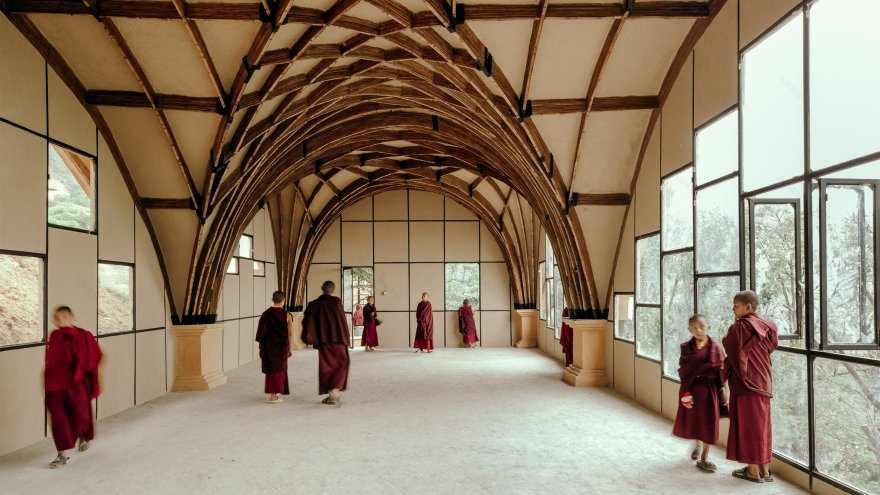
The dining hall at the Mahamudra Meditation Centre is characterised by timber arches
"The rammed-earth walls, made from local soil and hand-plastered with clay, create a tactile, thermally stable environment ideal for meditation," Adhikary continued.
"Above, bamboo trusses unfold in the geometry of a mandala, aligning structure with spiritual meaning."
Narrow, projecting openings in the upper two levels of the hall filter sunlight through latticed screens down into the hall, where a wooden floor has been partially sunken at its centre.
The panels that clad the hall's upper roofs, as well as its decorative pinnacle, were handmade from copper by local artisans, described by Adhikary as bringing a "human, handcrafted touch to a building otherwise defined by elemental mass and geometry".

The meditation hall has a three-tiered structure
Further down the sloping site, the centre's guest house and dining hall were constructed using a wattle and daub technique, with a framework of bamboo filled with earth and rendered in lime plaster.
While the guest house occupies a more conventional, gabled volume, the dining hall is topped by undulating timber arches, and overlooks the landscape through a geometric pattern of rectilinear windows.

The Mahamudra Meditation Centre is perched on a mountainside
Based in Nepal, Abari was founded by Adhikary in 2006, with a focus on promoting sustainable and vernacular building techniques.
Other Buddhist meditation centres featured on Dezeen include a "simple and modern" take on the typology by Design by 83 in Busan, South Korea, which paired traditional elements with contemporary materials and finishes.
The photography is by Chemi Dorje Lama.
南京喵熊网络科技有限公司 苏ICP备18050492号-4知末 © 2018—2020 . All photos and trademark graphics are copyrighted by their owners.增值电信业务经营许可证(ICP)苏B2-20201444 苏公网安备 32011302321234号
苏公网安备 32011302321234号客服
消息
收藏
下载
最近