

创作上传
VIP
收藏下载
登录 | 注册有礼
查看完整案例

收藏

下载

分享
屏东县政府近期选定了MVRDV联合HWC Architects提交的设计方案,对台湾最南端著名景区——佳乐水进行改造。佳乐水以风化与流水塑造的奇特岩石地貌闻名。以一系列以岩石本身为灵感的关键建筑为核心,Nature Rocks提出了一份全面总体规划,旨在强化景区的旅游基础设施,同时尊重自然环境。设计引入新的步道和公共空间网络,改善可达性,并在现有建筑范围内增设小型建筑——包括中央游客中心和三个观景点。
The Pingtung County Government has recently selected the design proposal submitted by MVRDV together with HWC Architects for the transformation of Jialeshui, a well-known scenic area in the southernmost part of Taiwan, known for its remarkable rock formations shaped by wind and water. Based around a series of key structures that take the rocks themselves as inspiration, Nature Rocks proposes a comprehensive masterplan that aims to strengthen the site’s tourism infrastructure while respecting its natural environment. The design introduces a network of new pathways and public spaces, improves accessibility, and adds small-scale buildings – including a central visitor centre and three lookout points – within the existing built footprint.
▼方案鸟瞰,Bird’s eye view © MVRDV


佳乐水位于台湾最南端,是垦丁国家公园内的一个景点,也是台湾少有的保持原始自然状态的区域。经过数千年的风力和海浪冲刷,该地区的软砂岩海岸线被塑造成一系列雕塑般的岩石地貌,其中许多形似动物,并被命名为兔子岩、蟾蜍岩和海豹岩等。这些自然景观使佳乐水成为台湾最知名的地质公园之一。然而,尽管游客众多,该地区的旅游基础设施仍然有限。目前,森林与岩岸之间仅有一条道路隔开——这条狭窄道路为接驳车、行人和自行车共享。沿路点缀的亭子和售货亭已受到台风和海水侵蚀的破坏。
Located in the far south of Taiwan, Jialeshui is a scenic spot within Kenting National Park and, for Taiwan, a remarkably untouched natural area. Over thousands of years, strong winds and sea waves have shaped the area’s soft sandstone coastline into a series of sculptural rock formations, many of which resemble animals and carry names such as Rabbit Rock, Toad Rock, and Seal Rock. These natural features have made Jialeshui one of Taiwan’s most well-known geological parks, yet despite its popularity with visitors, the area has limited tourist infrastructure. Currently, the forest is separated from the rocky shoreline by a single road that cuts through the landscape – a narrow route shared by shuttle buses, pedestrians, and cyclists. The pavilions and kiosks peppered along the road have been damaged by typhoons and seawater.
▼岩石地貌,Rock formations © MVRDV

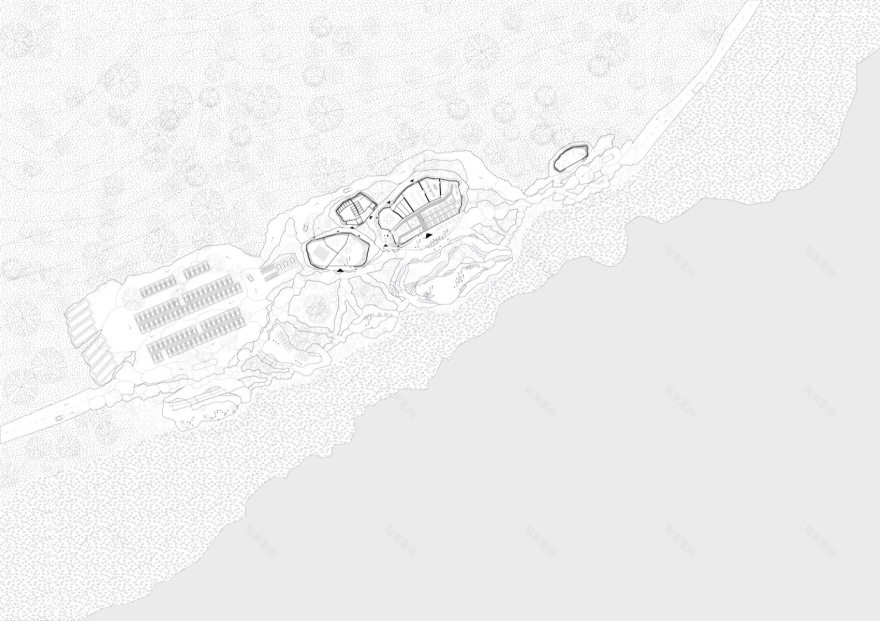
MVRDV的总体规划在提升旧有基础设施的同时,也强化了公园的自然特性。所有新建构筑物将限定在已有开发区域,以避免破坏原有自然景观。设计受海岸线层叠形态的启发,将原本的直线路段拆分,并将休闲步道重新构想为破碎、岩石感的自然景观,将森林与海岸线重新连结。岩石状碎片定义了不同的通行和公共活动区,其中一些向外延伸形成建筑,与当地岩石地貌的自然特征呼应,与周边环境融为一体。
MVRDV’s masterplan replaces and improves the old infrastructure while enhancing the park’s natural identity. All new construction will be confined to areas that are already developed to avoid disrupting the original natural landscape. Inspired by the layered forms of the coastline, the design breaks up the existing straight road and reimagines recreational pathways as a cracked, rocky, naturalistic landscape that stitches the forest and the coastline back together. The rock-like fragments define various zones for circulation and public activities while some are extruded into buildings that echo the natural features of the local rock formations, blending into the surrounding environment.
▼重塑的休闲步道,The redesigned recreational pathway © MVRDV

MVRDV创始合伙人Winy Maas表示:“今天的佳乐水呈现出自然与人工的明显界限;而这条人工步道又将自然自身隔开,将森林与海岸分离。在我们的设计中,人工元素取材于周围自然的形态,像是场地的自然延伸,而非外来的对象。我们的目标从来不是将建筑强加于景观,而是让它从自然条件中生成;打破直线的单调……并强调‘Nature Rocks!’”
“What you see today at Jialeshui shows a clear boundary between the natural and the artificial; in turn, this artificial trail separates nature from itself, separating forest from coastline”, says MVRDV founding partner Winy Maas. “In our design, the artificial elements feel take the shape of the surrounding nature, like natural extensions of the site rather than foreign objects. Our goal was never to impose architecture on the landscape, but to let it emerge from the natural conditions; to break the monotony of the straight line… and to emphasise that Nature Rocks!”
▼设计理念,concept © MVRDV


韧性与再生是佳乐水岩石改造的核心。为帮助管理雨水并减少台风和洪水的破坏,铺装中引入裂缝作为被动排水与保护缓冲。这些裂缝还支持生物多样性,让植物扎根,并为小动物在森林与海岸间穿行提供通道。采用渐变式植被策略,以自然森林形态为框架,森林附近种植高大密集的本土植被,逐渐过渡到靠近海边的耐盐低矮植物。即使建筑表面本身,也将在时间推移中被苔藓和小型植物覆盖扎根——混凝土是唯一适应该场地恶劣条件的材料,其中将回收部分拆除建筑的骨料。
Resilience and regeneration are central to the Jialeshui Rocks transformation. To help manage stormwater and reduce damage from typhoons and flooding, cracks in the pavement are introduced as passive drainage and protective buffers. These cracks also support biodiversity, allowing greenery to take root and creating passages for small animals to cross between forest and shoreline. A gradient planting strategy is adopted, using natural forest formations as a framework. Tall and dense native vegetation is clustered near the forest, gradually shifting to salt-tolerant, low-growing species closer to the sea. Even the building surfaces themselves will, over time, be colonised by moss and small plants that take root in the concrete – the only material suited to the site’s harsh conditions, which will recycle a percentage of its aggregate from demolished buildings.
▼轴测分析图,axo © MVRDV

在公园入口处,三座雕塑般的建筑形成迎宾群体。最大的一座“岩石”容纳游客中心、咖啡厅和纪念品商店。第二座建筑提供展览和环境教育空间,第三座则包含卫生间。主建筑的屋顶可作为观星和全景观赏的露台。入口群体坐落于坡状小高台和广场中,可用于活动、市集或单纯享受景观。
▼项目生成分析,analysis © MVRDV
At the entrance to the park, three sculptural buildings form a welcoming cluster. The largest of these “rocks” houses the welcome centre, a café, and a souvenir shop. A second building provides spaces for exhibitions and environmental education, while the third contains restrooms. The main building’s roof doubles as a terrace for stargazing and panoramic views. This entrance cluster is set within a sloping landscape of small plateaus and plazas designed for events, markets, or simply to enjoy the view.
▼室内空间,Interior space © MVRDV

沿路线的其余部分,现有道路将改造为更适合行人、自行车及接驳车通行的路径,同时明确划分通行与休憩区。在现有景点处设置若干小型“停靠点”:石质观景台、海上观景点和瀑布。每个停靠点都将替换掉过时的设施,设立观景平台、售货亭及其他配套设施。
For the rest of the route, the existing road will be transformed into a more accessible route for pedestrians, cyclists, and shuttle buses, as well as clear zones for movement and relaxation. Several smaller “stops” are positioned at existing points of interest: the stone viewing deck, a sea lookout point, and the waterfall. At each stop, the site’s existing outdated structures are replaced with viewpoints, kiosks, and other facilities.
▼夜览,Night view © MVRDV


通过该项目,MVRDV 展示了沿海地区如何以尊重和可持续的方式进行升级。佳乐水的设计改善了可达性,营造了对游客友好的环境,同时避免过度建设或破坏环境,让自然景观主导场地的未来发展。同时,这也支持了屏东县将佳乐水打造为台湾领先地质公园的目标,强化其作为旅游目的地的身份,同时保留其独特的自然特质。
With this project, MVRDV aims to demonstrate how coastal areas can be upgraded in a respectful and sustainable way. The design for Jialeshui improves accessibility and creates a visitor-friendly environment without overbuilding or disrupting the environment, instead letting natural scenery take the lead in shaping the site’s future. At the same time, it supports the county’s ambition to position Jialeshui among Taiwan’s leading geological parks, enhancing its identity as a destination while preserving the qualities that make it unique.
▼项目平面图,floor plan © MVRDV


▼剖面图,section © MVRDV


Facts
Project Name: Nature Rocks
Location: Manzhou Township, Pingtung County, Taiwan
Year: 2025
Client: Pingtung County Government
Size and Programme: 140 000 sqm, tourist centre, public spaces, kiosks, road design
Credits
Architect: MVRDV
Founding Partner in charge: Winy Maas
Director: Gideon Maasland
Head of Taiwan: Hui Hsin Liao
Design Team: Valentina Fantini, Samuel Tam, Vivian Yang
Copyright: MVRDV Winy Maas, Jacob van Rijs, Nathalie de Vries
Collaborators
Co-architect: HWC Architects
Structural engineer: Cross Structural Engineer & Associates
MEP: LiPeng Professional Electrical Engineer Firm
Surveyor: JengShing Surveying and Mapping Engineering Co., Ltd.
Environmental advisor: D.H. Engineering Consultants Ltd.
南京喵熊网络科技有限公司 苏ICP备18050492号-4知末 © 2018—2020 . All photos and trademark graphics are copyrighted by their owners.增值电信业务经营许可证(ICP)苏B2-20201444 苏公网安备 32011302321234号
苏公网安备 32011302321234号客服
消息
收藏
下载
最近