

创作上传
VIP
收藏下载
登录 | 注册有礼
查看完整案例

收藏

下载

分享
机遇:城市轴线、文化风貌、邻避效应消除
Opportunities: urban axis, cultural features, and elimination of NIMBY effect
项目位于上海市虹口区高阳路与周家嘴路交角,南邻虹口区北外滩,远眺陆家嘴建筑群。项目所在的高阳路多为里弄住宅及仓库旧址,有连绵起伏的红瓦坡屋顶和大片的红砖墙壁,富有历史底蕴。
The project is situated at the intersection of Gaoyang Road and Zhoujiazui Road in Hongkou District, Shanghai, adjacent to the North Bund area in the south and overlooking the Lujiazui skyline. Gaoyang Road, where the project is located, is characterized by its historical lane residences and former warehouse structures, featuring continuous red-tiled pitched roofs and expansive red-brick walls, reflecting a rich historical heritage.
▼鸟瞰营业中的加油站,Aerial view of a gas station in operation©刘国威
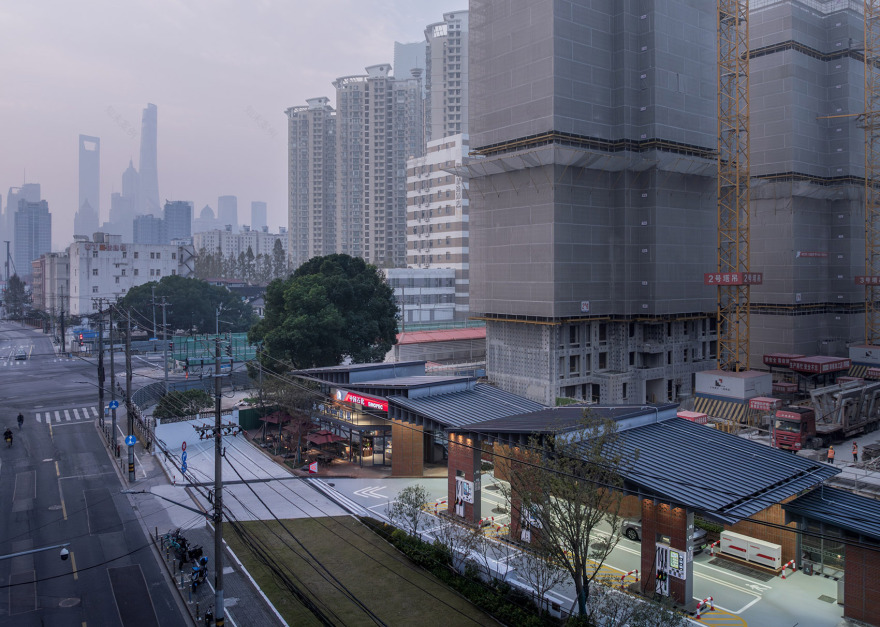
胜利加油站项目处在一个更宏观的城市更新的背景之中。由于道路拓宽、城市发展等要求,原有的加油站的用地面积被缩减,该地块用地又刚好处于区域发展轴线之上,周边地块的功能以住宅和办公为主,难免对于加油站的建筑产生一定的“邻避效应”。这些都给加油站设计带来了更多的机遇、给加油站这一类型承载的意义提出了更多要求:如何更集约的布局、如何完成轴线延续的定位、如何进行适度的文化表达与周围环境的链接以及功能的适度创新。
The Shengli Gas Station project is part of a broader urban renewal initiative. Due to urban development needs such as road widening, the original site area of the gas station was reduced. The site also happens to lie along a key regional development axis, surrounded predominantly by residential and office functions, which inevitably led to a certain degree of “NIMBY effect” regarding the gas station’s presence. These factors posed additional challenges for the design: the gas station typology had to embody broader significance, addressing issues such as more efficient layout planning, continuation of the urban axis, appropriate cultural expression to harmonize with the surroundings, and moderate functional innovation.
▼从高阳路看加油站,View of the gas station from Gaoyang Road©刘国威

本项目提出着力消除“邻避效应”,以积极的姿态融入街区及城市,提出了“城市链接+文化演绎+功能复合”的设计策略,力求打造“服务设施+展览游廊+里弄记忆”三位一体的城市“人+车生活驿站”,将加油站、城市驿站等功能紧密融合。以现代结构演绎的坡屋顶和红砖材质呼应在地文化,以转角咖啡厅融入城市生活,以建筑退让出的公共通廊贯通城市机能,形成特色明确、功能复合的“城市基础设施复合体”。▼分析图,diagram©同济原作设计工作室

This project aims to actively eliminate the “NIMBY effect” and integrate positively into the neighborhood and the city. It adopts a design strategy of “urban connectivity + cultural interpretation + functional composite,” striving to create an urban “pit stop for both humans and vehicles” that combines “service facilities + exhibition corridors + lane memory.” The design seamlessly merges functions such as the gas station and urban rest stops. The use of modern structural interpretations of pitched roofs and red-brick materials pays homage to local culture, while a corner café integrates urban life. A public corridor created by stepping back the building volume enhances urban connectivity, forming a distinctive and multi-functional “urban infrastructure complex.”
▼从高阳路看加油站,View of the gas station from Gaoyang Road©刘国威

城市链接:文化通廊链接绿地
Urban Connectivity: Cultural Corridor Linking Green Spaces
在后续的城市建设中,项目的南侧和北侧都是城市的公共绿地,这些公共绿地是城市绿轴的延续之一,但由于绿地的宽度所限,加油站的用地完全阻隔了两块绿地的联系,为了能够更好的发挥城市绿地的机能,设计提出利用红线内退界的距离,加油站的围墙内移,梳理出一条全天候的公共通廊,两侧作为文化展示功能,释放一部分的用地将南北两侧的绿地进行串联,也给加油站发挥更多的公益功能提供了另外的入口。加油站从一个阻碍者就变成了沟通者,甚至是一个内容的提供者。
▼轴测图,axonometric©同济原作设计工作室


In subsequent urban development, the project is flanked by public green spaces to both its north and south. These green areas serve as extensions of the city’s green axis, yet the gas station site originally completely severed the connection between them due to the limited width of the greenspaces. To better leverage the functionality of urban green spaces, the design proposes utilizing the setback space within the red line by relocating the gas station’s walls inward, creating an all-weather public corridor. This passageway, flanked by cultural exhibition areas, repurposes part of the site to link the northern and southern green spaces, while also providing an additional entrance for the gas station to serve more public functions. Thus, the gas station transforms from a barrier into a connector—and even a content provider.
▼从加油站看向北外滩与陆家嘴方向,Looking toward North Bund and Lujiazui from the gas station©刘国威

▼让渡给城市的公共景观连廊,Public landscape corridors share with the city©毕心怡

文化演绎:墙与坡顶的钢构红砖单元
Cultural Interpretation: Steel-and-Red-Brick Units for Walls and Pitched Roofs
加油站所在的高阳路具有悠久的历史,其沿街建筑也富有特色,连续的传统风貌和红砖立面让高阳路被称为“深红色的马路”。设计时受到街道场景的启发,希望能够以现代的方式演绎“红砖墙”与“坡屋顶”的经典要素,以呼应在地的城市特征。因此,加油站一改“柱子承重”的常见结构形式,以“墙”承重的结构意图形成“流动空间”的空间原型,承重的墙同时作为空间和流线组织的元素,在站房区前做了方向的扭转引导罩棚区的车行动线,在流动墙体之间增加玻璃界面形成站房的功能空间。
Gaoyang Road, where the gas station is located, boasts a long history and distinctive streetscape architecture. Its continuous traditional style and red-brick facades have earned it the nickname “The Crimson Road.” Inspired by this streetscape, the design aims to reinterpret the classic elements of “red-brick walls” and “pitched roofs” in a modern manner, echoing the local urban character. Accordingly, the design moves away from the conventional column-supported structure, adopting instead a load-bearing wall system that forms a “flowing space” prototype. These load-bearing walls also function as elements organizing space and circulation: a directional twist in the wall near the station area guides vehicle flow into the canopy zone, while glass interfaces inserted between the flowing walls create functional spaces within the station building.
▼由钢格构与红砖打造的加油区,Fueling area constructed with steel grating and red bricks©刘国威

坡屋顶也是考虑的要素之一,设计将坡屋顶与承重的墙体相组合,形成了结构-形态一体化的单元,通过翻转拼合完成了连续双坡屋顶的意向,而拼合中又由于流线和结构体系的原因存在一定的“交错”的组合,给组合带来了灵动和现代的形态。
The pitched roof is another key element. By integrating it with the load-bearing walls, the design forms structural-morphological units. Through flipping and splicing, a continuous dual-pitched roof effect is achieved. The splicing process introduces certain “interwoven” combinations due to circulation and structural needs, resulting in a dynamic and contemporary form.
▼交错的坡屋顶,’Staggered‘ Sloped Roofs©刘国威

实际上,“承重墙”并非砖砌或混凝土浇筑,其结构与钢结构的坡屋顶的结构同构——都是以钢板格构的方式形成结构体系,在钢格架之间填充砌筑了红砖,钢结构的精致、现代、轻盈与红砖的质朴、自然、厚重形成对比,给“承重墙”带来了更多感受的层次,增加一种熟悉的陌生感。
Most striking, the “load-bearing walls” are not made of brick or cast-in-place concrete. Their structure is homogenous with the steel-framed pitched roof—both are built using steel plate grid systems. Red bricks are laid within the steel frames, creating a contrast between the precision, modernity, and lightness of steel and the rustic, natural, and solid qualities of brick. This adds layers of sensory experience to the “load-bearing walls,” evoking a sense of familiar strangeness.
▼交错的坡屋顶,’Staggered‘ Sloped Roofs©刘国威

功能复合:红砖岛的街角公共性
Functional Composite: The Street Corner Publicness of the “Red Brick Island”
站房的面积十分有限,但项目仍然实现了功能复合,一层的超市和咖啡厅共用街角通透站房区域,毗邻“文化通廊”的钢楼梯对外开放,人们可以到露台观赏景观。场地铺装利用红砖形成一个“红砖岛”,将公共区域做一个柔性空间限定,形成一个可以外摆的空间外延。
Despite the limited area of the station building, the project achieves functional composite. The first-floor supermarket and café share a transparent street corner space within the station. A steel staircase adjacent to the “Cultural Corridor” is open to the public, allowing people to access a terrace for viewing. The site paving uses red bricks to form a “Red Brick Island,” softly defining the public area and creating an extended space for outdoor seating.
▼红砖岛限定的外摆空间,The outdoor seating area of Red Brick Island©刘国威
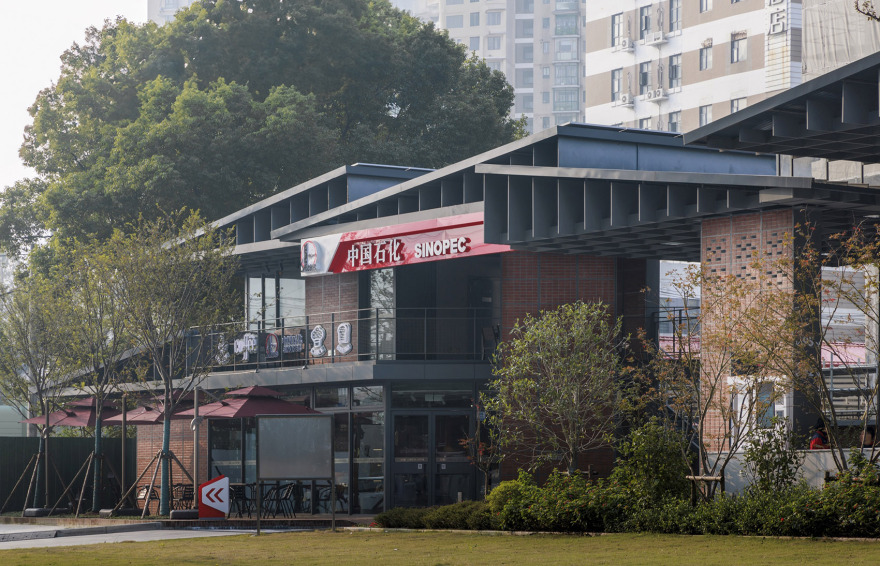
当公共绿地建成,文化通廊更多通行,街角的咖啡厅飘出更多“咖啡香”,人们在红砖岛里小坐休憩,在品尝咖啡的同时,不经意间也可能看到上海中心,这样非常规的场景的叠加会让人们在这里能感受到一份惊喜,也许会对于加油站逐渐转变固有认知。
As the public green spaces are completed and the cultural corridor becomes more frequented, the street corner café will emanate the aroma of coffee. People may take a moment to rest on the Red Brick Island, and while enjoying their coffee, they might unexpectedly catch a glimpse of the Shanghai Tower. Such unconventional overlapping scenes will bring a sense of surprise, potentially gradually shifting public perceptions of gas stations.
▼场景立体叠加,multi-scenario integration©刘国威
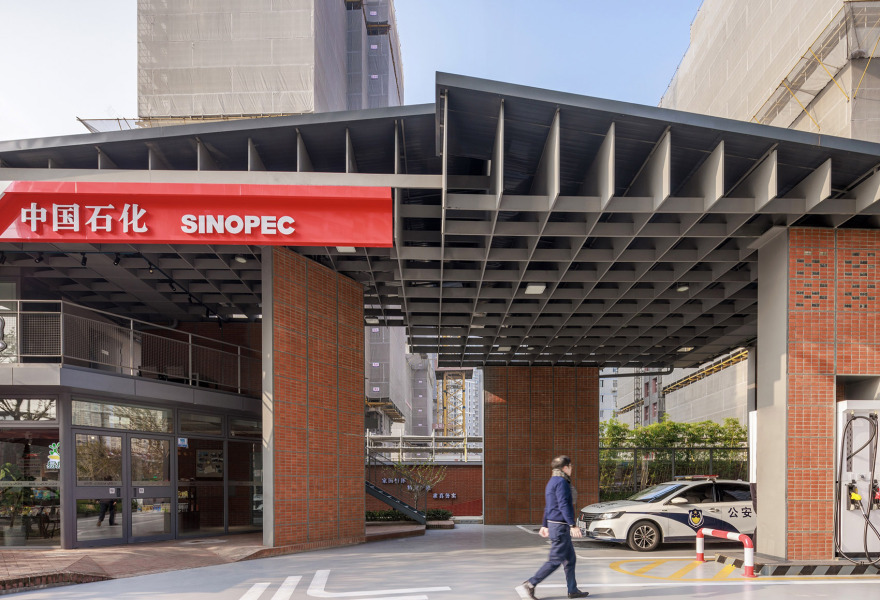
以“虹”为名
Named “The Rainbow”: Stitching Together Space and Community
将“虹”作为这个加油站的名字,一者指虹口,一者指红砖,更想暗示的是这种多彩而丰富的场景和体验,城市文脉的延续、经营的多样性,以及市民的真正的使用与接纳,是韧性基础设施的一种真正的意义和表达,也希望能够以“虹”之名,缝合空间,消除“邻避”。
The name “Rainbow” for this gas station refers both to Hongkou District and to the red bricks, but more importantly, it hints at the multifaceted and rich scenes and experiences offered here. The continuity of urban context, operational diversity, and genuine public use and acceptance embody the true meaning and expression of resilient infrastructure. It is hoped that, under the name “Rainbow,” spaces will be connected, and the “NIMBY effect” will be eliminated.
▼以“虹”之名,Named “The Rainbow”©刘国威

▼总平面图,site plan©同济原作设计工作室

▼底层平面图,master ground floor plan©同济原作设计工作室

▼二层平面图,upper floor plan©同济原作设计工作室

▼屋顶平面图,roof plan©同济原作设计工作室

▼立面图,elevation©同济原作设计工作室

▼剖面图,section©同济原作设计工作室

项目名称:虹口区胜利加油站
项目地址:高阳路551号
建设单位:中国石化销售上海石油分公司
主创设计单位:同济大学建筑设计研究院(集团)有限公司 都市建筑设计院 原作设计工作室
主创建筑师:章明、张姿、王绪男
建筑师:毕心怡、孙曦梦
施工图设计及工艺设计单位:哈尔滨天源石化工程设计有限责任公司
摄影版权:Daily建筑摄影-刘国威
Project Name: Shengli Gas Station in Hongkou District, Shanghai
Project Address: No. 551 Gaoyang Road
Construction Unit: Sinopec Sales Shanghai Petroleum Branch
Lead Design Unit: Original Design Studio, Urban Architecture Design Institute, Tongji University Architectural Design and Research Institute (Group) Co., Ltd.
Lead architects: Zhang Ming, Zhang Zi, Wang Xunan
Architects: Bi Xinyi, Sun Ximeng
Construction Drawing Design: Harbin Tianyuan Petrochemical Engineering Design Co., Ltd
Photography Copyright: Daily Architectural Photography – Liu Guowei
南京喵熊网络科技有限公司 苏ICP备18050492号-4知末 © 2018—2020 . All photos and trademark graphics are copyrighted by their owners.增值电信业务经营许可证(ICP)苏B2-20201444 苏公网安备 32011302321234号
苏公网安备 32011302321234号客服
消息
收藏
下载
最近