

创作上传
VIP
收藏下载
登录 | 注册有礼
查看完整案例

收藏

下载

分享
恒立液压是中国最大的高端液压元件制造公司,也是液压机械领域全球领先的一家企业,其总部园区坐落在常州市武进高新区。2022年初,weico获得恒立液压新总部暨国际研发中心的建筑与室内全过程设计委托。历经三年的设计与建设,恒立项目已于日前全面落成。
Hengli Hydraulics is China’s largest manufacturer of high-end hydraulic components and a globally leading enterprise in the field of hydraulic machinery. Its headquarters campus is located in the Wujin High-Tech District of Changzhou. In early 2022, weico was commissioned for the entire process design, encompassing both architecture and interiors, for Hengli Hydraulics’ new headquarters and International R&D Center. After three years of design and construction, the Hengli project has recently been fully completed.
▼园区鸟瞰,Campus Aerial View ©陈曦工作室

恒立液压是全球领先的精密液压机械领制造企业。在这个领域,恒立依靠技术创新打破了国外对中国多年的技术封锁,因此被誉为“民族英雄”。
▼常州市域及项目所在地及恒立园区总平面——新总部作为园区入口,Changzhou Municipality and Project Location andHengli Campus Master Plan——New Headquarters as the Campus Entrance©weico


Hengli Hydraulics is a globally leading manufacturer of precision hydraulic machinery. In this field, Hengli broke through years of foreign technological blockade against China through technological innovation, thus earning the reputation of a “national hero.”
▼综合楼顶层散步的中式庭院,Chinese-style courtyards scattered on the top floor of the Complex Building ©陈曦工作室

建筑设计-典型工业“厂前区”里的新面孔
Architectural Design-A New Face in the Typical Industrial “Administration and Services Zone”
项目位于恒立集团的常州总部园区内。这里是恒立较早建设的生产产区,已经使用多年,原有的研发办公楼与泵阀车间同在一栋大型厂房内,来访者由此也能感受到恒立脚踏实地的工业精神。但随着企业发展,这栋充满年代感的二层混合建筑,越来越难以代表一个国际化大型工业制造商的形象,也无法满足其与时俱进的办公和研发空间需求。▼恒立液压总部概览,Overview of Hengli Hydraulics HQ©陈曦工作室
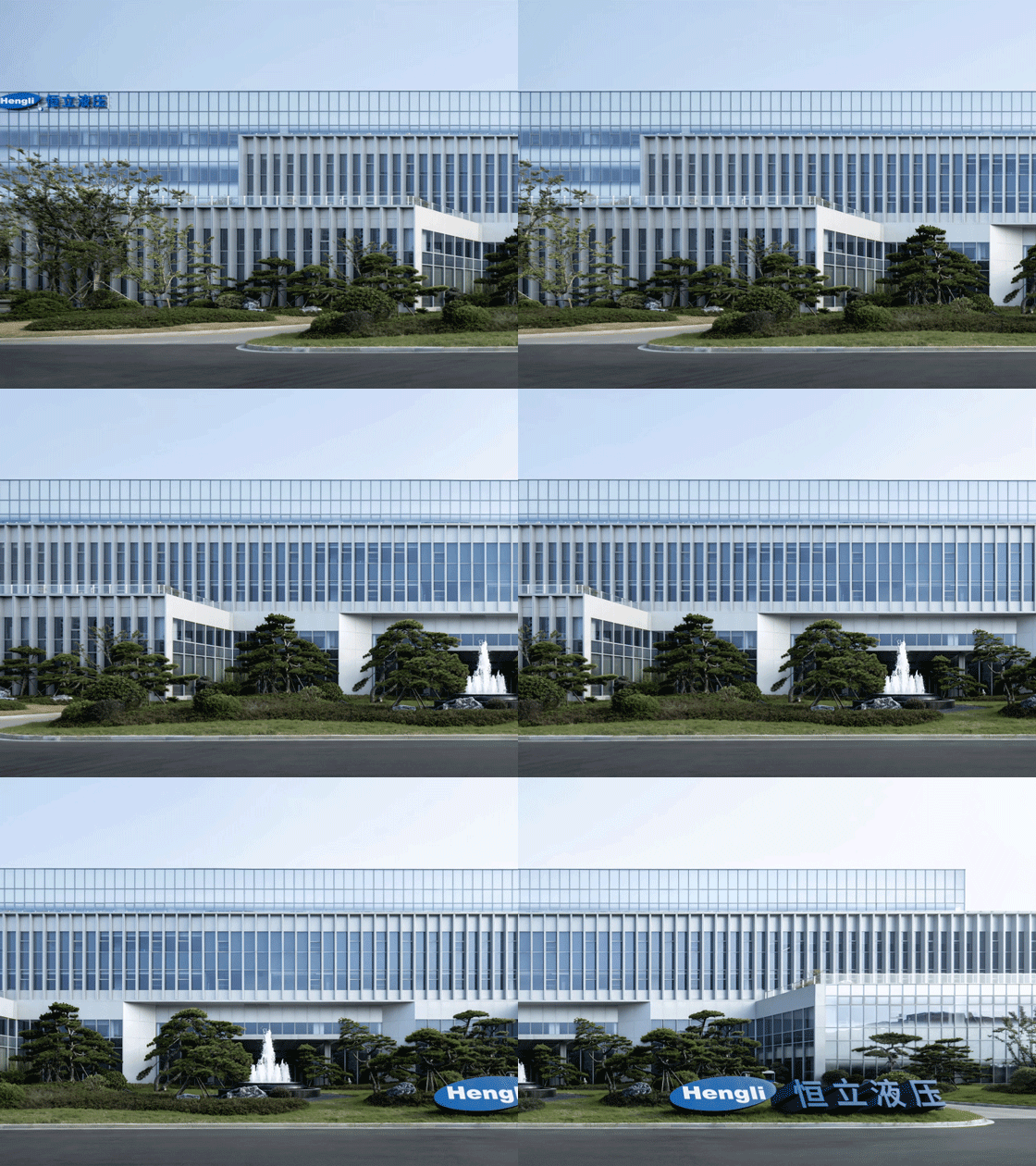
The project is situated within Hengli Group’s headquarters campus in Changzhou. This is Hengli’s earlier production area, which has been in use for many years. The original R&D office building was housed within the same large factory building as the pump and valve workshop, from which visitors could also sense Hengli’s down-to-earth industrial spirit. However, with the company’s development, this aged two-story mixed-use building increasingly failed to represent the image of a large international industrial manufacturer and could no longer meet its evolving office and R&D space requirements.
▼恒立液压的老总部大楼,The old headquarters building of Hengli Hydraulics ©网络图片

全新的恒立国际研发中心是企业为了满足企业未来发展、完善企业总部的功能所建设的综合型研发服务楼,地上建筑面积约五万平方米。项目场地位于生产园区的中线南端,紧邻外界城市道路,建成后将成总部园区的新入口形象。
The new Hengli International R&D Center is a comprehensive R&D service building constructed to meet the company’s future development needs and enhance the functionality of its headquarters, with a above-ground floor area of approximately 50,000 square meters. The project site is located at the southern end of the central axis of the production campus, adjacent to the external urban road. Upon completion, it became the new entrance image for the headquarters campus.
▼毗邻老总部的新总部大楼,New headquarters building adjacent to the old one ©陈曦工作室

在中国,生产园区的入口功能区及其所属建筑,通常被称为“厂前区”。“厂前区”的角色一般很多,它囊括了管理、服务、展示、研发、企业形象等种种非生产的功能。当人们谈起“厂前区”,常常会想起熙熙攘攘进出大门的工人们、领导合影时气派的大台阶、挂着优秀员工照片的工会俱乐部、乃至门口排着长龙的澡堂子…… 从50年代的国企到2000年代的富士康,一个“厂前区”总是万变不离其宗,给人的感觉亲切而复杂,但也很难留下一个清晰鲜明的印象。
▼电影《你好,李焕英》中唤起很多人回忆的“厂前区” ,The ” factory front area ” in the movie “Hi, Mom” evokes memories for many ©网络图片
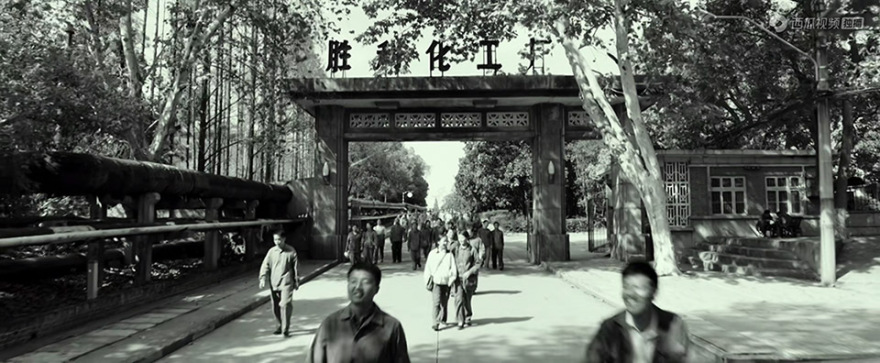
In China, the entrance functional area of a production campus and its associated buildings are commonly referred to as the “factory front area” or “Administration and Services Zone.” The role of the ” factory front area ” is usually multifaceted, encompassing various non-production functions such as management, services, exhibition, R&D, and corporate image. When people think of the ” factory front area ” they often recall workers bustling in and out of the gates, the grand stairs where leaders take group photos, the union club adorned with photos of outstanding employees, and even the bathhouse with long queues at the door…From state-owned enterprises in the 1950s to Foxconn in the 2000s, an ” factory front area ” always follows a familiar pattern, evoking a feeling that is familiar and complex, yet rarely leaves a clear and distinct impression.
▼恒立总平面——“厂前区”的复杂功能集合,Hengli Master Plan —— Complex functional of the ” factory front area “ ©weico

恒立的新总部办公及研发中心功能也相当多维,它包括:电气专业研究院、通用研发办公中心、行政办公中心、会议中心、企业会客接待(会所)、大型员工浴室、大型员工餐厅、管理层餐厅、游泳池、健身房等等。无论怎么看,它实际上也是一个典型的“厂前区”。传统的厂前区设计分为两种模式:一是各种功能各自为政,分布在不同的大小建筑中,其代价是效率和成本;二是功能高度整合,企业形象优先,做一栋端庄的大楼,其代价是部分功能的完整性和所有功能对唯一审美的服从。我们希望此次能做出不同于“传统”工业厂前区的尝试。针对复杂的功能、人群流线和企业形象的需求,也许能用类似当代综合体的眼光来重新看待设计,即:用形体统合不同,再用立面强调不同。我们首先对功能进行了分类与整合:
Hengli’s new headquarters office and R&D center also features highly multidimensional functions, including: Electrical Professional Research Institute, General R&D Office Center, Administrative Office Center, Conference Center, Corporate Guest Reception (Club), Large Employee Bathhouse, Large Staff Canteen, Management Dining Room, Swimming Pool, Gym, etc. By any measure, it essentially constitutes a typical ” factory front area ” Traditional ” factory front area ” design follows two patterns: First, various functions operate independently, distributed across different buildings of varying sizes, at the cost of efficiency and expense. Second, functions are highly integrated, with corporate image prioritized into a single dignified building, at the cost of the integrity of some functions and the subordination of all functions to a single aesthetic. We hoped to attempt something different from the “traditional” industrial ” factory front area ” this time. Addressing the complex functions, user circulation, and corporate image requirements, perhaps we could reconsider the design through a lens similar to that of a contemporary mixed-use complex: use the form to unify differences, then use the facade to emphasize them. We first classified and integrated the functions:
▼功能面积图,Functional area diagram©weico

实验中试和研发办公联系最紧密,它们相互咬合,成为主楼的核心部分,其延绵的大型平面决定了建筑近200米的长度。
试制车间和会议中心是相对独立,又各自服务于中试和办公的两大功能,它们的落位各自邻近自己的服务对象,联系它们的则是交流区等共享空间。由于进深不同,它们恰好形成两侧略呈对称的两个突出体量,定义出了建筑主入口的所在。
员工浴室、餐厅、企业会所等所有“热闹”的服务功能被集中在一个体量内,北侧设置一个厂区内部的大型绿地,方便大量内部人群的集散,也延伸了服务功能的休憩空间,与生产区域也通过共享绿地达到了更紧密的结合。
南北两个大体量再次通过各自的中庭、二层的连廊、连接层的休息厅等空间串联。
Pilot production and R&D offices are most closely linked. They interlock with each other, forming the core part of the main building. Their extensive, continuous floor plates determined the building’s nearly 200-meter length.
The trial production workshop and conference center are relatively independent functions, each serving pilot production and offices respectively. Their placement is near their respective service targets, connected by shared spaces like interaction areas. Due to their different depths, they form two slightly symmetrical protruding volumes on either side, defining the location of the main building entrance.
All the “lively” service functions, such as the employee bathhouse, canteen, and corporate club, are concentrated within one volume. A large green space is planned on the north side, within the factory area, facilitating the gathering and dispersal of large numbers of internal personnel, extending the recreational space for service functions, and achieving closer integration with the production area through this shared green space.
The two large north and south volumes are again connected via their respective atriums, second - floor corridors, and connecting level lounges.
▼功能的分类与整合, Functional Classification and Integration ©weico

至此,我们完成了一个“厂前区”综合体体量设计。第二步则是将它的复合性在立面上做出一比一的反应。整体立面使用金属和玻璃幕墙竖向拼接,但我们用同一材料的不同组合实现了一个立面上的四种幕墙形式,用它们的交替来强调明确的功能穿插关系。通过近200米长的立面观赏空间,不同幕墙形式配合体量交替出现,宛如一幅建筑画卷缓缓展开,展现出简洁、舒展、精确、大气的企业形象。
Thus, we completed the massing design of an ” factory front area ” complex. The second step was to reflect its composite nature one-to-one on the facade. The overall facade uses vertical splicing of metal and glass curtain walls, but we employed different combinations of the same materials to achieve four types of curtain wall forms on a single facade, using their alternation to emphasize clear functional interrelationships. Viewed along the nearly 200-meter-long facade, the different curtain wall forms alternate in harmony with the volumes, unfolding like an architectural scroll, presenting a corporate image that is concise, expansive, precise, and impressive.
▼建筑幕墙的日夜变化,The day and night changes of building curtain walls©陈曦工作室

该项目的幕墙系统可分为三类:装饰翼幕墙、彩釉玻璃幕墙、铝板幕墙。其中装饰翼幕墙按照装饰翼的不同,可再细分三类:大装饰翼幕墙、短装饰翼幕墙、内装饰翼幕墙。在深化设计中,建筑师力求达到细节精确,造价合理,性能优秀。针对彩釉玻璃幕墙和铝板幕墙各自的特点,我们在不透明或半透明的窗台、窗坎墙、窗间墙区域尽可能预留土建墙体,在保证外观的前提下平衡造价,并且为建筑争取到更好的热工性能。在此基础上,团队花费了几个月的时间,反复研究对比各种构件方案,减小杆件尺寸,从而寻找造型更简洁、安装更便捷的方法。通过不断的优化,最终幕墙的平均造价从2650元/平方米降低到1800元/平方米。
▼设计阶段的幕墙形式与组合研究 Curtain Wall Form and Combination Study during Design Phase ©weico
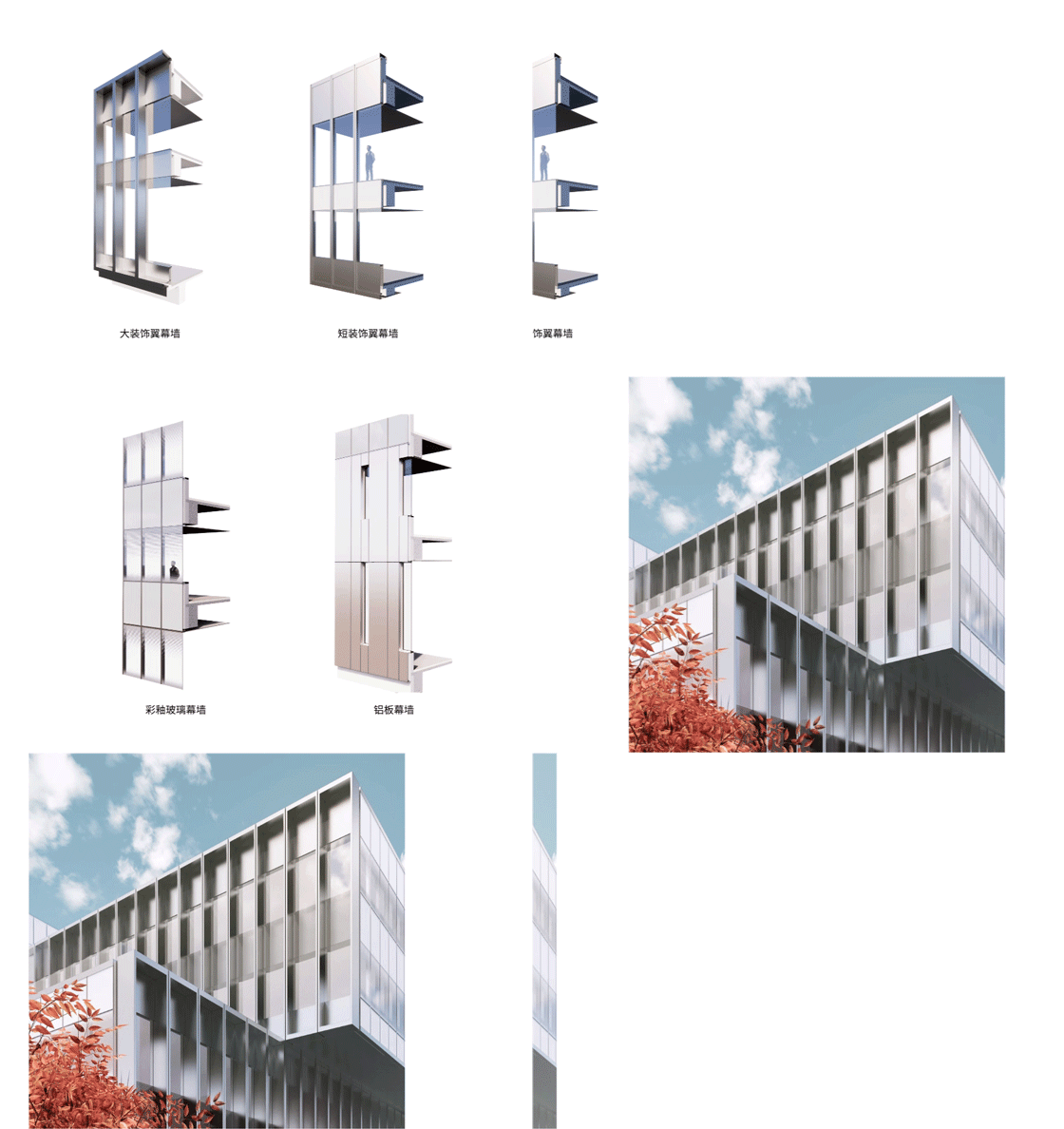
The project’s curtain wall system can be divided into three categories: Fin Wall Curtain Wall, Fritted Glass Curtain Wall, and Aluminum Panel Curtain Wall. The Fin Wall Curtain Wall can be further subdivided into three types based on the fin: Large Fin Wall, Short Fin Wall, and Internal Fin Wall.
During detailed design, the architects strived for precise details, reasonable cost, and excellent performance. Considering the characteristics of the fritted glass and aluminum panel curtain walls, we as much as possible reserved space for masonry walls in the opaque or semi-opaque sill, spandrel, and mullion areas to balance cost while ensuring the appearance and achieve better thermal performance for the building. Based on this, the team spent months repeatedly studying and comparing various component schemes, reducing member sizes to find methods that were more simply shaped and easier to install. Through continuous optimization, the average cost of the curtain wall was ultimately reduced from 2650 RMB/sq.m to 1800 RMB/sq.m.
▼建成后的幕墙形式与组合呈现,Post-Construction Curtain Wall Forms and Combination Presentation ©weico

▼建成后的幕墙形式与组合呈现,Post-Construction Curtain Wall Forms and Combination Presentation ©weico

同时为了在将建筑体量和立面形式的关系推到极度完整、明确,避免在体量变化的地方出现任何咬合而破坏幕墙系统的完整性,我们通过与结构工程师、幕墙工程师的通力合作,对悬挑位置、女儿墙位置进行精细化设计,做到了建筑体块与幕墙模数的完美衔接拼合。
▼典型墙身剖透视,Typical Wall Section Perspective ©weico

Simultaneously, to push the relationship between the building massing and facade form to an extremely complete and clear state, avoiding any interlocking at volume transition points that could compromise the integrity of the curtain wall system, we collaborated closely with structural and curtain wall engineers. We conducted refined design for cantilevered locations and parapet details, achieving perfect connection and assembly between architectural volumes and the curtain wall module.
▼夕阳下的总部大楼,Building under sunset©陈曦工作室
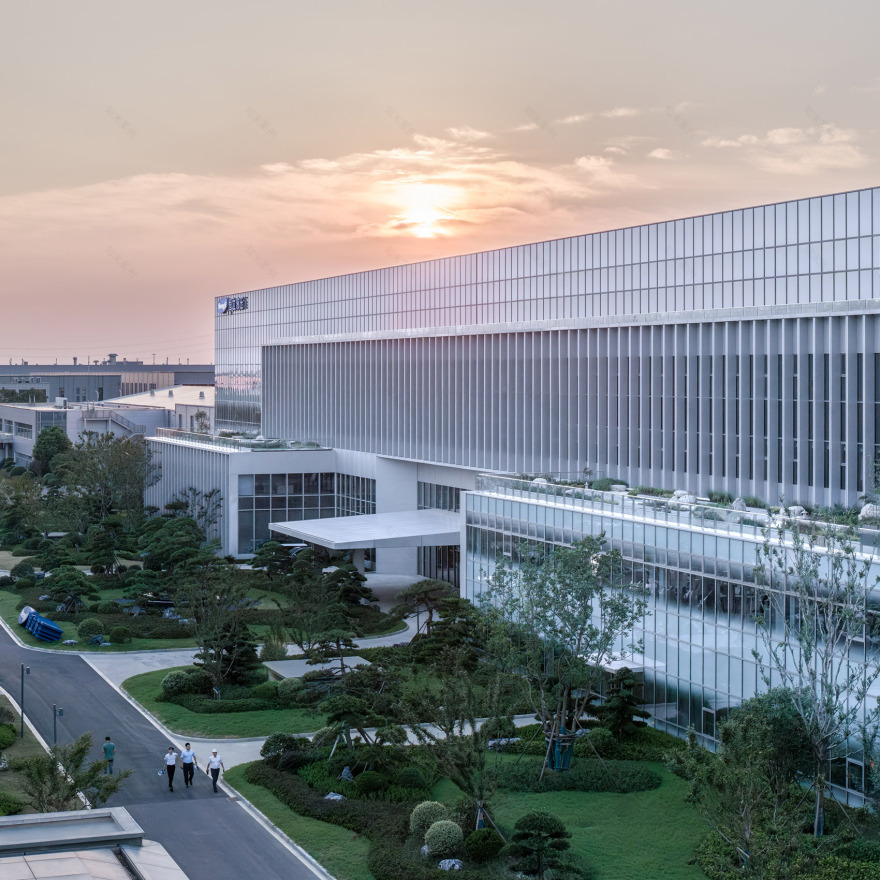
经过三年的建设与施工,这座庞大的厂前区综合体终于落成:
After three years of construction, this vast ” factory front area ” complex is finally complete:
▼入口鸟瞰,Entrance Aerial View ©陈曦工作室

室内设计-中国工业与中国院子
Interior Design—Chinese Industry and Chinese Courtyards
在开始建筑设计之前,weico对各使用方进行了大量走访和调研,对这栋建筑的日常使用场景包括各种员工服务空间、研发办公空间、屋顶花园会所等进行了深入的分析研究,这也为我们继续完成该项目的全部室内设计打下了基础。最终是室内设计和建筑的碰撞给了我们这个项目最大的惊喜:磅礴的工业矩阵深处,九个院落在综合楼的顶层如夜明珠散落,工业的秩序与江南的闲逸在此有了意外的对话。
Before commencing architectural design, weico conducted extensive visits and research with various end-users, performing in-depth analysis of the building’s daily usage scenarios, including various employee service spaces, R&D office spaces, rooftop garden club, etc. This also laid the foundation for us to complete the entire interior design for the project. Ultimately, the collision between interior design and architecture gave this project its biggest surprise: deep within the vast industrial matrix, nine courtyards are scattered like pearls across the top floor of the complex building, creating an unexpected dialogue between industrial order and the leisurely elegance of Jiangnan.
▼研发楼与综合楼共同组成厂前区,R&D Building and Complex Building together form the ” factory front area” ©陈曦工作室

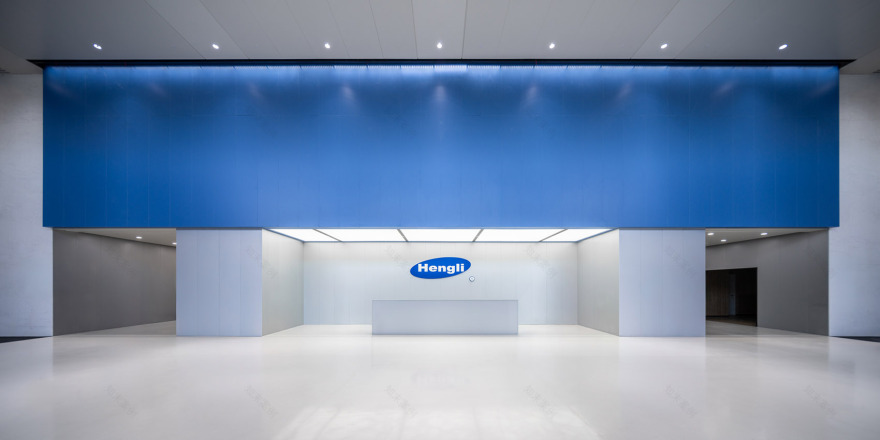
基于业主的使用需求,我们在4.5米层高的建筑中采用了12米的柱网尺寸。开敞的大空间内少柱甚至无柱,光照、通风和心理感受都获得了一定的改善,但挑战就是结构尺寸偏大。在综合平衡了功能需求后,我们通过设备专业的提前介入、精细设计管线布局、重点位置重点处理等方式,实现了主要空间全部自然排烟、管线无交叉,保证装修完成后室内净高在最不利处仍在2.8米以上,主要使用空间净高可达4.0米,解决了空间品质和结构之间的矛盾。研发楼大堂正中,巨幅蓝色品牌墙结合了投影技术,可以展示欢迎辞等互动内容。大堂高8米,宽34米,尺度低调实用,体现了企业脚踏实地的作风。室内以浅灰与白色金属构筑的基调冷静而专业,木色与品牌蓝色作为点缀。▼研发楼大堂和会议中心,R&D Building Lobby and Conference Center ©weico

Based on the client’s usage needs, we adopted a 12-meter column grid within the 4.5-meter floor-to-floor height building. The open large spaces have few or even no columns, improving lighting, ventilation, and psychological perception, but the challenge was the relatively large structural member sizes. After comprehensively balancing functional requirements, we involved the MEP disciplines early, meticulously designed pipeline layouts, and focused on key areas. This achieved natural smoke exhaust for all main spaces, eliminated pipeline conflicts, and ensured a finished interior clear height of at least 2.8 meters even at the most unfavorable points, with the main usable spaces reaching 4.0 meters clear height, resolving the contradiction between spatial quality and structure. In the center of the R&D Building lobby, a large blue brand wall incorporates projection technology to display interactive content like welcome messages. The lobby is 8 meters high and 34 meters wide, a scale that is modest and practical, reflecting the company’s down-to-earth style. The interior palette, constructed with light gray and white metal, is calm and professional, accented with wood tones and corporate blue.
▼研发楼大堂 R&D Building Lobby ©陈曦工作室
▼办公区室内 Office Area Interior ©陈曦工作室

研发楼的核心是一座18米高贯通四层的共享中庭,阳光倾泻而下,照亮了环绕其间的开放式交流区、休憩角与协作岛。一座企业蓝的楼梯转折而上,如纽带般连接各个楼层,成为视觉焦点与活力枢纽,无声地鼓励跨层的沟通与流动,梯段高2米,稳重大气,再次强调了企业本身行稳致远的文化追求。▼研发楼中庭尺度,R&D Building Atrium Scale ©weico
The heart of the R&D Building is an 18-meter-high, four-story shared atrium. Sunlight pours down, illuminating the open interaction areas, rest nooks, and collaboration islands surrounding it. A corporate blue staircase winds its way up, connecting the various floors like a link/nexus, becoming a visual focus and activity hub that silently encourages cross-level communication and movement. The stair risers are 2 meters high, steady and impressive, again emphasizing the company’s cultural pursuit of steady and enduring progress.
▼研发中庭—蓝色纽带,R&D Atrium — The Blue Link ©陈曦工作室


▼研发中庭—蓝色纽带,R&D Atrium — The Blue Link ©陈曦工作室


研发楼顶层为管理层办公区。在这里,weico的室内与景观团队于规整严谨的办公矩阵中加入了不寻常的元素。这一空间创造性地引入大幅天窗与45度旋转的室内景观绿岛,柔化了空间的规则感,为决策者提供了激发灵感、舒缓身心的氛围。▼管理层办公区域,Management Office Area ©weico
The top floor of the R&D Building houses the management office area. Here, weico’s interior and landscape teams introduced unusual elements into the orderly and rigorous office matrix.This space creatively introduces large skylights and indoor landscape green islands rotated 45 degrees, softening the regularity of the space and providing an atmosphere that inspires and relaxes for decision-makers.
▼管理层办公区材料、色彩与布局与普通工区显著不同,Management office area materials, colors, and layout are significantly different from general work areas ©陈曦工作室


▼研发会议室,R&D meeting room©陈曦工作室

综合楼则是在延续研发楼的整体风格基础上,容纳了更多的员工服务空间。综合楼的空间中容纳了可接待700人的食堂、为一千余名工人提供淋浴更衣服务的后勤层、超过800平米包含羽毛球场和游泳池的活动中心及其他各类休憩空间。▼综合楼服务区域,Complex Building Service Areas ©weico
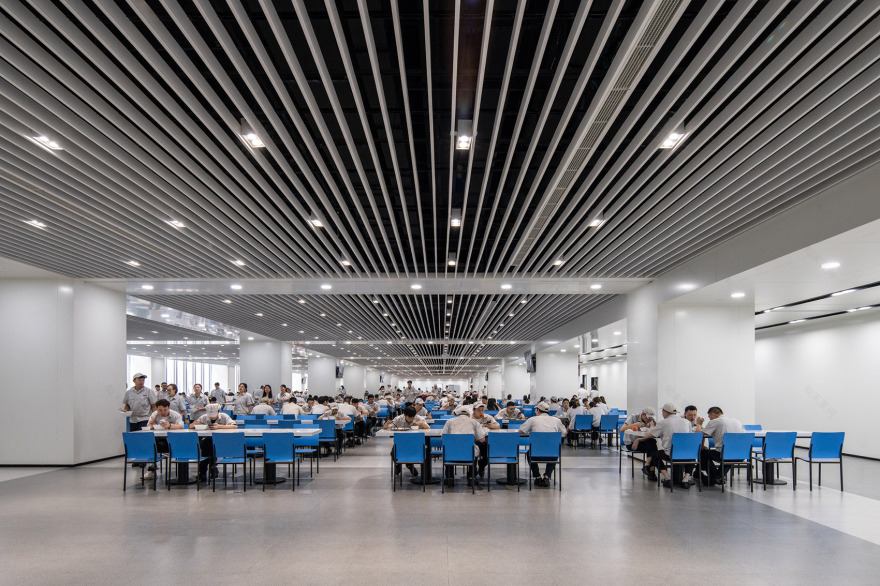
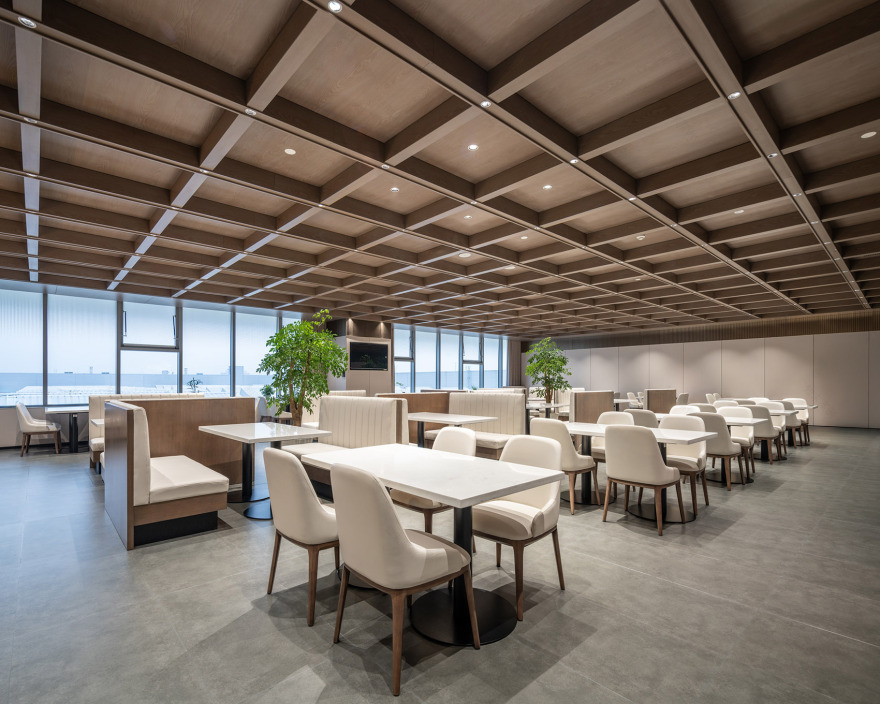
The Complex Building, while continuing the overall style of the R&D Building, accommodates more employee service spaces.The spaces within the Complex Building include a canteen capable of serving 700 people, a logistics floor providing shower and changing facilities for over a thousand workers, an activity center exceeding 800 sq.m containing badminton courts and a swimming pool, and various other recreational spaces.
▼常为人忽视的工厂大食堂、办公室茶水间,Often overlooked factory canteen, office pantry ©陈曦工作室
▼茶水间,Pantry©陈曦工作室

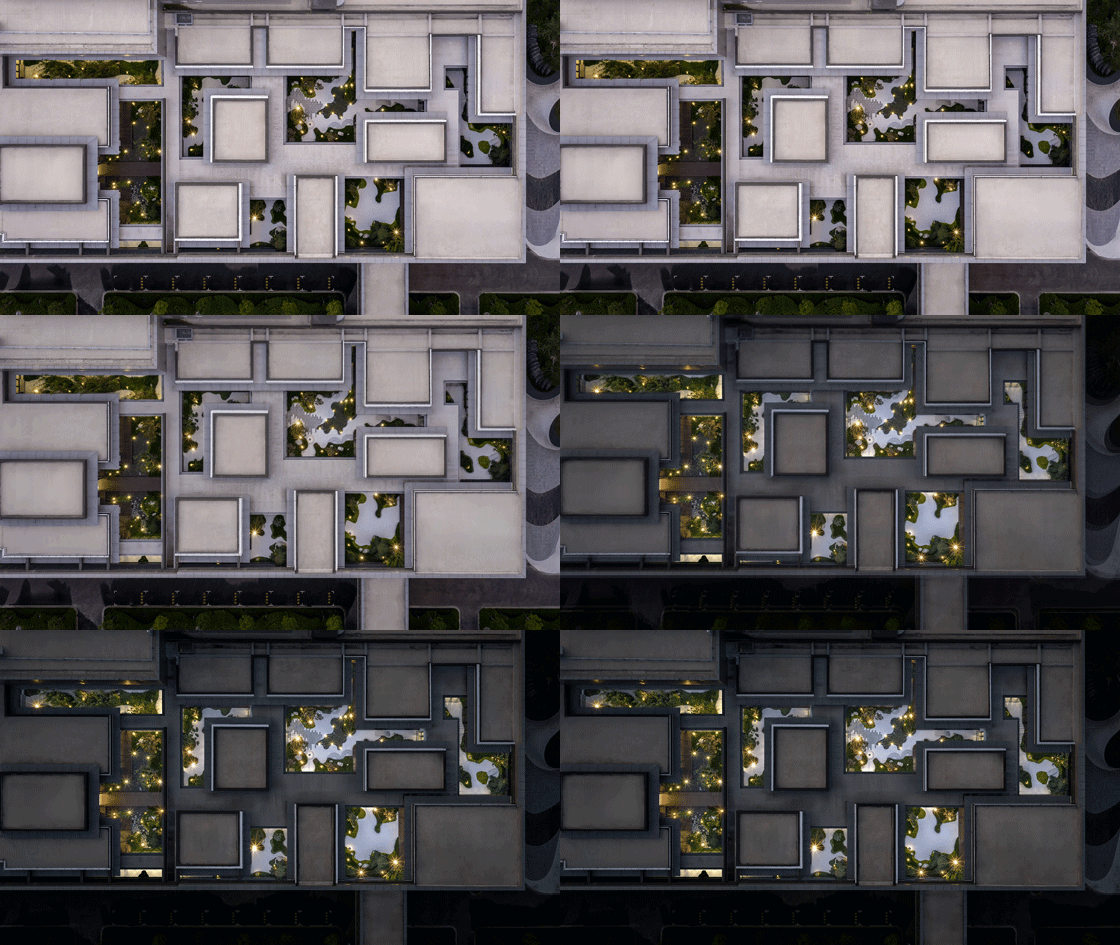
在综合楼最高层,空间骤然变化:在安静统一的立面风格内部,错落布置着9个庭院,以及景观掩映着的静谧房间,彷佛置身另一个世界。工业的严整与冰冷突然消失,被园林的闲适与放松取代。同一个空间内不同场景的冲突与共生是工业建筑中难得一见的一幕:液压阀门的铿锵遇见白石小径的回响;不锈钢的冷冽光泽晕染上松影的墨色,金属檐口与石上青苔临窗相映。
▼综合楼庭院区域 Complex Building Courtyard Area ©weico
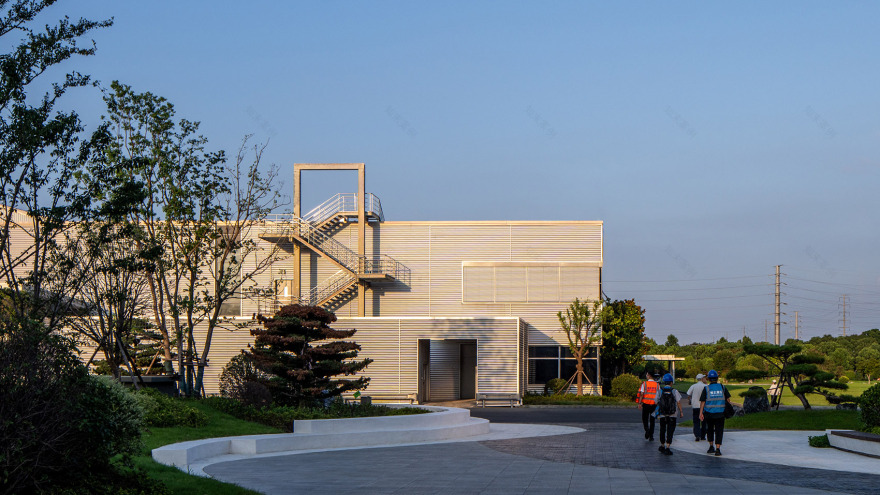
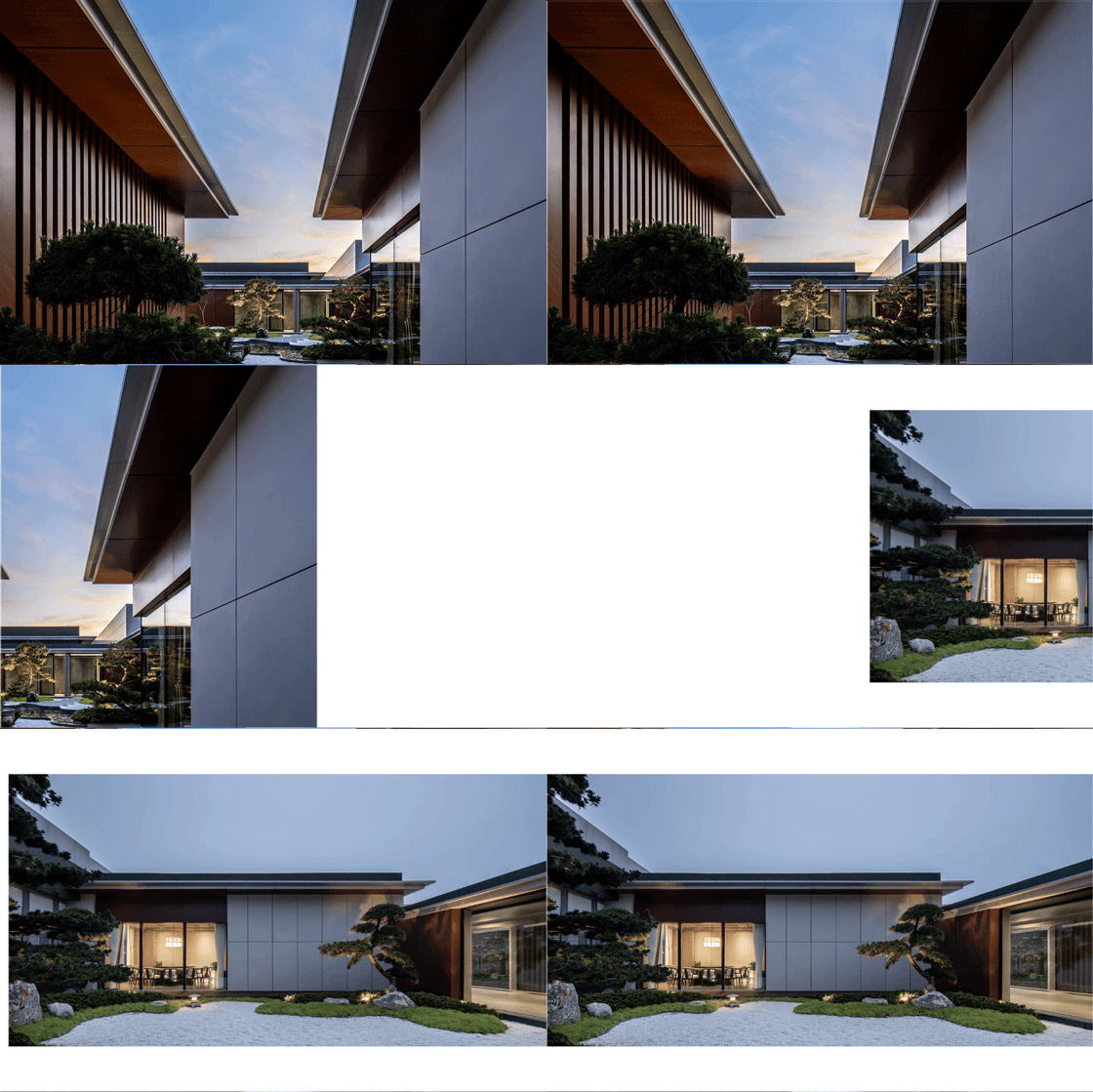
On the top floor of the Complex Building, the space changes abruptly: behind the quiet, uniform facade style, nine courtyards are arranged in a staggered layout, alongside tranquil rooms nestled within the landscape, as if entering another world. The strict order and cold nature of industry suddenly disappears, replaced by the leisure and relaxation of the garden. The conflict and coexistence of different scenes within the same space is a rare sight in industrial architecture: the clang of hydraulic valves meets the echo of white stone paths; the cold gleam of stainless steel is tinged with the ink-wash shade of pine shadows; metal eaves and moss on stones reflect each other by the window.
▼工厂里的院子也可以独立世外,Courtyards in the factory can also exist independently, apart from the world ©陈曦工作室


▼走出“院子“,相同的景观元素继续延伸到新老厂区交界之处,Stepping out of the “courtyards,” the same landscape elements extend further to the junction between the new and old factory areas ©陈曦工作室
恒立液压国际研发中心是weico对中国工业建筑中“厂前区”领域的首次尝试,它既满足了中国新型工业企业对形象升级的期待,又成功容纳了从员工的日常生活、到内部的研发办公、再到企业的接待休憩等多种复杂功能,并将这种种需求糅合在一个简单的体量内,再放入现有的厂区里。这次尝试在目前看来是成功的,也引发了weico后续对“厂前区”的多次迭代研究,未来三年我们会有更多的“新工业”项目面世,请持续关注。
The Hengli Hydraulics International R&D Center is weico’s first attempt at the ” factory front area ” typology within Chinese industrial architecture. It meets the expectations of China’s new industrial enterprises for image upgrade, successfully accommodates a variety of complex functions from employees’ daily lives to internal R&D offices and corporate reception and leisure, and integrates these diverse demands into a simple volume placed within the existing factory campus. This attempt appears successful thus far and has prompted subsequent multiple iterative studies by weico on the ” factory front area ” We will have more “New Industrial” projects completed in the next three years. Stay tuned.
▼容纳员工的日常生活,accommodates employees’ daily lives©陈曦工作室

项目名称:恒立液压国际研发中心
项目类型:企业总部办公、研发中心、服务中心
设计方:weico建筑事务所 PR@weico.work
项目设计:2022-2025
完成年份:2025
设计团队:孙伟、段芸、郭浩嘉、吕旻佳、秦伟、孙晨、王德元、曾令岳、张利宁、赵越、周婧怡、朱焕荣
项目地址:中国江苏省常州市武进高新区
建筑面积:地上51488.7㎡,地下31647.9㎡
摄影版权:陈曦工作室
合作方:
建筑施工图设计:北京汉华建筑设计有限公司;
室内施工图设计/景观设计:苏州合展设计营造股份有限公司
幕墙设计:SuP华纳工程咨询(北京)有限公司
客户:江苏恒立液压股份有限公司
Project name:Hengli Hydraulics International R&D Center
Project type:The corporate headquarters, R&D center, and service center
Design:weico Architects
PR@weico.work
Design year:2022-2025
Completion Year:2025
Leader designer & Team:SUN Wei, DUAN Yun, GUO Haojia, LV Minjia, QIN Wei, SUN Chen, WANG Deyuan, ZENG Lingyue, ZHANG Lining, ZHAO Yue, ZHOU Jingyi, ZHU Huanrong
Project location:Wujin High-Tech District, Changzhou City, Jiangsu Province, China
Gross built area:Aboveground: 51,488.7 ㎡; Belowground: 31,647.9 ㎡
Photo credit: Chen Xi Studio
Partner:
Architectural Construction Documents Design:Beijing Hanhua Architectural Design Co., Ltd.
Interior Construction Documents Design / Landscape Design:Suzhou Hezhan Design & Construction Co., Ltd.
Curtain Wall Design:SuP Warner Engineering Consulting (Beijing) Co., Ltd.
Clients:Jiangsu Hengli Hydraulic Co.,Ltd


南京喵熊网络科技有限公司 苏ICP备18050492号-4知末 © 2018—2020 . All photos and trademark graphics are copyrighted by their owners.增值电信业务经营许可证(ICP)苏B2-20201444 苏公网安备 32011302321234号
苏公网安备 32011302321234号客服
消息
收藏
下载
最近