

创作上传
VIP
收藏下载
登录 | 注册有礼
查看完整案例

收藏

下载

分享
设计很少是线性的;它更适合在思想自由流动、合作自然而生、创造力不断切换角色的环境中蓬勃发展。H+A Studio的首席建筑师Aayushi Gajjar与Harihar Lacewala深知这一点。在他们的实践中,设计往往在专注的独立工作与充满活力的团队协作之间来回摆动——绘图、建模、制作原型、编辑、展示。“如果设计不是静态的,”他们问道,“那么它被创造的空间为何要是静止的呢?”基于这一理念,他们将位于苏拉特的1000平方英尺工作室围绕两个核心原则塑造出来:模块化,让空间随需求变化而演进;多功能性,让每个元素都能发挥多重用途。
Design is rarely linear; it thrives in environments where ideas flow, collaborations spark spontaneously, and creativity wears many hats. Aayushi Gajjar and Harihar Lacewala, principal architects at H+A Studio, know this firsthand. In their own practice, design often oscillates between focused solo work and energetic bursts of teamwork – sketching, modelling, prototyping, editing, presenting. “If design isn’t static,” they reasoned, “why should the space where it is created be?” Based on this philosophy, they shaped their 1,000 sq. ft. Surat workspace around two core principles: modularity, which allows the space to evolve as needs change and multifunctionality, where each element serves multiple purposes.
▼室内概览,overview of the interior space ©Ishita Sitwala


工作室的设计将这一理念具象化,在不同的工作模式之间无缝切换。一张桌面,可能此刻承载速写本,下一刻支撑比例模型,随后又变成一张团队即兴讨论的会议桌。这种适应性确保了空间既能轻松回应专注的个人任务,也能满足充满活力的团队协作。将这一愿景转化为现实并非易事:模块化家具需要精确规划,而寻找既高效实用又视觉统一的五金件也为设计增加了复杂性。从大型构件——如多用途隔断与桌子——到小细节——如定制照明与可调节的安装系统——一切都以灵活性为核心。同时,设计也着眼未来:所有表面都可以拆解、移动或重新利用,让工作室能随团队一同成长。
The studio design brings this philosophy to life, seamlessly shifting between different modes of work. A surface might hold a sketchbook one moment, support a scale model the next, and then transform into a table for a spontaneous team meeting. This adaptability ensures that the space responds effortlessly to both focused individual tasks and dynamic group collaborations. Translating this vision into reality, however, wasn’t without challenges. Modular furniture required precise planning, and sourcing hardware that was both functionally efficient and visually cohesive added another layer of complexity to the design. From the larger gestures – like multi-use partitions and tables – to smaller details, such as customized lighting and adaptable mounting systems, everything was designed with flexibility in mind. The space also had an eye on the future – surfaces could be dismantled, moved, or repurposed, allowing the studio to evolve alongside the team.
▼多功能长桌,multi-functional long desk ©Ishita Sitwala

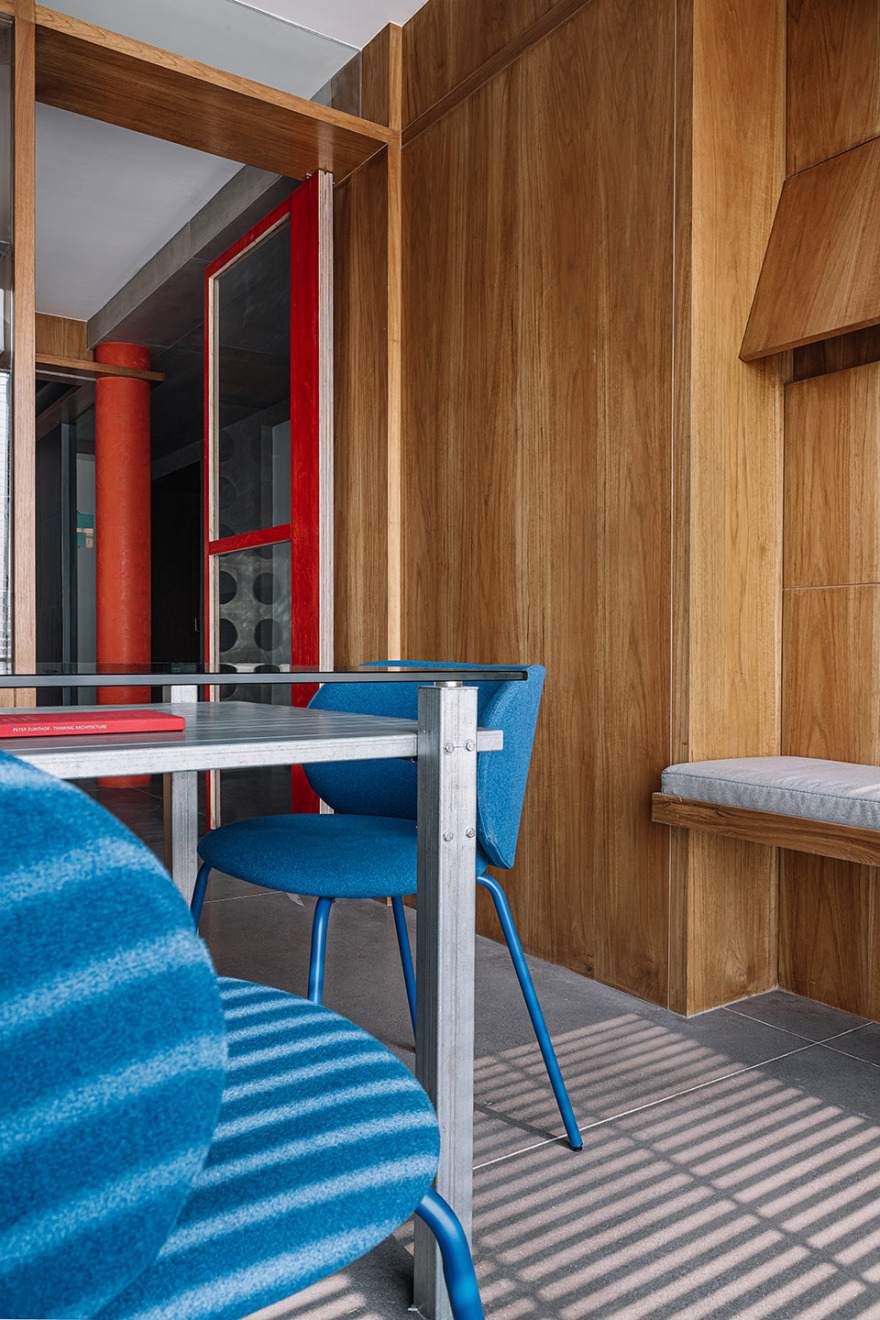
从刻意收敛的入口与过道开始,布局逐渐展开至中央开放区,这里被设计为协作的核心。工作室其余部分围绕这一中心展开,隔断被巧妙地整合,平衡了私密性与功能性。入口左侧是会议室,对面则是团队工位。中央空间的后方布置了首席设计师的独立办公室,而更远处则延伸至露台,为休憩与思考提供空间。
Starting with an intentionally modest entry and passage, the layout gradually opens up into the central area, designed to support collaboration. The rest of the studio unfolds around this central space, with partitions thoughtfully integrated to balance privacy and functionality. On the left, near the entry, is the conference room, while on the opposite side, work desks are arranged for the design team. Lining the rear of the central space are the principal designer’s cabins, and beyond them lies the terrace, extending the studio’s space for moments of relaxation and reflection.
▼刻意收敛的入口与过道,an intentionally modest entry and passage ©Ishita Sitwala


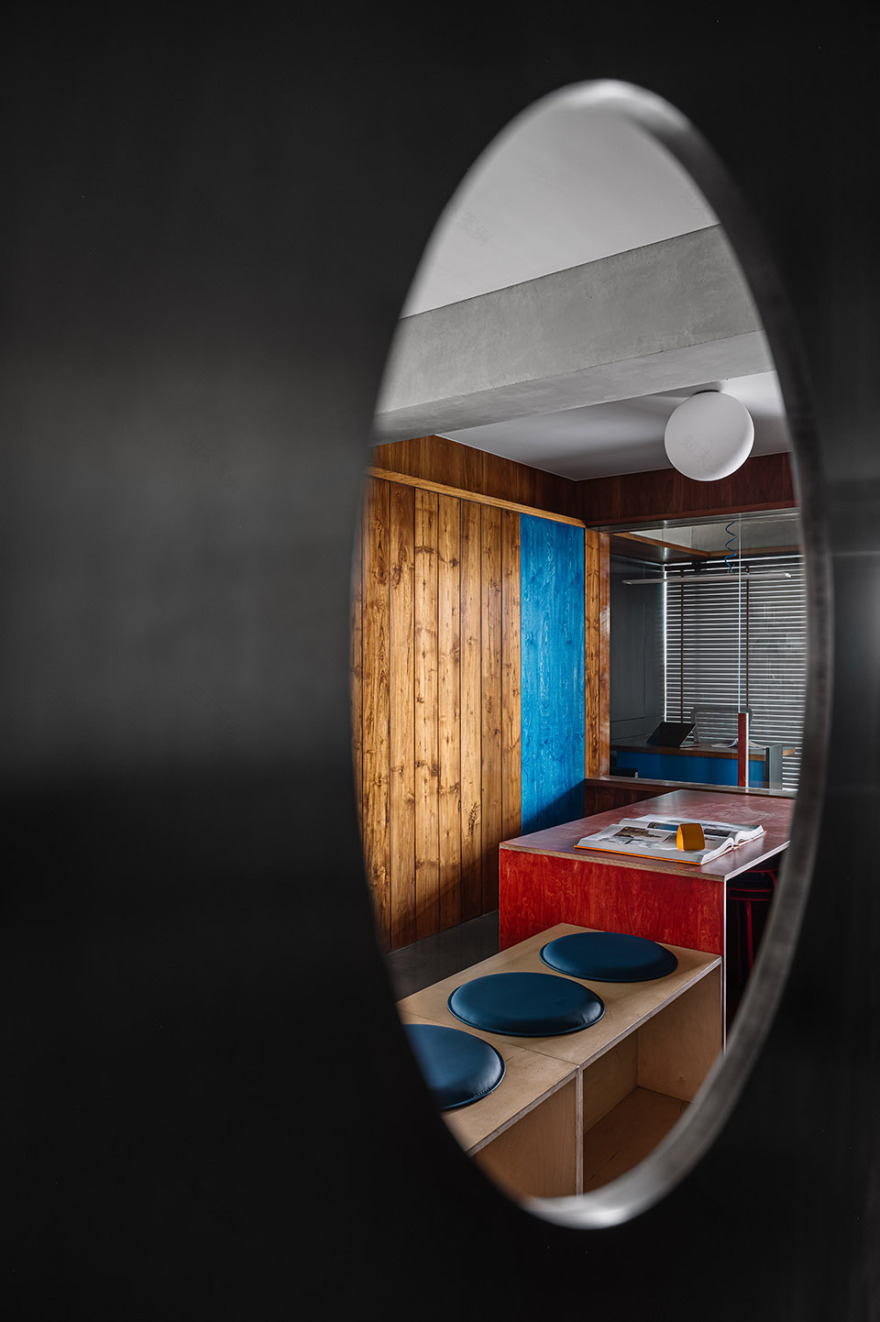
走入中央空间后,平静的灰色调调性渐渐浮现,以其简洁营造氛围。抹灰墙面与骨料混凝土地面构筑了原始、干净的基底。点缀的红、蓝主色为空间注入微妙的能量,形成鲜明而有目的性的对比。木材、桦木夹板、低碳钢与不锈钢构成了其余的材料语言,组合成诚实、实用的表达。空间的核心是一件由夹板与金属打造的简约家具。乍看之下,它只是一个简单的矩形体块,但其真正的魅力在于多变的功能:它既是储物台面、座位,也是讨论桌与工作台,悄然成为房间的主角。
Once inside the central space, a calm, grey-toned palette emerges, setting the mood with its quiet simplicity. Plastered walls and an aggregate concrete floor set a raw, clean foundation. Accents of primary red and blue colors add subtle pops of energy, creating a contrast that feels both vibrant and purposeful. Wood, birch ply, mild steel and stainless steel define the rest of the studio’s material vocabulary, coming together in honest, utilitarian forms. Central to this space is a large, minimal furniture element crafted from plywood and metal. At first glance, it appears to be a straightforward rectangular volume, but its true beauty lies in its versatility. Quietly commanding the room, it adapts to the needs of the moment: a surface for storage, a place for seating, a table for discussion, and a workstation all in one.
▼点缀的红、蓝主色为空间注入微妙的能量,
Accents of primary red and blue colors add subtle pops of energy ©Ishita Sitwala

“我们希望创造出可以改变的元素。”Aayushi 说。“它的适应性如此之强,以至于我们将来可以拆开并重新利用这些夹板来制作新桌子。”Harihar 补充道。
“We wanted to create elements that had the possibility to change,” says Aayushi. “It is so adaptable that we could take it apart and repurpose the plywood panels to build new tables in the future,” adds Harihar.
▼桦木夹板用于制作门板,the plywood panels used for door ©Ishita Sitwala

位于一侧的会议室延续了工作室的精神——功能性与亲和力并重。一道定制的书架式隔断,由线性钢板构成,让自然光自由渗透,柔和地照亮中央空间与相邻的工位,同时提供了不封闭的私密感。另一侧的工作区则展现出沉静的专注感。一道利落的不锈钢隔断界定了空间,在确保私密性的同时保留视觉联系。工位两侧的墙面由热轧钢板制成,不仅提供视觉隔断,还可作为钉图表面。
The conference room that lies on one side of this area echoes the studio’s ethos – functional yet welcoming. A custom bookshelf-style partition, composed of linear MS plates, allows natural light to stream through, softly illuminating both the central space and the adjoining workstations, while offering a sense of privacy that doesn’t feel closed off. On the opposite side, the work area unfolds with a quiet sense of purpose. A sleek stainless steel partition defines this zone, offering privacy while preserving visual connectivity. The walls flanking the workstations are made from hot-rolled MS sheets that not only provide visual privacy but also function as pin-up surfaces.
▼由线性钢板构成的书架式隔断,
a custom bookshelf-style partition, composed of linear MS plates ©Ishita Sitwala


“我们在这些面板上加入了符合人体尺度的标准槽口,帮助设计师进行可视化。”Harihar 解释道。
“We added grooves to this paneling at standard anthropometric heights and sizes to help designers with visualization,” explains Harihar.
▼书架式隔断上的标准槽口,grooves in this panelling ©Ishita Sitwala
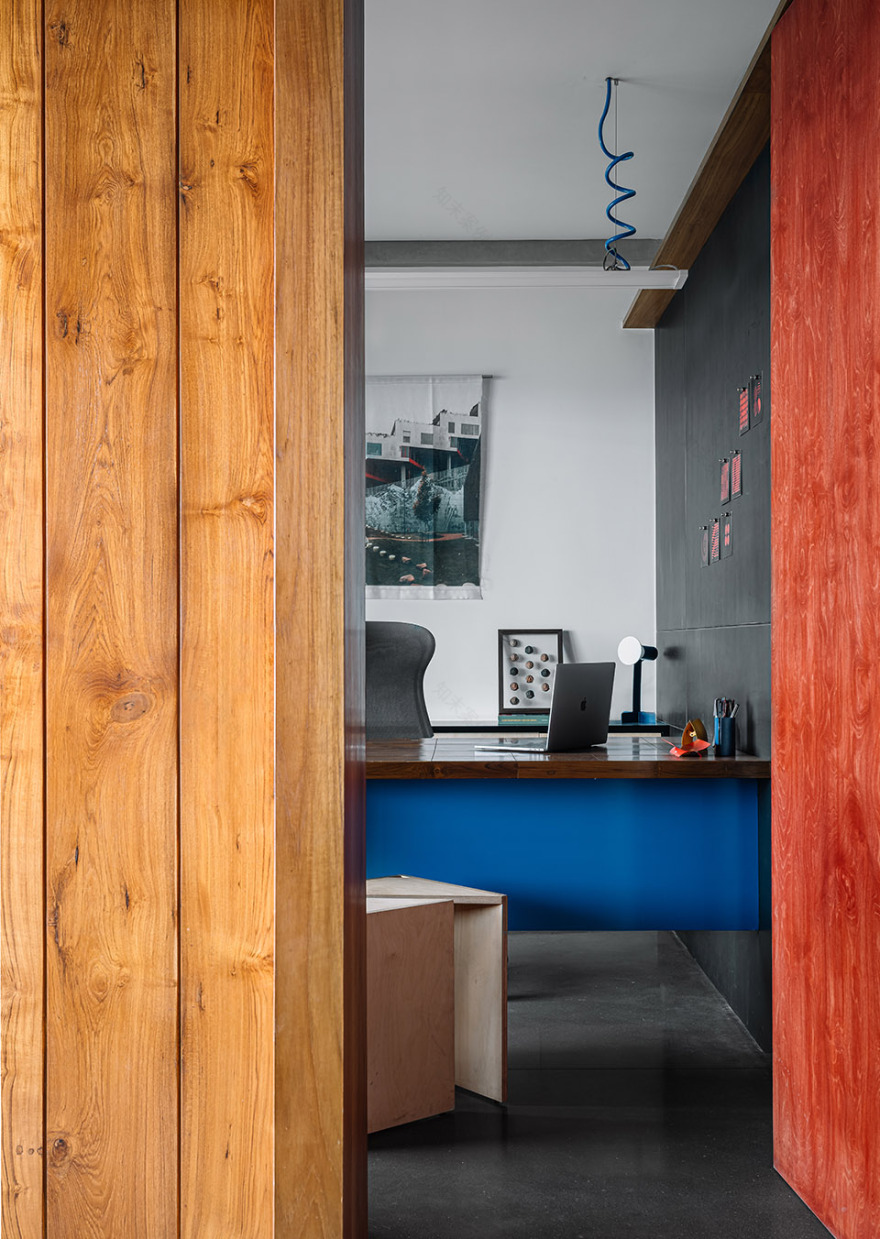
越过工位,首席建筑师的独立办公室出现——这是为专注而设的空间。这里以简洁为主:水平的平面构成可调节的工作台与储物单元,功能与简约兼备。这些桌子可以重新配置,甚至被拆解并改造为新的桌子。钉图钢板墙在此再次出现,既保证视觉连贯,又具备实用价值。面向露台的大窗户引入自然光,营造宁静氛围。办公室有意避免复杂纹理与装饰,突出清晰与实用。但在这里,与工作室其他部分一样,细微的材质变化带来一丝趣味。桦木夹板在不同区域呈现多样处理——有的染成红色或蓝色,有的保持自然原色——在专注氛围中增添层次感与趣味性。
Moving beyond the workspaces, the principal architects’ cabins emerge – spaces designed for focus. Here, simplicity reigns. Straightforward horizontal planes create adaptable work tables and storage units that are as functional as they are minimal. These tables are designed to be reconfigured or removed and repurposed into new tables in the future. The MS pin-up walls make a return, offering both visual cohesion and practical utility. Large windows, facing the terrace beyond, allow natural light to spill in, crafting a serene atmosphere. The cabins are kept intentionally free of texture and decoration, prioritizing clarity and functionality. Here, as in the rest of the studio, subtle variations in texture and material introduce a touch of playfulness. Birch ply appears in different finishes – some stained red or blue, while other areas feature its natural shade, adding depth and interest without disrupting the focus-driven environment.
▼首席建筑师的独立办公室,the principal architects’ cabins emerge ©Ishita Sitwala

在工作室最深处,氛围发生转变:空间延伸至半开放的露台——一个为休憩、交流与社群而设的缓冲区。无论是安静的午餐、即兴的聚会,还是独处的停留,露台都能轻松适应。由工作室定制的模块化家具以金属网格方盒单元构成,可根据需要展开为立方体,形成可伸缩的阶梯式小剧场系统。这些模块同时也可作为座椅、脚凳、长凳或餐桌,灵活回应当下的需求。
At the furthest end of the studio, the atmosphere shifts as the space opens up into a semi-open terrace – a breakout space designed for pause, conversation, and community. Whether it’s a quiet lunch, a spontaneous gathering, or a solitary pause, the terrace shifts effortlessly to accommodate. The modular furniture, custom-made by the studio, consists of metal mesh cube units – that expand into cuboid forms whenever needed – to create a retractable amphitheatre system. These modules also double up as seating, footrests, benches, and dining tables, adapting gracefully to whatever the moment calls for.
▼模型区,model zone ©Ishita Sitwala


以模块化逻辑为根基、以多功能为导向,这座工作室随着使用者的节奏而呼吸——随着创意的成型而扩展、收缩与变换。它拒绝固定性,而拥抱可能性,成为一个能随人而自然生长、不断变化的空间。
Rooted in modular logic and shaped by multifunctional intent, the studio is designed to move with the rhythms of its occupants – expanding, contracting, and shifting as ideas take form. It resists permanence in favour of possibility, a space that grows and changes naturally with the people who use it.
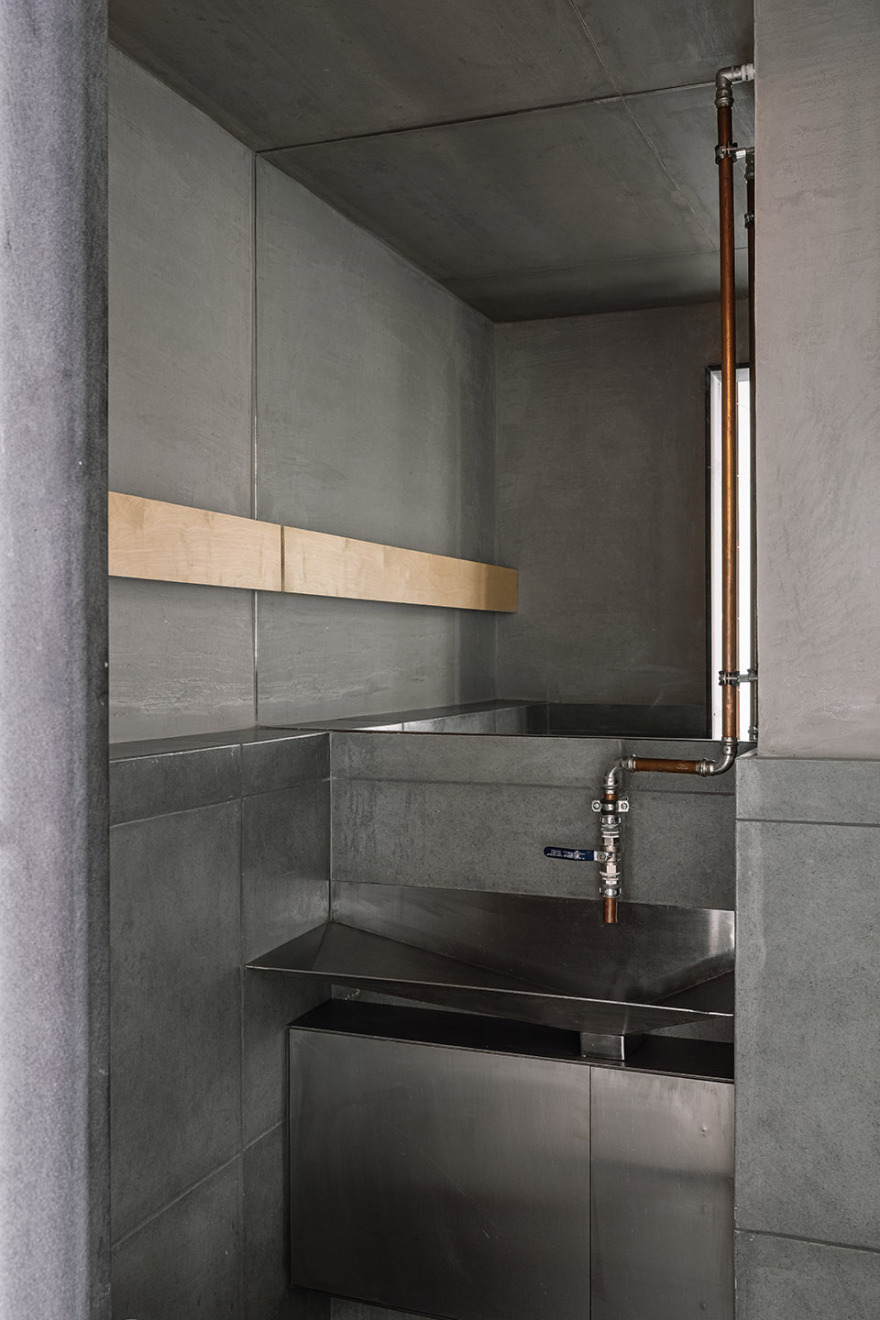
▼卫生间,bathroom ©Ishita Sitwala
Name of the Project- Surface and Silence
Design Firm- H+A Studio
Area (in sqft)- 3,200 sqft
Location: Surat, India
Principal Designers: Aayushi Gajjar, Harihar Leshwala
Photographer: Ishita Sitwala ( For every image)
南京喵熊网络科技有限公司 苏ICP备18050492号-4知末 © 2018—2020 . All photos and trademark graphics are copyrighted by their owners.增值电信业务经营许可证(ICP)苏B2-20201444 苏公网安备 32011302321234号
苏公网安备 32011302321234号客服
消息
收藏
下载
最近