

创作上传
VIP
收藏下载
登录 | 注册有礼
查看完整案例

收藏

下载

分享
在中国城市化进入存量时代的背景下,我们不得不面对过去快速建设所遗留的问题:许多公共建筑因其粗暴、苍白的设计而“建成即废弃”,成为低效的存量资产;与此同时,在新兴城区,居民渴望的优质公共配套却依然匮乏。如何用最少的资金资源,把建成即废弃的公共建筑,转化成充满活力的社区客厅?这是当今社会面临的一大难题,也是金湾邻里汇改造想要解决的问题。在项目的更新设计中,易加设计以公园为锚点,用一道“共享平台”重新连接分散的建筑,构建立体的社交空间,激活社区生机。在极限造价下,将四栋孤建筑转变为珠海最活跃的社区客厅。为盘活存量资产、激发社区活力提供了一个高性价比的样板。
Amid China’s transition into an era of urban regeneration, many cities are grappling with the lingering consequences of rapid construction in the past decades. Many public buildings, hastily constructed with ill-considered and lifeless designs, fell into disuse soon after completion, becoming underutilized assets. Meanwhile, in emerging urban districts, there is a lack of high-quality public amenities that citizens increasingly long for. How can these “built-then-abandoned” structures be transformed into vibrant community hubs with minimal financial resources? This pressing urban challenge is what the project set out to address. In this urban regeneration project, E+UV anchored the intervention on an existing municipal park. A “shared platform” was introduced to reconnect four previously isolated buildings, creating a multidimensional network of social spaces that reactivates community life. Despite an extremely tight budget, the project has transformed four disconnected structures into one of Zhuhai’s most dynamic community hubs, offering a cost-effective model for revitalizing underutilized assets and fostering neighborhood vitality.
▼改造后鸟瞰,Overall bird ‘s-eye view of the project© 杜睿

PART.01
困境:稀缺与浪费并存的社区难题
Challenge: The Paradox of Scarcity and Underutilized Assets
金湾航空新城作为珠海人口增长最迅速的社区之一,迫切需要一个能满足居民需求的新型社区中心。基地选择在航空新城的核心地带,是被大型高密度住宅围绕的四栋孤立的配套物业。由于设计的仓促,这几栋建筑都具有明显的设计缺陷,立面非常封闭,流线互不相连。业主原来的想法,是对这四栋建筑进行立面的改造,各自赋予办公,社区活动,商业等业态,实现社区配套功能。
Jinwan Aviation New City, one of Zhuhai’s fastest-growing areas, urgently needed a new community center to meet the demands of its expanding population. The site, located in the heart of this new district, consisted of four standalone ancillary buildings surrounded by dense housing developments. However, due to rushed planning, these buildings suffered from design flaws: closed facades, disconnected circulation, and a lack of functional synergy. The client’s initial plan was to renovate the facades and assign each building a distinct function—offices, community activities, or retail—to serve as ancillary facilities supporting daily community life.
▼改造前鸟瞰,Overall bird ‘s-eye view of the project© E+UV

然而改造建设的资金非常紧张,如果按照常规的改造思路,必然是捉襟见肘,勉强为止。必须另辟蹊径。建筑师现场勘察后发现,要打造社区的灵魂客厅,其最重要的不是立面升级,是重塑整个场所的精神。而核心全在于被人们遗忘的宝藏——市政绿化公园。
However, with budget severely limited, a conventional renovation approach would only deliver piecemeal improvements. A new strategy was required. During on-site investigations, the architects recognized that the key to creating a true community hub lay not in simply upgrading the facades, but in reimagining the spirit of place. At the heart of this vision was a long-overlooked gem—the adjacent municipal green park.
▼改造前立面,Overall bird ‘s-eye view of the project© E+UV

PART.02
破题:让公园成为社区的“心脏”
Concept: Making the Park the “Heart” of the Community
基地围绕着一个半圆形的市政绿化带。解题的思路,在于把四栋建筑物围绕的市政绿化公园作为空间焦点,以一个舒展的二层平台,将光秃秃的建筑物连成一体。整个建筑群的姿态和面貌,由于这个简单而坚定的动作,发生了180度的改变。每栋建筑都张开双臂拥抱公园,能量焦点聚集在一起。
The site is centered around a semicircular municipal greenbelt. The design strategy repositions the park—surrounded by four isolated buildings—as the spatial anchor. A sweeping second-level platform unites these stark structures into a cohesive ensemble. This simple yet resolute gesture has dramatically transformed the complex’s form and identity. Each building now opens toward the park, channeling energy and activity into a vibrant community core.
▼改造前后对比鸟瞰,Overall bird ‘s-eye view of the project© E+UV(左),吴嗣铭(右)

平台以坡道和楼梯与接到层相连,实现了双首层,大大提升商铺价值。而平台的下面,又提供了炎热的岭南最需要的阴影。光秃秃的人行道,变成了舒适的檐下空间。这里为炎热的夏天提供了难得的荫凉,也抵御了海边的随时袭来的暴雨。
Ramps and stairs connect the platform to the street level, creating two distinct ground levels that significantly enhance accessibility and boost the commercial value of the retail spaces. Beneath the elevated platform, shaded areas offer relief from the hot, humid climate typical of the Lingnan region. Previously exposed sidewalks are transformed into comfortable, sheltered spaces, offering respite during hot summer days and protection from sudden coastal storms.
▼概念草图,Concept sketch © 周奕奕
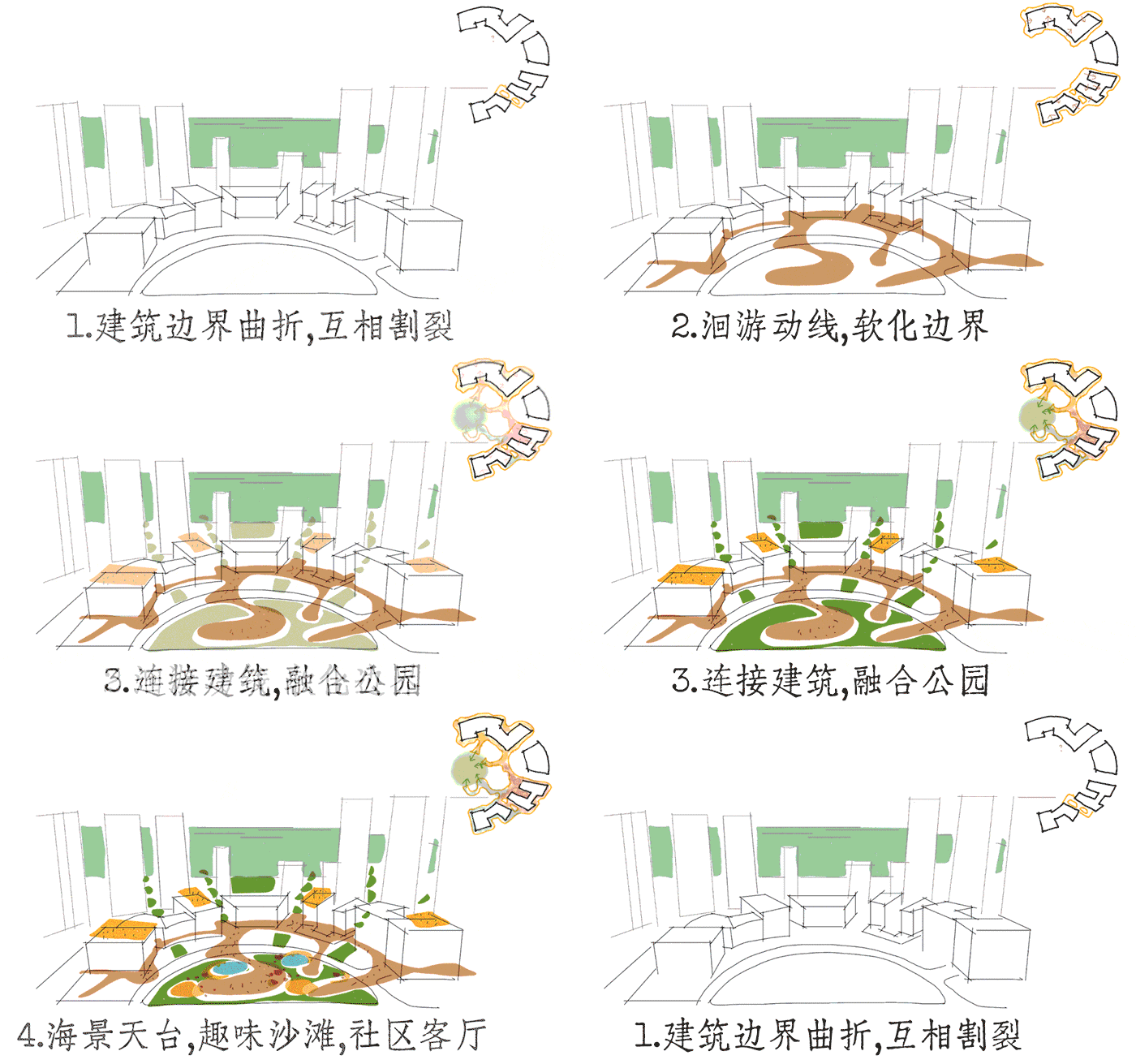
当立体的社交空间形成,多种多样的社区活动也随之产生。这里是儿童们玩耍,老人们聊天,家长们等着孩子放学的热闹空间。大大小小的圆形开洞,有的是树池,有的是滑梯,在板下形成活泼的光影。
The resulting three-dimensional social space supports a diverse range of community activities. Children play, seniors chat, and parents wait for their children after school. Circular openings of varying sizes—ranging from tree pits to slides—create a lively interplay of light and shadow beneath the platform, activating the space and encouraging interaction.
▼板下家长等候区,Parent pick-up waiting area beneath the platform © 吴嗣铭

▼圆形开洞,Circular openings © 吴嗣铭

▼板下社交空间,Social space beneath the platform © 吴嗣铭

▼板下商业灰空间,Retail and semi-open spaces beneath the platform © 吴嗣铭

一条长长的坡道把人引向二层平台,略带起伏的地形是滑板和单车少年的最爱。平台上又是另一个层次的社区生活,生鲜市场就设在二层。在夏夜炎热褪去,人们在这里可以享受习习的海风,又能坐在大台阶上参与社区舞台热闹的活动。
A gently undulating ramp draws people up to the second-floor platform, doubling as a favorite spot for local skateboarders and cyclists. Above, a new layer of community life unfolds, with a fresh food market located on this upper level. On summer nights, when the heat subsides, residents gather here to enjoy the sea breeze or sit on the broad steps to engage in the lively events on the community stage.
▼上板坡道,Ramp leading up to the platform © 吴嗣铭

▼坡道通向生鲜市场,Ramp to the fresh food market © 吴嗣铭

▼板上休闲空间连接各个建筑,Leisure spaces on the platform linking the buildings © 吴嗣铭

▼板上的活动,Activities on the platform © 吴嗣铭

平台上下,是看和被看的即兴互动产生的场所。我们的空间鼓励社区居民的参与和再创造,唯有这样,才能让这里成为居民们自己的归属之处。
Above and below the platform, spontaneous interactions of seeing and being seen unfold. The space invites active engagement and co-creation, evolving into a true place of belonging for the community.
▼俯瞰大板平台,Aerial view of the expansive platform © 吴嗣铭

▼大板平台与圆洞,Expansive platform and circular openings © 吴嗣铭

▼傍晚的平台上下,Spaces above and beneath the platform at dusk © 杜睿

▼平台与大台阶,Platform and large steps © 吴嗣铭

PART.03
界面:轻投入,好效果
Interface : Minimal Intervention, Maximum Effect
由于极限造价的限制,对立面的改造采取非常克制的手法。而聚焦空间场所的设计策略,让对立面的轻改造成为可能。
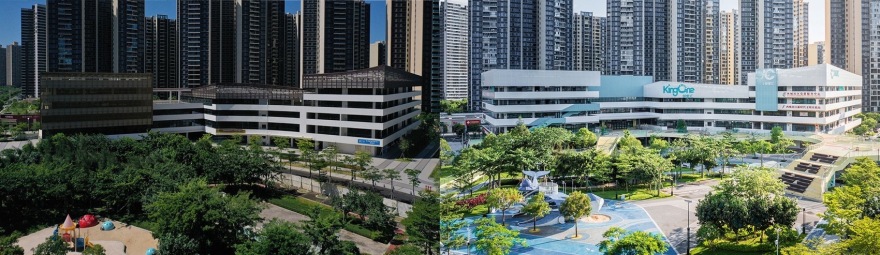
▼邻里中心改造前后对比,Community center – before and after renovation © E+UV(左),杜睿(右)
▼邻里中心墙身剖面,Wall section of building © E+UV

Constrained by an extremely limited budget, the facade renovation employs a restrained yet strategic approach. By focusing on the sense of place rather than superficial upgrades, the design achieves a light-touch transformation with significant impact.
▼平台与大台阶,Facade of building © 吴嗣铭
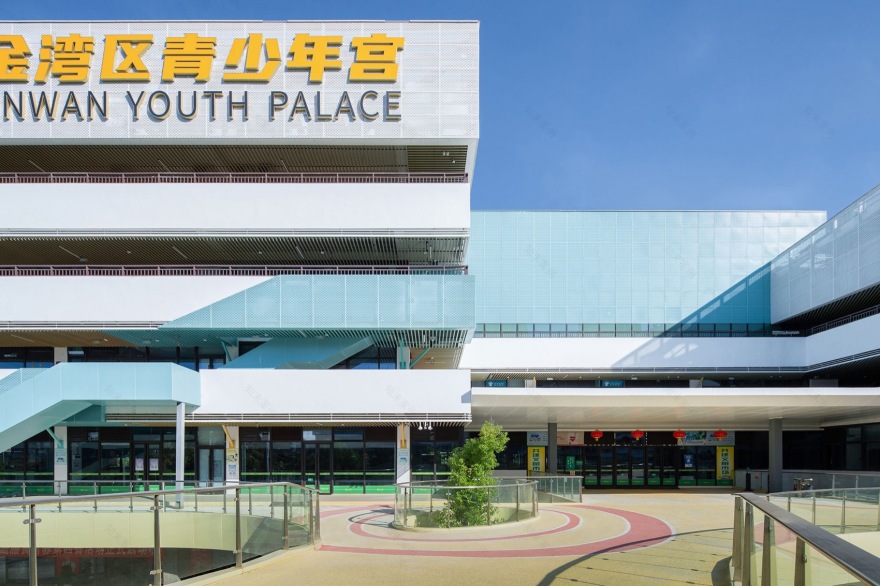
▼邻里中心色彩带与外挂楼梯,Color bands and exterior stairs © E+UV(左),吴嗣铭(右)

我们以颜色作为武器,用一种轻盈的手法,在原来毫无表情的立面上,创造出了活泼而灵动的表情。各栋建筑以不同的主题色,呼应这里丰富的社区业态——政府服务,餐饮商业,生鲜市场,老年之家,少年活动中心。原来沉闷的穿孔铝板被拆除,换以洁白清新的横线条立面,在青少年宫的楼层,立面被完全打开,焕新成围绕四周的外廊,让流线空间完全外化。孩子们在盘旋而上的楼梯上下跑动,成为立面上最有趣的风景。
▼餐饮生活楼改造前后对比,Dining & lifestyle building – before and after renovation © E+UV(左),杜睿(右)

▼政务办公楼改造前后对比,Government office building – before and after renovation © E+UV(左),吴嗣铭(右)

▼餐饮生活楼墙身剖面,Wall section of the dining & lifestyle building © E+UV

▼政务办公楼墙身剖面,Wall section of the government office building © E+UV

Color became the primary design tool—a gentle intervention that breathes life into once monotonous facades. Each building was assigned a distinct theme color, echoing its specific program—such as government services, dining, retail, fresh food market, senior facilities, or youth activity center—visually highlighting the diversity of community life. The original dull perforated aluminum panels were replaced with clean, white horizontal bands, refreshing the visual identity of the facades. At the Youth Palace, the facade has been completely opened up and reimagined as a wraparound external corridor, turning circulation into a visible, animated experience. Children running up and down the spiraling staircase become a delightful feature of the facade, turning everyday movement into a playful scene.
▼政务办公楼,Government office building © 吴嗣铭

PART.04
自然渗透:让生长的绿地为生活赋能
Natural Integration: Growing Green Spaces that Nurture Community Life
原市政绿地已经有非常茂密的植被。我们只需在里面插入和活动相关的景观元素,一切以人为本。
The existing municipal greenbelt was already densely vegetated. Therefore, the design intervention simply introduced activity-oriented landscape elements, prioritizing everyday human experience.
▼大板平台环抱公园,Large platform embracing the park © 杜睿

一颗也不能少——原来绿化带的树木被完全保留。现状的树木和平台的开洞严格对位,向上延展的的树冠给二层平台带来绿色和荫凉。
Not a single tree was removed. Existing trees were fully preserved, with their canopies carefully aligned with the platform openings above, bringing greenery and shade to the upper platform.
▼林间漫步道,Tree-lined walkway© 吴嗣铭

▼林荫树阵广场,Tree-shaded plaza © 吴嗣铭

一个在树荫里的开放式儿童游乐场,成为孩子们每天消耗精力的乐园。一个通向二层平台的大台阶和舞台,是各类大小的社区,学校,街道组织举办活动的绝佳场所。
Beneath the trees, an open-air playground becomes a daily haven for kids to play and explore. A grand staircase and stage leading to the second-level platform offer ideal venues for varied events organized by the school and the local community.
▼鲸鱼广场俯瞰,Aerial view of whale plaza © 吴嗣铭

围绕板下空间的消防车道,被改造成海洋主题的景观步道,是每晚热闹的夜市举行的场所。
The fire lane beneath the platform was transformed into an ocean-themed landscape pathway, doubling as a vibrant night market venue.
▼海洋主题儿童游乐场,Ocean-themed children’s playground © 吴嗣铭

PART.05
成效:从“建成即废弃”到“开业即火爆”
Impact: From “Built then Abandoned” to “Thriving once Opened”
在开业1年多以来,金湾邻里汇已经成为珠海最活跃的邻里中心,举行了大大小小近百场的各种活动。绿化渗透为商业提供了松弛的氛围。而围绕公园的灯光夜市,更是持续火爆。这是一个真正服务于居民的活动场所,一个属于居民的城市客厅。金湾邻里汇提供了一个样板,向社会展示了如果用低廉的造价,快捷的手段,筑造出充满社活力的社区场景。当建筑师只关注形式,便只能收获形式。当建筑师开始关注人,会收获真正的生活。
Since opening over a year ago, KING ONE Community Center has emerged as Zhuhai’s most vibrant community hub, hosting nearly a hundred events of varying scales. The lush greenery creates a relaxed, inviting atmosphere for both community life and commercial activities. The park-centered night market continues to draw lively crowds every evening. This is more than a public venue—it is a true “urban living room,” shaped for and embraced by its residents. The project offers a compelling model, demonstrating how low-cost, rapid interventions can create a socially dynamic and inclusive community environment. When architects focus solely on form, they achieve only form. When they begin to focus on people, they cultivate true life.
▼整体俯瞰,Overall aerial view © 杜睿

这里我们能看见丰富的生活场景,看见人们在这里流连,玩耍,和海风,阴影,树林产生对话。在这里他们的活动也将叠加,书写他们自己的社区的故事。
Here, the richness of everyday life is on full display—people lingering, playing, and interacting with the sea breeze, the shade, and the trees. Their activities layer together, collectively writing the ongoing story of the community.
▼总平面图,Master plan © E+UV

▼首层组合平面,Combined 1F plan © E+UV

▼二层组合平面,Combined 2F plan © E+UV

▼首层景观图,First floor landscape plan © E+UV

项目信息
项目名称:金湾邻里汇社区中心改造
业主名称:珠海汇华控股集团有限公司
项目地点:珠海市金湾区
建筑面积:56589㎡
景观面积:46693㎡
设计时间:2022年5月
开业时间:2023年11月
建筑方案设计:深圳易加设计有限公司 E+UV
建筑方案主创设计师:周奕奕、李甫
项目负责人:郭思博
设计组:李耕、黄海峰、董思谊、李鑫、张艳、王俊力、黄小芮、鄢玉蓉、张旭斌、孙宏楠
施工图设计:深圳易加设计有限公司
景观方案、施工图设计:深圳华棠景观事务所
景观设计主创设计师:范烨
项目负责人:何伊翔
设计组:范晓旭、郑衍麟、张丁丁、覃薇燕、刘晶晶、李水星、齐志娟、黄小莲
建筑摄影:©吴嗣铭 ,©杜睿
Project name: KING ONE Community Center
Client: Zhuhai Huihua Holdings Group Co., Ltd.
Location: Jinwan District, Zhuhai
Building area: 56,589㎡
Landscape area: 46,693㎡
Design phase: May 2022
Opened: November 2023
Architectural design: E Plus Design(E+UV)
Chief architect: Coco Zhou,Li Fu
Project director: Guo Sibo
Design team: Li Geng, Huang Haifeng, Dong Siyi, Li Xin, Zhang Yan, Wang Junli, Huang Xiaorui, Yan Yurong, Zhang Xubin, Sun Hongnan
Construction drawings: E Plus Design
Landscape scheme & construction drawings: HTLA Design Studio
Chief landscape designer: Fan Ye
Project Director: He Yixiang
Design team: Fan Xiaoxu, Zheng Yanlin, Zhang Dingding, Qin Weiyan, Liu Jingjing, Li Shuixing, Qi Zhijuan, Huang Xiaolian
Photo credits: © Wu Siming, © Du Rui

南京喵熊网络科技有限公司 苏ICP备18050492号-4知末 © 2018—2020 . All photos and trademark graphics are copyrighted by their owners.增值电信业务经营许可证(ICP)苏B2-20201444 苏公网安备 32011302321234号
苏公网安备 32011302321234号客服
消息
收藏
下载
最近