

创作上传
VIP
收藏下载
登录 | 注册有礼
查看完整案例

收藏

下载

分享
1.项目背景与概况
1. Project Background and Overview
柬埔寨德崇国际机场位于金边市中心以南20公里,占地2600公顷。设计汲取了柬埔寨乡土建筑的灵感,体现了强烈的地方特色,并融合古老文明的智慧,对热带气候作出了因地制宜的回应。航站楼整体以人性化尺度与布局,选用温暖宜人的室内材料,以现代手法诠释柬埔寨本土特色。航站楼内自然光线充盈、绿植环绕,树木点缀于建筑缝隙间,灌木花草柔化空间边界,营造出生机盎然的“室外在室内”景观。项目以可持续发展为核心,将前沿技术与本地工艺深度结合,最大限度地降低运营能耗,致力于建设成为最环保的机场之一。机场航站楼一期工程包括核心主楼和北侧指廊,每年可容纳1300万人次旅客。未来将建设南指廊,年接待能力将提升至3000万人次。预计于2025年7月投入运营的德崇国际机场,正以“文明对话”的姿态,成为“一带一路”沿线交通建筑的绿色典范。
Techo International Airport is located 20 kilometers south of downtown Phnom Penh, covering an area of 2,600 hectares. The design draws inspiration from Cambodia’s vernacular architecture, expressing a strong sense of local identity while integrating the wisdom of its ancient civilization, offering a climate-responsive solution to the tropics. The terminal adopts a human-scaled layout with warm and inviting interior materials, reinterpreting Cambodian traditions through contemporary design. Flooded with natural light and surrounded by greenery, the terminal features trees woven into the architectural interstices, with shrubs and flowers softening spatial boundaries to create a vibrant “outdoor within indoor” experience. Anchored in the principles of sustainability, the project combines cutting-edge technologies with local craftsmanship to minimize energy consumption and aims to become one of the most environmentally responsible airports worldwide. Phase I of the terminal comprises the central main hall and the northern concourse, designed to accommodate 13 million passengers annually. With the future addition of the southern concourse, capacity will expand to 30 million passengers per year. Scheduled to open in July 2025, Techo International Airport aspires to stand as a green benchmark for transportation architecture along the Belt and Road Initiative, embodying the spirit of “dialogue among civilizations.”
▼机场主入口鸟瞰图, Aerial View of the Airport Main Terminal Entrance © 中国建筑西南设计研究院有限公司

从2020年至今,西南院与Foster + Partners通力合作,在方案理念及目标的背景下,持续优化系统构建策略,深化完善设备系统,精细把控材料细节,确保项目设计得以持续优化、精准实施与完美呈现,得到业主及柬埔寨社会各界的认同与赞誉。
Since 2020, CSWADI has worked in close collaboration with Foster + Partners to refine system-building strategies, further develop equipment systems, and meticulously manage material details under the shared design vision and project objectives. These efforts have ensured the continuous optimization, precise execution, and outstanding realization of the project, earning recognition and praise from the client as well as from across Cambodian society.
▼机场高架桥入口鸟瞰图, Aerial View of the Airport Elevated Road Entrance © 中国建筑西南设计研究院有限公司

机场的设计及建设是一个复杂系统工程,凝聚了多方协作的智慧与力量。过去的五年中,西南院团队牵头与业主、Foster + Partners及50余家专项顾问以及专业厂商充分沟通,紧密合作,系统性整合各方诉求及意见。团队以系统最优为原则,统筹旅客流程、行李处理系统、商业设施、安检与机电设备系统等专业板块,开展全周期综合评估及风险管控,确保了项目设计意图高质量还原与落地。同时,通过不断优化设计与细节控制,为项目节省了约2000万人民币的投入,显著提升了经济效益,充分彰显了设计团队的价值创造能力。
The design and construction of the airport represent a highly complex system engineering endeavor, one that brings together the wisdom and collective strength of many stakeholders. Over the past five years, CSWADI has taken the lead in working closely with the client, Foster + Partners, more than 50 specialized consultants, and professional vendors. Through extensive dialogue and collaboration, the team systematically integrated diverse requirements and perspectives. Guided by the principle of systemic optimization, the team coordinated key components including passenger flow, baggage handling, commercial facilities, security, and MEP systems. They conducted full-cycle assessments and risk management, ensuring that the design intent was faithfully translated into a high-quality built reality. At the same time, continuous design refinements and precise detail control helped save approximately RMB 20 million in project costs, significantly enhancing economic efficiency and demonstrating the design team’s strong capacity for value creation.
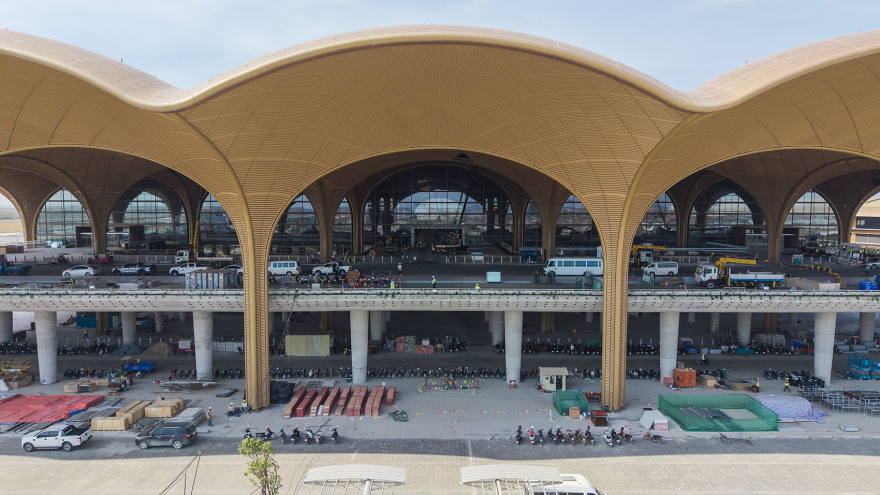
▼航站楼正立面透视图, Front Elevation Perspective of the Terminal Building © 中国建筑西南设计研究院有限公司
2.标准融合:多体系研究与实践
2. Standard Integration: Research and Practice across Multiple Systems
本项目采用美国标准体系,涵盖全周期管理,强调从概念到施工配合的全过程设计管理,流程控制严格。项目团队积极调整思维方式,精准匹配国际项目设计阶段的深度要求,顺利实现了从国内设计逻辑向国际设计逻辑的转变,为我院拓展全球海外市场奠定了坚实基础。
The project adopts the U.S. standards system, covering the entire project cycle and emphasizing rigorous process control from concept through construction coordination. The design team proactively adjusted its mindset to align with the depth requirements of each design phase in international projects, successfully achieving the transition from domestic design logic to international design logic. This has laid a solid foundation for CSWADI to expand into the global overseas market.
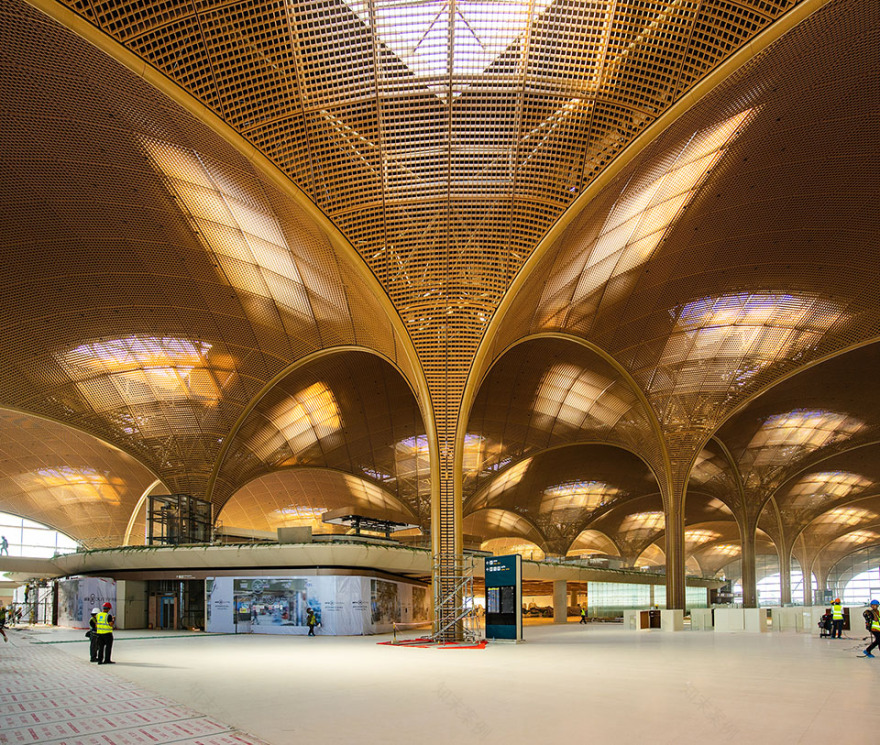
▼航站楼商业区透视图, View of the Terminal Retail Concourse © 中国建筑西南设计研究院有限公司
本项目采用了多体系国际标准的融合应用,涵盖消防遵循美国NFPA系列标准、无障碍设计执行美国ADA法案、建筑通用设计依据美国IBC规范及英国BS规范、节能设计执行LEED标准、声学与幕墙设计需同时满足英标与美标等要求。与中国规范不同,海外规范体系侧重理论框架,标准逻辑更偏向性能导向,设计团队基于具体项目参数,开展详尽的计算推导与构造设计,从理论和实践两方面确保设计逻辑闭环。例如在消防及生命安全设计中,团队从基本逻辑出发,严格按照NFPA101、NFPA5000等要求,从建筑总体情况分析、建筑功能定性、空间功能定性、人员荷载计算、疏散路径及出口设计、建筑耐火等级、室外消防设计等多方面,全方位多角度分析本项目特征,对前序消防设计提出了针对性且极具逻辑依据的深化建议并加以实施。在卫生间设计中,由于其采用了英国BS相关规范,但前序设计并未对卫生间洁具数量、内部通道宽度等一系列数据进行详细的计算,导致大部分卫生间不满足BS规范要求。在深化设计中,团队通过计算模型,根据航站楼各区域的旅客流量、性别比例、停留时间等参数,精确推算出各类洁具的配置数量。同时,对无障碍卫生间的转弯半径、门扇开启角度、扶手安装位置等细节进行了全面优化,确保每一处设计都符合国际标准的人性化要求。项目不仅全面符合多元国际规范体系的严苛要求,也大幅提升了旅客的整体使用体验。
The project applies a fusion of multiple international standards: fire protection in accordance with the NFPA series, accessibility design under the U.S. ADA Act, general building design based on both the IBC (U.S.) and BS (U.K.) codes, energy efficiency following LEED standards, and acoustic and façade design meeting both U.S. and U.K. requirements. Unlike Chinese codes, which tend to be prescriptive, overseas codes emphasize theoretical frameworks and performance-based logic. Based on project-specific parameters, the design team carried out detailed calculations and constructive design, ensuring a closed-loop design logic from both theoretical and practical perspectives.
For example, in fire protection and life safety design, the team began with fundamental principles and strictly followed NFPA 101 and NFPA 5000. They analyzed the project comprehensively and from multiple perspectives—including overall building conditions, functional classification, spatial usage, occupant load calculations, egress routes and exit design, fire-resistance ratings, and outdoor fire protection. Based on this analysis, the team proposed and implemented targeted, logically grounded recommendations to refine earlier fire safety designs.
In restroom design, the project followed relevant BS standards from the U.K. However, the earlier design had not carried out detailed calculations for fixture quantities, internal circulation widths, and other critical parameters, resulting in many restrooms failing to meet BS requirements. During the design development phase, the team applied computational modeling to determine precise fixture counts based on passenger flow, gender ratio, and dwell time across different areas of the terminal. In addition, details such as turning radii for accessible restrooms, door swing angles, and handrail placement were thoroughly optimized to ensure that every aspect of the design met the human-centered requirements of international standards.
The project not only fully complies with the stringent requirements of diverse international standards but also significantly enhances the overall passenger experience.
▼航站楼02层安检区中庭透视图 View of the Security Check Atrium on Level 02 © 中国建筑西南设计研究院有限公司

3.功能优化:弹性化空间设计
3.Functional Optimization: Flexible Space Design
功能优化是设计过程中持续推进的核心工作,也是西南院机场设计在国内多年的技术经验积累与国际需求深度融合的过程。业主方期望航站楼自投入运营之初便实现收益最大化,并为未来客流增长预留充足的灵活调整空间,使项目在“当下效益”与“长远发展弹性”之间实现最优平衡。北指廊全长约200米,二层整层作为游客等待区,通过对旅客动线、停留时长与商业视线的精细模拟,将原预留的卫生间调整为连续的商业单元,扩大展示面宽度并优化店铺入口,与人员动线平行布置,在保证流线顺畅的同时显著提升商业价值,减轻机场早期运营压力。为兼顾远期发展,设计上预留管线接口和改造条件,为未来引入新业态提供快速转换可能,既避免重复建设,又保持运营灵活性,实现全周期价值最大化。
Functional optimization has been a core task throughout the design process, representing the fusion of CSWADI’s long-accumulated expertise in domestic airport projects with the deep demands of international standards. The client envisioned a terminal that could maximize returns from the very beginning of operation while also reserving ample flexibility to accommodate future passenger growth, thus achieving an optimal balance between “immediate benefits” and “long-term adaptability.” The northern concourse, approximately 200 meters in length, dedicates its entire second floor to passenger waiting areas. Through detailed simulations of passenger flow, dwell time, and sightlines toward commercial spaces, the originally planned restrooms were reconfigured into a continuous sequence of retail units. This adjustment increased display frontage, optimized shop entrances, and aligned commercial layouts with passenger movement, ensuring smooth circulation while significantly enhancing commercial value and easing the financial pressures of early operations. At the same time, provisions for utility interfaces and adaptable conditions were reserved in the design to enable rapid transformation for future business models. This approach avoids redundant construction, preserves operational flexibility, and ensures value maximization throughout the full lifecycle of the project.
▼航站楼00层国内到达大厅到达视角 Arrival View of the Domestic Arrivals Hall, Level 00 © 中国建筑西南设计研究院有限公司

▼指廊02层国际候机区透视图View of the International Boarding Area on PIER Level 02 © 中国建筑西南设计研究院有限公司

4.机电整合:隐形化界面协同
4. MEP Integration: Invisible Interface Coordination
作为大型枢纽机场,航站楼内机电点位繁杂,且地面、墙面、玻璃隔断、吊顶、卫生间及商业内装由多国分包承担,若缺少统一坐标与界面控制,极易导致视觉杂乱。设计团队以界面一体、效果一致为原则,将建筑内所有的机电点位与家具布置、完成面材质、维护方向进行综合梳理,反复校正,使灯具、插座、探测器、扬声器等终端均与天花分、地面、墙面分缝精准对齐;卫生间则根据隔断模数,调节洁具、阀门、感应器位置,保证板面完整。经过近两年的持续精细整合,项目实现了公共空间“见设备而不露机”的设备隐形化整合效果,在显著提升视觉秩序感和空间纯净性的同时,为多国分包团队的协同施工提供了统一的标准依据。
As a major hub airport, the terminal features a dense array of MEP service points. Meanwhile, the finishes of floors, walls, glass partitions, ceilings, restrooms, and retail interiors were each handled by subcontractors from different countries. Without unified coordinates and interface control, visual clutter would have been inevitable. Guided by the principle of seamless integration and visual consistency, the design team conducted comprehensive coordination between all MEP points and the layout of furniture, finish materials, and maintenance access. Through repeated adjustments, terminal elements such as lighting fixtures, outlets, detectors, and speakers were precisely aligned with ceiling, floor, and wall joints. In restrooms, the placement of fixtures, valves, and sensors was adjusted to the partition module, ensuring continuous and unbroken surfaces. After nearly two years of meticulous coordination, the project achieved an “equipment concealed yet accessible” integration effect in public spaces. This not only enhanced the sense of visual order and spatial purity but also provided a unified standard for collaborative construction among multinational subcontracting teams.
▼航站楼00层国内到达大厅接机视角 Meeting View of the Domestic Arrivals Hall, Level 00 © 中国建筑西南设计研究院有限公司

机场航站楼是一台兼容众多机电设备的复杂“机器”,管线种类繁复、标高交错。西南院团队结合美标规范与设备参数,制定详细的管线优先级原则和空间分配策略,确立“重力流 – 通风 – 强弱电”由上至下的综合优先级,并对每条主干线设置控制带宽和检修走廊。通过Revit模型实时同步现场施工进度,当现场实测与图纸出现偏差,立即更新管综数据库并生成调整报告,记录净高修正、管线改位等措施,并在业主、监理及F+P团队联合评审后,迅速下达闭环整改措施,确保设计逻辑贯穿施工始终。在运营方介入后,提出众多商业经营向的修改意见,设计团队通过三维模型,模拟不同吊顶造型和地面高差变化对空间的影响,针对不同业态提出差异化解决方案,通过提高乘客可达区域净高,压缩后勤区域净高,在空间舒适度和现场改造成本之间取得平衡,机电与土建由此在精准配合中完成深度协同。
The airport terminal functions as a complex “machine” accommodating a wide array of MEP systems, with numerous pipelines crossing at varied elevations. Drawing on U.S. standards and equipment parameters, the CSWADI team developed detailed principles for pipeline prioritization and spatial allocation, establishing a comprehensive hierarchy of “gravity flow – ventilation – power and low-voltage systems” from top to bottom. Each main trunk line was assigned control bandwidths and maintenance corridors. Using a Revit model to synchronize construction progress in real time, any discrepancies between as-built conditions and design drawings were immediately reflected in the MEP database, accompanied by adjustment reports documenting ceiling height corrections, pipeline rerouting, and other measures. Following joint reviews with the client, supervision team, and F+P, closed-loop rectifications were swiftly issued, ensuring design logic carried through to execution. Once the operator became involved and raised numerous business-oriented modification requests, the design team employed 3D modeling to simulate the impact of different ceiling profiles and floor-level variations on spatial quality. Tailored solutions were proposed for different commercial typologies, balancing passenger comfort and renovation costs by increasing clear height in public areas while compressing back-of-house clearances. Through this precise coordination, MEP systems and civil works achieved a deeply integrated collaboration.
▼值机大厅透视图, View of the Check-in Hall © 中国建筑西南设计研究院有限公司

5.细节掌控:高完成度节点设计
5. Mastering Details: High-Precision Node Design
项目的完成度在很大程度上取决于细节设计的精细程度。面对国际规范体系缺乏标准图集的现状,团队以图形化思维,将国内措施表系统转换为节点详图,精确表达结构层次、节点衔接、材料选用等信息,重点突出关键节点、材料适配与施工工艺。通过详尽的节点详图,统一施工指引,确保各部位精准落地。以墙体砌筑为例,节点图细化至排砖模数、配筋位置;结构梁配筋则逐根标示钢筋直径及间距,有效提升图纸传递精度。本项目共完成了1500余项节点详图的设计工作。
The overall completeness of the project largely depends on the refinement of detail design. Confronted with the absence of standardized drawing libraries in international code systems, the team adopted a graphic-oriented approach, converting domestic specification tables into detailed node drawings. These drawings conveyed structural hierarchy, node connections, and material specifications with precision, highlighting critical junctions, material compatibility, and construction techniques. By providing comprehensive node drawings, the team established unified construction guidelines, ensuring accurate execution on site. For example, in wall masonry, the drawings specified brick layout modules and reinforcement positions; in structural beams, every rebar diameter and spacing was clearly indicated, significantly improving the accuracy of information transfer through drawings. In total, the project produced more than 1,500 detailed node drawings.
▼航站楼屋面节点透视图, View of Roof Node Details © 中国建筑西南设计研究院有限公司

6.国际管控:研究性设计方法
6. International Management: A Research-Oriented Design Approach
回顾整个项目历程,让我们印象颇深的是海外高水平方案设计成果,成熟的工程管理体系以及高完成度的供应及实施体系。
Looking back at the entire project journey, what impressed us most were the high-quality overseas design schemes, the mature project management system, and the highly accomplished supply and implementation framework.
▼行李提取大厅透视图, View of the Baggage Claim Hall © 中国建筑西南设计研究院有限公司

在方案设计初期,建筑专业统领各相关效果控制专业,开展多方案建筑推演与可视化表达,以设计报告和图表为载体,对项目关键细部进行量化管理,涵盖外部围护体系构造、内部装饰节点、灯光景观对人体感知等层面。材料选择环节高度重视科学性,通过实物样板(mock-up)及技术规格书(Specification),对各类材料进行多维度对比分析并精准把控技术指标,全面强化标准制定前置。通过上述高度系统化与细致化的设计与管理手段,最大限度提升了项目的可控性,有力支撑了实现业主对品质与目标的严苛要求。
At the early design stage, the architecture discipline took the lead in coordinating related specialties responsible for quality control, conducting multiple architectural iterations and visualizations. Design reports and diagrams were used as carriers to quantify and manage critical project details, covering aspects such as the external envelope system, interior finishing nodes, and the perceptual impact of lighting and landscape on users. The material selection process placed strong emphasis on scientific rigor: through mock-ups and technical specifications, materials were compared and analyzed from multiple dimensions, with precise control over performance indicators. This proactive standard-setting approach significantly reinforced design reliability. With these systematic and meticulous design and management strategies, the project achieved the highest possible level of controllability, powerfully supporting the client’s stringent requirements for quality and project objectives.
▼航站楼02层边检区透视图, View of the Immigration Area on Level 02 © 中国建筑西南设计研究院有限公司

在设计过程中,境外项目团队展现出极强的研究性设计态度。由于海外项目周期普遍较长,团队有充分的时间对每一项设计决策进行深入论证和系统研究。从材料的热工性能到声学效果,从自然采光模拟到人流动线分析,每项设计都建立在充分的理论依据与严密的数据支撑之上。尤其在可持续设计方面,团队通过对全生命周期碳排放、能耗模拟、雨水收集利用等多维度进行细致研究,实现了环境效益与经济效益的双重提升。这种基于实证的设计方法,将感性的创意转化为理性的技术语言,为项目品质提供了坚实保障,值得我们在今后的项目中深入学习和实践。
During the design process, the overseas project team demonstrated a highly research-oriented design approach. Given the generally longer timelines of international projects, the team had ample opportunity to conduct in-depth reasoning and systematic studies for every design decision. From thermal performance of materials to acoustic effects, from natural daylight simulation to passenger flow analysis, each design was grounded in solid theoretical foundations and rigorous data support. Particularly in the realm of sustainable design, the team carried out detailed studies on lifecycle carbon emissions, energy consumption simulations, and rainwater harvesting, thereby achieving improvements in both environmental and economic benefits. This evidence-based design methodology transformed intuitive creativity into rational technical language, providing a strong guarantee for project quality—an approach well worth learning from and applying in our future projects.
▼航站楼02层望塔台视角透视图 View of the Control Tower from Headhouse Level 02 © 中国建筑西南设计研究院有限公司

在项目实施过程中,境外项目团队展现出高度结构化、规范化的管控水平。依托PMIS在线管理平台,项目实现了时间进度、现场影像、组织架构以及图纸审批等多项核心功能的集成,使得信息流转高效顺畅、各类流程全面可追溯。管理团队专人专项、全周期驻场,严格落实从前期策划到施工配合的全流程分工与执行。这种科学严谨的管理模式,加强了多专业、多单位的协同效能,为项目高质量推进和成果落地提供了坚实保障,充分体现了境外团队在项目管理上的高标准与成熟经验。
During the project implementation phase, the overseas project team demonstrated a highly structured and standardized level of control. Leveraging the PMIS online management platform, the project integrated core functions including schedule tracking, on-site imagery, organizational structure, and drawing approvals, ensuring efficient information flow and full traceability of all processes. Dedicated specialists were stationed on-site throughout the entire project cycle, rigorously implementing full-process task allocation and execution from early-stage planning through construction coordination. This scientific and meticulous management approach strengthened the collaborative efficiency across multiple disciplines and units, providing a solid foundation for high-quality project delivery. It fully reflects the overseas team’s high standards and mature experience in project management.
结语
Conclusion
柬埔寨德崇国际机场的完美呈现,标志着中建西南院院在海外工程领域由“技术跟跑者”向“价值创造者”的崭新跨越。项目中展现出的“三维整合能力”——对国际规范的精准解读、对复杂系统的高效集成、对跨文化团队的协同驾驭,为中国建筑企业“走出去”树立了可借鉴的范式。
The successful realization of Techo International Airport in Cambodia marks a significant leap for CSWADI in the overseas engineering arena, transitioning from a “technical follower” to a “value creator.” The project demonstrates a “three-dimensional integration capability”—precise interpretation of international standards, efficient integration of complex systems, and adept coordination of cross-cultural teams—setting a valuable precedent for Chinese architectural firms expanding globally.
▼航站楼远景鸟瞰图, Distant Aerial View of the Terminal Building © 中国建筑西南设计研究院有限公司

这座屹立于湄公河畔的机场,不仅是柬埔寨连接世界的崭新门户,更是中国设计走向国际舞台的标杆。在历史与未来的交汇点上,我们用技术致敬传统,以创新定义未来,于国际合作的广阔语境中,书写出东方建筑的全新叙事。
Situated on the banks of the Mekong River, the airport is not only a new gateway connecting Cambodia to the world but also a benchmark for Chinese design on the international stage. At the intersection of history and the future, we honor tradition through technology and define the future through innovation, crafting a new narrative of Eastern architecture within the broad context of international collaboration.
▼航站楼到达层, Level 00 – Terminal Arrival Floor © 中国建筑西南设计研究院有限公司
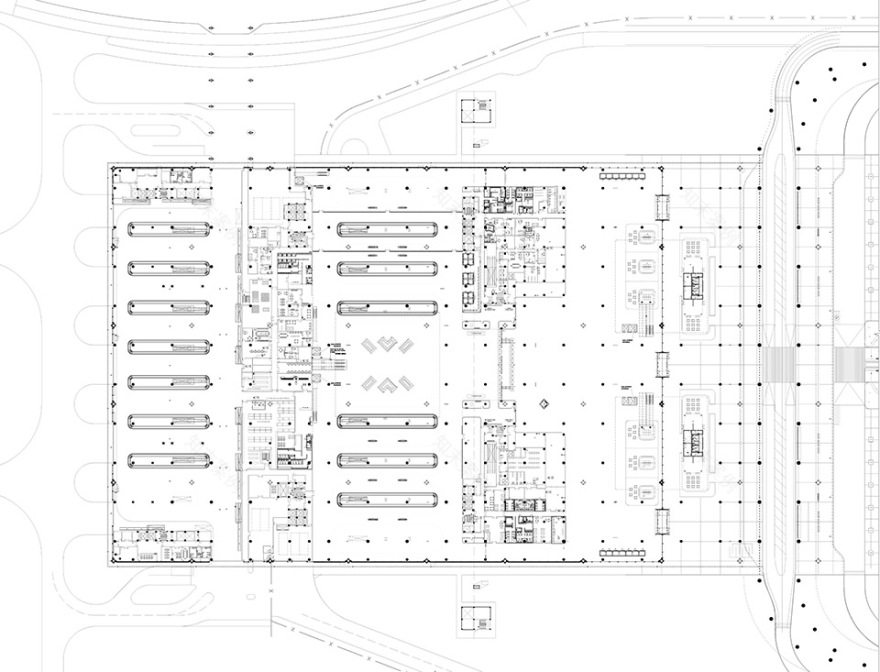
▼02层-航站楼出发层, Level 02 – Terminal Depature Floor © 中国建筑西南设计研究院有限公司

项目地点:柬埔寨金边市
设计时间:2020年1月至今
建成时间:2025年9月
业主单位:柬埔寨机场投资有限公司(CAIC)
用地面积:26000000 ㎡
建筑面积:220000㎡
结构形式:钢结构+钢砼结构
设计单位:福斯特建筑事务所(方案+初设)Foster+ Partners,中国建筑西南设计研究院有限公司(施工图+施工深化)
China Southwest Architectural Design and Research Institute Corp. Ltd
中国建筑西南设计研究院有限公司项目团队:
设计总负责人:陈荣锋 杨洋
建筑专业:杨洋 汪佳 谢巍晗 苏彦杰 骆娟
结构专业:张彦 刘宜丰 陈志强 罗二虎 胡轶平
给排水专业:潘柄辰 毕英菲 许光红 樊旭 邢霆峰 龚世坤
暖通专业:吕小亮 黄友超 戎向阳 杨玲 侯余波 刘志欣
电气专业:杜毅威 刘胜华 孟婷 谢建新 张晓刚 孙林 季绍诗
智能化专业:关怀 周海林 韩硕
幕墙专业:董彪 殷兵利 莫红梅 向宇 钟志强 鲜晗
景观专业:陈春旭、邹威廉、王曾炜、陆晶、邓心笛、邓晓
道路专业:陶庆鹏 程佳佳 牛俊杰 赵蕾
现场经理:熊骜寒 高建
南京喵熊网络科技有限公司 苏ICP备18050492号-4知末 © 2018—2020 . All photos and trademark graphics are copyrighted by their owners.增值电信业务经营许可证(ICP)苏B2-20201444 苏公网安备 32011302321234号
苏公网安备 32011302321234号客服
消息
收藏
下载
最近