

创作上传
VIP
收藏下载
登录 | 注册有礼
查看完整案例

收藏

下载

分享
“在这些当代空间中我最关注的是由局部相互接续所形成的连续空间。也就是说,这是一种揭示出位置、接续方式和相互关系的空间,表现出隐藏在世界中的构成和结构的空间,并且是一眼望去场景在不断扩展的空间,穿越时能够体验到的连续展开的空间。可以说这样的空间并非是均质连续的,而是由许多不同的局部场所连接而成的空间。”——坂本一成,“从封闭迈向开放、解放——空间配列的建筑论”,《建筑的诗学》[1]
“Within these contemporary types of spaces, the space I am most interested in, as noted above, is that which continues through a chaining of parts. In other words, in the space that expresses that totality of where things are, how those things are connected, how all the relationships are expressed, the composition and construction of that totality—as well as whether these elements spread out visibly from a single point, or develop continuously in the experience of moving through them. This could be said to be a space that, rather than continuing uniformly, is connected by the impressions arrived at by passing through its various highly differentiated places.”
——Kazunari Sakamoto. From “closed”, to “open”, to “free”. House: Poetics in the Ordinary [2]
©间架工作室
▼东侧鸟瞰,Aerial view from the east©侯博文
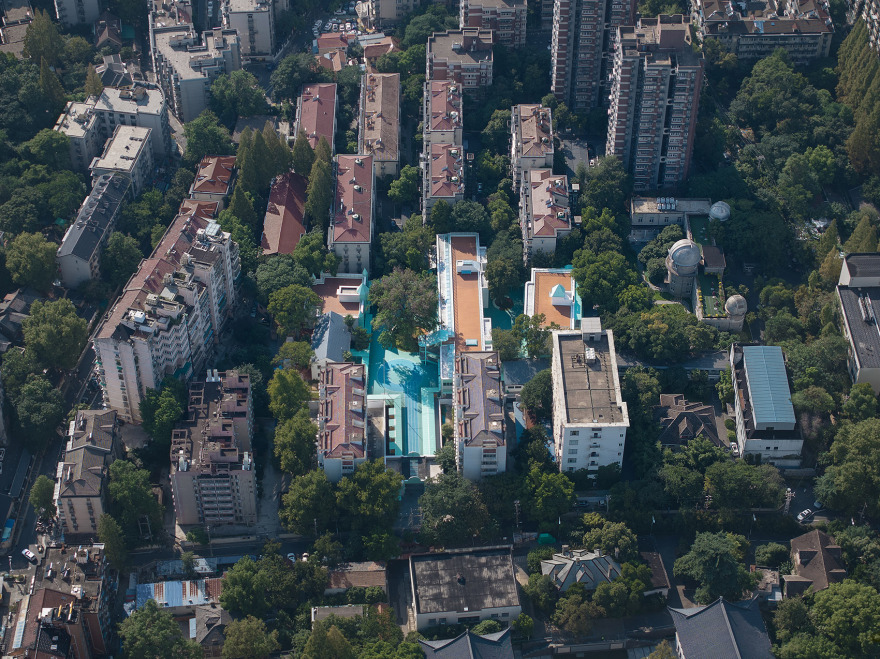
▼东侧鸟瞰,Aerial view from the east©侯博文

南京大学幼儿园是一所面向社会招生的公立幼儿园。它位于南大鼓楼校区西侧,与校区“北园”隔平仓巷而邻。幼儿园北侧为南大工程管理学院(包括原天文楼),东侧为留学生公寓,西、南侧为社会性居住小区。园区主体处于街廓腹地,仅通过东侧学生公寓间的狭长用地与平仓巷入口连通。
▼区位图,Location Map©间架工作室

The Kindergarten of Nanjing University is a public kindergarten open to the general public. It lies on the west side of the university’s Gulou Campus, facing the “North Campus” across Pingcang Lane. To its north stands the School of Management and Engineering (including the former Astronomy Building); to the east, the international-student dormitories; and to the west and south, social residential blocks. The main part of the site lies deep within the city block, reached solely through a narrow strip of land between student dormitories that connects to the Pingcang Lane entrance on the east.
▼俯视图,Top view©侯博文

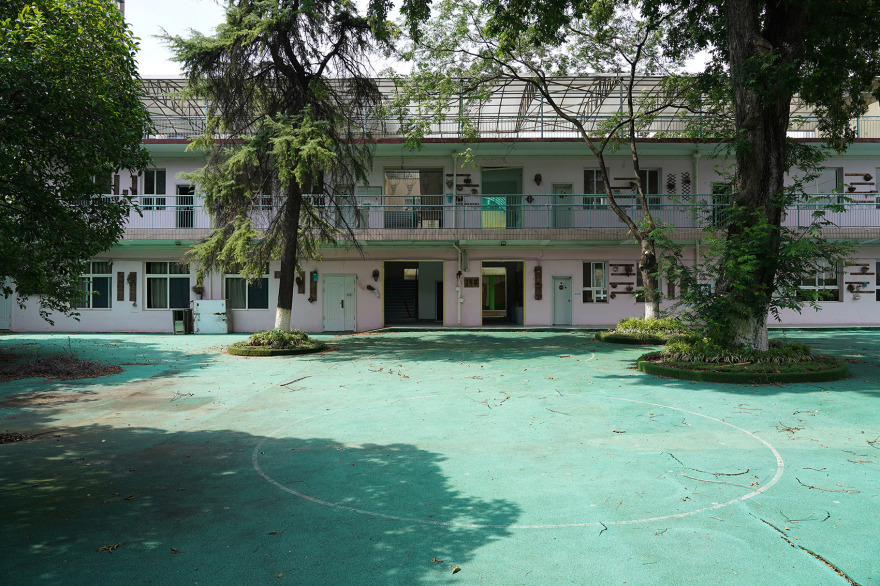
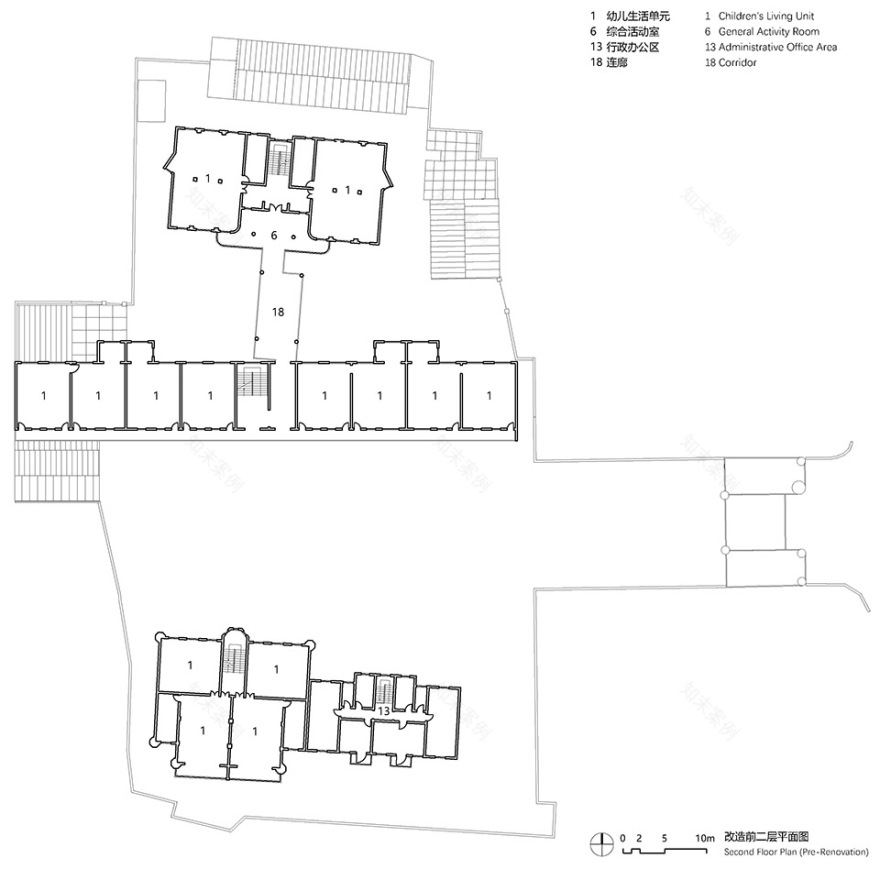
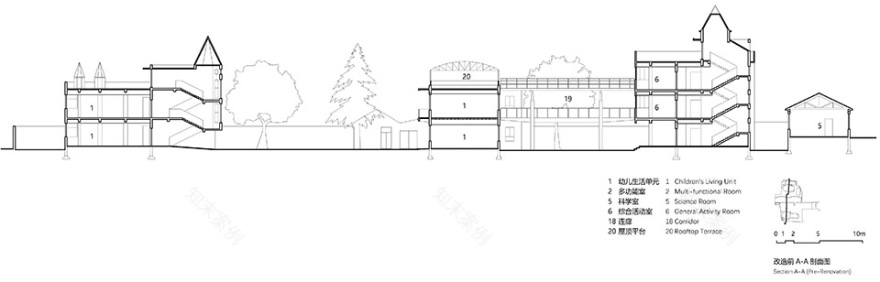
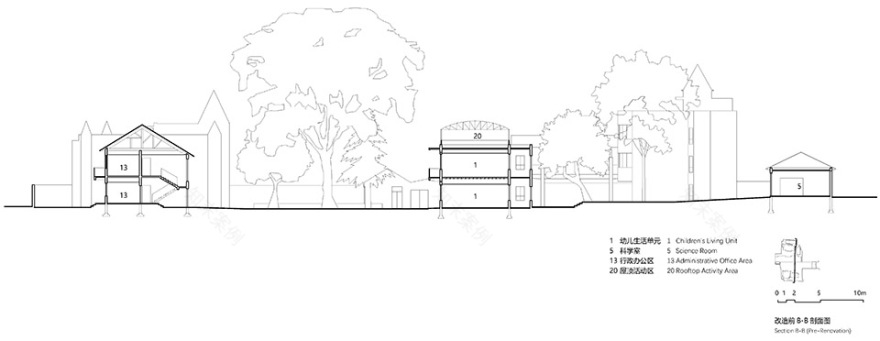
自1953年建园以来,园区经过多次拓展、扩建而成。在此过程中,由于缺乏整体的规划,而存在空间、使用上的诸多问题。并且,部分园舍建筑经结构检测已无法达到安全标准。因此,本次改造更新既需要重新梳理、整合园区空间结构,又需要对园舍建筑进行加固、改造。▼总平面图,Masterplan©间架工作室

Founded in 1953, the kindergarten has been enlarged and expanded in several phases. Because each expansion proceeded without an overall master plan, the campus now suffers from spatial disorganization and functional inefficiencies. Moreover, structural inspections have shown that portions of the existing buildings no longer meet current safety standards. The current renovation therefore must both restructure and integrate the site’s spatial layout and strengthen or reconstruct the buildings themselves.
▼改造前幼儿园,kindergarten before renovation©间架工作室

园区空间结构重整
Reconfiguration of the Campus Spatial Structure
改造前的园区空间布局中,厨房、非机动车停车等服务性功能被安排在园区西侧边缘,与东侧入口距离很远,货运、停车等服务流线须东西向穿越整个园区,导致物流、人流交叉,流线组织混乱。▼改造前后流线分析图,Circulation Analysis Diagram (Pre-Renovation)and(Post-Renovation)©间架工作室
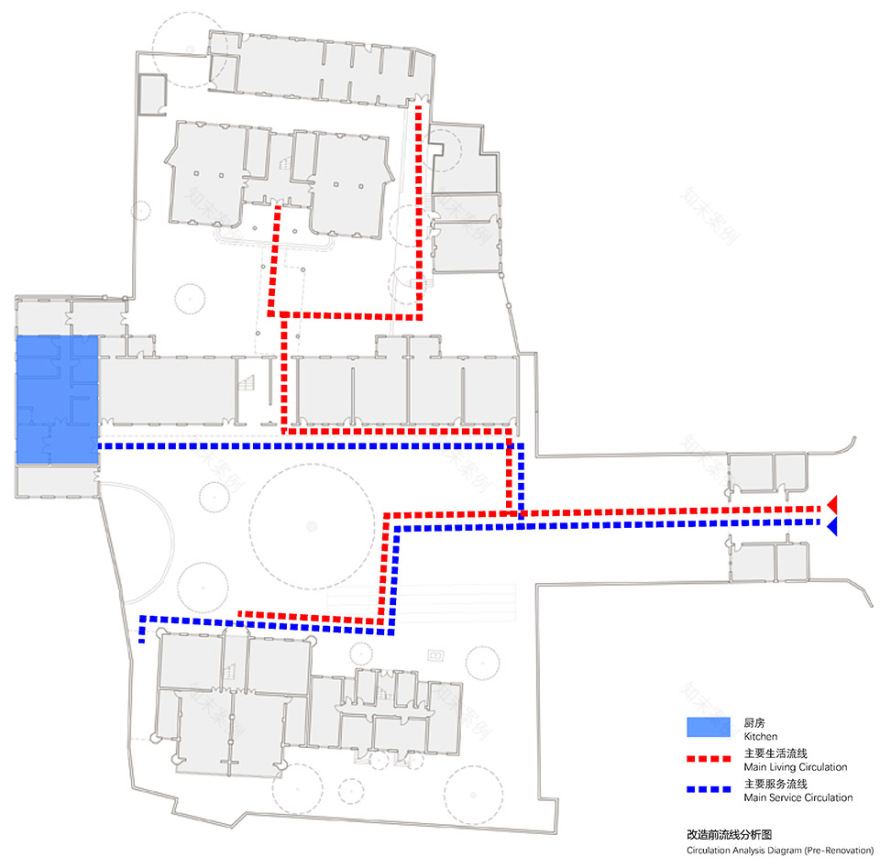

In the pre-renovation layout, service programs such as the kitchen and non-motorized parking were relegated to the western edge of the campus, far from the main entrance on the east. Consequently, delivery vehicles and staff bicycles all had to travel the full east–west span of the grounds, entangling service and circulation flows and creating persistent confusion.
▼入园空间鸟瞰,Aerial view of lead-in space©侯博文

2号楼体量狭长,东、西两端直抵园区边界,将园区拦腰切分为南、北两部分,之间仅能通过2号楼中部通道连通。厨房位于2号楼底层西端,对于主要作为幼儿生活、教学空间的2号楼,有很大的消防安全隐患,同时,其油烟污染对幼儿健康不利。
Building 2, a long, narrow bar running east–west, abutted the site’s western and eastern boundaries and effectively bisected the campus into northern and southern halves. The only link between them was a single passageway through the middle of the building. The kitchen, located at the western end of the ground floor, posed a significant fire hazard inside what was otherwise a children’s living and learning zone, while cooking fumes threatened the pupils’ health.
▼入园空间,Lead-in space©侯博文

本次改造,首先将厨房从2号楼西侧底层的不利位置调整至园区东侧原“建构活动室”位置,经由沿园区东侧边缘设置的后勤服务通道,与门卫楼新开设的后勤出入口直接联系。由此,避免了后勤服务流线与幼儿生活流线交叉,改造方案通过这一关键性调整启动了整个园区流线的重新组织和空间结构调整。基于后勤服务通道,结合入园空间的风雨连廊北廊,设置了停车棚,方便教工从后勤出入口入园停车。
For this renovation, the kitchen was first relocated from its disadvantaged position on the ground floor of the west side of Building 2 to the former “Constructive Activity Room” on the east side of the campus. Via a service lane running along the eastern edge, it now connects directly to a new logistics entrance opened in the Gatehouse. This completely separates logistical flows from children’s daily circulation. This single strategic adjustment triggers a wholesale reorganization of the campus’s circulation and spatial structure. Along this service lane and in conjunction with the north arm of the new sheltered corridor at the lead-in space, a covered parking shed is provided for staff arriving via the logistics entrance.
▼1号楼、厨房之间的风雨连廊,Sheltered corridor between Building 1 and the Kitchen©侯博文
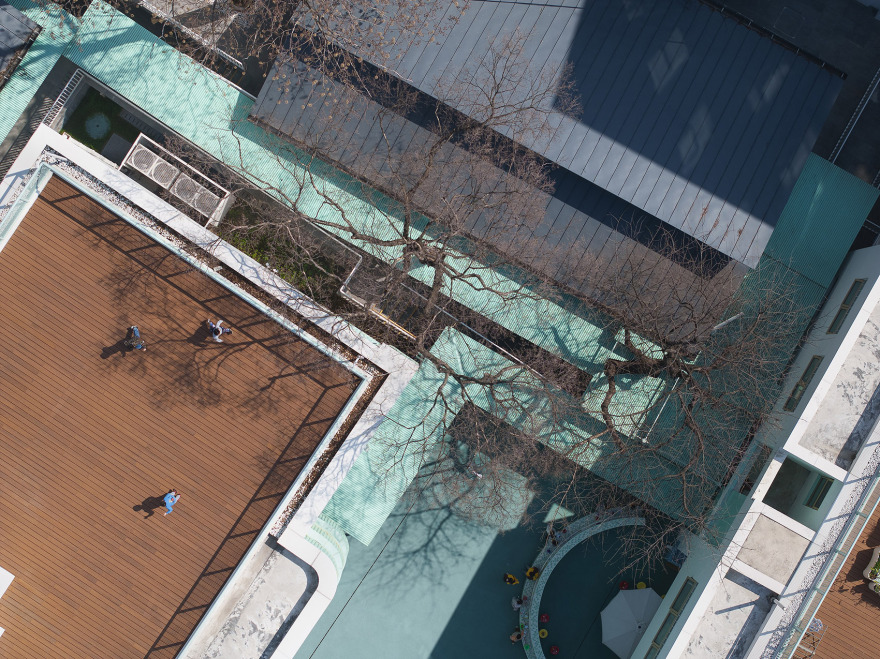
结合2号楼单体改造,通过在2号楼底层架空2个单元开间,再加上东、西两侧通道,大大增强2号楼南北两侧外部空间的视线、流线联系,使原本被2号楼切分而割裂的园区南、北两部分在感知上成为一个整体。
Through the renovation of Building 2, two ground-floor units are left open, and new passageways are inserted on both the east and west sides. These moves dramatically strengthen visual and circulatory connections between the outdoor spaces north and south of the building, allowing the two previously severed halves of the campus to be perceived as a single, continuous whole.
▼1号楼、厨房之间的风雨连廊,Sheltered corridor between Building 1 and the Kitchen©侯博文

在园区内置入一套风雨连廊系统,串联各栋园舍及服务设施,将原本异质、散乱的园区各部分联系成一个整体。除了具有遮阳避雨的功能,连廊系统也对园区外部空间尺度起到了调节作用,为园区整体增加了一个近人尺度的空间层次。其中,门卫楼南、北两翼各有新开的门洞,作为风雨连廊系统的两个端点,分别向北引向2号楼、1号楼,向南引向4号楼、3号楼。将主入口与园区主体之间的狭长空间,转换成尺度适宜的入园先导空间。北廊通过OSB板分隔幼儿入园流线和后勤服务流线,同时作为展墙;南廊则围合出4个展亭,也可作为活动器械的临时收纳处。
▼风雨连廊大样图,Detailed Drawing of Sheltered Corridor©间架工作室

Finally, a sheltered corridor system is woven through the campus, linking every building and service facility into one coherent whole. Beyond providing shade and shelter, the corridor recalibrates the scale of the outdoor spaces, adding a human-scaled layer to the entire site. Newly opened doorways in the north and south wings of the Gatehouse serve as the two endpoints of the sheltered corridor system: the northern branch leads to Buildings 2 and 1, while the southern branch leads to Buildings 4 and 3. This reconfigures the formerly narrow strip between the main entrance and the heart of the campus into a comfortably proportioned lead-in space. In the northern branch, OSB panels separate the children’s arrival route from the service lane and double as an exhibition wall; in the southern branch, four small pavilions are enclosed that can also serve as temporary storage for play equipment.
▼1号楼、厨房之间的风雨连廊,Sheltered corridor between Building 1 and the Kitchen©侯博文

园舍单体改造
Buildings Renovation
在园舍建筑中,70年代建造的2号楼规模最大,使用强度最高,可被视为园区主楼,然而其建筑质量较差,空间亦不适用,无法与其重要性相匹配。因此,本次改造对2号楼的改造力度最大。2号楼本体仅保留部分墙体,将其结构体系从原砖混结构替换为钢筋混凝土框架结构,使之符合幼儿园结构安全要求。结构替换使空间扩展和转换成为可能。
▼改造后结构示意图,Structural Diagram (Post-Renovation)©间架工作室

Among the kindergarten’s structures, Building 2—constructed in the 1970s—is the largest and most intensively used and can therefore be regarded as the main building of the campus. Yet its poor construction quality and unsuitable spaces do not match its importance. Consequently, it receives the most extensive intervention. Only portions of the original walls are retained; the structural system is entirely replaced, shifting from the original brick-and-concrete bearing walls to a reinforced-concrete frame that meets kindergarten safety codes. This structural replacement enables spatial expansion and transformation.
▼施工中的2号楼,Building 2 under construction©间架工作室
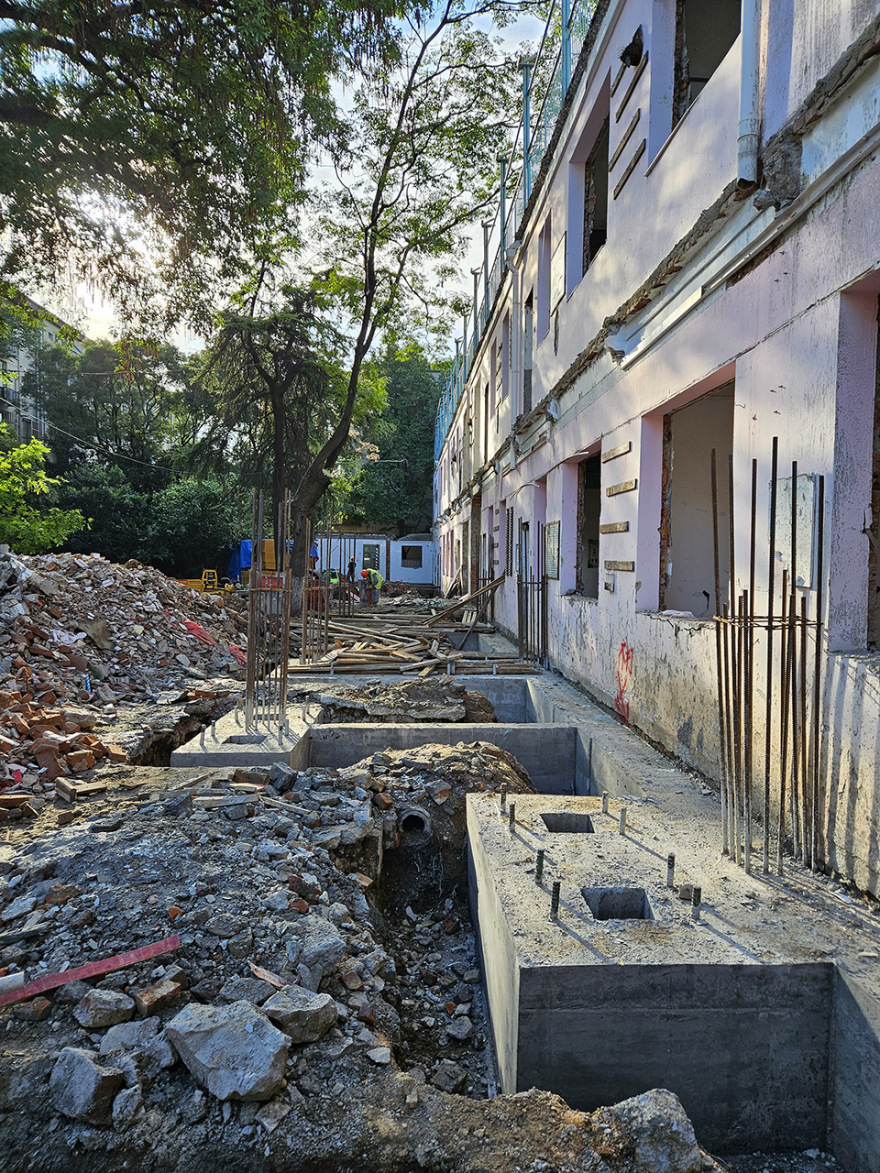

将2号楼2层外走廊从1.2米净宽的挑廊,拓宽至2.8米至3.2米宽的柱廊,使其既符合幼儿园疏散要求,又可额外作为生活单元活动空间的延伸。该走廊外侧采用半封闭围护界面,可作为生活单元的气候缓冲空间。走廊立面、屋面设有纵贯整个空间的中悬窗和天窗,通过其开闭,可对走廊内的微气候进行调节。夏季,开启悬窗和部分天窗,可获得良好的通风;反之,冬季可产生“暖廊”效应。天窗设置在靠生活单元一侧,可补充室内采光,走廊吊顶的铝合金垂片将天窗采光调节成柔和的光线。另外,调整生活单元的开间划分和楼梯间的位置,将原本位于2号楼中部的楼梯调整为东、西侧各一部,以满足疏散规范要求。两部楼梯分别位于走廊内、外侧,以适应不同的气候情况,并且与园区风雨连廊系统相衔接。
The 2nd-floor exterior corridor of Building 2 is widened from a 1.2 m cantilevered balcony to a 2.8–3.2 m colonnade. This meets kindergarten evacuation codes and doubles as an extension of the living unit activity space. A semi-enclosed outer envelope turns the corridor into a climatic buffer for the units. Continuous center-pivot windows along the façade and a strip of skylights on the roof run the full length of the corridor, allowing its micro-climate to be fine-tuned. Operable center-pivot windows and skylights allow cross-ventilation in summer and a “warm corridor” effect in winter. The skylights sit on the side adjoining the living units, borrowing daylight inside; aluminum baffles in the ceiling soften the light. By re-ordering the bay layout and relocating the stair cores, the single central stair is replaced by two—one on each side—fulfilling evacuation requirements. One stair is set inside the corridor, the other outside, allowing use in different weather conditions, and both connect to the campus-wide sheltered corridor system.
▼2号楼底层架空空间,Open ground-floor space of Building 2©侯博文

▼作为气候缓冲空间的2号楼二层走廊,The second-floor corridor of Building 2 as a climate buffer space©侯博文


▼2号楼幼儿生活单元,Children’s living unit of Building 2 ©侯博文

1、3号楼及门卫楼为上世纪90年代建造的幼教建筑,为半砖混、半框架结构。本次改造对它们进行结构加固,并同时改善保温、隔热、通风和采光等建筑性能。1、3号楼各增设一部钢结构疏散楼梯。
Buildings 1 and 3, together with the Gatehouse, are early-childhood education buildings erected in the 1990s with a hybrid masonry-frame structure. The current renovation strengthens their structures and simultaneously upgrades thermal performance, ventilation, and daylighting. Each of Buildings 1 and 3 gains an additional steel evacuation stair.
▼2号楼东侧楼梯,The east stair of Building 2©侯博文

▼2号楼底层走廊与风雨连廊衔接,The ground-floor corridor of Building 2 connects to sheltered corridor©侯博文

原“科学室”、4号楼为砖承重墙、木屋架混合结构房屋。本次改造在加固砖砌体结构的同时,将木屋架替换为钢屋架。“科学室”屋面增设天窗,使之适用于阅览、美术等教学内容。“科学室”东、南侧在原有檐口以下增加披檐,与风雨连廊和1号楼疏散通道衔接。▼施工中的美术室、阅览室,Art Room and Reading Room under construction©间架工作室

The former “Science Room” and Building 4—both brick-bearing-wall structures with timber roof trusses—are reinforced, timber trusses are replaced with steel. New skylights of the Science Room convert it into a light-filled space suitable for reading and art activities. Additional overhanging eave is installed below the original cornice on the east and south sides of the Science Room, connecting it to the sheltered corridor and the evacuation corridor of Building 1.
▼美术室、阅览室,Art Room and Reading Room©侯博文


原“建构活动室”、“器材室”为简易搭建的棚屋,已无法继续使用,本次改造中将它们拆除重建。其中,原“建构活动室”替换为钢结构厨房;原“器材室”替换为钢结构教师休息室。
The former “Constructive Activity Room” and “Equipment Room,” makeshift sheds that had reached the end of their service life, are demolished and rebuilt. The Constructive Activity Room becomes a new steel-frame Kitchen; the Equipment Room is replaced by a steel-frame Teachers’ Lounge.
▼教师休息室,Teachers’ Lounge©韩曼

1、2、3号楼朝向主要活动场地的立面,采用穿孔铝板幕墙,赋予主要空间界面视觉连续性,并与风雨连廊的金属波浪板屋面相呼应。
▼2号楼墙身大样图,Detailed Drawing of Building 2 Wall Section©间架工作室
The façades of Buildings 1, 2, and 3 that face the main activity yard are clad in perforated-aluminum curtain walls, giving the primary spatial interface visual continuity and echoing the corrugated-metal roof of the sheltered corridor.
▼1号楼南立面、2号楼北立面,South façade of Building 1 and north façade of Building 2©侯博文
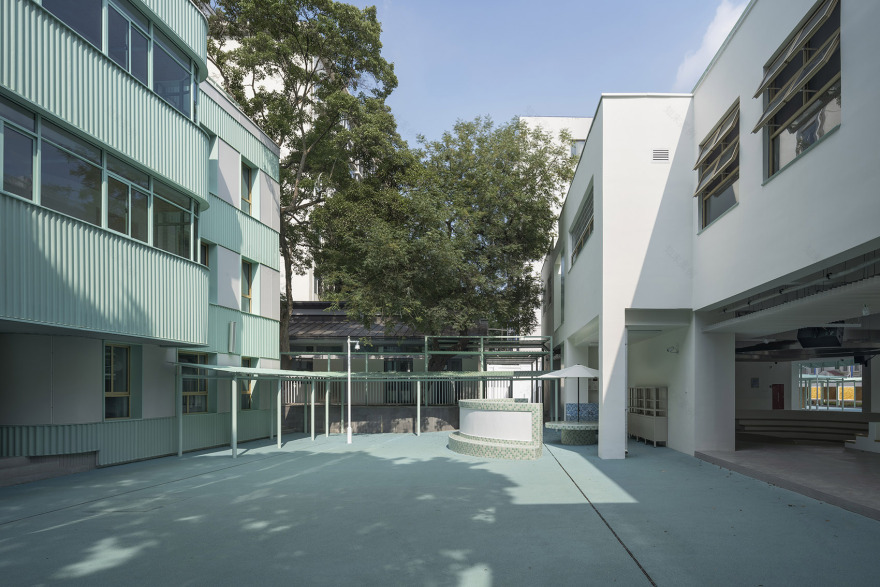
▼2号楼南立面细部,Detailof the south façade of Building 2©侯博文

▼2号楼南立面局部,Part of the south façade of Building 2©侯博文


▼2号楼窗墙细部,Detail of the window wall of Building 2©侯博文

场地与景观
Playgrounds and Landscape
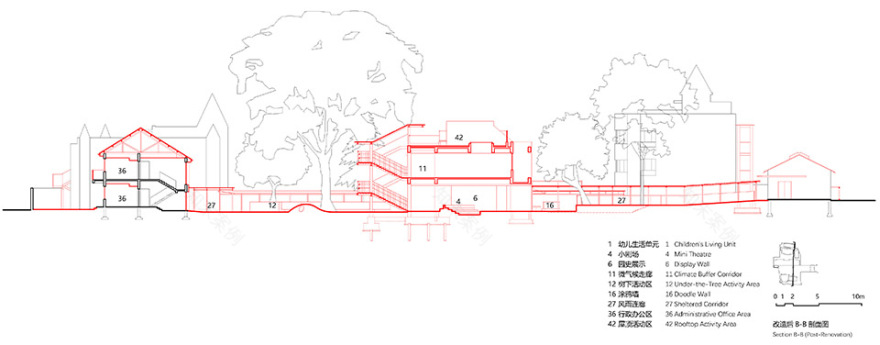
结合园内原有的高大树木,用弧形矮墙围合出尺度不同的树下活动区域。部分建筑渣土被用于填充坡地活动区的人工地形,周边的弧形矮墙正好成为挡土墙。2号楼底层架空空间,设置有下沉的小剧场,其看台外侧的弧形矮墙、西侧多功能室舞台背后的弧形展墙、小剧场屏幕背后户外手作区的弧形涂鸦墙,与各处树下活动区的弧形矮墙,形成了建筑、景观要素之间的关联。
Working with the existing tall trees, curved low walls demarcate a series of under-the-tree activity areas of varying scales. Some of the construction spoil is reused to sculpt the artificial topography of the hillside activity area, its perimeter curved walls doubling as retaining structures. In the open ground floor of Building 2, a sunken mini theatre is inserted; the curved wall that forms its seating, the curved exhibition wall behind the stage of the multi-functional room, and the curved doodle wall enclosing the outdoor craft area echo the curved walls that encircle the under-the-tree activity areas, creating a coherent dialogue between architectural and landscape elements.
▼树下活动区、坡地活动区,Under-the-tree and hillside activity area©侯博文

▼树下活动区,Under-the-tree©侯博文


▼活动场地与架空空间的连续,Continuity between the playgrounds and the open ground-floor space©侯博文

▼小剧场,Mini theatre ©间架工作室
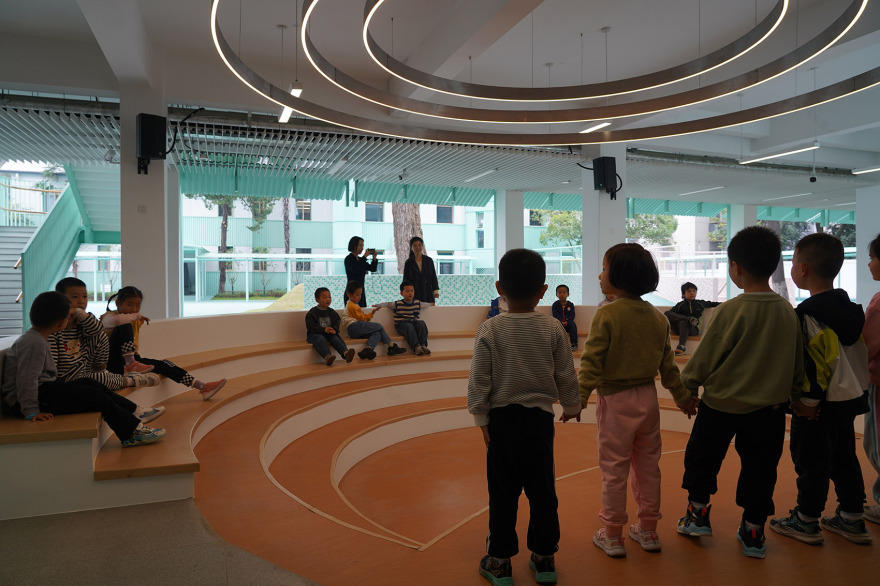
▼户外手作区、涂鸦墙,Outdoor craft area and doodle wall©间架工作室

▼涂鸦墙,doodle wall©侯博文

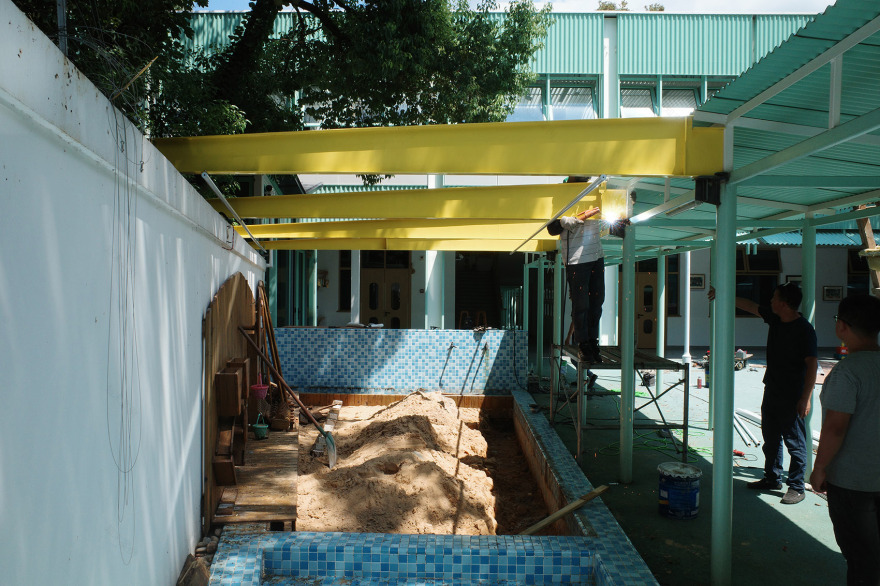
原来园区边缘的消极地带,由于风雨连廊的串联和限定而变得积极,设置了水池、沙坑、种植和饲养园地等自然教育场地。风雨连廊可以被视为有覆盖的活动场地,其构架可以作为附加活动设施的“支撑体”。
The previously inactive strips at the edge of the campus has been enlivened by the sheltered corridor that threads through and defines them, now hosting natural-learning areas such as a shallow pond, a sandpit, and plots for planting and small-animal care. The sheltered corridor can be seen as covered playground, and its frame can serve as a “support” for attached activity facilities.
▼种植园地,Planting area©侯博文
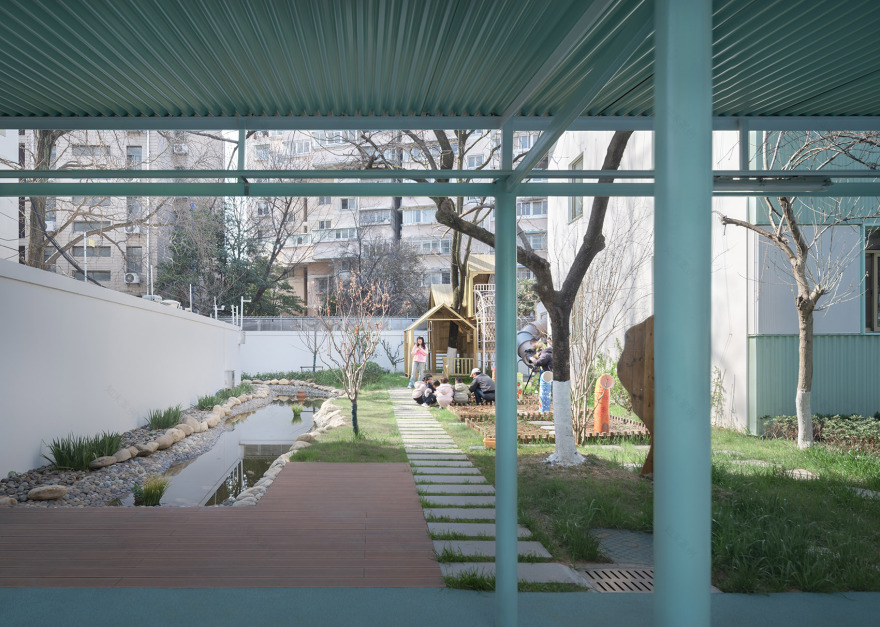
▼风雨连廊作为活动场地,Sheltered corridor as playground©侯博文

▼风雨连廊作为活动场地,Sheltered corridor as playground©侯博文

▼2号楼屋顶活动区,Rooftop activity area of Building 2©侯博文

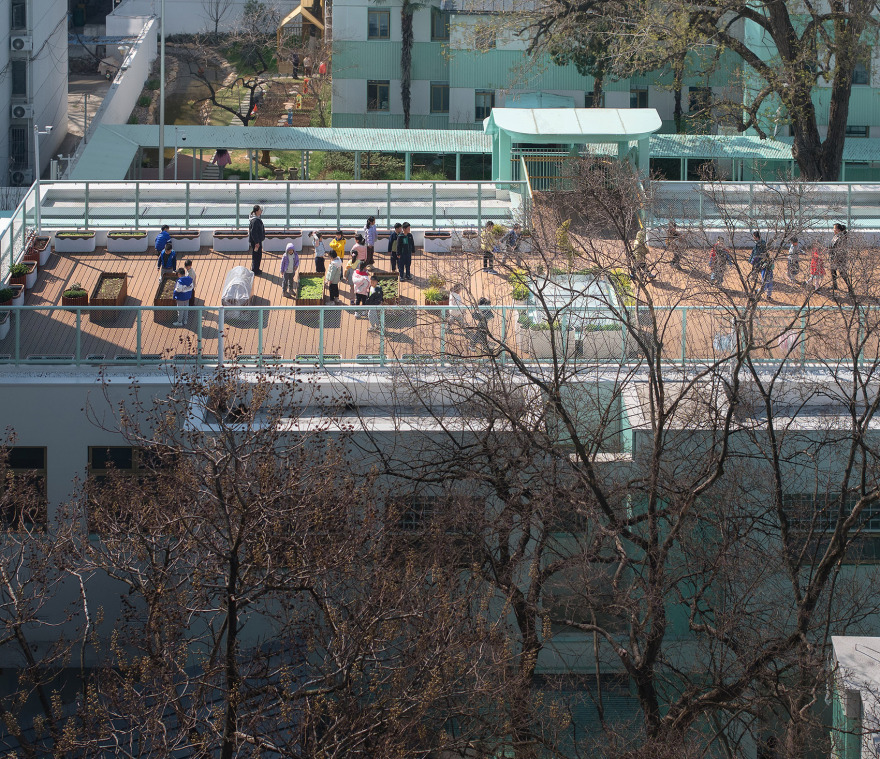
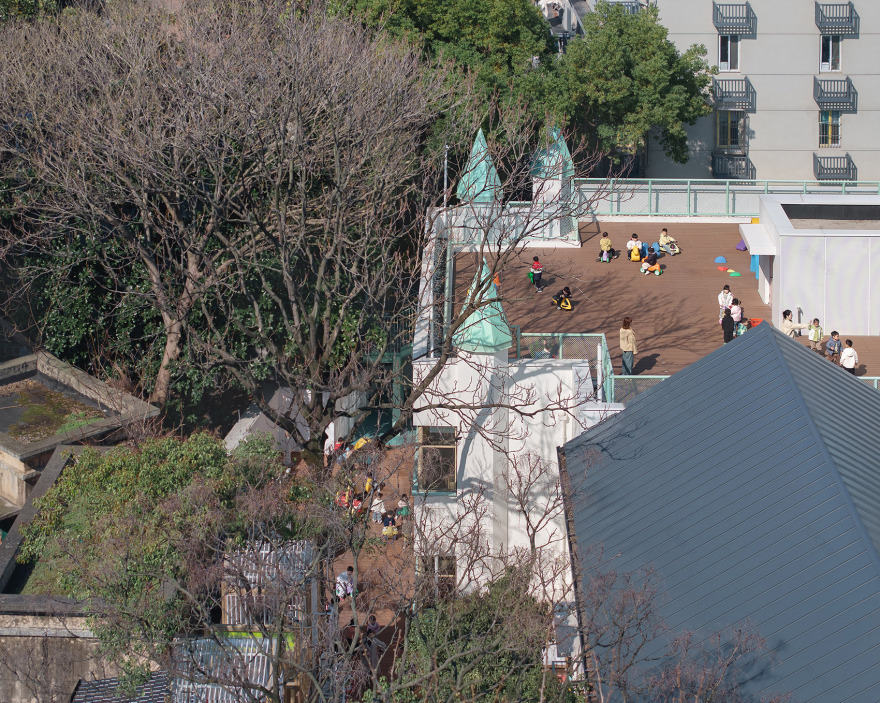
▼3号楼屋顶活动区及南侧活动区,Rooftop activity area and south activity area of Building 3©侯博文
2号楼南侧巨大的枫杨树,对于该园具有重要的精神性意义。从平仓巷主入口进入园区,正对高大枫杨树的景观,具有纪念性意味。改造后,入口门厅空间将进一步开敞,而入园过渡空间的宽度由两侧风雨连廊的限定而收窄,再加上风雨连廊的对称性,以及地面上跑道的导向性,都强调了这一空间序列。
The towering Chinese wingnut tree on the south side of Building 2 holds profound spiritual significance for the kindergarten. Upon entering the premises from the main entrance of Pingcang Lane, one is greeted by the majestic sight of this grand tree, creating a commemorative and monumental atmosphere. Following the renovation, the spatial sequence is accentuated through the openness of the entrance lobby, the inward contraction and symmetry of the sheltered corridors flanking the lead - in space, and the spatial directionality generated in conjunction with the running track.
▼入口门厅与风雨连廊的连接关系,The connection between the entrance lobby and the sheltered corridor©侯博文

▼从入口门厅看枫杨树,View of the Chinese wingnut tree from the entrance lobby ©侯博文

▼从枫杨树看入园空间,View of lead-in space from the Chinese wingnut tree©侯博文

结语
Epilogue
如上所述,在对现实问题的不断应对和解决中,建筑师主动或被动地对空间和构架进行“合”与“分”的处理,并对空间尺度不断做出调节。从而,园区整体呈现出“由局部相互接续所形成的连续空间”,兼具局部场所(place)的稳定感、归属感,与整体空间(space)的流动性、自由感。建筑师相信,这种环境的多义与可读,可以成为幼儿对世界认知的原初风景。
▼幼儿园小朋友共同绘制的园区认知地图,A cognitive map of the campus collectively drawn by the children ©南京大学幼儿园

As described above, in the continuous process of responding to and solving practical problems, the architect—actively or passively—manipulates space and structure through acts of “integrating” and “articulating,” while constantly adjusting spatial scale. In this way, the campus as a whole becomes a continuous space formed by the sequential connection of parts, possessing at once the stability and sense of belonging of places and the fluidity and freedom of an overall space. The architects believe that this multiplicity and legibility of the environment can become the primordial landscape through which children first come to know the world.
▼2号楼南立面,South façade of Building 2©侯博文


▼2号楼北立面,Northfaçade of Building 2©侯博文

▼从1号楼看户外手作区和小剧场,View of the outdoor craft area and mini theatre from Building 1©侯博文

▼改造后一层平面,Ground floor plan after renovation©间架工作室

▼改造后二层平面,First floor plan after renovation©间架工作室

▼改造后剖面,Section after renovation©间架工作室

参考文献:
[1] 郭屹民. 建筑的诗学:对话-坂本一成的思考[M]. 1版. 南京:东南大学出版社,2011: 281.
Reference:
[2] Kazunari Sakamoto. House: Poetics in the Ordinary[M]. Tokyo: TOTO publishing, 2009: 241.
项目名称:南京大学幼儿园改造
项目地点:南京市鼓楼区平仓巷3号
建筑、室内、景观设计:南京大学建筑规划设计研究院有限公司 间架工作室
主创建筑师:王峣、杨侃
建筑、室内、景观方案设计团队:杨侃、王峣、翟曌钰、邱国强、陈志凡、潘晴、周理洁
建筑施工图设计团队:王峣、杨侃、毛羽臻
南京大学建筑规划设计研究院各专业配合团队:景观深化与施工图设计:沈佩玉,包佳楠;幕墙设计:曹丽珠;机电设计:徐庆(给排水);王碧通(暖通);高晟、邢自巧(电气);巫程、陈洪亮(智能化);结构设计(风雨连廊):张巍;结构设计(含加固):江苏东南建筑工程结构设计事务所有限公司;室内施工图设计:南京市第二建筑设计院有限公司;标识设计:及地设计
业主:南京大学
施工单位:南京金鸿装饰工程有限公司(总包)、南京革煊建设工程有限公司(景观)
用地面积:5178平方米
建筑面积:3980平方米
设计时间:2019年12月—2023年2月
建设时间:2023年8月—2024年8月
图片摄影:侯博文、韩曼、间架工作室
Project Name: Renovation of NJU Kindergarten
Location: No. 3 Pingcang Lane, Gulou District, Nanjing
Design: Atelier Jian-Jia, Institute of Architecture Design and Planning Co., Ltd, Nanjing University
Principal Architects: Wang Yao, Yang Kan
Architectural, Interior, and Landscape Design Team: Yang Kan, Wang Yao, Zhai Zhaoyu, Qiu Guoqiang, Chen Zhifan, Pan Qing, Zhou Lijie
Architectural Construction Documents Design Team: Wang Yao, Yang Kan, Mao Yuzhen
Landscape Detailed Design & Construction Documents Design: Shen Peiyu, Bao Jianan
Structural Engineering: Jiangsu Southeast Architectural Engineering & Structural Design Co., Ltd.
Structural Engineering (Corridor): Zhang Wei
Curtain Wall Construction Documents Design: Cao Lizhu
Water Supply and Drainage Engineering: Xu Qing
HVAC Engineering: Wang Bitong
Electrical Engineering: Gao Sheng, Xing Ziqiao
Intelligence System Design: Wu Cheng, Chen Hongliang
Interior Construction Documents Design: Nanjing Second Architectural Design Institute Co., Ltd.
Signage & Wayfinding System Design: JIDI DESIGN
Client: Nanjing University
General Contractor: Nanjing Jinhong Decoration Engineering Co., Ltd.
Landscape Contractor: Nanjing Gexuan Construction Engineering Co., Ltd.
Design period: December 2019 – February 2023
Construction period: August 2023 – August 2024
Site area: 5178m2
Gross floor area: 3980m2
Photographer: Hou Bowen, Han Man, Atelier Jian-Jia
Film: Zhang Yaotian




南京喵熊网络科技有限公司 苏ICP备18050492号-4知末 © 2018—2020 . All photos and trademark graphics are copyrighted by their owners.增值电信业务经营许可证(ICP)苏B2-20201444 苏公网安备 32011302321234号
苏公网安备 32011302321234号客服
消息
收藏
下载
最近