

创作上传
VIP
收藏下载
登录 | 注册有礼
查看完整案例

收藏

下载

分享

翻译
Architects:Berger Parkkinen + Architects
Year:2022
Photographs:Ana Barros
Category:Chapel
Design Team:Berger Parkkinen + Architects
Country:Austria

The Chapel - Designing a funeral chapel is not the everyday business of an architect. All the more curiosity and creative interest were triggered by the commission from a family in Styria to the Austrian-Finnish office BERGER+PARKKINEN. An inspiring, atypical, and particularly exciting task, also because it was a "building freed from compromising functions," as architect Alfred Berger found.

Adolf Loos wrote very appropriately in 1908 in "Ornament and Crime": "Only a very small part of architecture belongs to art: The tomb and the monument. Everything else, everything that serves a purpose, is to be excluded from the realm of art." Adolf Loos, Ornament and Crime, 1908. "So we were dealing with a borderline area of architecture, an area where otherwise determining themes such as function have little influence on the design. It was therefore necessary to find a new approach, as a basis for the actual design work ", say the architects.


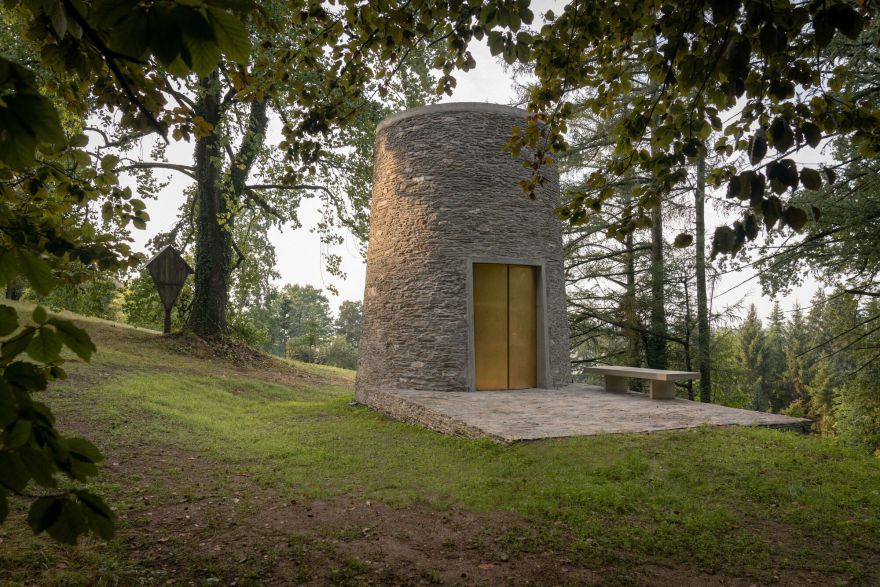
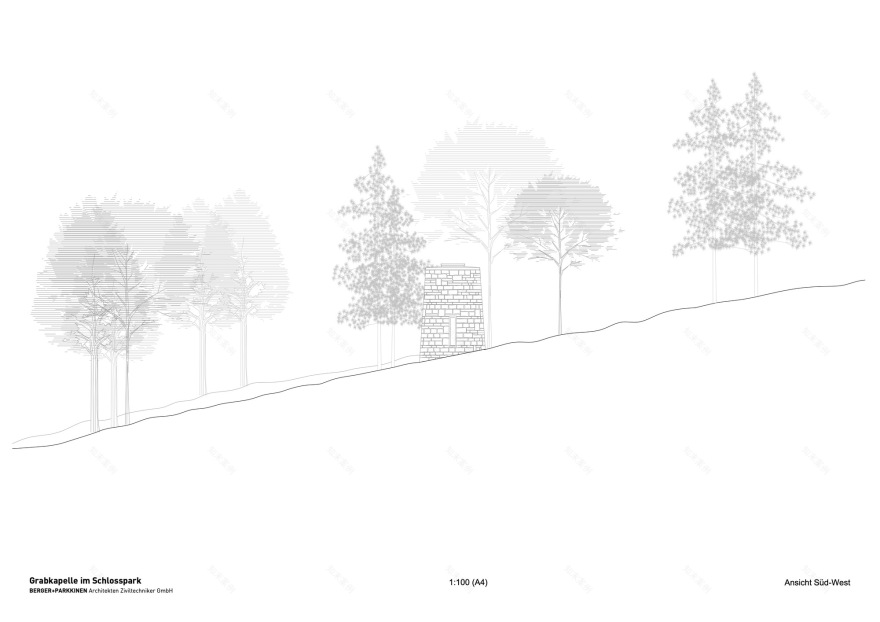
The result is a free-standing chapel in the castle park with an archaic, minimalist tower form that draws on the traditional burial culture of human history as a point of reference, as well as the special location in the midst of old trees. The architects created a connection to the castle within sight, using light and a vertical orientation to create the mysticism and spiritual atmosphere appropriate for a tomb.
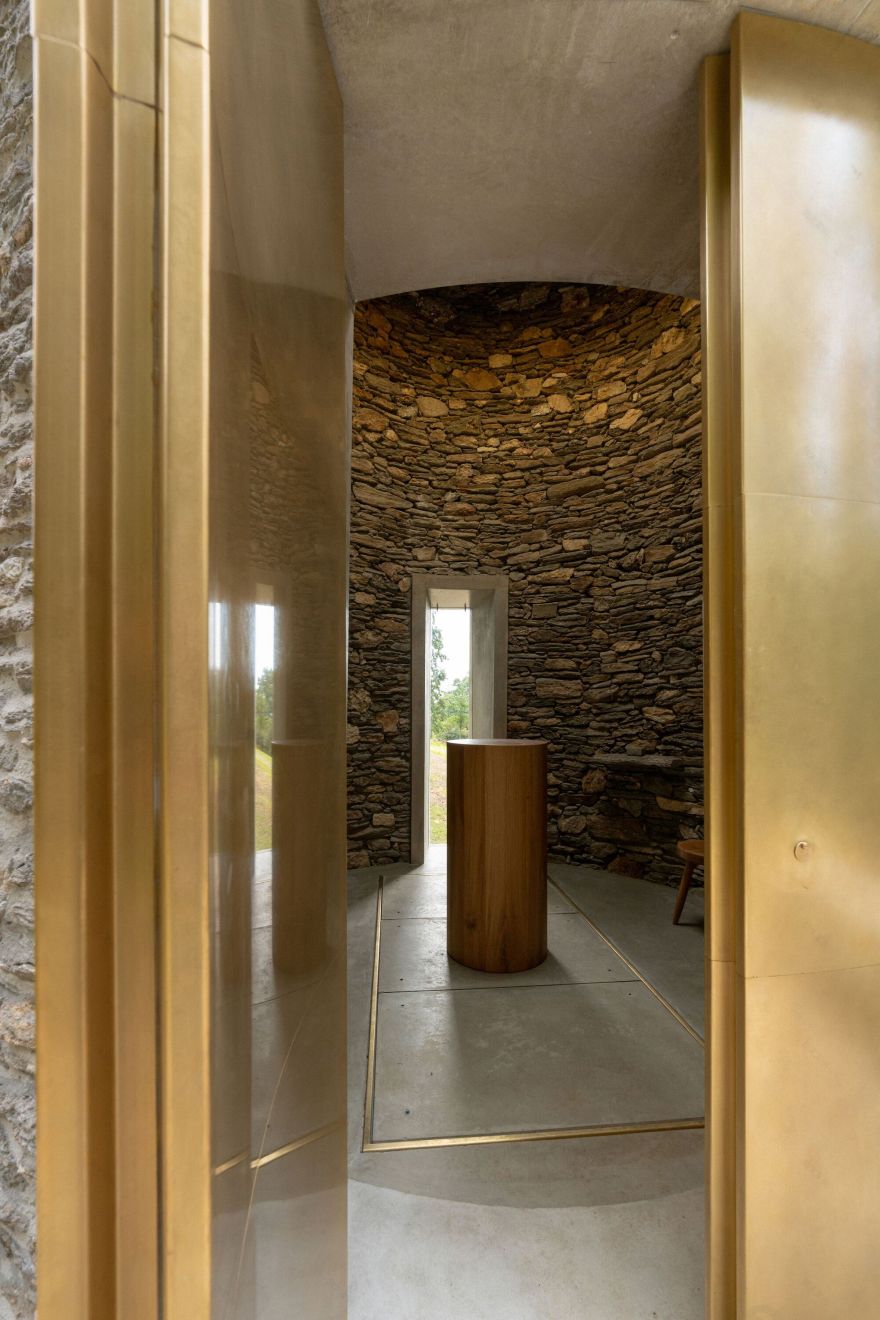
The Material - If we examine examples of architecture from early cultures, the oldest evidence of human history is tombs. While houses were built in wood, clay, straw, and similar perishable materials, the desire for permanence was paramount in the construction of tombs. This is still true today for all sedentary cultures. In the specific case, old masonry that would be suitable in principle for the construction of the chapel was available at the site. This local stone comes from a farm building mentioned in documents more than 800 years ago, which had collapsed a long time ago. The material coincides with that of the retaining walls and also with the masonry of the foundation walls of the castle. The stone, with all its peculiarities, thus became decisive for the design, and the architects succeeded in creating a material-aesthetic connection of the new building with the castle. The new walls were thus created from the remains of old walls, a fine example of sustainability and a cycle through direct reuse of existing demolition material.
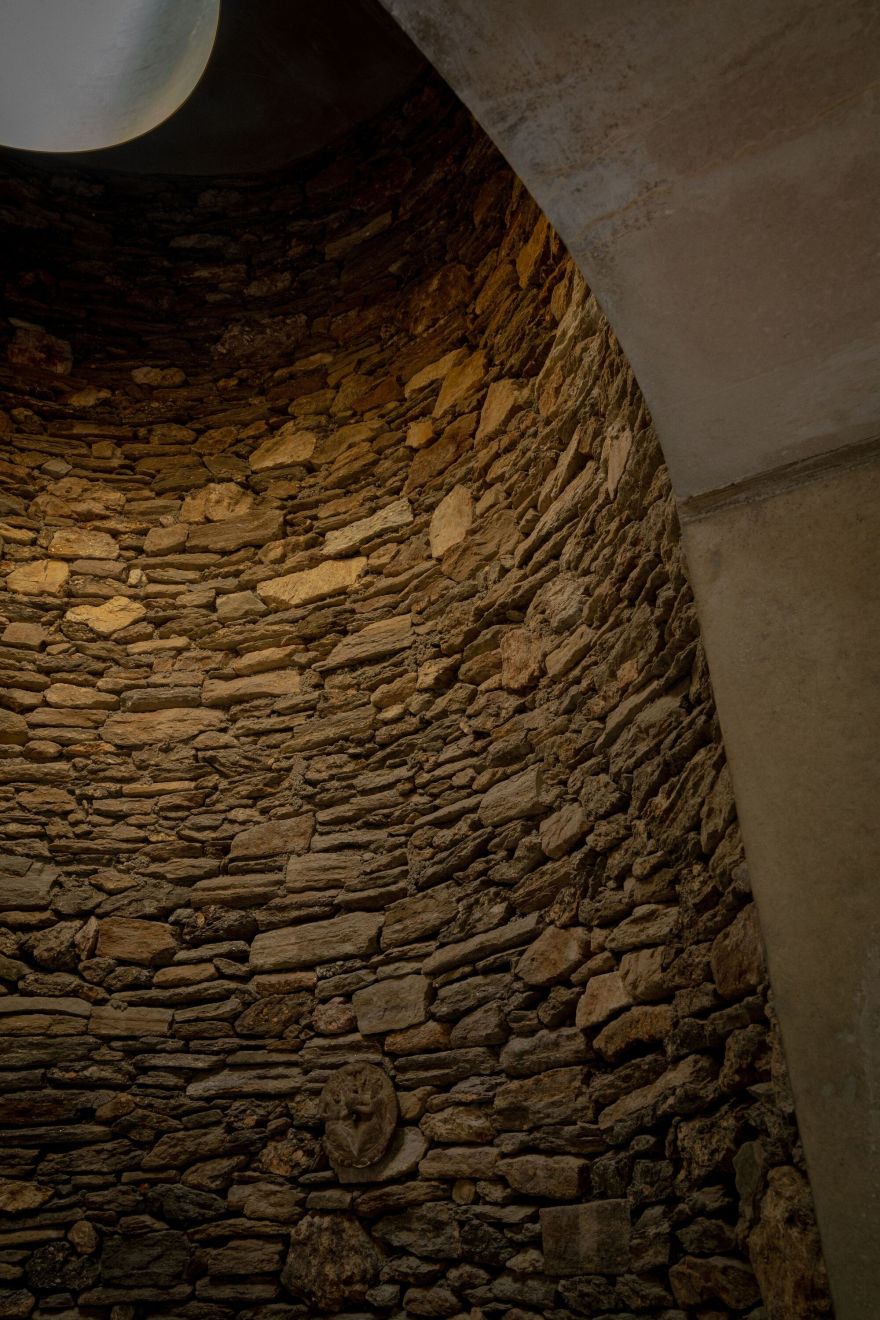

The Shape - Not all stone is the same, and this local stone has its peculiarities. "Rough-hewn and very rustic, it does not lend itself to fine geometric shapes; even edges are difficult to make. This material shows its effect best in the surface," says Alfred Berger. Thus, a decisive parameter for the design was defined. The solution was found in the development of a very simple form without edges. The result was a round solitaire that calmly and powerfully takes up its position in the landscape. Timeless like the walls of the castle, but clearly contemporary in the precision of its design. The tower, which tapers slightly towards the top, has only three openings. The gate and the narrow window are recessed with prefabricated, sandblasted reinforced concrete frames in natural stone. The third opening is formed by a circular hole in the ceiling slab.

The Light - A double-leaf door leads into the chapel space on the averted side from a small vestibule. The narrow window opposite provides a view of the castle tower. Through this visual axis, the Chapel of the Dead is connected to the Castle of the Living. The consecrated interior is brightly lit even when the door is closed, flooded with sunlight that enters through an opening in the ceiling. The round hole provides a view of the sky. The light coming from above emphasizes the height of the room, creating a vertical orientation. An inverted cone with a gilded interior surface diffuses light evenly downward into the room. The intense light from above creates a warm glow on the rough stone walls. The plasticity and depth of the perfectly crafted, solid material are highlighted by the light.

Project gallery



南京喵熊网络科技有限公司 苏ICP备18050492号-4知末 © 2018—2020 . All photos and trademark graphics are copyrighted by their owners.增值电信业务经营许可证(ICP)苏B2-20201444 苏公网安备 32011302321234号
苏公网安备 32011302321234号客服
消息
收藏
下载
最近