

创作上传
VIP
收藏下载
登录 | 注册有礼
查看完整案例

收藏

下载

分享

翻译
Architects:Berger Parkkinen + Architects
Area:3877m²
Year:2025
Photographs:erger Parkkinen + Architects
Structural Engineering:BauCon
Construction Physics:Ingenieurbüro Rothbacher
MEP HVAC Consultant:Haustechnik Dick + Harner
Electrical engineering:Technisches Büro Herbst GmbH
Lighting Planning:Bartenbach - The Lighting Innovators
Elevators:Kone AG
project management:Bernhard Kaiser, Jana Raudnitzky, Lucas Schuh, Jure Kozin (stellvertr. PL)
Local Construction Supervision:Bleierer Baumanagment
Construction:RHZ Bau Gmbh
Demolition:Ragginger Rammtechnik Transport und Erdbewegung Gmbh
Ground Works:Ragginger Rammtechnik Transport und Erdbewegung Gmbh
Category:University
Architecture:Alfred Berger, Tiina Parkkinen
Project Team:Lucie Najvarova, Serban Ganea, Lenia Mascha, Frane Trebotic, Joanna Magiera, Viktor Gautrin
Gross Floor Area Above Ground:3.195m²
Floor Space Above Ground:2.268m2
Floor Space Underground:722m2
Floor Space Total:2.990m2
Constructed Area:951 m2
Property Size:5.062 m2
Car Parking Spaces:5
Bike Parking Spaces:34
Costs:idealice Landschaftsarchitektur
Fire Safety:IBS - Technisches Büro
Façade Planning:Wilfried Minniberger
Ceramics:NBK Keramik GmbH
Façade Consultant:GFT Fassaden GmbH
Culture Design:MJP ZT Gmbh
Roof:RHZ Bau Gmbh
Screeds:Hlawna Gmbh
Terrazzo:Hlawna Gmbh
Electrical Installations:EAS Stöckl
HVAC:Markus Stolz Gmbh&Co.Kg
Ventilation:Bacon Gebäudetechnik Gmbh
Façades:m+e Metallbau Gmbh
Dry Wall Installation:Edelsbacher+Staudinger BauGmbh
Metalwork:Metallbau Schlosserei Schrattenecker Gmbh
City:Salzburg
Country:Austria

Text description provided by the architects. In 2021, the architectural firm BERGER PARKKINEN + was commissioned to construct a new building for the Mozarteum University at the Kurgarten (UMAK) in Salzburg. The Mozarteum University at the Kurgarten is located directly next to the Paracelsus Bad & Kurhaus, which was also designed by BERGER PARKKINEN + and completed in 2019. Both buildings now characterize the historic city center of Salzburg with their clear and distinctive architectural language.

For the design of the new building, the architects took their cue from the morphology of the adjacent spa gardens and the former fortifications. The aim was to make the transition from the Baroque grounds of Mirabell Palace to the Wilhelminian-style Markus-Sittikus-Straße tangible.

The Location - The plans for the Mozarteum University at the Kurgarten did not only relate to the building site itself, but to the entire surroundings of the inner-city parks – Kurgarten, Zwergerlgarten, and Mirabellgarten. The main building of the Mozarteum University is located at the south-western end of this area.

The new building is part of an urban development concept that combines different structures – from Baroque to Wilhelminian to 20th century – while also forming a bridge between the parks and the city streets. To this end, the UMAK was divided into two structures, which are staggered in height and size to match the surrounding buildings: the closed structure of Auerspergstraße on one side and the more open Schwarzstraße on the other. As with the neighbouring Paracelsus Bad & Kurhaus, the main entrance is located on a newly created square at the corner of Schwarzstraße and Auerspergstraße.

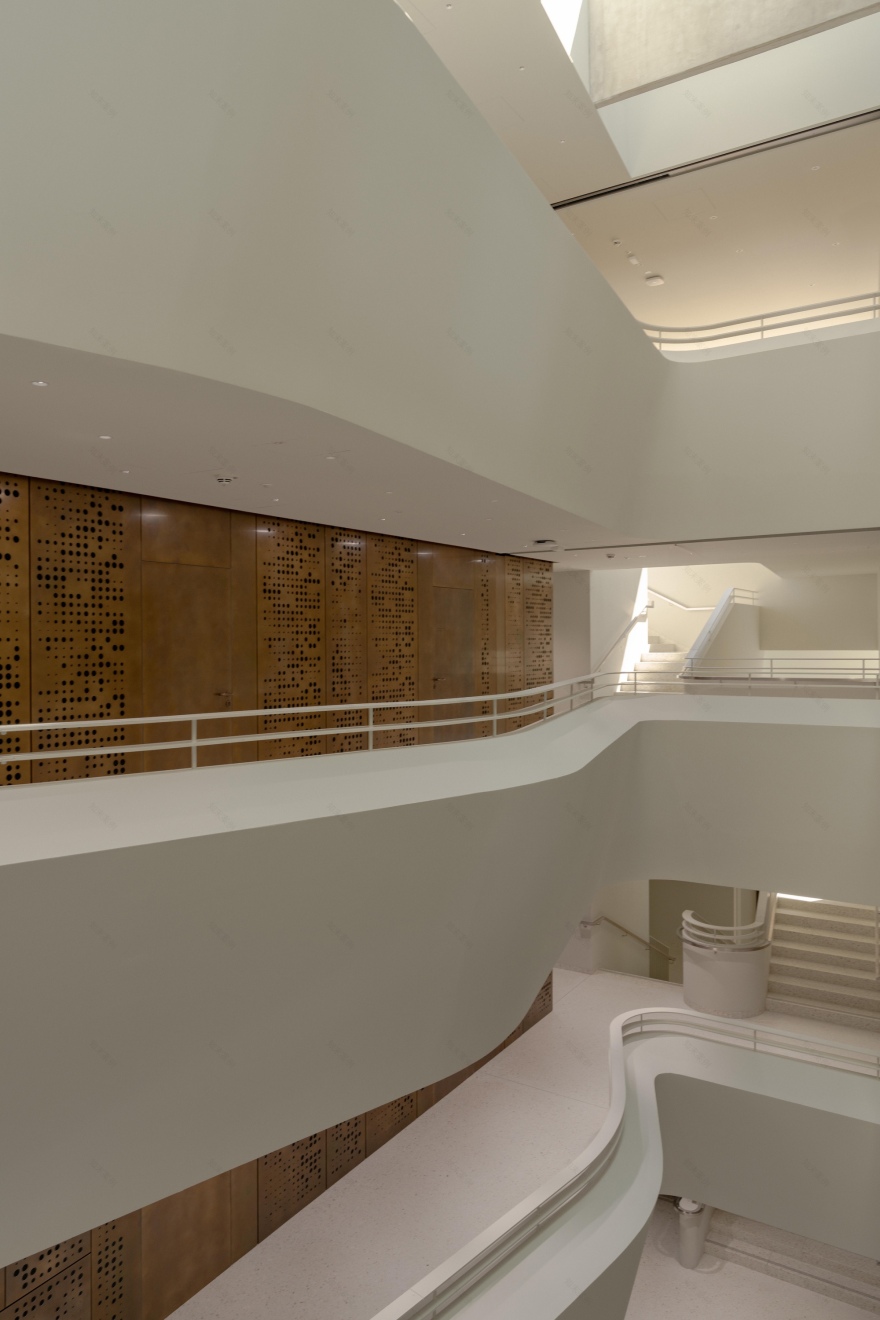
The Interior - In keeping with its use as a university building, the ground floor of the building is open to the public. The heart of the building is the hall with natural skylights, which extends to the top floor. The division of the building into two structures allows for the accommodation of large halls and practice rooms with special ceiling heights. The powerful overhang of the upper floors above the entrance area emphasises the importance of the square in front and provides a view of the neighbouring Paracelsus Baths & Spa.


The Façade - Like the neighbouring Paracelsus Bad & Kurhaus, the façade of the UMAK is designed with ceramic panels. While open slats were used there, the UMAK has a closed, rear-ventilated ceramic façade.

This design takes into account the special requirements of an art university with a focus on music: individual rooms need daylight and ventilation, concert halls need large glazing, while studios need darkness and quiet. The materials, colours, and proportions are based on the bathhouse, but at the UMAK, the slats are closed. Only in the large rehearsal rooms do fixed slats provide sun protection. A uniform window format with integrated sun and glare protection was developed for the classrooms. The entrance area and the connection between the two buildings are generously glazed.

Despite the high technical requirements, the building was designed to remain flexible in its use. In addition, the compact construction contributes to a good energy balance and long-term sustainability.

Project gallery


南京喵熊网络科技有限公司 苏ICP备18050492号-4知末 © 2018—2020 . All photos and trademark graphics are copyrighted by their owners.增值电信业务经营许可证(ICP)苏B2-20201444 苏公网安备 32011302321234号
苏公网安备 32011302321234号客服
消息
收藏
下载
最近