

创作上传
VIP
收藏下载
登录 | 注册有礼
查看完整案例

收藏

下载

分享
世间一切轻盈之选,终将显露其沉重之负——Richard·Serra
All That Seems Light Reveals Its Heaviness — Richard Serra
▼建筑锚在丹江口的地理水系中,The Architecture Anchored in the Geohydrological System of Danjiangkou © 吴清山

▼屋面的镜水既与山体的复杂肌理形成对照,亦呼应远处水库,The Reflective Roof Water Mirrors the Rugged Mountain Texture and Echoes the Distant Reservoir © 吴清山

1.缘起
Origin
2023年冬,我们接到一处项目委托:已规划好的民宿区设计一栋公共配套建筑,需要涵盖简餐、厨房、咖啡厅及会议等多项服务功能。建筑选址在湖北十堰市龙王沟村里,毗邻丹江口水库区的一处小山谷,距丹江口的水坝约莫一小时的车程。水库的沿岸多是浅山丘陵,溪谷交织纵横。
In the winter of 2023, we were commissioned to design a public amenities building within a planned guesthouse complex. The structure was to serve multiple functions, including light dining, a kitchen, a café, and spaces for meetings and gatherings. The site is located in Longwanggou Village, Shiyan City, Hubei Province, nestled in a small valley near the Danjiangkou Reservoir—about an hour’s drive from the Danjiangkou Dam. The surrounding landscape is defined by gentle hills and a network of interlacing stream valleys that fringe the reservoir’s edge.
▼建筑、地形与水岸线,Architecture, Terrain, and the Waterfront © 末广建筑

在我们到来之前,施工队伍已经完成了修路与场地平整的工作。初次踏勘时,眼前景象略显意外:原本自然衔接至谷地、水稻的地貌,已被削切为数级人工台地和停车场,与最初基于丘陵水系地貌的设想相去甚远。在许多乡村振兴项目中,市政基础设施的施工往往先行,建筑师在项目的后期才得以介入。于是出现在道路与场地的营造阶段,建筑设计得在既有条件下作出被动调整,整体建造的空间品质与自然的延续受到一定程度的约束。
Before we arrived, the construction team had already completed roadworks and site grading. On our first visit, the scene came as something of a surprise: the terrain, which once flowed naturally into the valley and rice paddies, had been carved into a series of artificial terraces and parking lots—deviating significantly from the original vision shaped by the site’s hilly topography and hydrological system. In many rural revitalization projects, municipal infrastructure is often implemented ahead of architectural planning, with architects brought in only at a later stage. As a result, when roads and landforms are already in place, architectural design becomes a passive process of adaptation. This unavoidably limits both the spatial quality of the built environment and the continuity of the natural landscape.
▼临时的永久性,既是工程设施,又在无意间成为荒诞的“景观界线”,The Permanence of the Temporary ©末广建筑

▼科罗拉多州来福镇科廷谷,”Valley Curtin, Rifle, Colorado” © CHRISTO & JEANNE-CLAUDE

2.用混凝土重塑的地平线
A Horizon Reshaped in Concrete
不过,我们意外地被施工方搭建的临时围挡触发了灵感,联想到大地艺术家Christo 与Jeanne-Claude所创作的巨大的、震撼人心的瞬时地景介入装置。远观,这道蓝色围挡以一道纯色横切山谷,仿若数码图像中的涂抹笔触;近看,彩涂金属板的波纹、螺钉与人工痕迹将抽象的形态拉回到现实的自然中。不同于艺术家作品中以轻盈布料顺势与山体对话,这道金属直线并不顺应地形,而是冷硬地划定施工场域。由于台地由削坡而成,这条工业蓝线反而强化了人工切口,将两侧山体并置,生成一种带荒诞幽默的“人工山谷”。
Unexpectedly, it was the temporary construction barricade that sparked our inspiration—calling to mind the monumental yet ephemeral land art installations of Christo and Jeanne-Claude. From a distance, the blue barrier sliced across the valley as a flat band of pure color, like a brushstroke in a digital rendering. Up close, the corrugated metal panels, exposed screws, and traces of manual labor pulled this abstraction back into the tangible reality of the landscape. Unlike the artists’ works, which used lightweight fabric to engage fluidly with the contours of the land, this metal line defied the terrain—asserting itself with a rigid, industrial clarity. Cut into the slope to form terraces, the blue construction line instead accentuated the artificial incision, juxtaposing the two flanking hills and creating an “artificial valley” imbued with a sense of absurdist humor.
▼人造构筑,悬浮于地平之上,Architecture Suspended on the Edge of the Horizon © 吴清山


蓝色金属围挡——这条精准的水平线恰好落在台地边缘,横向延伸,将两侧山体在视觉上连缀,又意外生成上下分割的景观界线。我们延续这种介入,将建筑以一道直线切入地形:保留远景的抽象感,也将其转化为承载功能的景观长廊。
This precise horizontal line—demarcated by the blue metal fence—happened to align perfectly with the edge of the terrace. As it extended laterally across the site, it visually stitched together the hills on either side, unintentionally establishing a landscape threshold that separated upper and lower grounds. Building upon this gesture, we introduced a similarly assertive intervention: a linear architectural insertion into the landform, preserving the distant abstraction while transforming it into a functional landscape corridor.
▼主入口,Main Entrance © 吴清山

▼主立面背后隐藏着垂直光庭与有序开洞的空间体系,Behind the main façade lies a spatial system of vertical light courts and orderly openings © 吴清山

施工预算的约束下,以150mm宽的标准成品木地板替代传统小木模板,浇筑后的混凝土表面呈现出更强的纹理节奏与方向感,同时木地板的肌理融入几何的构图,消解了混凝土的抽象。
Constrained by a limited construction budget, we substituted traditional small timber formwork with standard 150mm-wide finished wood decking. The resulting concrete surface exhibits a stronger texture and directional rhythm. The wood grain, embedded into the geometric composition, softens the abstraction of the concrete and anchors it in material tactility.
▼木地板模板浇筑前后,Before and After Timber Formwork Concrete Casting ©末广建筑

3.在实体之间的虚空
The Void Between Volumes
建筑构建了服务于活动内容的第二地平面和边界,通过“水平”与“垂直”的形体来组合:在混凝土实体筒内插入三个与交通动线相连的光庭,一系列开洞将光线、大地、树影与天空引入并加以框定,重置使用者的视线与身体感受,确立人在自然中新的定位。
▼虚实关系,Relationship Between Solid and Void ©末广建筑

▼概念轴测,Conceptual Axonometric ©末广建筑
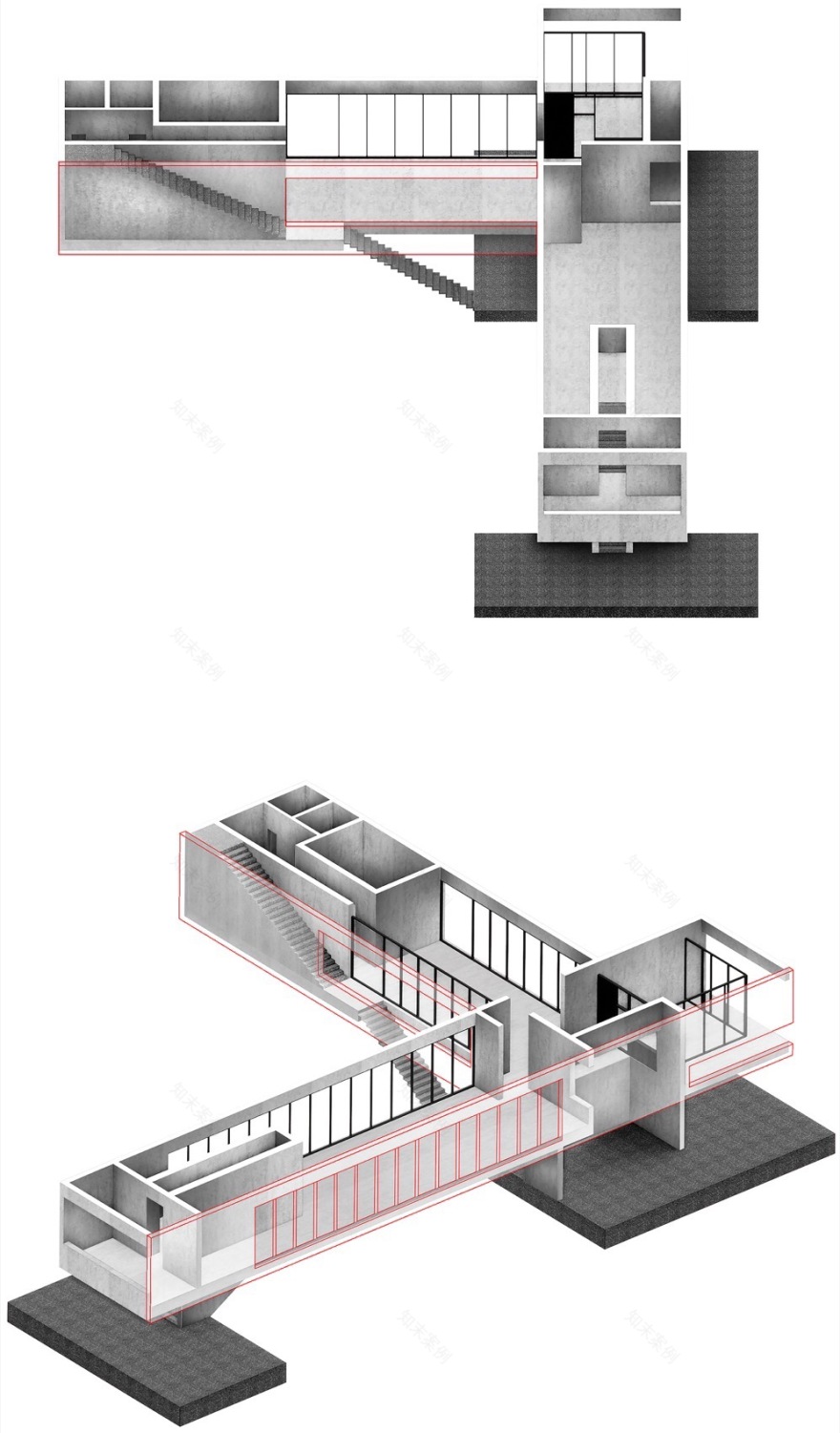
The architecture establishes a secondary plane and boundary dedicated to programmatic activities, composed through a dialogue of horizontal and vertical forms. Within the concrete volumes, three light courts are inserted—each connected to the circulation paths. A series of carefully placed openings bring in and frame natural elements such as sunlight, the earth, tree shadows, and the sky, resetting the user’s gaze and bodily experience while establishing a new orientation for the human presence within nature.
▼从餐厅望向光庭,Looking Toward the Light Court from the Dining Area © 吴清山

▼贯通室内与室外的垂直光庭,Vertical Light Court Connecting Interior and Exterior © 吴清山

▼从光庭望向厨房,Looking Toward the Kitchen from the Light Court © 吴清山

▼从厨房望向相邻会议室,Looking Toward the Adjacent Meeting Room from the Kitchen © 吴清山
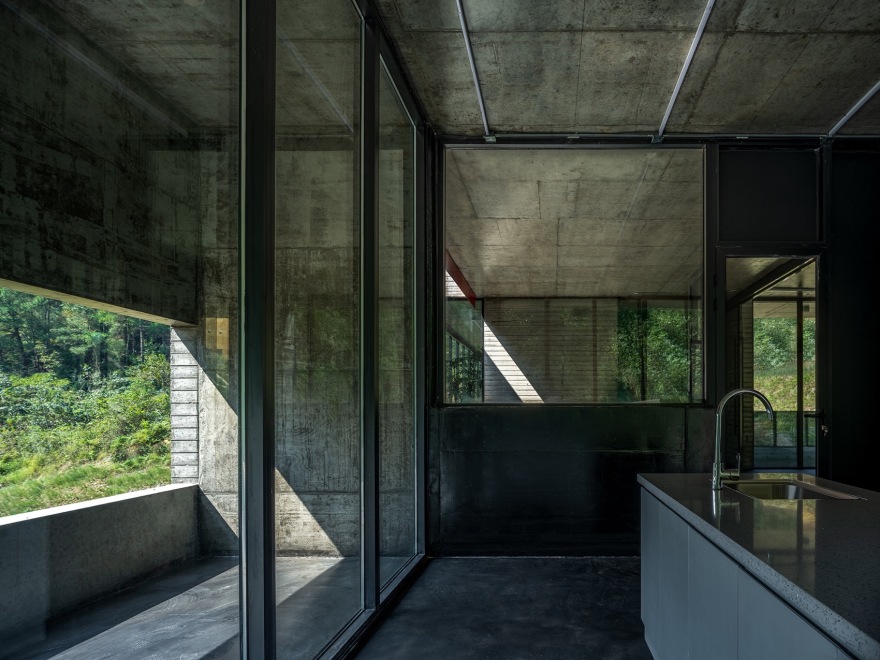
▼开敞厨房里,混凝土与玻璃在光影中相互映照,Concrete and Glass Interplay in Light and Shadow Within the Open Kitchen © 吴清山

▼从光庭分别望向厨房和会议室,Views from the Light Court Toward the Kitchen and Meeting Room © 吴清山
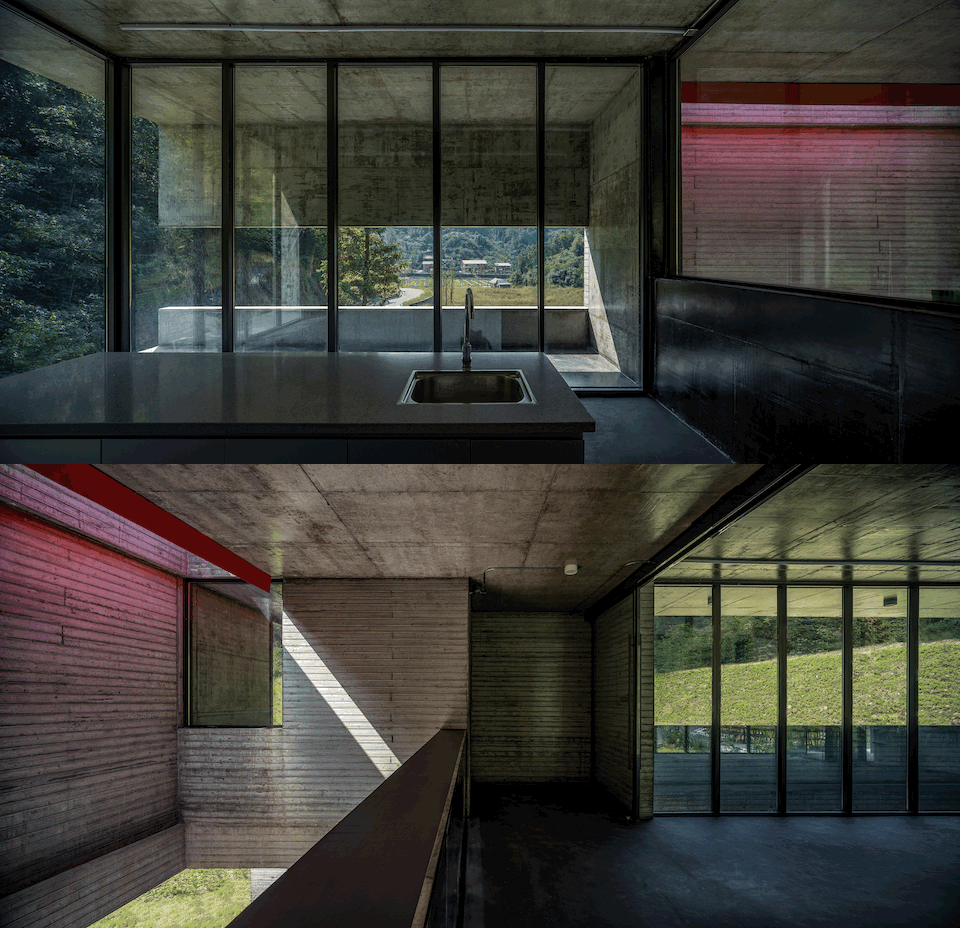
▼会议室回望光庭,Looking Back Toward the Light Court from the Meeting Room © 吴清山

▼窗外风景贯穿会议室,The View Outside Extends Through the Meeting Room © 吴清山

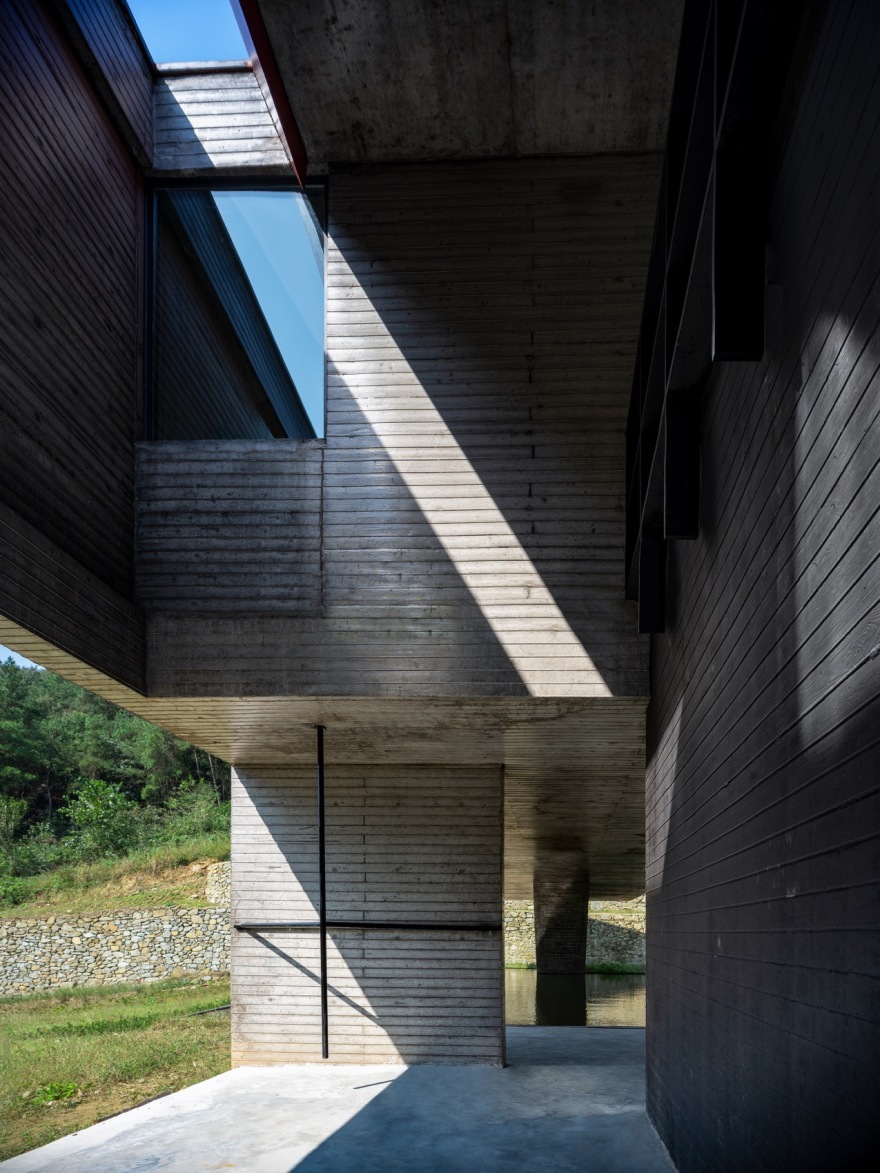
“垂直光庭”Light court是一处通高、半室外的、7.5m×7.5m×7.5m的立方体:横向联通餐厅、开敞厨房与会议室;竖向以光的变化连接人、天空与大地。原本单纯内向的室内空间有了虚实节奏与进退转折,三间功能房相互联系又各展其貌。“光庭”通过光线的流动表达时间的挪移,同时也在调控着人的视线,建筑片段地被人感知,呈现出一定的丰富感。室内地面采用质感与色值接近混凝土的环氧地坪,强化内外一体的秩序。
The vertical light court is a double-height, semi-open cubic void measuring 7.5m × 7.5m × 7.5m. It connects the dining area, open kitchen, and meeting room laterally, while vertically linking people to the sky and the ground through shifting light. What was once an inward-facing interior space is now animated with a rhythm of solidity and void, progression and retreat. The three functional rooms are interrelated yet individually expressive. The light court registers the passage of time through the movement of light while also guiding the user’s line of sight. Architectural fragments are perceived sequentially, creating a layered spatial experience. The interior flooring is finished with an epoxy resin in a tone and texture close to concrete, reinforcing the continuity between interior and exterior space.
▼镜面水池,与建筑的水平抽象呼应,The Reflecting Pool Echoes the Horizontal Abstraction of the Architecture © 吴清山
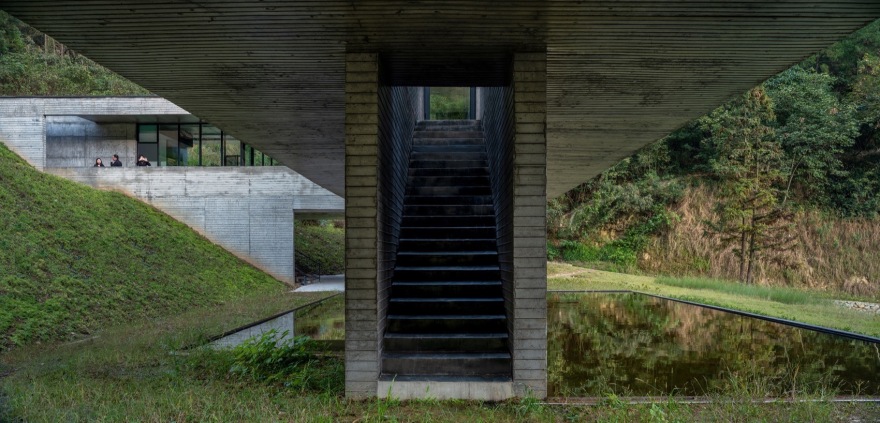
▼楼梯光庭的置入,组织起空间的虚与实,The Insertion of the Staircase Light Court Organizes the Relationship Between Solid and Void © 吴清山


▼光从楼梯光庭倾入,挑台与会议室的视线在此相遇,Light Pours Through the Staircase Light Court, Where Views from the Terrace and Meeting Room Converge © 吴清山

4.悬浮在风景中
Floating Within the Landscape
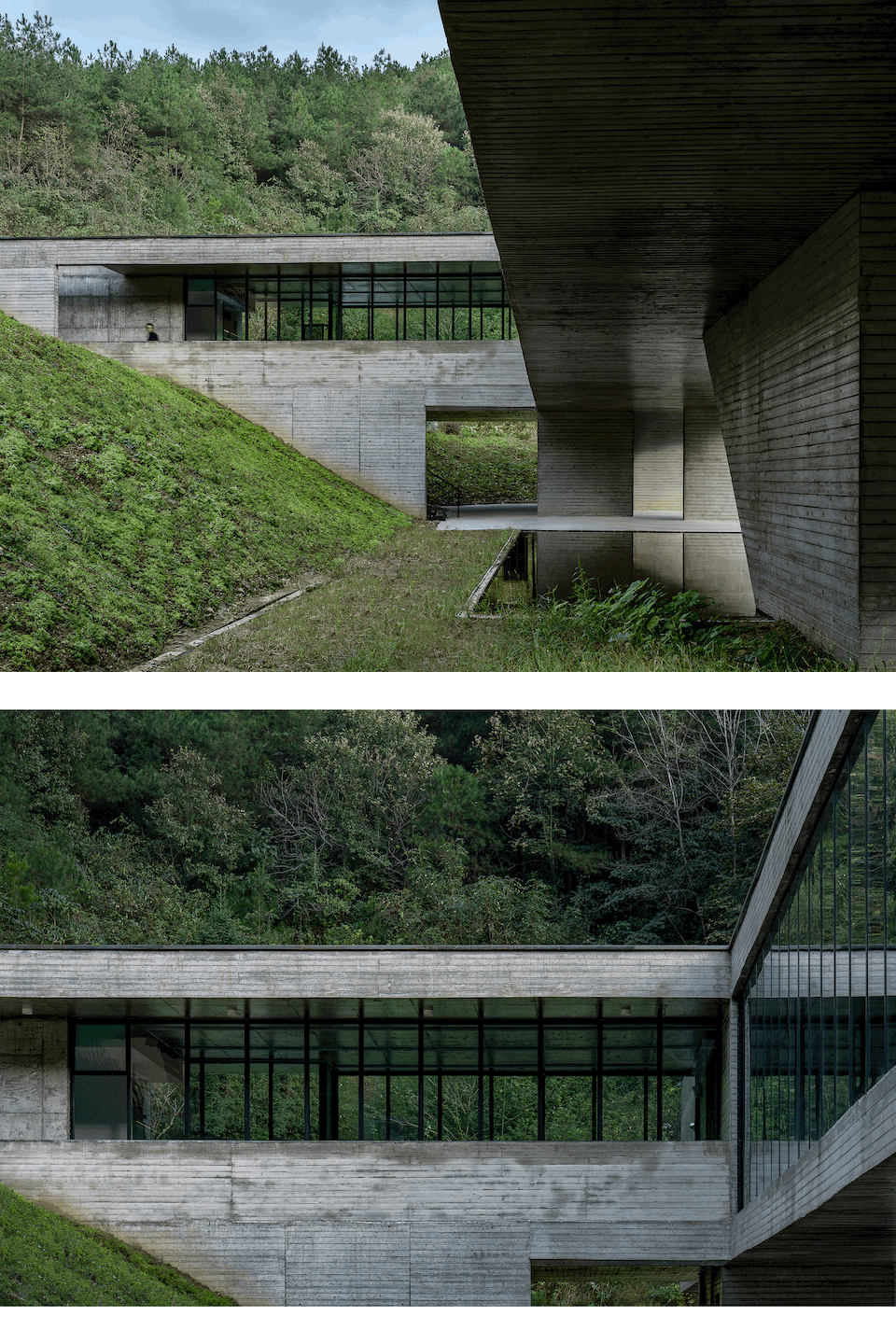
为使空间呈现“悬停”姿态并实现无柱大跨度,建筑顶面与地面均采用密肋混凝土板,构成三维筒体受力体系。竖向荷载由两端的楼梯、其侧墙及纵向交错片墙传递至底部整体筏板;非受力区尽可能通高开设长向大窗,两端配电动开启窗形成对流通风,从而弱化结构体量,提升室内通透度。顶板混凝土反梁整合机电管线,顶面保留清水混凝土肌理。
To give the architecture a sense of levitation and achieve a large column-free span, both the roof and the floor are constructed with ribbed concrete slabs, forming a three-dimensional structural shell. Vertical loads are transferred through the stair cores at both ends, their adjoining shear walls, and a series of staggered longitudinal wall planes, all bearing down onto a monolithic raft foundation. In non-load-bearing areas, full-height longitudinal windows are introduced wherever possible, and operable windows at both ends enable cross-ventilation. These strategies collectively reduce the visual and physical mass of the structure, enhancing spatial transparency. The inverted beams in the roof slab also serve to integrate MEP systems, while the ceiling surface retains the raw texture of fair-faced concrete.
▼结构计算模型,Structural Analysis Model ©末广建筑

建筑屋面覆以超薄镜面水池,以削弱反梁的厚重感,使体量更为轻盈、抽象;其水平反射既与山体的复杂肌理形成对照,亦呼应远处水库。混凝土筒体为一次整体浇筑;为平衡主梁中跨弯矩,顶板与地面经计算均作微起拱,以降低早期应力与变形,保证了混凝土不会在硬化凝固的过程中开裂。在自然界的杂乱无章之中,一座桥梁就是一处几何学的领地。
The roof is topped with an ultra-thin reflecting pool, softening the visual weight of the inverted beams and lending the volume a lighter, more abstract presence. Its horizontal mirror contrasts with the rugged textures of the surrounding mountains, while also echoing the distant surface of the reservoir. The concrete shell was cast in a single pour. To balance the mid-span bending moments of the main beams, both the roof and floor slabs were designed with a slight upward camber. This subtle adjustment minimizes early-stage stress and deformation, preventing cracking during the curing process. Amid the natural world’s irregularity, the building stands like a bridge—a precise geometric territory carved out of chaos.
▼连接民宿住宿区与戏水池的室外楼梯,Outdoor Staircase Connecting the Guesthouse Area to the Reflecting Pool © 吴清山
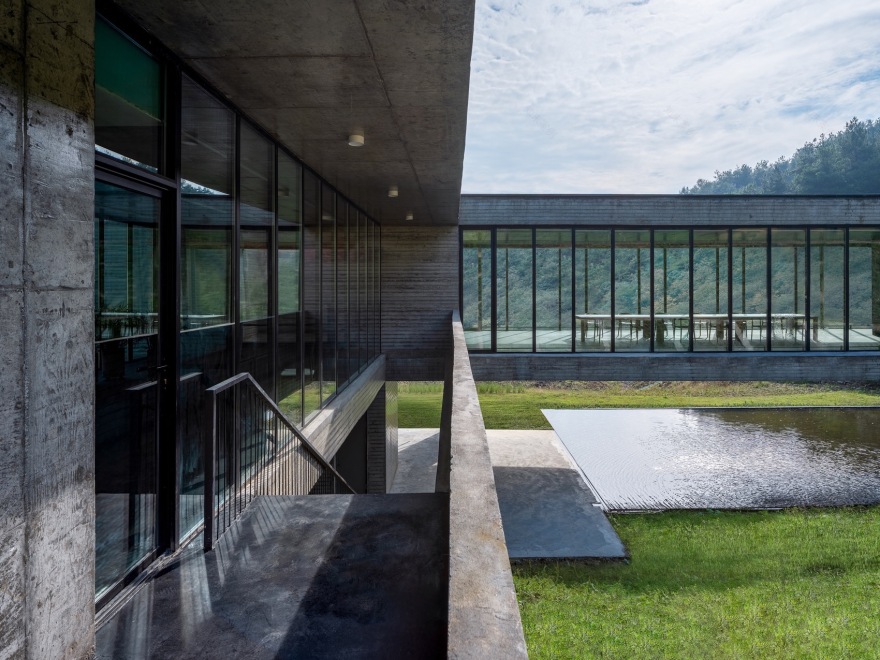
▼连接民宿住宿区与戏水池的室外楼梯,Outdoor Staircase Connecting the Guesthouse Area to the Reflecting Pool © 吴清山
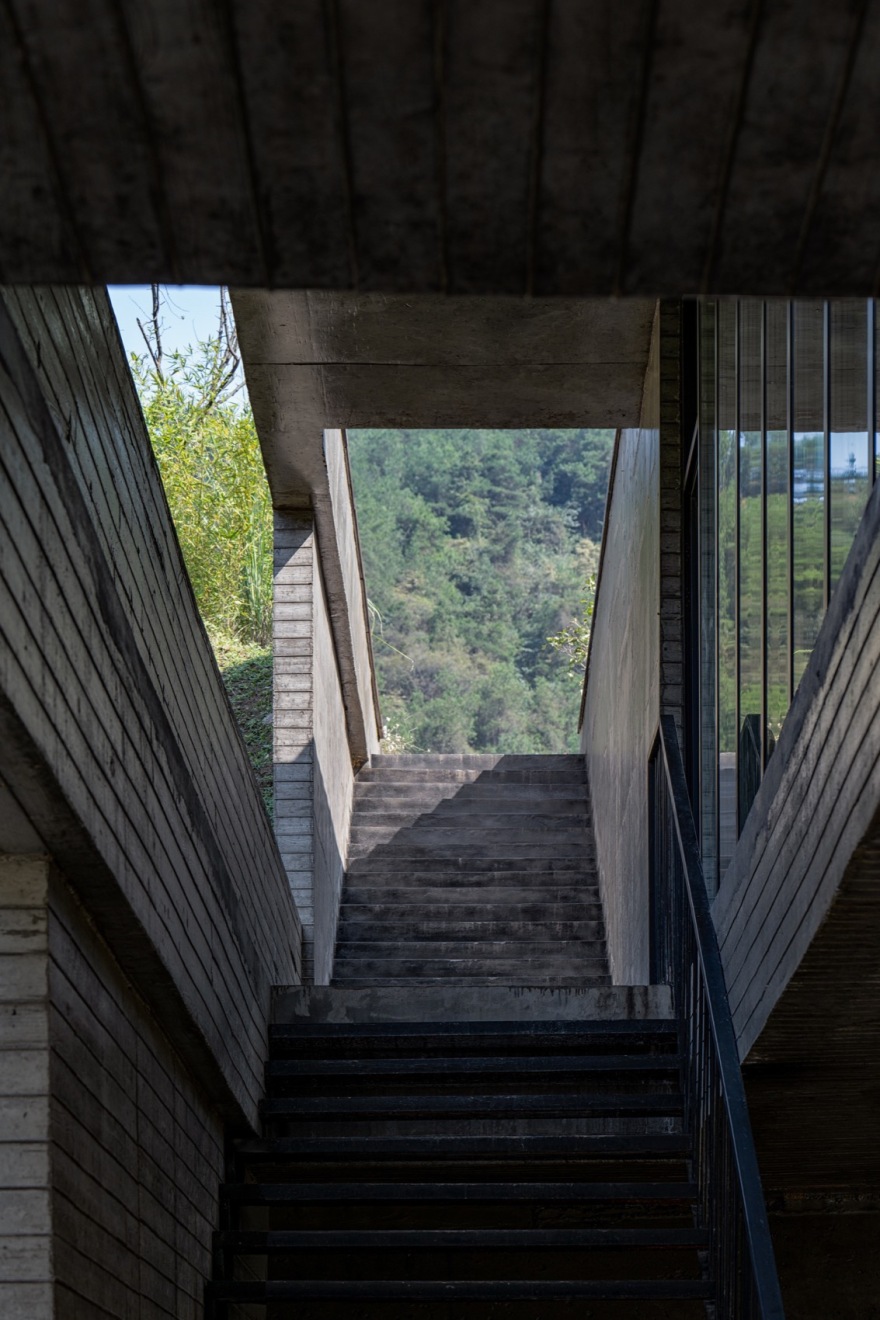
▼底层剪力墙被抽象为装置化几何体,Ground-Level Shear Walls Abstracted into Geometric Installations© 吴清山

▼从地面回看光庭,Looking Back at the Light Court from Ground Level © 吴清山

▼自底层通廊望向山谷,Toward the Valley© 吴清山
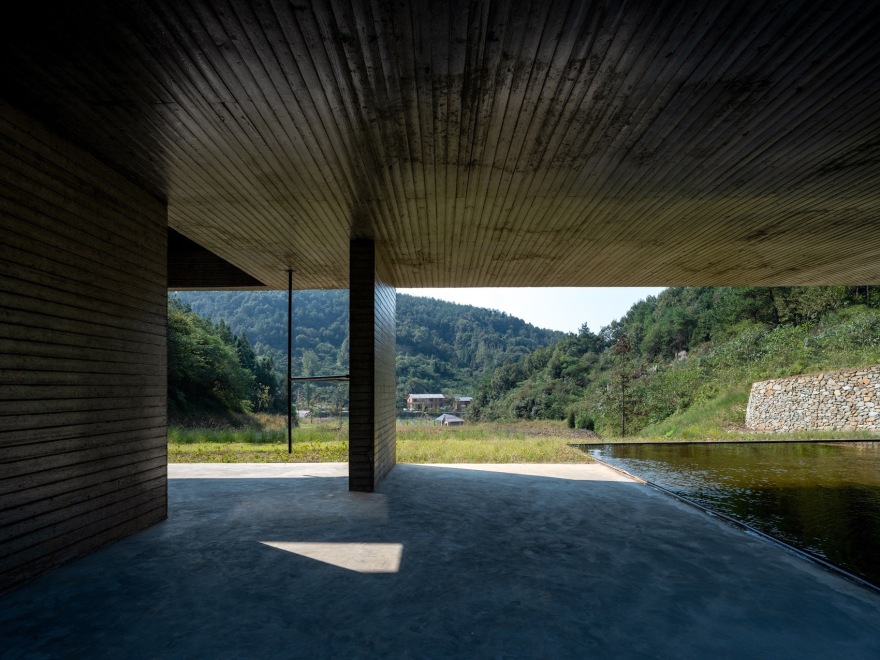
横向木纹顺着水平的台地展开;悬挑和留空像是把地形做了一个微缩版:平台上更轻,剖面间更透。与蓝色围挡的偶然、粗糙不同,建筑把人工的痕迹变成了精确、克制的极简雕塑。在同一片场地里,粗与细、无意与有意、临时与恒久并排呈现。
Horizontally oriented timber grain extends across the terraces, while cantilevers and voids function like a miniature abstraction of the topography: lighter above, more open in section. In contrast to the rough, accidental presence of the blue construction fence, the building transforms human traces into a precise, restrained minimalist sculpture. On the same site, roughness and refinement, the incidental and the intentional, the temporary and the permanent coexist in quiet dialogue.
▼平面图,Floor Plan Drawing ©末广建筑
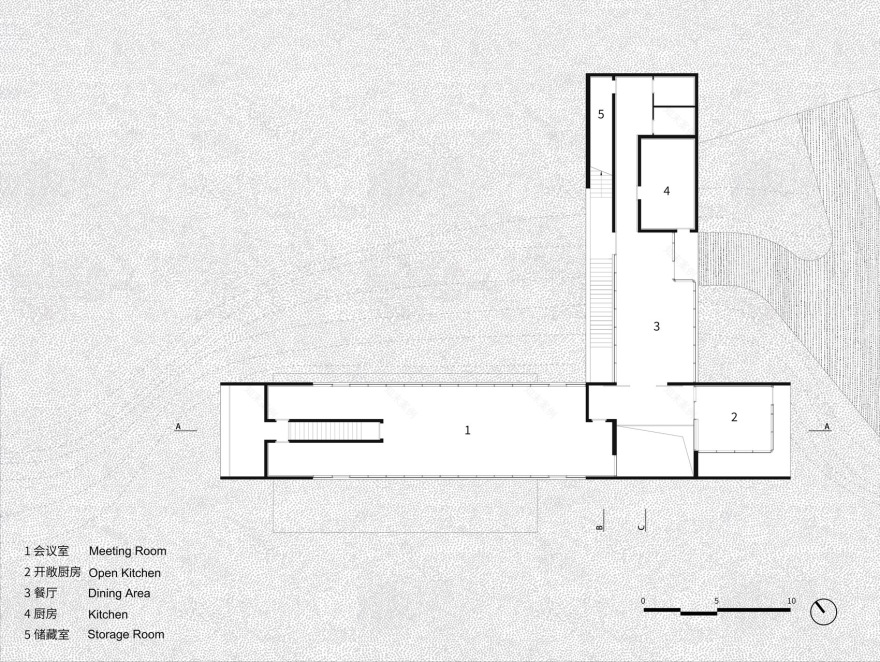
▼A-A剖面,A-A Section ©末广建筑

▼B-B剖面,B-B Section ©末广建筑

▼C-C剖面,C-C Section ©末广建筑

项目名称:武当山麓游客中心:重塑台地之线
项目地址:湖北省十堰市龙王沟村武当山山麓
建筑面积:450㎡
规划/建筑/室内/景观 整体设计:上海末广建筑设计有限公司
设计团队:李佳颖、冯昕
结构设计:马智刚
机电团队:何春会、刘红菲、魏天亮
平面摄影:吴清山
设计时间:2023年12月
竣工时间:2024年5月
Project Title: Wudang Mountain Visitor Center: Reconfiguring the Terrace Lines
Location: Longwanggou Village, Foothills of Wudang Mountain, Shiyan City, Hubei Province, China
Building Area: 450 m²
Integrated Design (Master Planning / Architecture / Interior / Landscape): Moguang Studio
Design Team: Li Jiaying, Feng Xin
Structural Design: Ma Zhigang
MEP Team: He Chunhui, Liu Hongfei, Wei Tianliang
Photography: Wu Qingshan
Design Period: December 2023
Completion: May 2024
南京喵熊网络科技有限公司 苏ICP备18050492号-4知末 © 2018—2020 . All photos and trademark graphics are copyrighted by their owners.增值电信业务经营许可证(ICP)苏B2-20201444 苏公网安备 32011302321234号
苏公网安备 32011302321234号客服
消息
收藏
下载
最近