

创作上传
VIP
收藏下载
登录 | 注册有礼
查看完整案例

收藏

下载

分享

翻译
Architects:Blue Temple
Year:2025
Photographs:Aung Htay Hlaing,Raphaël Ascoli
Lead Architects:Raphaël Ascoli
Bamboo construction:KoZin
Construction:Housing NOW
Category:Social Housing
Architect:Nyan Lin Aung, Bhone Mo Win Khet
Architect / Partner:Htoo Aung
Visual Artist:António Distante
City:Bago
Country:Myanmar

Text description provided by the architects. Since the military coup of February 2021, Housing NOW has developed a modular bamboo housing system engineered for emergency and conflict-affected contexts in Myanmar. The country has hundreds of bamboo species in all shapes, colors, and forms. Conventionally, the largest-diameter species are used for construction, while smaller culms are employed for farming or fencing. The larger culms go for higher prices on the market; by contrast, small-diameter bamboo is extremely abundant and inexpensive because its traditional applications demand it in large quantities. This affordability presents an architectural opportunity: by bundling and reconfiguring these small culms into structural frames, Housing NOW has repurposed a low-value material into a groundbreaking construction system.

Each frame integrates column, floor beam, roof beam, and diagonal bracing into one continuous monolithic assembly. Four frames interlock to form the load-bearing skeleton, on top of which the finishes are mounted. To evaluate performance, five full-scale prototypes were built and tested: frames were pulled laterally with a dynamometer in both directions to mimic wind loads and stressed until failure. This process provided precise data on resistance thresholds and allowed the design to be refined for higher performance under extreme weather conditions.

Before larger deployment, ten pilot units were built across varied contexts. In Hmawbi (Yangon Region), two units for a preschool and four units for an orphanage for kids from Chin State. In Yangon Region slums, two single-unit houses were built for displaced families (mother and daughter, both living with HIV) evicted during military slum clearances. In Kyauktaw (Rakhine State), two units were built with UNHCR as a community center for displaced Arakan families. These pilots confirmed the system's adaptability across rural, peri-urban, and active conflict zones.


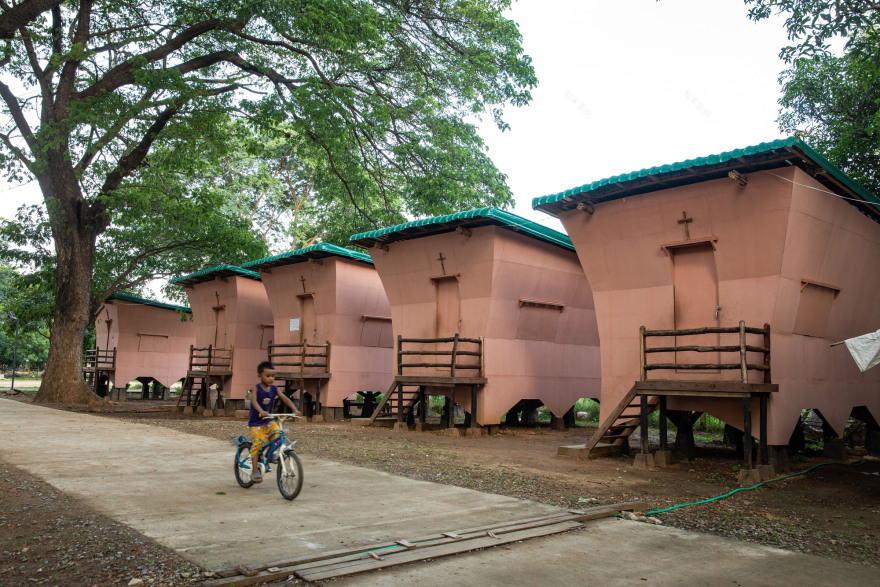
The decisive test came with a 26-unit Internally Displaced People (IDP) camp near Mandalay. Shortly after completion, a magnitude-7.7 earthquake struck, with its epicenter only 15 km from the site. Mandalay—the country's second-largest city—was wiped out, yet all 26 houses resisted the event without damage. This outcome provides rare, field-based seismic validation and demonstrates that rigorous, on-the-ground tracking can yield architecture resilient under disaster conditions.


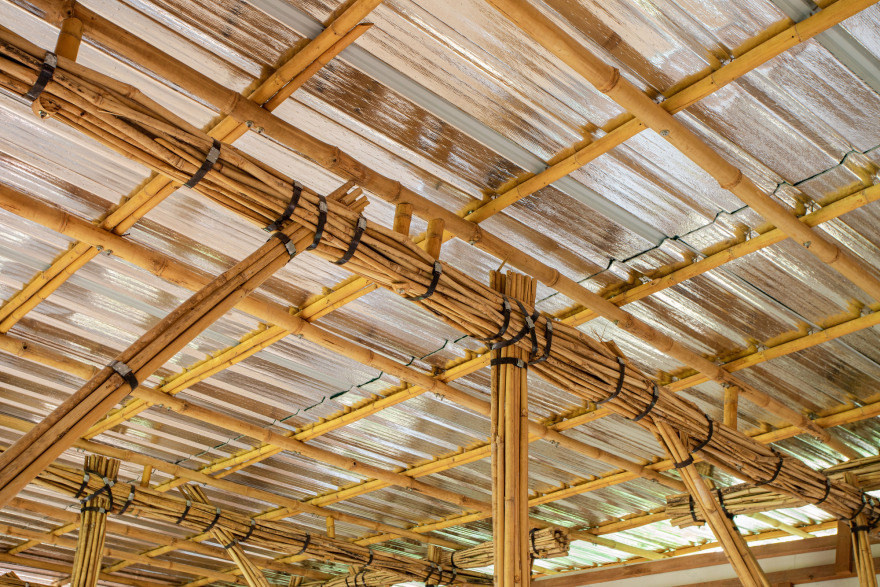
Architecture - The structural system uses bundled small-diameter bamboo culms, configured into standardized frames fabricated with jigs. Each frame combines vertical and horizontal members with bracing into a single structural unit. Four frames interlock to form a rigid chassis, onto which floors, walls, and roofing are mounted. The result is light, stiff, and modular. A complete house can be delivered in one week at a cost of USD 1,000–1,300—roughly the price of a smartphone.


Emergency housing & logistics - Delivering housing in Myanmar requires navigating constraints beyond material or cost. Early attempts to transport prebuilt frames on custom low-bed trailers failed; however, the unconventional cargo sizes meant that military checkpoints would arrest, seize, and threaten us for money. The system adapted: today, we transport only jigs and raw bamboo, fabricating frames directly on site. In distant regions, small-scale mobile treatment tanks are deployed to process local species. At Kyauktaw, construction of the community center could only proceed during a short and temporary ceasefire; fighting resumed the next day after our team left. These realities underline the difference between working in Myanmar and in countries where humanitarian housing unfolds without an active nationwide war.
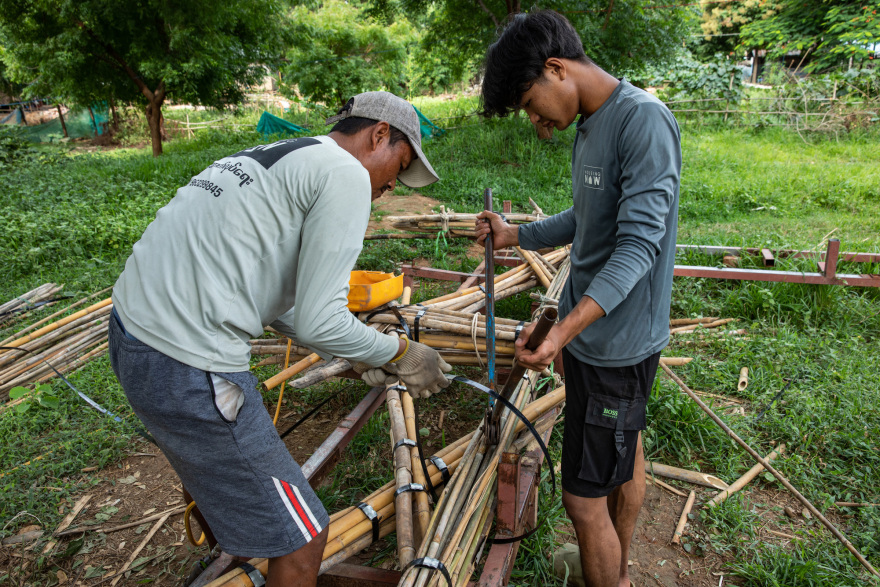
Participative approach - Construction is carried out with the displaced community itself. Residents make design decisions—adjusting window sizes, partition layouts, and entrance positions. In Hmawbi, a local displaced carpenter proposed and built the flooring design by interweaving bamboo shingles. Training and daily wages ensure local participation, but more importantly, hyper-local construction mitigates risks. Under the current conscription law, skilled workers face arrest and military drafting if they move across regions. By working directly with IDPs, the system bypasses these risks while embedding skills in the community.


Compounding Crises - Conflict is only part of Myanmar's housing crisis. Since the coup in 2021, nearly 110,000 civilian houses have been burned down. In 2023, Cyclone Mocha displaced approximately 360,000 people. Severe flooding from Typhoon Yagi in 2024 displaced millions more. Combined with ongoing earthquakes, these events create overlapping, long-term emergencies.
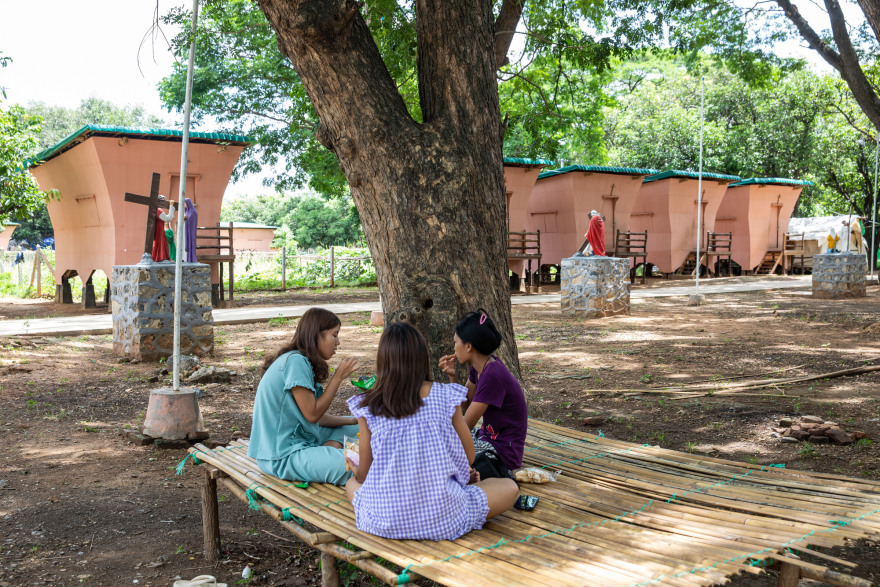
Housing NOW is not speculative research but a validated, field-ready construction method. The survival of 26 houses in Mandalay during one of the region's strongest earthquakes demonstrates that architecture, when designed hyper-locally and stress-tested in the field, can achieve reliability under war, disaster, and logistical extremes.
Project gallery

南京喵熊网络科技有限公司 苏ICP备18050492号-4知末 © 2018—2020 . All photos and trademark graphics are copyrighted by their owners.增值电信业务经营许可证(ICP)苏B2-20201444 苏公网安备 32011302321234号
苏公网安备 32011302321234号客服
消息
收藏
下载
最近