

创作上传
VIP
收藏下载
登录 | 注册有礼
查看完整案例

收藏

下载

分享
在北京798艺术区的红砖建筑群中,MUXA798眼镜店以一种冷静而诗意的姿态嵌入历史与当代的交汇处。设计以“工业遗存与侘寂哲学”为内核,通过现代建筑语汇重构零售空间体验,在功能性与精神性之间建立平衡,形成一场过去与未来、粗粝与精致、宏大与微末的对话。
Nestled among the red-brick buildings of Beijing’s 798 Art District, MUXA798 Eyewear Store inserts itself calmly yet poetically at the intersection of history and contemporaneity. The design is rooted in the dual concepts of industrial heritage and Wabi-sabi philosophy, redefining the retail spatial experience through a modern architectural language that balances functionality and spirituality. It orchestrates a dialogue between past and future, roughness and refinement, grandeur and minutiae.
▼室内概览,overview of the interior space©立明


一、空间构型:巨构建筑的微缩隐喻
Spatial Configuration: A Miniature Metaphor of Megastructure
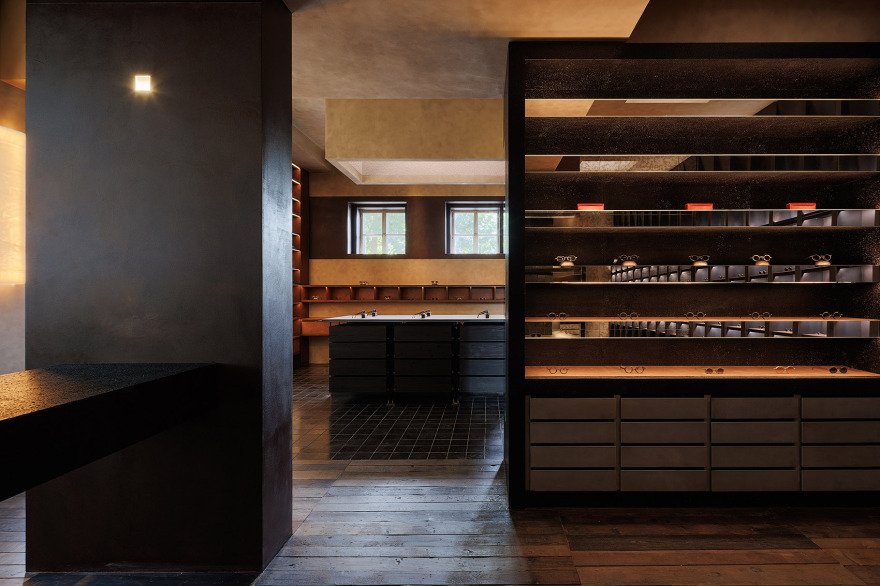
设计从前苏联社会性住宅与巨构建筑中提取灵感,将宏大的建筑逻辑转化为人体尺度的空间体验。模块化的功能体量、重复的线性结构、悬挑的基本单元,塑造出具有秩序感的沉浸场景。中岛陈列柜以悬挑结构为原型,通过力学支撑杆件实现体块的视觉悬浮,既是对现代主义建筑技术的致敬,亦将功能性家具转化为空间雕塑。红砖厂房原有钢窗的秩序感也被保留,形成内外历史的对视,同时引导自然光以某种“仪式性”的方式渗入室内。
The design draws inspiration from Soviet-era social housing and megastructures, translating grand architectural logic into human-scaled spatial experiences. Modular functional volumes, repetitive linear structures, and cantilevered basic units together form an immersive environment with a strong sense of order. The central display cabinet, derived from the logic of cantilevered construction, achieves visual levitation through exposed structural supports—paying homage to modernist architectural techniques while transforming utilitarian furniture into spatial sculpture. The ordered rhythm of the original steel windows in the red-brick factory hall is preserved, facilitating a visual dialogue between interior and exterior histories, while allowing natural light to enter the space in an almost ritualistic manner.
▼将宏大的建筑逻辑转化为人体尺度的空间体验,translating grand architectural logic into human-scaled spatial experiences©立明

▼将宏大的建筑逻辑转化为人体尺度的空间体验,translating grand architectural logic into human-scaled spatial experiences©立明


▼将功能性家具转化为空间雕塑,transforming utilitarian furniture into spatial sculpture©立明

▼陈列细部,display detail©立明


▼通过力学支撑杆件实现体块的视觉悬浮,achieves visual levitation through exposed structural supports©立明
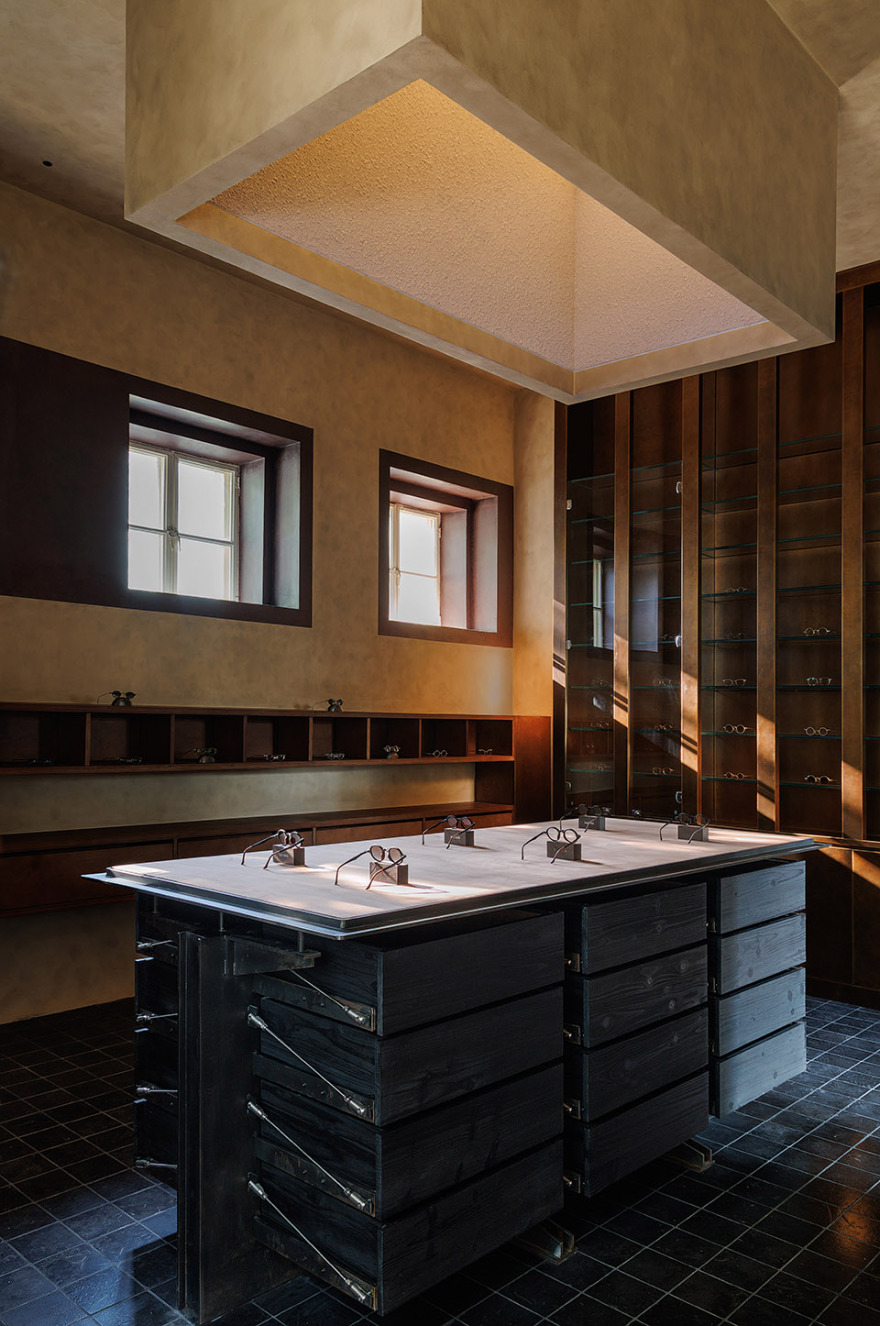

▼力学支撑杆件细部,exposed structural supports detail©立明


二、材料叙事:时间痕迹与当代肌理
Material Narrative: Traces of Time and Contemporary Textures
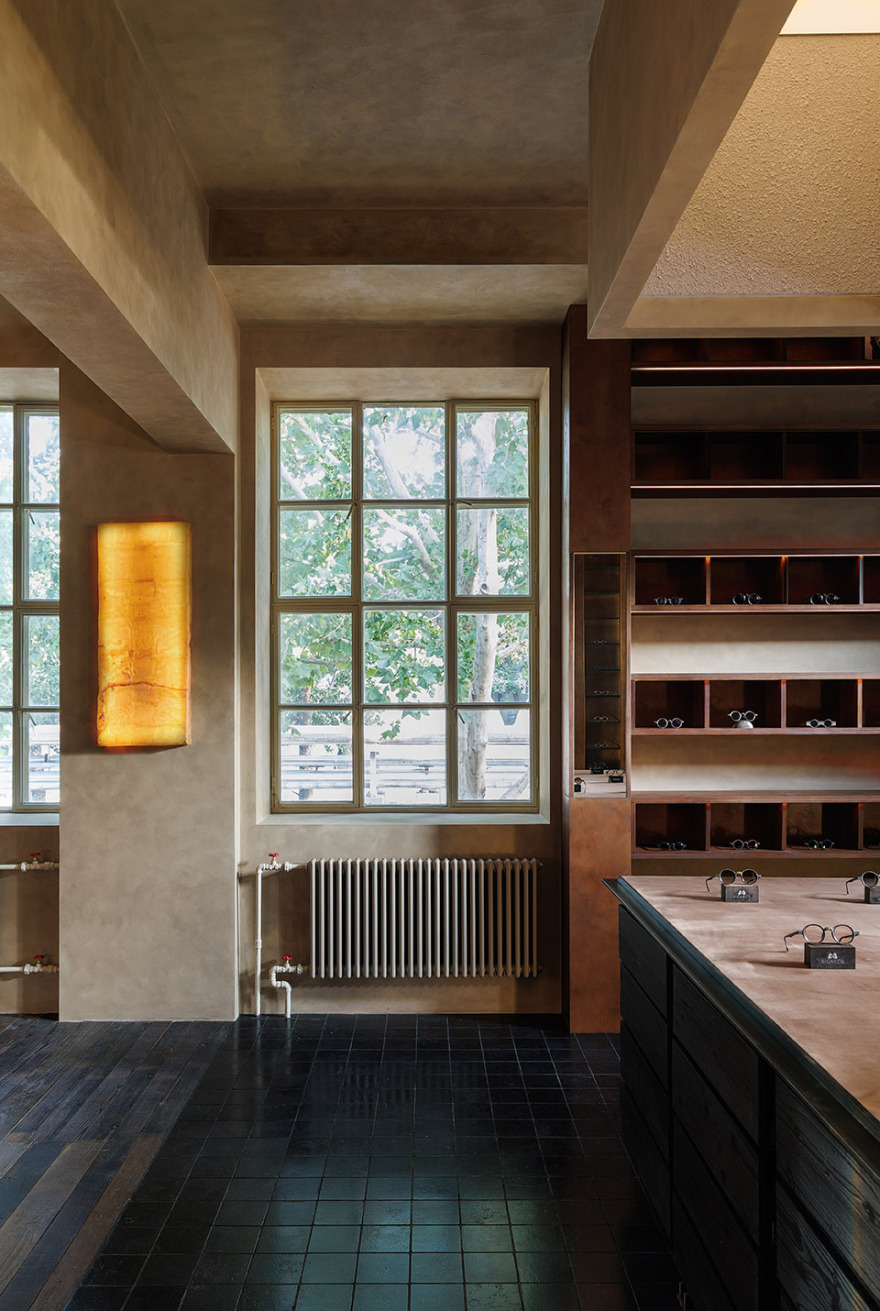
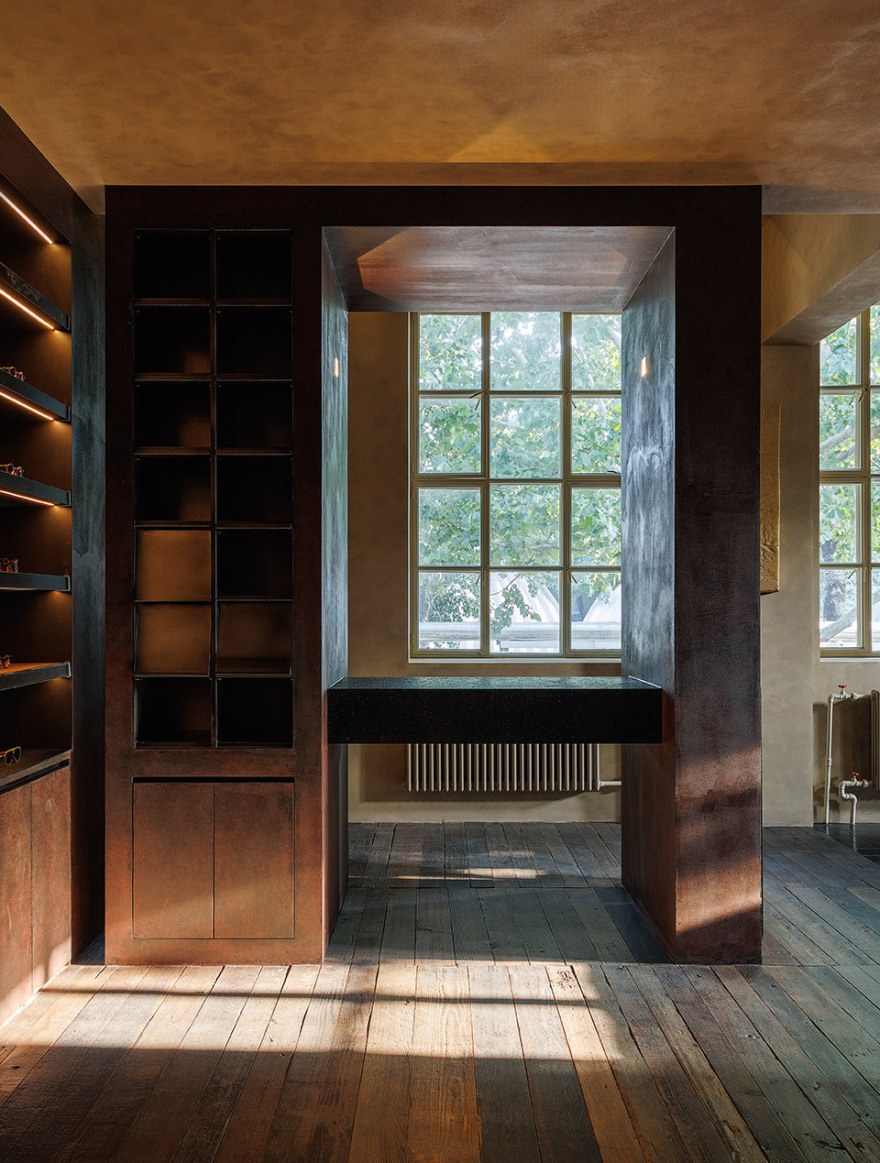
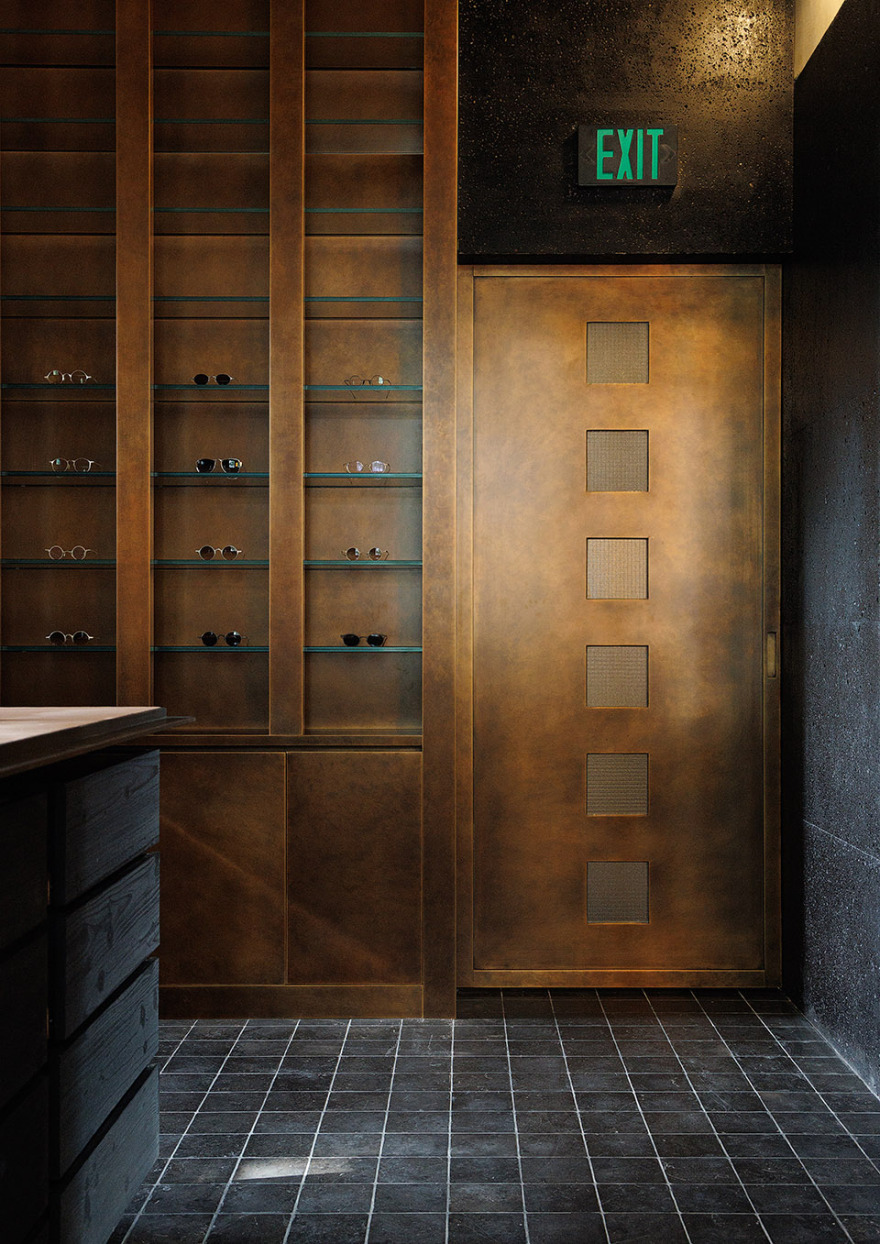
空间材质成为连接记忆与未来的媒介。黑色火山岩以原始肌理赋予墙面深邃的层次感,与黑色钢板的冷峻光泽形成张力;浅棕色做旧涂料以手工涂刷的斑驳质感软化工业的硬朗,而棕色桦木海洋板则用温润的木纹为空间注入自然呼吸感。入口处的一个板型塔楼式的做旧铜板柜子,随着时间推移将氧化出独特的色泽,成为空间中“活的历史”。这些材料既保留着人工与自然的痕迹,又通过现代技术精控其表现形态,呼应侘寂美学中“无常”与“残缺”的哲思,亦强化了工业场域的厚重底色。
Materials serve as a medium linking memory and future. Black volcanic stone cladding adds depth and textural richness to the walls, contrasting with the cool gloss of black steel panels. Light brown distressed paint, applied by hand, softens the industrial rigidity with its mottled texture, while brown birch plywood imbues the space with warmth and organic breathability. At the entrance, a tower-like cabinet clad in pre-oxidized copper will develop a unique patina over time, becoming a form of “living history” within the space. These materials preserve traces of human and natural intervention, yet are precisely orchestrated through contemporary techniques—echoing the Wabi-sabi philosophy of impermanence and imperfection, while reinforcing the gravitas of the industrial setting.
▼入口处做旧铜板,pre-oxidized copper panel©立明

▼材料保留着人工与自然的痕迹,the material retains the traces of both artificiality and nature©立明
三、光影实验:理性与感性的双重剧本
Light and Shadow: A Dialogue Between Rationality and Sensibility
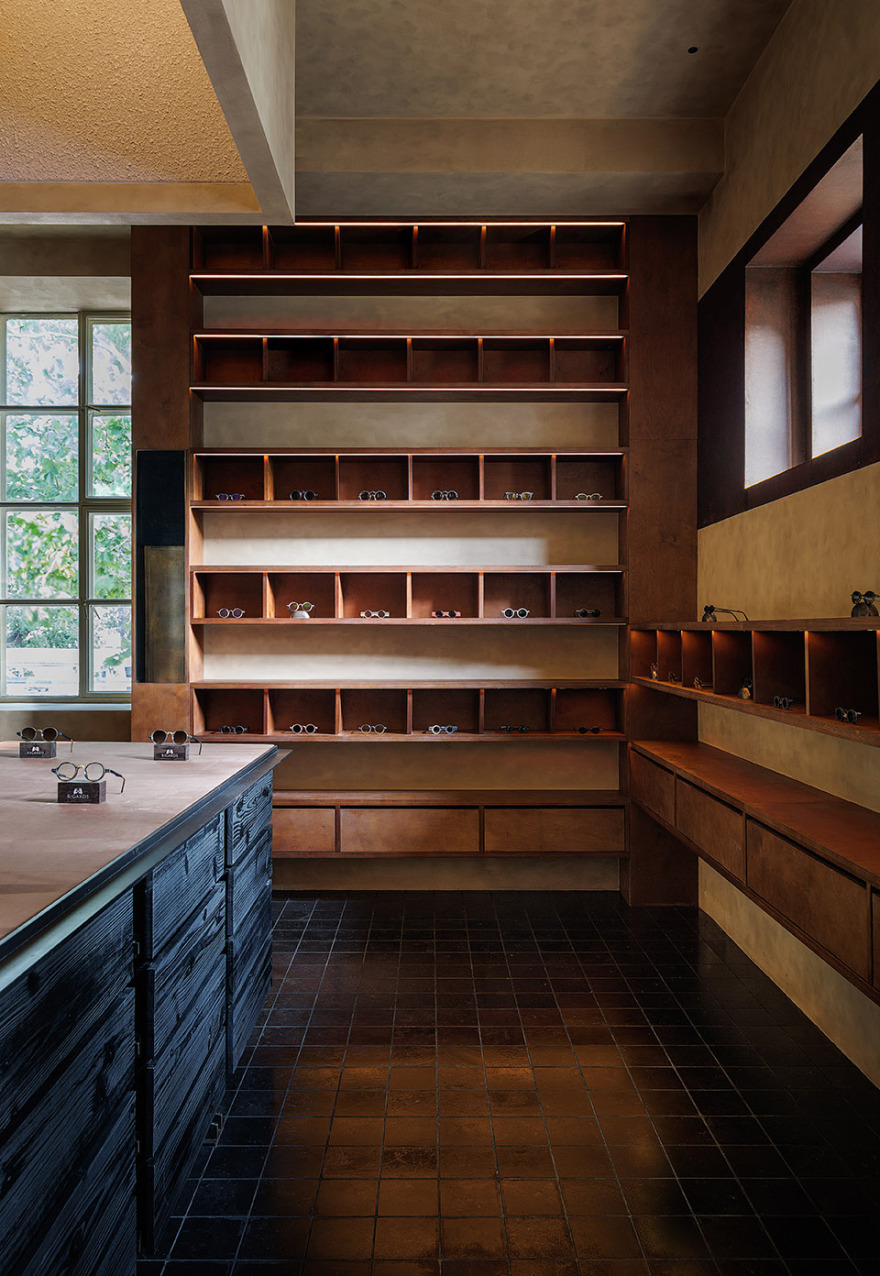
光成为空间中最具流动性的材质。自然光透过钢窗洒入,在室内空间映刻出随时间变化的光影戏剧;定制灯光系统以精准的角度勾勒展陈区域,使每一副眼镜如同博物馆中的展品。铜板柜体在光照下折射出暖调微光,桦木材质在漫射光中凸显温润质感——光不仅满足功能需求,更成为划分空间情绪的工具,在冷峻与柔寂之间建立平衡。
Light is treated as the most fluid material in the space. Natural light filters through the steel windows, casting ever-shifting patterns that dramatize the interior throughout the day. A customized lighting system highlights display areas with precision, elevating each pair of eyeglasses to the status of museum artifacts. The copper-clad cabinet reflects a warm glow under illumination, while the birch plywood emanates a soft texture under diffused light. Here, light serves not only functional purposes but also becomes a tool for shaping spatial ambiance, striking a balance between austerity and tranquility.
▼自然光透过钢窗洒入,natural light filters through the steel windows©立明

▼定制灯光系统,acustomized lighting system©立明
▼灯光系统以精准的角度勾勒展陈区域,lighting system highlights display areas with precision©立明

▼灯光系统以精准的角度勾勒展陈区域,lighting system highlights display areas with precision©立明


四、侘寂哲学:零售空间的精神转向
Wabi-sabi Philosophy: The Spiritual Turn in Retail Design
MUXA798店试图挑战传统零售空间的过度装饰与消费焦虑,以“秩序”、“质朴”和“时间性”重新定义商业场景。涂料的手工涂刷质感,金属与木材的天然瑕疵,均被保留为空间叙事的一部分。这种“不完美的真实”消解了商业空间的浮华感,赋予场所一种沉静、内省的气质。消费者在此不仅是选购商品,更是经历一场空间与时间的漫游。
MUXA798 challenges the conventions of overly decorated commercial spaces and consumer anxiety, redefining retail through principles of order, simplicity, and temporality. The hand-applied unevenness of paint, the natural flaws in metal and wood—all are retained as integral parts of the spatial narrative. This “aesthetics of imperfect authenticity” dissolves the ostentation typical of commercial environments, endowing the space with a contemplative and introspective quality. Here, visitors do not merely shop for products—they embark on a journey through space and time.
▼赋予场所一种沉静、内省的气质,endowing the space with a contemplative and introspective quality©立明

项目名称MUXA北京798店
项目地点:北京市
建筑面积: 80㎡
设计师:张家赫/VANISHED DESIGN
设计时间:2025年3月
完成时间:2025年8月
摄影师:立明
文字:张家赫
Project name:Muxa 798 store, Beijing
Project location:Chaoyang District, Beijing
Project area:80㎡
Design agency: Jiahe Zhang /VANISHED Design
Design time:2025.3
Completion time:2025.8
Photography:Liming
Xiaohongshu:VANISHED Design
Design description: Jiahe Zhang




南京喵熊网络科技有限公司 苏ICP备18050492号-4知末 © 2018—2020 . All photos and trademark graphics are copyrighted by their owners.增值电信业务经营许可证(ICP)苏B2-20201444 苏公网安备 32011302321234号
苏公网安备 32011302321234号客服
消息
收藏
下载
最近