

创作上传
VIP
收藏下载
登录 | 注册有礼
查看完整案例

收藏

下载

分享
“明月坞”是一个“命题作文”。项目以“花坞樽前微笑”为题,却并非对诗意进行直接转译,而是以岛上原有的一座废弃花房为物质起点,开启了一场关于结构、空间与意象的深度对话。通过对“水、月、花、舟”等母题的抽象与重组,最终营造出一个整体的、特殊的、非日常的体验场所。
The “Moon Pavilion” was conceived in response to an ancient Chinese verse depicting a poet, intoxicated and smiling amid a field of flowers. Rather than translating this imagery literally into architectural form, the designers used an abandoned greenhouse as their point of departure, layering onto it abstractions and recombinations of spatial and figurative motifs—water, moon, flower, and boat.
▼项目概览,Overall view© 陈颢


水月
Moon
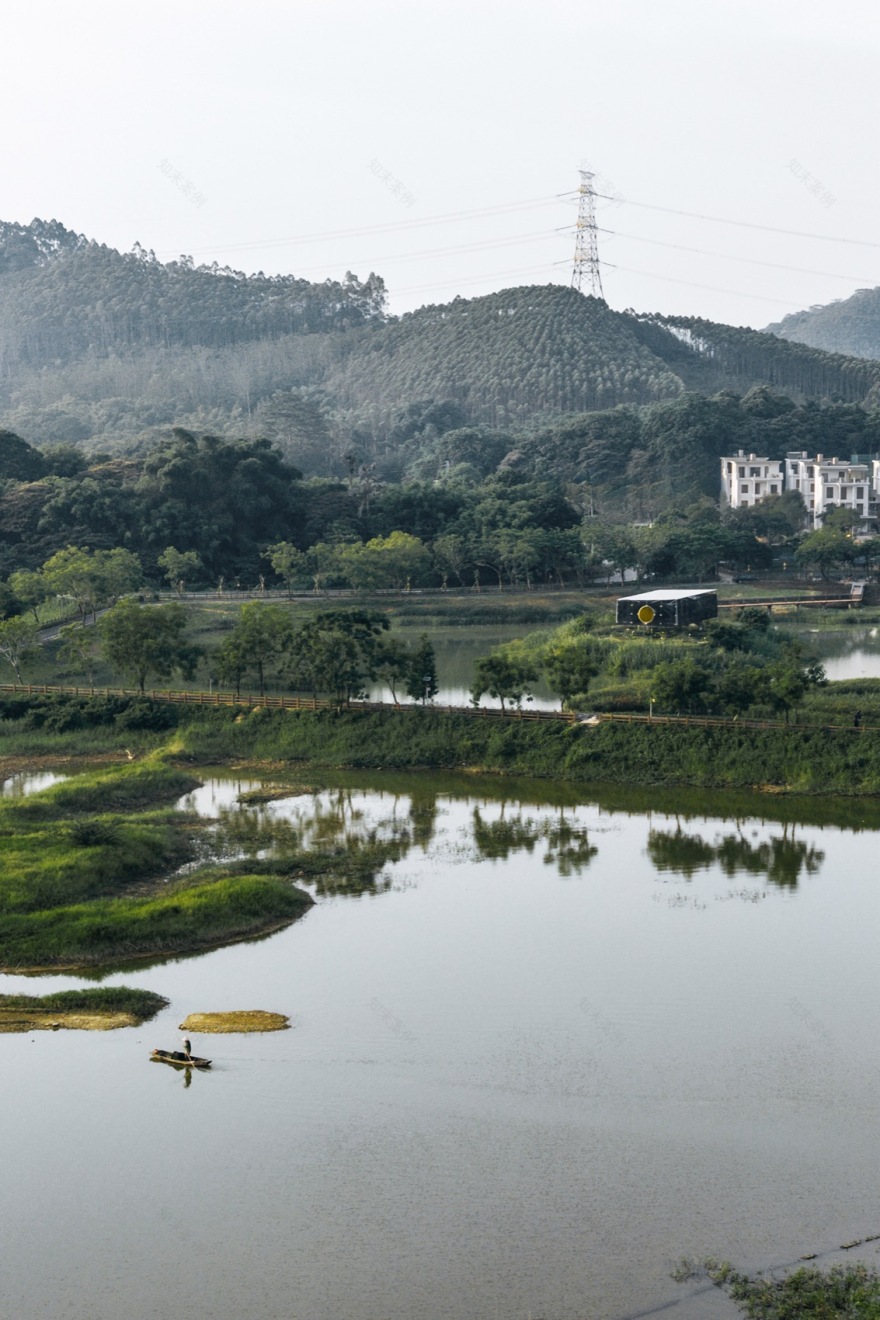
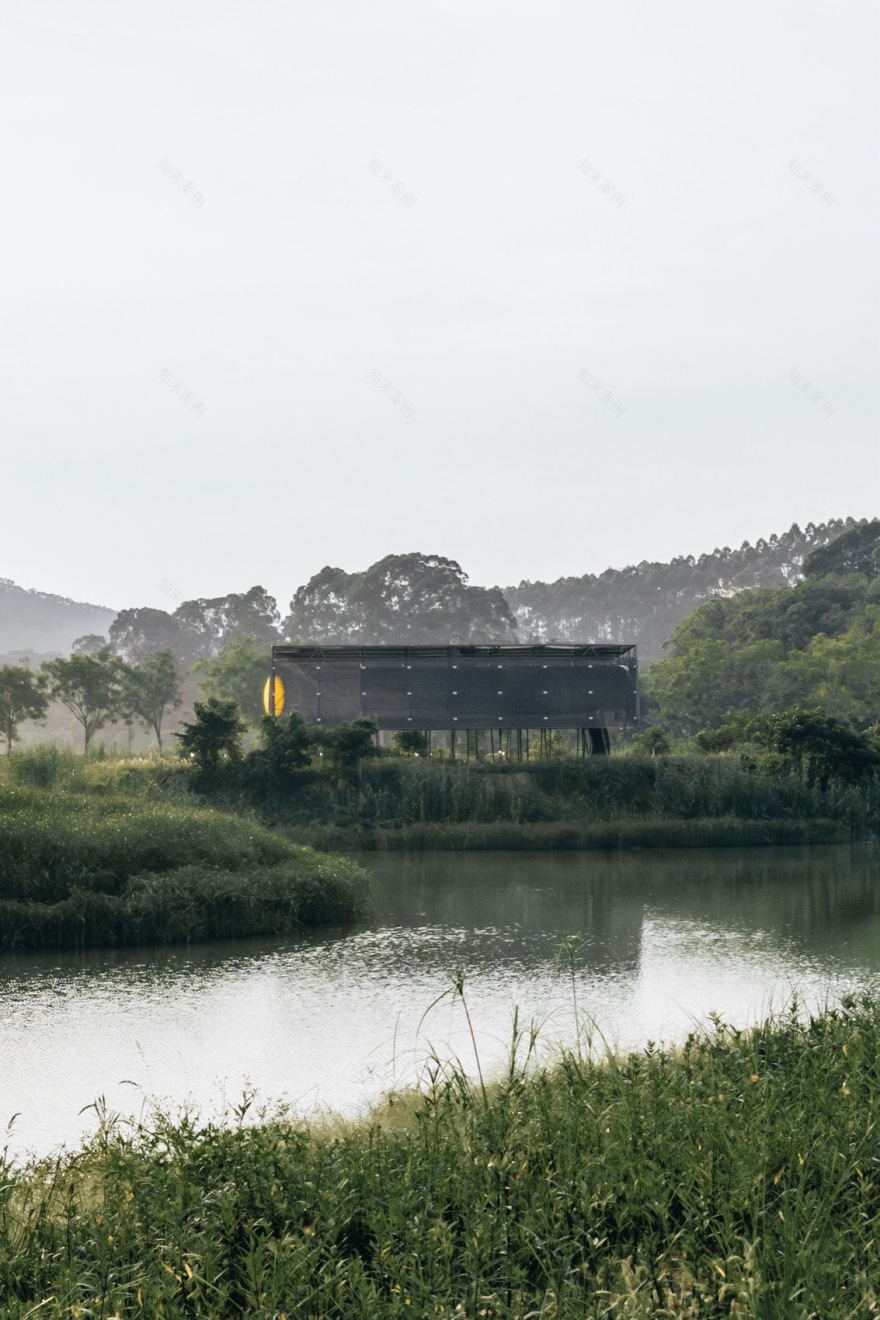
“月”的概念源于对“饮酒作诗”场景的追索。在设计中,它不仅是立面上一个可机械转动的具象装置,更成为串联不同感知尺度的空间媒介。远望时,人造月轮与真月在水面之上彼此映照;沿塘缓行,建筑整体勾勒出水上月初升的轮廓;步入内部,它又转化为一个可与身体互动的平面符号。
The idea of the “moon” is closely tied to the literary trope of “drinking and composing poetry.” In the pavilion, it takes the form of a rotatable art installation on one façade of the pavilion, acting as a medium that links different perceptual scales. At a distance, the “artificial” moon of the installation and the “real” moon are both reflected in the pond surrounding the pavilion. Walking slowly along the water’s edge, the pavilion’s silhouette itself recalls the moon rising over the horizon.
▼鸟瞰,Bird’s eyeview© 陈颢

▼周边环境,Surrounding context© 陈颢


▼远观,Distant view© 陈颢
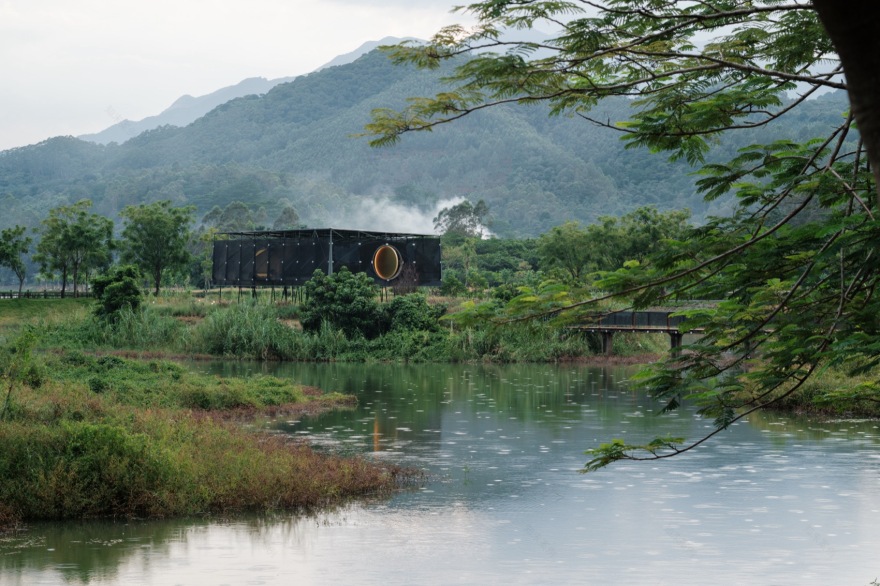
▼隔水相望,Across the water© 朱雨蒙

花房
Greenhouse
项目的重要出发点,在于保留原花房的结构质量、空间语言与材料效果。原花房由铰接节点构成的轻巧结构,呈现出鲜明的临时性与农用建筑特征;其层叠的空间构造——顶层平整、中层起拱,分别覆以阳光板与遮阳黑纱——则塑造出独特的半透明感。基于此理念,新建的二层结构延续了原有构件的尺寸与节点衔接方式。
▼分析图,analysis© 郭廖辉工作室

A crucial starting point for the design was the decision to preserve the structural, spatial, and material language of the greenhouse. Its lightweight pin-jointed structure carried the character of temporary, makeshift agricultural construction. Its configuration—a flat upper layer and an arched middle layer, clad in polycarbonate panels shaded by black netting—gave the interiors a distinctive semi-transparent quality. The new two-story pavilion evokes a similar atmosphere, reinterpreting the proportions of the original structure and the articulation of its connections.
▼室外草甸,Meadow© 朱雨蒙
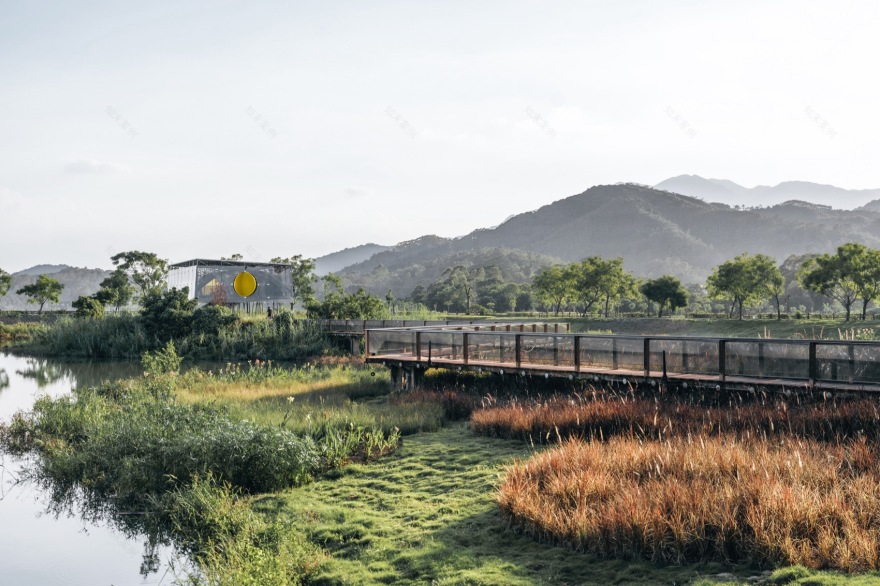
▼水上通道,Waterway passage© 陈颢


▼花房近景,Close-up of the greenhouse© 陈颢

▼花园小径,Garden path© 陈颢

船坞
Boat
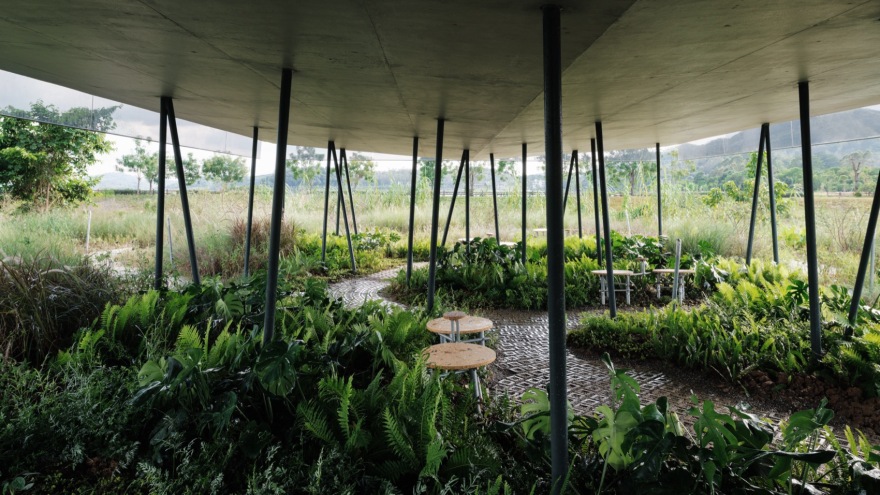
为将远方水库的景色纳入视野,同时释放出地面的空间,建筑由原花房的一层增至两层,二层混凝土楼板如同抬起的地面,又如同漂浮的“舟”。受到在枯水季把船架高于水面的临时结构的启发,底层采用相对细密的乱钢柱,营造出一种看似无序的支撑状态,水电管线隐藏于局部A形柱中。中间层的浅V字形混凝土楼板,在视觉上强化了船体结构,并与轻盈的上层形成鲜明对比。屋架上翻策略,不仅优化了横向抗侧力,更在形态上强化了“船坞”的意象。
The pavilion expands the footprint of the greenhouse from a single story into two, opening views toward a distant water reservoir and freeing the ground-level space. The second-floor concrete slab acts like a raised ground plane—a solution inspired by the temporary supports used to lift boats above water during the dry season. The slab is supported by dense, seemingly irregular steel columns, which conceal water and electrical services. The shallow V-shaped slab of the first floor reinforces the impression of a boat’s hull, creating a striking contrast with the lightweight roof above. By raising the roof truss higher, the new structure improved lateral stability while strengthening the allusion to a boat.
▼上层入口处,Upper-level entrance© 朱雨蒙

▼被抬升的体量,Elevated volume© 陈颢

▼立面近景,Facade closeview© 朱雨蒙

▼立面细部,Facade details© 陈颢(上),朱雨蒙(下)


▼楼梯结构近景,Stairs details© 朱雨蒙

绿岛
Green Island
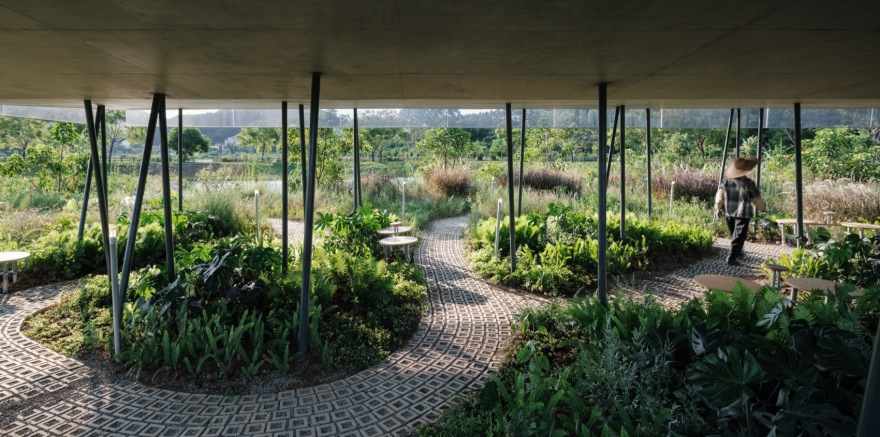
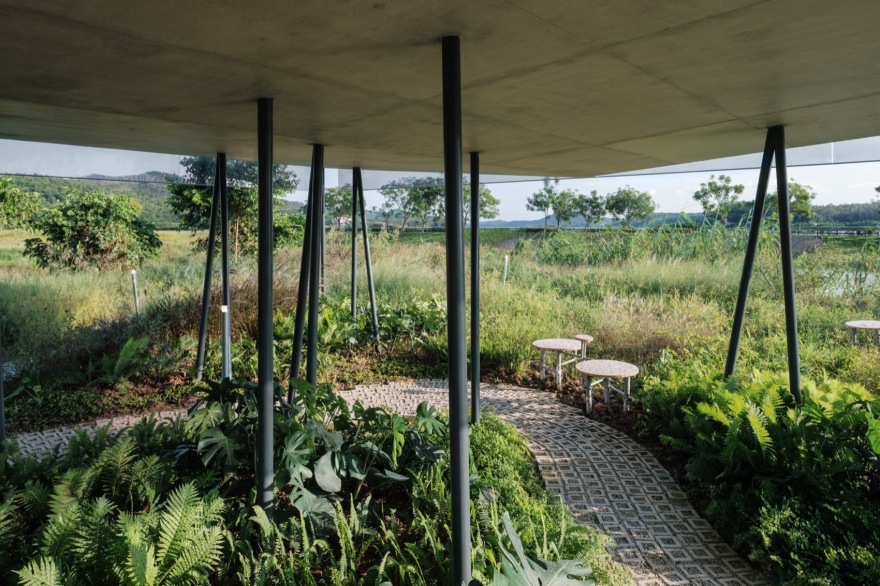
尽管原花房的物质结构未被保留,但“种花”这一行为被延续下来。设计打破了原有育苗花房清晰的室内外界限,使植物从建筑内部自然溢出,延伸至整个岛屿景观之中。由楼板底部的阴生植物逐渐向外过渡,与岛上原有植被融为一体,形成一种松弛的绿意,与建筑本身的精确性形成对比。
Although the physical structure of the greenhouse was not preserved, its function of cultivating flowers was carried forward. The design dissolves the sharp indoor-outdoor boundary of the greenhouse, allowing plants to spill naturally from the pavilion into the surrounding landscape. A gradient unfolds—from shade-tolerant species beneath the slab to the existing vegetation beyond—forming a loose, living “edge” that offsets the geometric precision of the architectural volume.
▼内部空间概览,Interior view© 朱雨蒙(上),陈颢(下)


▼看向室外,Looking out side© 刘国威(上),陈颢(下)


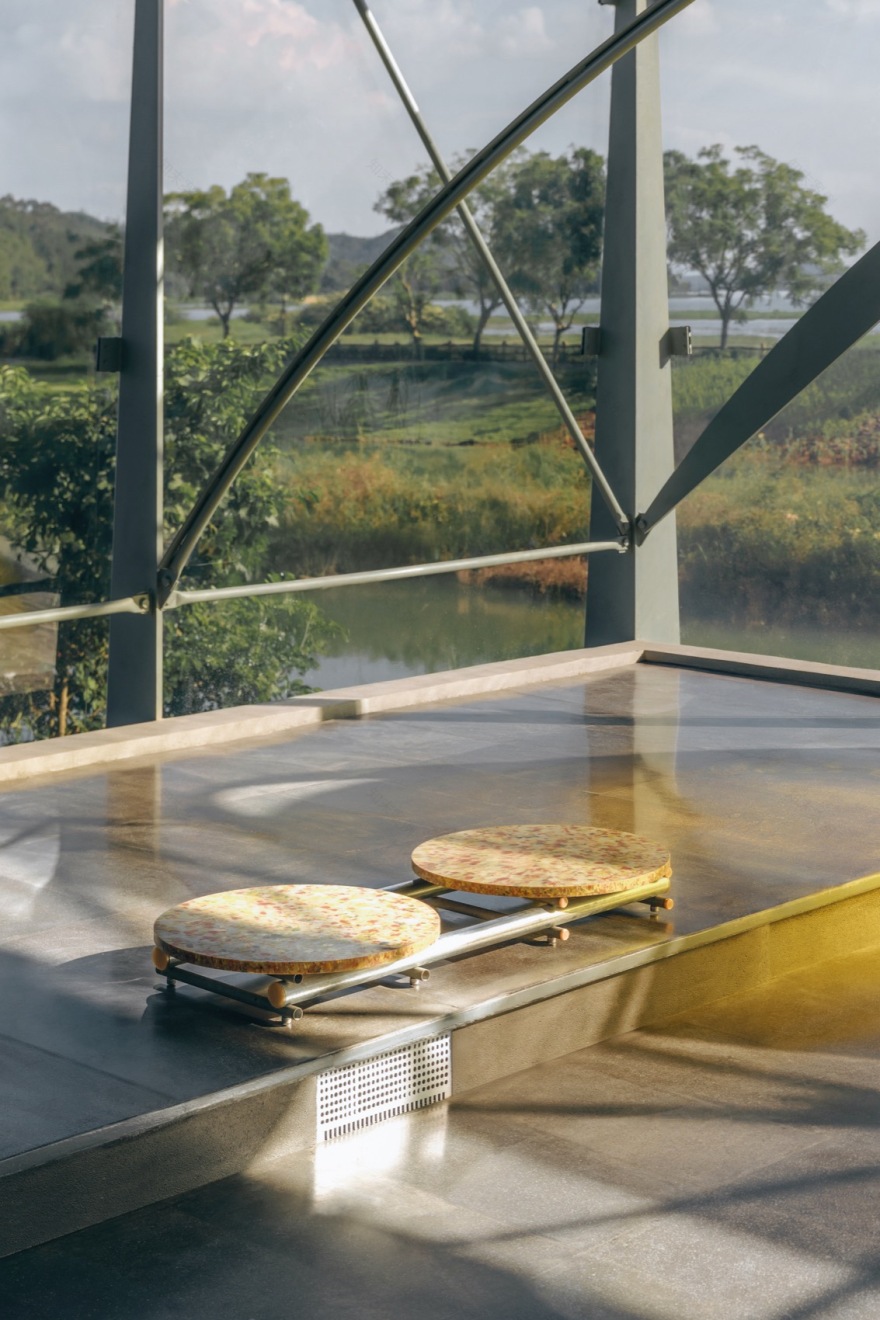
▼座椅近景,Seating area close view© 朱雨蒙


“墨镜”
Sunglasses
为延续原花房的氛围并呼应农业景观,建筑外覆深色耐力板,远观犹如一副墨镜。这种深色外观在白天衬托出月的明亮,而内部则呈现出高透的状态,使复杂的结构层次清晰可辨。不同层级的钢构件由不同颜色区分,进一步强化了视觉层次,辅助了整体的透明性表达。
To evoke the atmosphere of the greenhouse and respond to the site’s agricultural context, the pavilion is clad in dark polycarbonate panels, appearing from afar like a pair of “sunglasses.” This dark skin accentuates the brightness of the moon installation by day, while giving the building a literal transparency that makes its structural layers legible. Steel members are distinguished by color, clarifying the hierarchy of the frame and reinforcing the overall expression of transparency.
▼结构近景,Structure close view© 张准

▼结构近景,Structure close view© 陈颢


材料的半透明性也带来了热工挑战。设计通过被动式通风、遮阳覆盖以及机械的水雾风扇等综合措施,经过可持续顾问的软件模拟和计算,将新的内部空间保持在气温水平。内部舒适度对空气流通的依赖度仍然是高的。
The semi-transparency of the cladding also posed thermal challenges. These were addressed through integrated strategies—passive ventilation, shading, and mechanical mist fans. With simulation and calculation by sustainability consultants, the pavilion achieves an environmental balance with the outdoors, relying primarily on air movement to ensure comfort.
▼夜览,Nightview© 刘国威

▼总平面图,master plan© 郭廖辉工作室

▼底层平面图,ground floor plan© 郭廖辉工作室

▼1楼平面图,first floor plan© 郭廖辉工作室

▼2楼平面图,second floor plan© 郭廖辉工作室

▼夹层平面图,mezzanine plan© 郭廖辉工作室

▼新旧对比图,before and after© 郭廖辉工作室
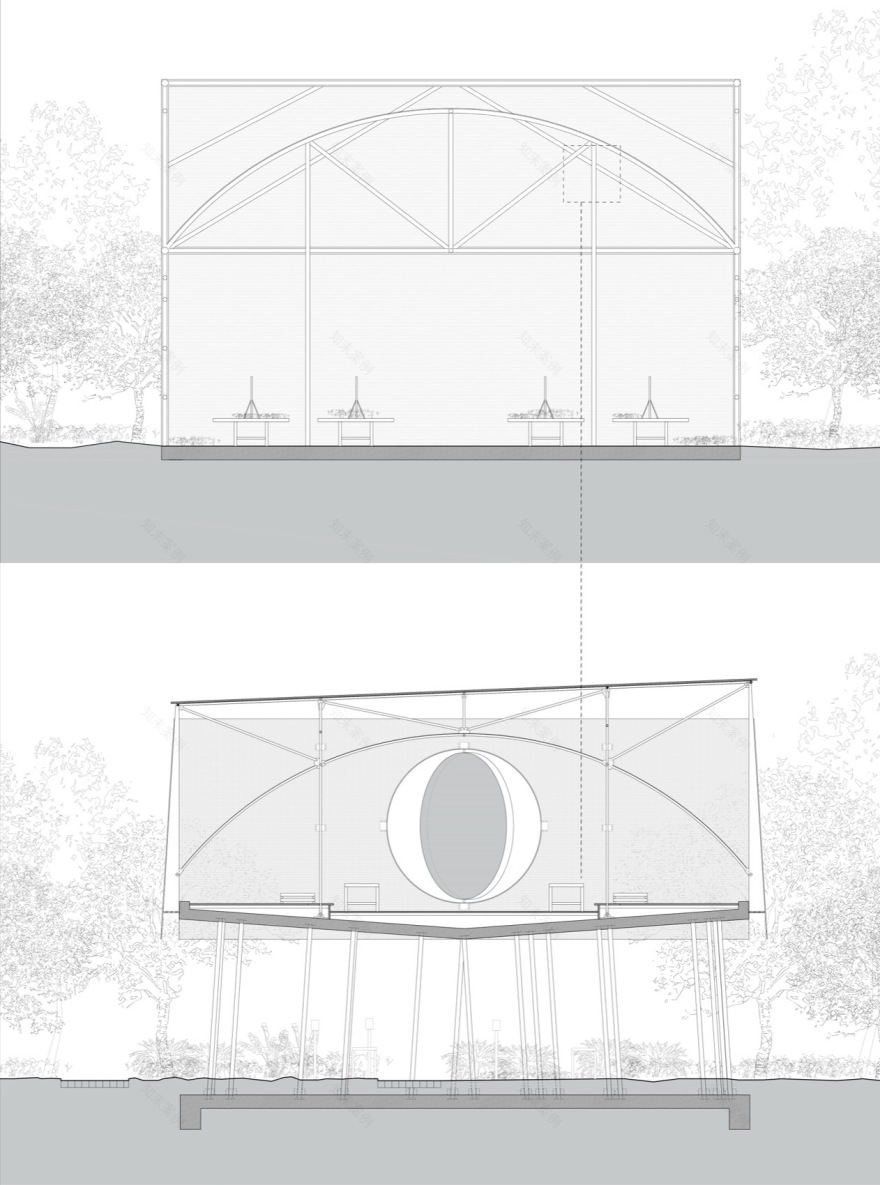
▼立面图,elevation© 郭廖辉工作室


设计单位:郭廖辉工作室
项目名称:明月坞
项目地点:中国广东惠州
项目面积:120平方米
项目年份:2025年
主持建筑师:郭廖辉
项目建筑师:许佩瑶
驻场建筑师:许佩瑶
设计团队:郭廖辉、许佩瑶、王文楷、徐琰钧
合作艺术家:高美琳、许刚
结构设计:张准+和作结构建筑研究所
可持续顾问:李寅建筑设计与可持续咨询
施工方:四川匠人清水劳务有限公司、桂林铭锌会展有限公司
委托方:上海风语筑文化科技股份有限公司
摄影师:陈颢、朱雨蒙、刘国威、张准
Architects: Atelier Guo
Project Name: Moon Pavilion
Location: Huizhou, Guangdong, China
Area: 120 m²
Year: 2025
Principal Architect: Guo Liaohui
Project Architect: Xu Peiyao
Site Architect: Xu Peiyao
Design Team: Guo Liaohui, Xu Peiyao, Wang Wenkai, Xu Yanjun
Artists: Gao Meilin, Xu Gang
Structural Design: Zhang Zhun + AND Office
Sustainability Consultant: Atelier Li Yin (Architectural Design & Sustainability Consulting)
Contractor: Sichuan Jiangren Qingshui Construction Co., Ltd. / Guilin Mingxin Exhibition Co., Ltd.
Client: Shanghai Fengyuzhu Culture & Technology Co., Ltd.
Photographs: Chen Hao, Zhu Yumeng, Liu Guowei, Zhang Zhun




南京喵熊网络科技有限公司 苏ICP备18050492号-4知末 © 2018—2020 . All photos and trademark graphics are copyrighted by their owners.增值电信业务经营许可证(ICP)苏B2-20201444 苏公网安备 32011302321234号
苏公网安备 32011302321234号客服
消息
收藏
下载
最近