

创作上传
VIP
收藏下载
登录 | 注册有礼
查看完整案例

收藏

下载

分享
由包赞巴克事务所(2Portzamparc)设计的中国国家会议中心二期(China National Convention Center Phase II)于近日正式投入使用。作为一座集展览与接待功能于一体的会议中心,国家会议中心二期旨在承办未来的国际会议及国家元首峰会。建筑以轻盈的曲线造型与多孔立面,消解了整体庞大的体量,呈现出群鸟展翅飞翔的意象。
Designed by 2Portzamparc, the China National Convention Center Phase II in Beijing is a major convention facility with exhibition and reception halls to host future international conferences and summits of heads of state. The vast building is characterized by its sweeping curved shape and a facade with multiple openings, a poetic evocation of birds taking flight.
▼项目概览,Overall view© 2Portzamparc, photographer Yumeng Zhu

北京,以中轴为骨,以秩序立势。从元大都奠基之初,北京的中轴线贯穿南北,穿越天安门广场、紫禁城;在奥运之后,这条轴线继续向北延展,串联起鸟巢、水立方、奥林匹克公园及国家会议中心一期,形成“奥运中轴”。于2025年正式开放运营的国家会议中心二期,为这一轴线注入全新活力,它既是一期功能的拓展,也是国家形象的提升。
Beijing is a city defined by its central axis—from the historic spine that begins at the Forbidden City to its Olympic-era northern extension. Along this line, the China National Convention Center emerges as a key point of continuity and renewal. Officially inaugurated in 2025, The China National Convention Center Phase II (hereinafter referred to as CNCC II), marks the northern culmination of this axis and serves as both a functional expansion of Phase I and a symbolic renewal.
▼项目鸟瞰,Bird ‘s-eye view© 2Portzamparc, photographer Yumeng Zhu
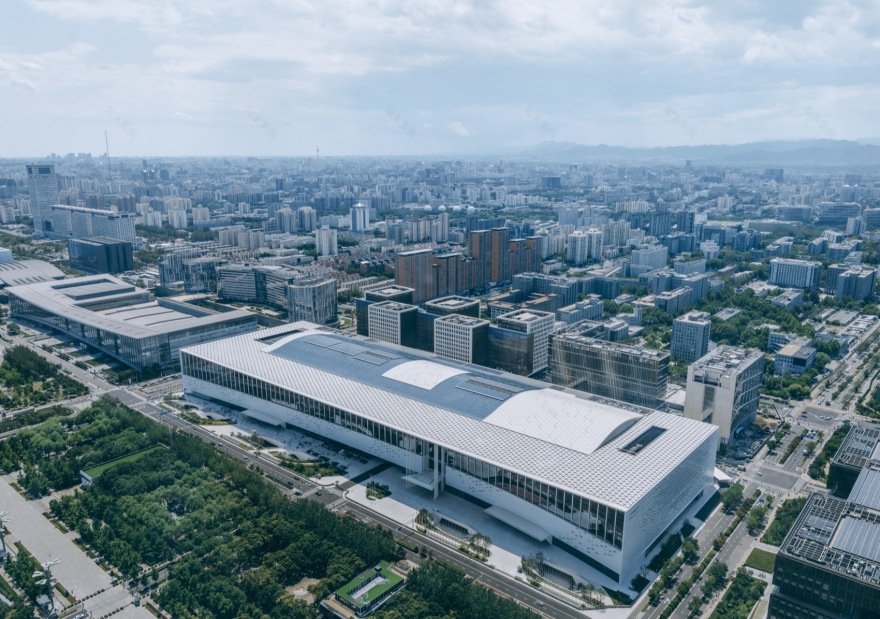
在普利兹克奖得主、包赞巴克事务所创始人克里斯蒂安·德·包赞巴克(Christian de Portzamparc, CEO of 2Portzamparc)眼中,北京与巴黎在布局上巧妙投契。“北京的中轴线从紫禁城出发,穿越9公里抵达国家会议中心,这与巴黎卢浮宫所在的轴线形成一种巧合的呼应:从卢浮宫越至凯旋门,再到拉德芳斯新区同样9公里”——在那里,包赞巴克设计过一座大型体育场。
在这条由多座标志性建筑所构成的轴线上,全新的国家会议中心二期也带来一种全新的空间语言。包赞巴克说:“我希望用内凹的曲线、轻盈的起伏,在这连续的轴线上定义一个开放的聚会场所,一个庄严但不沉重、宏大却不压迫的空间。”这座全新建筑,不仅是中轴线上的一次轻盈转折,也以一种当代建筑语言,展现了一种凝聚开放气度与文化自信的国家姿态。
For Pritzker Prize–winning architect Christian de Portzamparc, the CEO of 2Portzamparc, Beijing and Paris—capitals of two civilizations—are both cities structured by axial order. “Beijing’s axis stretches from the Forbidden City to the CNCC, a distance of nine kilometers, equivalent to the historical axis in Paris that runs from the Louvre through the Arc de Triomphe to La Défense,” he notes—where he and his team also designed a major stadium.
Along this axis, defined by a series of iconic buildings, the new Phase II of the China National Convention Center introduces a completely new architectural language. “I wanted to create an open gathering place along this ceremonial line—solemn but not heavy, monumental yet never oppressive,” he reflects. This new building marks a subtle, graceful shift along the central axis, while expressing, through a contemporary architectural language, a national posture that combines openness with cultural confidence.
▼建筑立面,Facade© 2Portzamparc, photographer Yumeng Zhu

400米方寸之间
400-Meter Volumes
整座国家会议中心二期南北跨度全长约400米,总建筑面积约41.9万平方米,其中地上25.6万平方米,地下16.3万平方米,是事务所迄今在中国乃至全球参与设计的最大单体建筑。国家会议中心二期坐落于奥运中轴线北端,紧邻一期北侧,与之隔街相望。其主建筑为三层会议中心,西侧则布置七座塔楼(超五星级酒店、商务酒店及5A写字楼),通过连桥与会议中心连接,构成完整配套体系。会议中心主体建筑实际横跨两个街区,一条既有城市道路穿行其中,建筑以架空形式跨过,被纳入整体设计中。
首层设有约2万平方米12米净高的大型展厅、约3,000平方米通高26米的“迎宾合影厅”和一座可容纳5,000人、举办国家级仪式活动的约8,000平方米主会场,满足博览会、大型展示与公众活动的需求;二层布置多个大中小型会议室和新闻发布厅。三层最具特色,在大型玻璃穹顶之下,在两座象征东西方的温室庭院之间,峰会厅、午宴厅与宴会厅以单体建筑形式连续排布。地下两层容纳设备机房、地下展厅及约6,000平方米的餐饮商业街区。
The CNCC II spans approximately 400 meters from north to south, with a total floor area of 418,680㎡—256,000㎡ above ground and 162,680㎡ underground—making it one of the largest single-building projects undertaken by 2Portzamparc. Located at the northern end of the Olympic Axis and adjacent to the Phase I building, the CNCC II main building houses a three-story conference center. Overhead bridges connect the main structure to seven supporting buildings on its west side, including a luxury hotel, a business hotel, and Grade-A office spaces. The main building flies over the city road that runs through the site.
The ground floor includes a 20,000㎡ exhibition hall with a 12m high ceiling, a 3,000㎡ photo area with a 26m high ceiling, and an 8,000㎡ main venue accommodating up to 5,000 people. The 2nd floor houses meeting rooms of different sizes and a press conference hall. On the third floor, a vast glazed dome encloses a series of halls—including summit, banquet, and lunch halls—which are arranged between two indoor gardens.
▼手绘草图,hand drawing© 2Portzamparc

屋顶:飞檐向天,庇下迎客
The Roof: Welcoming Flying Eaves
国家会议中心二期的主立面可视作对中国传统“飞檐”的一种当代转化。通过内凹的弧形立面和一个简洁斜面的几何拼接,构成一道横贯南北的屋檐,下方主立面以内凹曲线缓缓收回。屋檐与立面由此形成结构张力,使两端向上轻轻卷翘,凝聚为视觉焦点。它既象征向上与进取,也如一纸徐徐展开的邀请,迎接来客。包赞巴克将飞檐视为中国场所精神性的建筑语言:是庇荫,是欢迎,传达了聚会场所的精神。如他所言:“中国传统建筑中很少有直线。入口的曲线像是遮阳的屋檐,延伸向天穹,是空间的哲学。”
The main volume reinterprets the traditional Chinese flying eave with a contemporary architectural vocabulary. A concave curve meets a clean, slanted plane, forming a continuous eave that sweeps from south to north. Below, the facade recedes in a gentle curve, creating a subtle tension that makes its ends seem to lift skyward, drawing the eye to a single point. This gesture suggests both aspiration and welcome, like a scroll unfurling to reveal an invitation. For Christian de Portzamparc, the flying eave is a language of place: it shades, it invites, it gathers. “In traditional Chinese architecture,” he observes, “straight lines are rare. The curve of the entrance, like a shading eave, rises toward the sky—a philosophy of space.”
▼立面近景,Facade close view© 2Portzamparc, photographer Yumeng Zhu
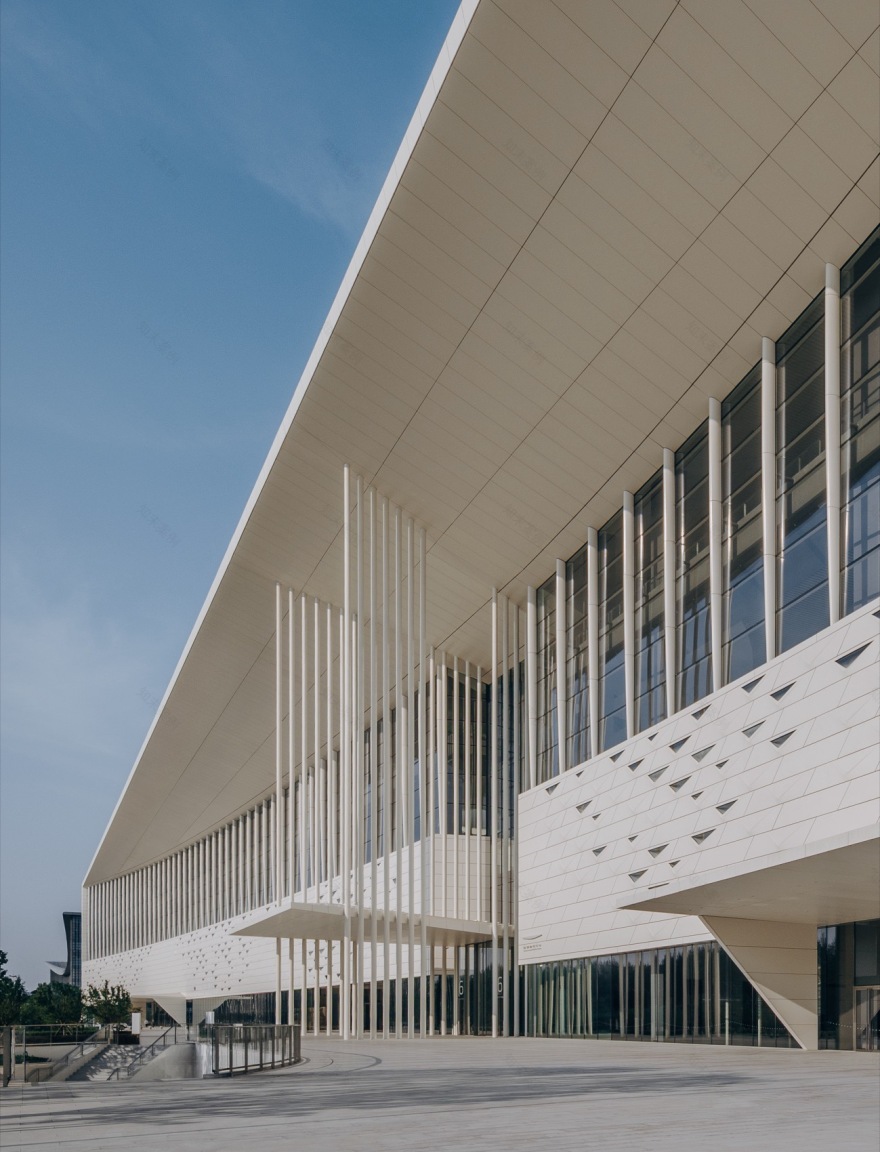

立面:浮雕飞鸟画卷
Facade: Monument of Flying Birds
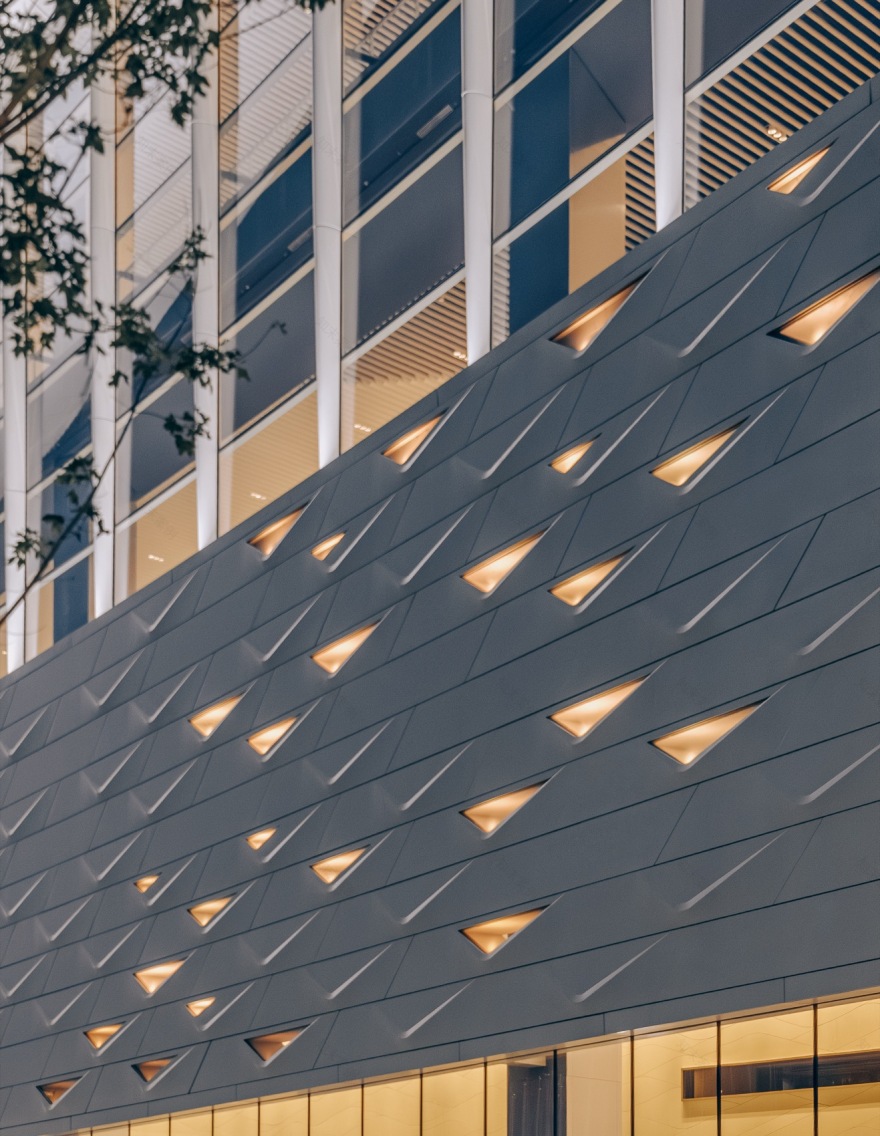
飞檐之下,整个外立面犹如一幅巨大的飞鸟画卷浮雕——东立面由大尺度白色菱形搪瓷钢板构成,每块钢板达7.5 米 × 1.2米。其中,部分钢板开有三种不同尺度的三角异形窗,这些开窗精细排布,既在整体上构成一幅群鸟齐飞意象,也兼顾采光与遮阳。南北立面延续这一设计语言,使用几个不同模数的菱形窗,满足办公区域的采光和通透性。整体幕墙通过参数化设计,在光影交错与虚实对比之间,营造出如自然云雾缭绕般的氛围感。包赞巴克最终选择搪瓷钢板作为主立面材料,因其表面晶润、耐久和自清洁性能良好,不仅满足国家级场馆对耐久性与精度的严苛要求,也呼应了东方审美传统——而搪瓷本身也是富有中国特征与集体记忆的材料。面对整个搪瓷钢板立面的制造、鸟窗三维曲面处理及其运输安装等挑战,设计团队与幕墙顾问紧密协同,在业主的大力支持下,历经反复建模、打样与调试,实现了这道“国家幕墙”。
Beneath the sweeping eave, the facade unfolds into a monumental tableau of birds in flight. On the east side, vast enamel-coated steel panels are pierced with triangular openings, their pattern evoking flocks taking wing while balancing light and shade. On the north and south facades, this motif gradually evolves into diamond-shaped windows to bring daylight and transparency to the offices. The curtain wall, shaped parametrically, shifts between light and shadow, solid and void, like clouds dissolving in mist. Enamel-coated steel was chosen for its crystalline surface, durability, and deep cultural resonance in China.
▼街道测夜览立面,Street night view© 2Portzamparc, photographer Yumeng Zhu

▼立面材质细部,Facade material details© 2Portzamparc, photographer Yumeng Zhu
仪式之门:贵宾入口
VIP Entrance: Ceremonial Gate
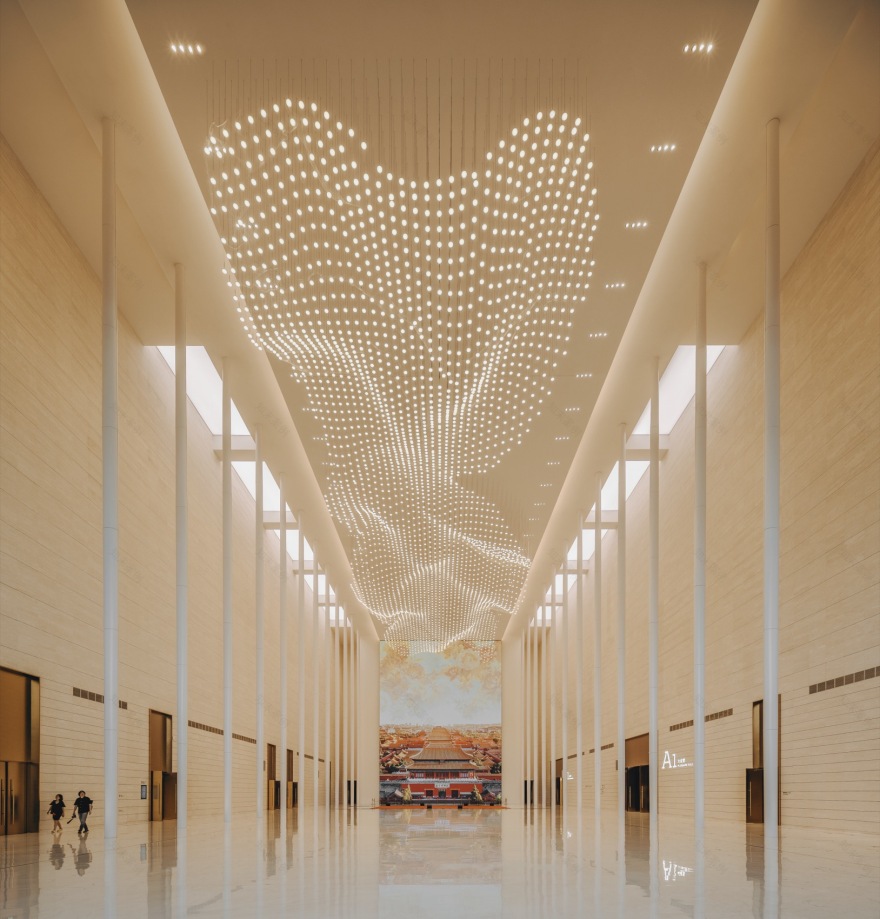
在轻盈通透的东立面之中,特设一道36米通高的VIP入口,如一处被拉开的帷幕。入口处于两道弧形墙交汇之处,两侧各设12根廊柱逐渐向内收敛,引导视线聚焦于中间的通高入口。入口门顶为一座22米大悬挑的雨棚,下方则是3米宽、8.5米高的自动平移门,这是一个对结构极限的挑战,也成就了庄重、内敛、大气的入口空间。进入其中,即为挑高26米的“迎宾合影厅”,26根细长的白色装饰柱分列两侧引向尽头的巨型LED屏幕壁画,吊顶数百组定制水滴状LED灯如飞鸟排布、波光起伏,在天地下铺展出一幅流动的光影序章。
A fissure in the curved facade reveals the monumental VIP entrance, which is framed by a diaphanous colonnade. Above, a cantilevered canopy sweeps 22 meters outward, hovering lightly over a set of 8.5-meter-high automatic sliding doors. The colonnade extends into the 26-meters-high lobby where a constellation of droplet-shaped LEDs drifts overhead and terminates on a dynamic full-height LED display.
▼立面入口处,Entrance© 2Portzamparc, photographer Yumeng Zhu

序厅:开放聚会的场所
Lobbies: Gathering Spaces
在包赞巴克看来,国家会议中心不仅服务于国家级首脑会晤,更是一个世界性、多元性、当代性的聚会场所。因此,建筑三层均以面向龙形水系与奥运中轴线的东立面作为开放序厅,打造出贯通三层、连续通高的宽阔廊道。首层序厅的下半部采用6米高无柱玻璃幕墙,实现极致通透;上半部则为不透明幕墙,结合飞鸟形开窗,令室内光影自然流动;二三层立面为通透玻璃幕墙,椭圆锥形立柱每隔6米有致排列,增强仪式感。序厅的吊顶采用定制格栅系统,吸声和整合设备之余,弧形格栅片也营造出虚实相生的视线层次关系。二三层的序厅天顶通过曲线分割形成如鱼尾相接的美好寓意之形,与二层盘旋而上的悬挑楼梯形成有力的整体。阶梯如展翅飞鸟之势旋升向上,与贯穿建筑始终的“飞鸟”意象呼应。
All three lobby levels open eastward toward the Olympic axis and dragon-shaped water system. On the ground level, a column-free, 6-meter-high glass wall forms the lower portion, while the upper portion features an opaque façade punctuated by bird-shaped windows allowing natural light and shadows to flow into the interior. On the second and third floors, fully glazed curtain walls frame the space, supported by elliptical conical columns that heighten the sense of ceremony, order, and procession. Overhead, ceiling lights and acoustic louvers are arranged in fluid patterns that recall birds in flight.
▼入口接待处,Reception© 2Portzamparc, photographer Yumeng Zhu

▼开敞的室内空间,Open interior space © 2Portzamparc, photographer Yumeng Zhu

▼阶梯状如飞鸟,Stepped like a flying bird © 2Portzamparc, photographer Yumeng Zhu
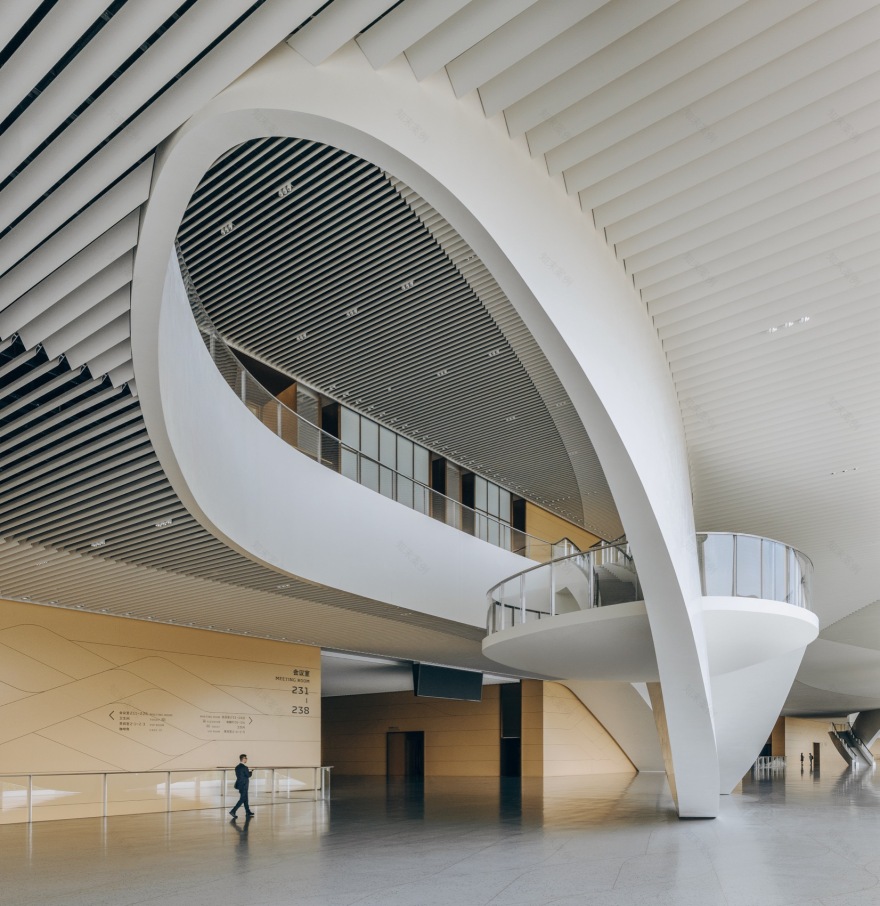

▼电梯间,Elevator lobby © 2Portzamparc, photographer Yumeng Zhu
东西互文的世界花园
Rooftop Gardens: East Meets West
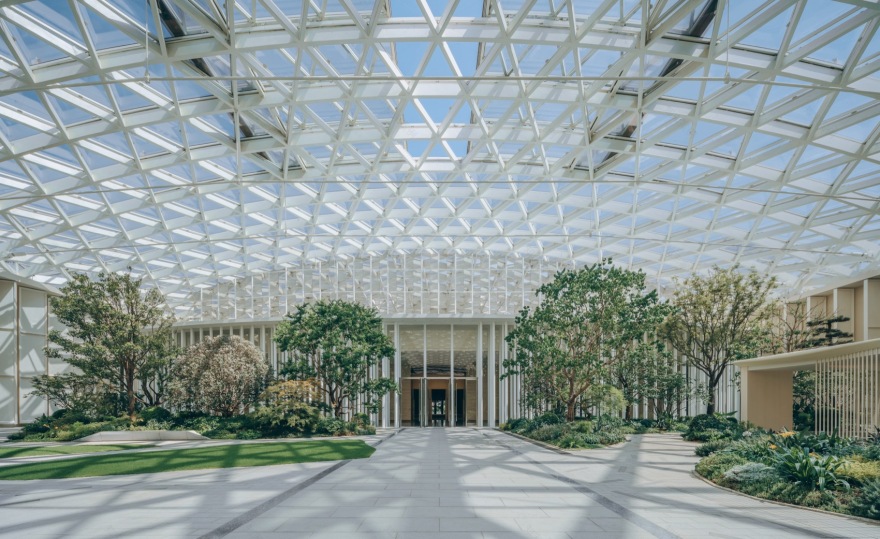
三层,在一个3,000平方米的巨型可开合玻璃穹顶之下,落定两个内置的温室花园——“苏园”(Su Garden)与“西园”(Xi Garden),彼此联袂对应,东西并茂。在设计伊始,包赞巴克事务所便提出“微缩世界花园”的理念,以象征宏大世界的多元共生。其中,“西园”由包赞巴克事务所与合作多年的景观设计师携手打造。在依日照条件布置、耐阴与喜阳植物交错生长的植被之间,数座凉亭穿插其间,似庭园游览中的驻足节点——亭体半开合的曲线廊柱与围合结构确保私密与通透并存。一侧设有取意古戏台的演艺舞台,左右设亭,亦作后台。
On the third floor, beneath a vast operable glass roof, two gardens unfold—Su Garden representing the traditional, Xi Garden reflecting the contemporary—in harmonious dialogue. Conceived as “miniature world gardens,” they embody harmony and diversity. In Xi Garden, sun-seeking and shade-loving plants are interwoven with the sun’s path, punctuated by pavilions whose curving colonnades balance intimacy and openness. A stage recalling traditional Chinese theaters anchors the landscape.
▼温室花园入口处,Entrance of the garden© 2Portzamparc, photographer Yumeng Zhu

▼三层的温室花园,The garden© 2Portzamparc, photographer Yumeng Zhu
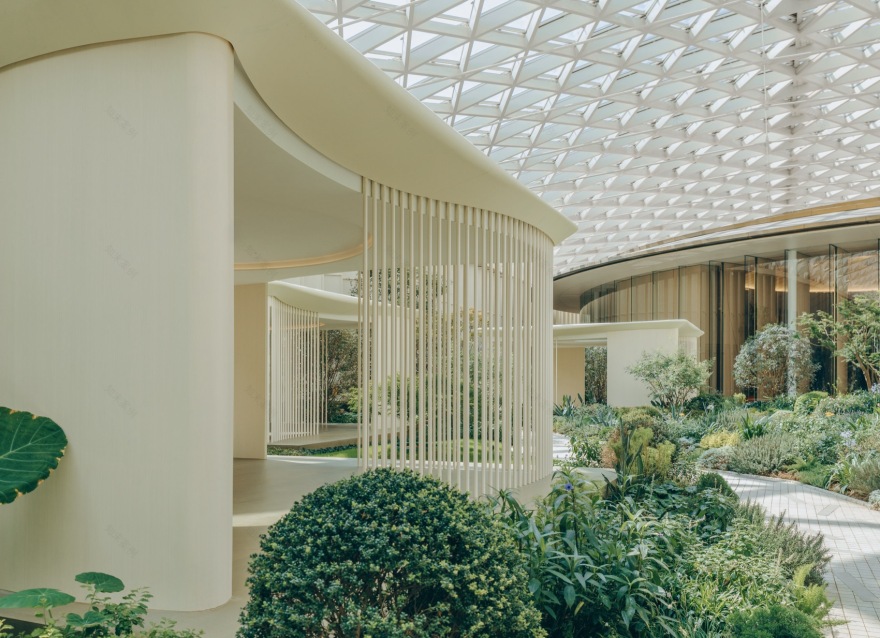
沿西园庭院景观向前,一方净澈水面悄然展开,圆顶午宴厅仿若轻盈悬浮其上。“天圆地方”的东方智慧,以现代设计语汇被呈现。午宴厅采用内外双层围合设计:外层为通高透明玻璃幕墙;内层则为可开合的活动声学隔断。隔断可灵活启闭,不仅提供了灵活的空间使用方式,还具备良好的声学与视觉隔离效果。在两层立面之间,多根立柱有序围合出环廊空间,增强了整体的层次感与仪式感。
Beyond the garden lies a still reflecting pool, upon which the Lunch Hall seems to float, reinterpreting the ancient principle of “round heaven and square earth” in contemporary form. The hall is encircled by an outer glass wall and inner operable partitions that provide flexibility as well as acoustic and visual insulation; between them, a stately colonnade of evenly spaced columns forms a dignified arcade.
▼圆顶午宴厅,Lunch Hall © 2Portzamparc, photographer Yumeng Zhu
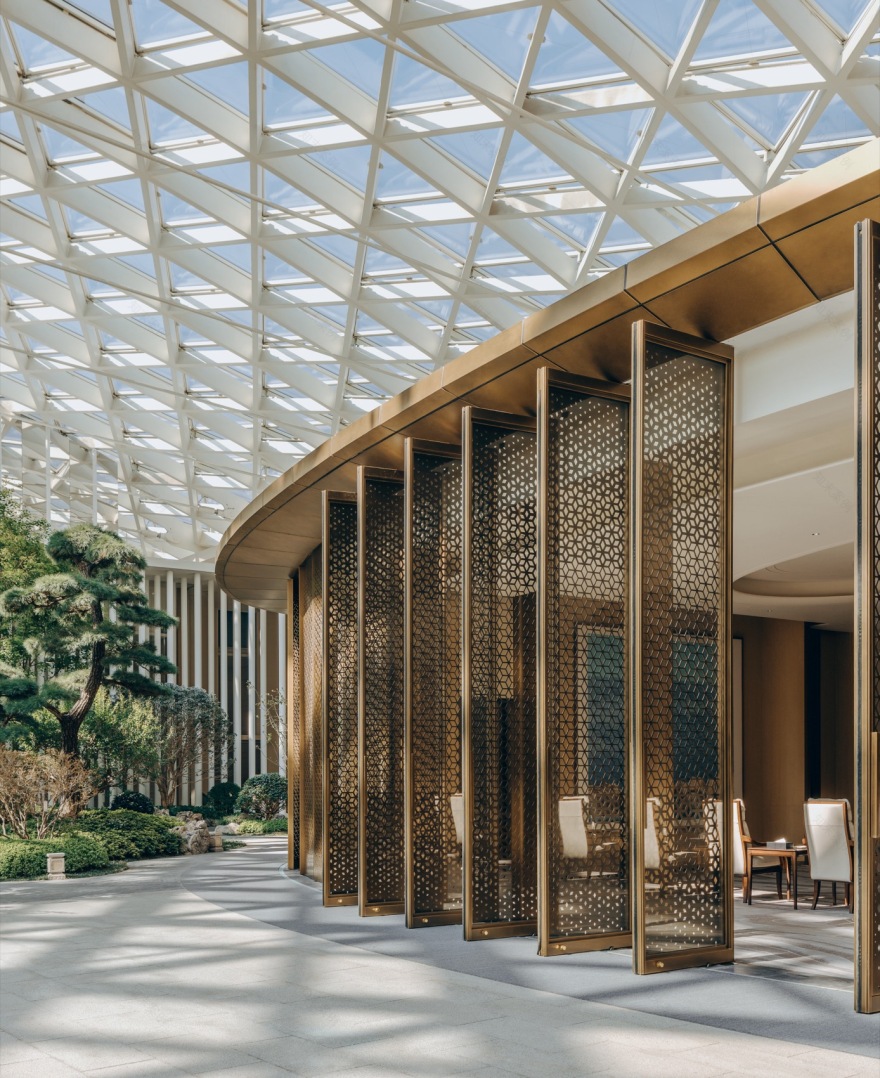
覆于三层之上的玻璃穹顶,更是一项精妙的结构壮举。自承三角网格以曲率成拱,屋顶可向两侧开启,让“苏园”与“西园”真正沐于天光之下。如包赞巴克所言,这道曲面宛如“金属构成的一座石拱”,轻盈而坚定,为其下空间带来最大限度的自由与广阔。
Above it all, the operable glass roof spans an extraordinary distance, its curving triangular grid parting to either side to flood the gardens with light. Portzamparc calls it “a stone arch rendered in metal”—light yet resolute—granting the spaces below a profound sense of openness and freedom.
▼环廊空间,Bird ‘s-eye view© 2Portzamparc, photographer Yumeng Zhu

结语
Conclusion
国家会议中心二期,是一种新的文明姿态的显现——它向城市致意,向历史致敬,向世界发出邀请。如包赞巴克对这一场所的理解,这不仅是一座现代功能性建筑,也是文明交流的集体容器,是聚合开放精神与文化品格的全新起点。
The China National Convention Center Phase II embodies a new civic posture—saluting the city, honoring history, and welcoming the world. In Christian de Portzamparc’s vision, it is more than a functional landmark: it is a vessel for cultural exchange, a point of departure where openness of spirit meets the depth of tradition.
▼温室花园夜览,Bird ‘s-eye view© 2Portzamparc, photographer Yumeng Zhu

项目名称:国家会议中心二期
客户:北京北辰会展投资有限公司
项目类型:会展、文化、多功能综合体
建筑设计:包赞巴克事务所(2Portzamparc)
首席建筑师:克里斯蒂安·德·包赞巴克(Christian de Portzamparc)
设计副总监:雷克斯·邦巴尔代利(Rex Bombardelli)
项目总监:许桦
项目经理:乔蕾
幕墙项目经理: Khatir Madjidi
施工项目经理: 牛丽江
建设用地面积:92,626㎡
主体建筑总面积:418,680 m² 包括:256,000 ㎡(地上) / 162,680 ㎡(地下)
合作设计方:北京市建筑设计研究院有限公司
幕墙顾问:法国TESS; RFR上海
景观设计:弗洛伦思·梅歇尔(Florence Mercier)
声学顾问:德国BBM
结构及防火设计顾问(方案阶段):ARUP
机电顾问(方案阶段):WSP
泛光及景观照明设计:栋梁国际照明设计中心
室内照明设计:日本Lighting Planners Associates Inc.
导视系统:原设计研究所(原研哉)
摄影:朱雨蒙
Project Name: China National Convention Center Phase II
Client: Beijing North Star Convention and Exhibition Investment Co.;LTD
Project Type: Exhibition, Cultural, and Mixed-Use Complex
Architect: 2Portzamparc
Principal Architect: Christian de Portzamparc
Associate Design Director: Rex Bombardelli
Project Director: Léa Xu
Project Manager: Lei Qiao
Facade Project Manager: Khatir Madjidi
Construction Project manager: Lijiang Niu
Site Area: 92,626 m²
Gross Floor Area: 418,680 m² including 256,000 m² (above ground) / 162,680 m² (underground)
Cooperative Design Institute: Beijing Institute of Architectural Design(Group) Co.,Ltd (BIAD)
Facade Consultant: TESS (France); RFR Shanghai
Landscape Design Consultant: Florence Mercier Paysagiste(France)
Acoustic & AV design Consultant: BBM (Germany)
Structural & Fire Safety Consultant (SD Stage): ARUP
MEP Consultant (SD Stage): WSP
Lighting Consultant for facade and landscape: Toryo International Lighting Design Center
Lighting Consultant for Interior Space: Lighting Planners Associates Inc. (Japan)
Signage & Wayfinding: Hara Design Institute
Photography: Zhu Yumeng
南京喵熊网络科技有限公司 苏ICP备18050492号-4知末 © 2018—2020 . All photos and trademark graphics are copyrighted by their owners.增值电信业务经营许可证(ICP)苏B2-20201444 苏公网安备 32011302321234号
苏公网安备 32011302321234号客服
消息
收藏
下载
最近