

创作上传
VIP
收藏下载
登录 | 注册有礼
查看完整案例

收藏

下载

分享

翻译
Architects:Ahmed and Rashid Bin Shabib
Year:2025
Photographs:WeExhibit,Anthony Fleyhan
Category:Pavilion
Curators:Ahmed and Rashid Bin Shabib
Participants & Collaborators:Rashid bin Shabib, Ahmed bin Shabib, Amna Abulhoul, Vladimir Yavachev, Yusaku Imamura, Jonathan Shannon, Davide De Carlo, Valentina Chiesi, Grazia Sechi, Mohammed Alruways, Abdullah Al Kenani, Dhai Dubai, Expo City
City:Venezia
Country:Italy

Reinterpreting Vernacular Gulf Architecture as a Living Scaffold for the Future – The Majlis & The Manama (Wind Catchers) pavilion at the 19th International Architecture Exhibition in Venice presents a powerful reimagining of Gulf vernacular intelligence. Anchored in personal memory and regional tradition, the pavilion draws from the architectural archetypes of the Majlis and Manama to propose a contemporary structure that breathes, hosts, and remembers. Supported by Expo City Dubai.

At its core, the pavilion serves as a majlis for Venice, a space of both scheduled and unscheduled ritual, where visitors are invited to sit, speak, reflect, and reconnect. The architecture is not simply symbolic; it is spatial, thermal, and social. Constructed as a lightweight, elevated, and porous structure, it channels the passive cooling strategies of the Barjeel (wind tower), filtered through fabric panels and soaked sails to invite air and people alike.

Vernacular Architecture as Environmental Intelligence – The pavilion's design is rooted in the indigenous architectural wisdom of the Gulf, particularly the Manama: a seasonal, palm-frond-roofed shelter used to endure Dubai's extreme summer heat. Elevated and wrapped in fabric, the Manama embodies adaptive environmental design, cooling through windcatchers, absorbing humidity, and shaping communal experience through porosity and shade. In tandem, the Barjeel, long revered for its climatic responsiveness, is more than an environmental device. It is a cultural and conceptual anchor that choreographs social life. In the Gulf, its architectural presence structured time, ritual, and community activity, even under inhospitable summer heat.
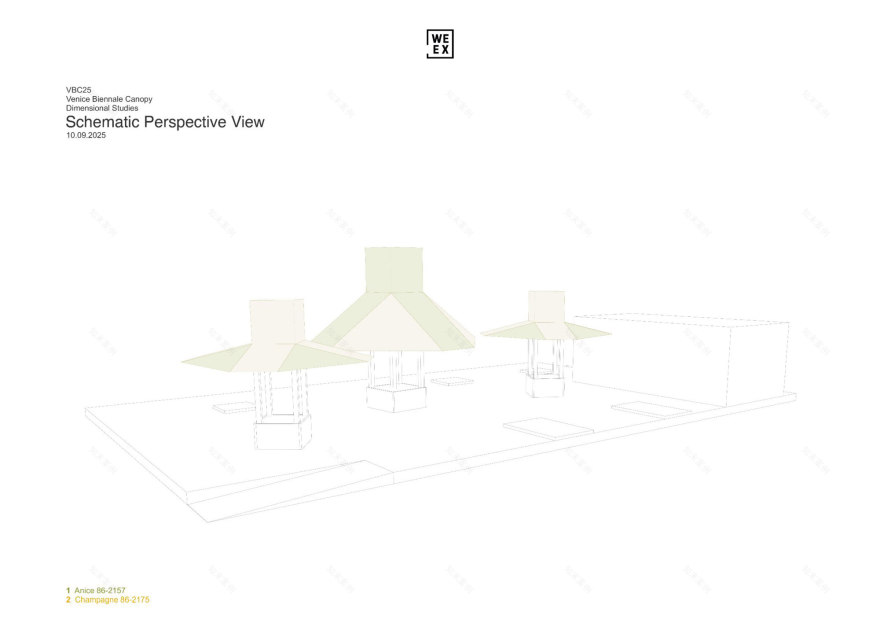

A Pavilion of Living Rituals – The pavilion is informed by generational narratives: a grandmother's memory of Shindigha, a family photograph in a historic Manama, and the ceremonial use of the Majlis during weddings. These spaces were never sealed off; they breathed with the climate, invited conversation, and framed community. In Dubai's past, the act of providing shade was more than a climatic response; it was an act of generosity. The Majlis stands not as a monument, but as a paradigm of communal architecture, maintaining its cultural and social relevance by adapting to contemporary forms. It continues to function as a scaffold for kinship, dialogue, and hospitality.

A Contemporary Ritual for Venice – The Venice installation offers a contemporary reinterpretation of this legacy: a hybrid pavilion that merges historical ingenuity with modern fabrication, proposing a renewed relationship with nature through architecture. Drawing from past material and emotional intelligence, it curates ritual in real time, both spatially and symbolically.

What We Bring to Venice – What Majlis & The Manama brings to Venice is not only a physical installation, but a philosophy of living architecture: one that preserves memory, embodies social values, and performs climate with grace. This is not a retreat into nostalgia; it is a forward-looking act of cultural continuity.
This project continues the exploration of architecture in relation to the region's ecology, as previously presented with Rizzoli in the book Anatomy of Sabkhas, part of the UAE Pavilion, winner of the Golden Lion Award in 2021.

Project gallery




南京喵熊网络科技有限公司 苏ICP备18050492号-4知末 © 2018—2020 . All photos and trademark graphics are copyrighted by their owners.增值电信业务经营许可证(ICP)苏B2-20201444 苏公网安备 32011302321234号
苏公网安备 32011302321234号客服
消息
收藏
下载
最近