

创作上传
VIP
收藏下载
登录 | 注册有礼
查看完整案例

收藏

下载

分享
这座项目是印度IT巨头Wipro在海得拉巴的新办公园区,它将传统的庭院类型与现代高层建筑相结合,打造了一个功能性强、协作性好、健康的工作环境,供Wipro的11,000名员工使用。该项目位于38英亩的土地上,是位于海得拉巴金融区和GachibowliIT中心附近的Gopanpally地区的101英亩总体规划的一部分。作为总体规划第二阶段的一部分,新园区引入了四座充满活力的塔楼,并与三座现有建筑相得益彰。这个高效能、节能的园区超越了常规标准,并获得了IGBC铂金认证,同时促进了社区和员工之间的联系。
Indian IT giant Wipro’s new office campus in Hyderabad adapts the vernacular courtyard typology to the modern high-rise, creating a functional, collaborative, and healthy workplace for the company’s 11,000 employees. The 38-acre site is part of a 101-acre master plan located in Gopanpally, a neighbourhood proximate to the city’s IT hubs of the Financial District and Gachibowli. Developed as part of the second phase of the master plan, the new campus introduces four vibrant towers that complement three existing buildings. The high-performing, energy-efficient campus has exceeded conventional benchmarks and earned an IGBC Platinum rating while fostering a sense of community and connection.
▼办公园区概览,overview of the office campus © Paul Raftery


设计的两个主要目标是:一是应对海得拉巴的热带气候,二是优化近100万平方英尺的办公空间的地面覆盖率。通过分析该地区的降水模式和地质条件,确定了一个15英亩的低洼自然含水层。设计过程中,采用了多个版本的建筑形态,结合庭院规划和不同密度与高度的建筑体量,并与太阳辐射、风向和日照自主性等因素进行了重叠分析。最终,微型庭院类型被确定为最有效的方案,它可以最大限度地减少户外空间的太阳辐射,同时优化风流和日照。
▼概念生成,concept generation © Morphogenesis

The brief focused on two key objectives: designing a campus that responds to Hyderabad’s tropical climate and optimising ground coverage for nearly 1 million sq. ft. of office space. A 15-acre low-lying natural aquifer was identified by analysing the region’s rainfall patterns and geology. Multiple iterations were developed for the built form using courtyard planning and volumes of varying density and height. They were then overlapped with studies of solar radiation, wind movement, and daylight autonomy. The micro-courtyard typology emerged as the most effective, minimising solar radiation in outdoor spaces and optimising wind movement and daylight.
▼建筑外观,exterior of the building © Paul Raftery


设计包括四座塔楼,塔楼从一个平台上升,平台内围绕着多个庭院。平台内包含了关键的配套设施,包括餐饮区、娱乐空间、图书馆和健身房,所有这些空间通过遮阳的步行街连接起来。设计的重点是打造一个多功能的迎接广场和社交中心,以仅为常规成本的10%完成。平台内包含餐饮区、图书馆、健身房等关键设施,并设有多个休闲区域,通过步行街与大自然互动,创造了一个开放的氛围。
The design features four towers rising from a podium which encloses multiple courtyards. The podium houses key amenities, including a food court, recreational spaces, a library, and a gym, all connected via shaded pedestrian streets. It is designed as a multi-functional arrival plaza and social hub, achieved at just 10% of conventional costs. It houses key amenities, including a food court, library, gym, and pockets for leisure, connected via shaded pedestrian streets, encouraging interaction with nature in an open atmosphere.
▼塔楼从一个平台上升,towers rising from a podium © Paul Raftery
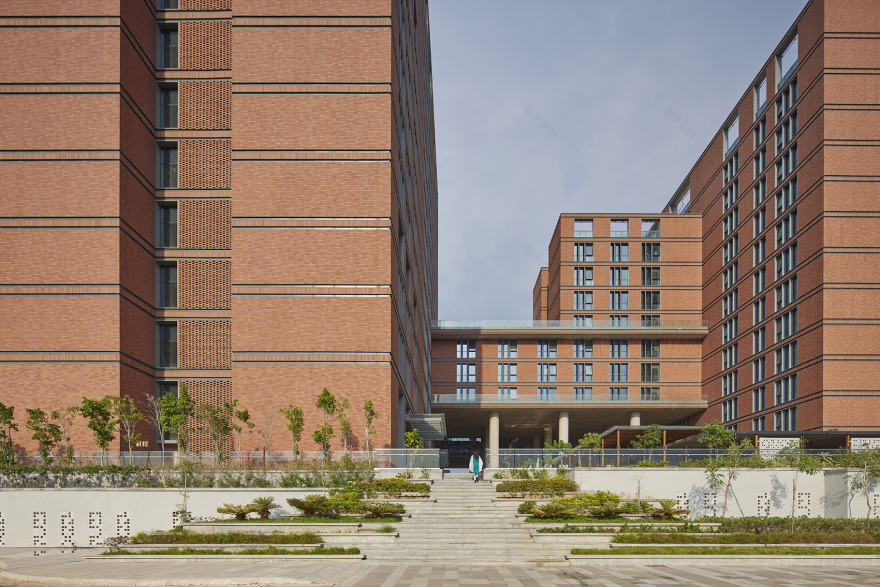
▼围绕着多个庭院展开,It unfolds around multiple courtyards © Paul Raftery

塔楼的朝向为南北向,东西立面向主导风向开放,以实现自然通风。塔楼的高度逐渐递增,从9到14层不等,旨在缓解整体规模,同时最大化自我遮阳和空气流动。建筑体量的错落布局还引入了平台上的露台,作为工作空间的延伸,将室内员工与户外环境连接。
The towers are oriented north-south, opening up the east-west facades to prevailing winds for natural ventilation. The staggered building heights—9 to 14 floors—temper the overall scale while maximising self-shading and air movement. The massing also introduces terraces that function as extensions to the workspaces, connecting occupants to the outdoors.
▼实现自然通风的塔楼中庭,A tower atrium with natural ventilation © Paul Raftery
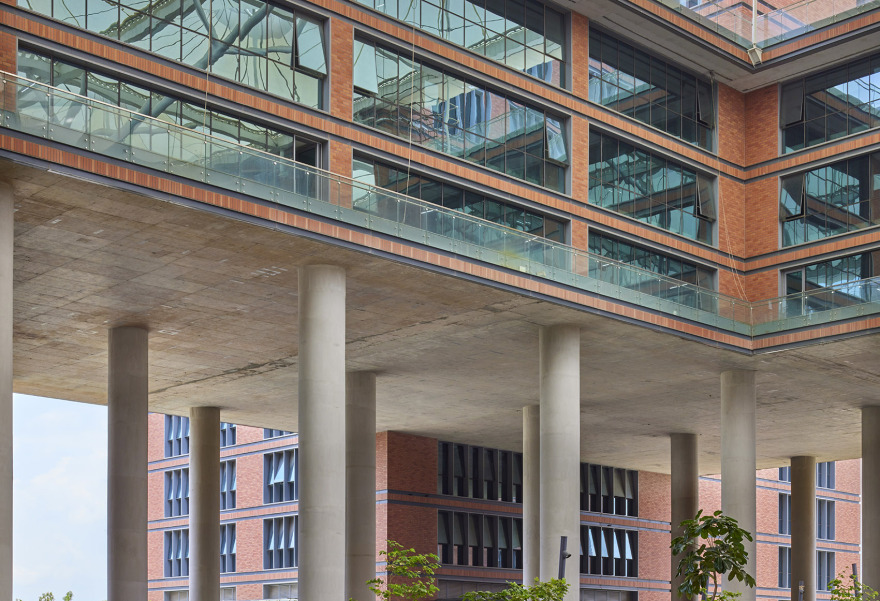
▼抬高的平台,elevated terrace © Paul Raftery

塔楼之间通过多个楼层进行连接,形成了通往平台的大门,平台通过张拉膜遮阳蓬进一步遮蔽。设计参考了传统的水滨建筑形式,如印度古代的baolis和ghats,以促进蒸发冷却并降低周围环境温度。园区入口处的水景灵感来源于海得拉巴中世纪Nizami宫殿的华丽喷泉,旨在为整个园区提供被动冷却并提高热舒适度。
The towers are connected on multiple floors, creating grand gateways to the podium, which is further shaded by tensile canopies. Traditional waterfront structures like baolis and ghats have been referenced as an experimental element within the terraced landscape to facilitate evaporative cooling and reduce ambient temperatures. Water features at the pedestrian entrance, inspired by the ornate fountains of Hyderabad’s mediaeval Nizami palaces, contribute to passive cooling and enhance thermal comfort throughout the campus.
▼平台通过张拉膜遮阳蓬进一步遮蔽,further shaded by tensile canopies © Paul Raftery

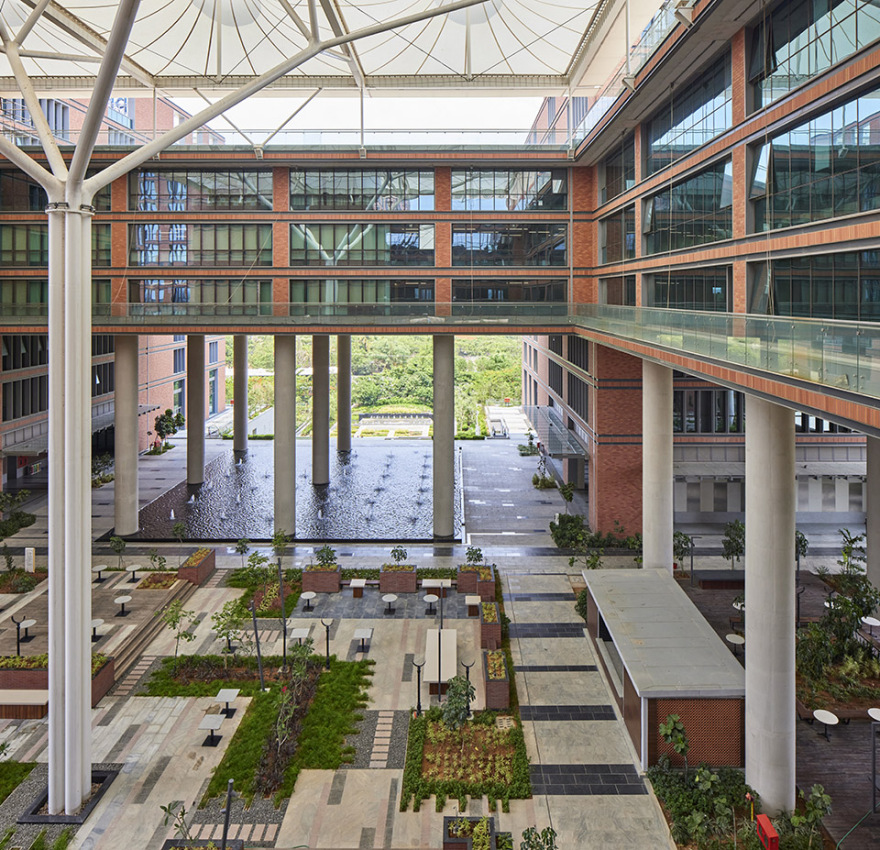
被动策略包括在热干季节采用蒸发冷却技术,在潮湿季节通过利用东南风进行生理冷却。立面的设计最大限度地减少了热增益,同时优化了自然光的进入。墙体与窗户的比例为70:30,结合裸露砖墙空腔系统,提升了保温性能,降低了热负荷。立面采用了海得拉巴市场传统的土色陶砖,具备低U值,从而通过改善保温性并调节室内温度,减少能耗。
▼立面细部,facade detail © Morphogenesis

Passive strategies include evaporative cooling during hot-dry months and physiological cooling during humid periods by capitalising on east-west winds. The facade design minimises heat gain while optimising daylight ingress. A wall to window ratio of 70:30, along with an exposed brick cavity system, improves insulation while reducing thermal load. Taking a cue from the old-school construction of Hyderabadi markets, the facade is clad in earth-hued clay bricks with low U-values, lowering energy consumption by improving insulation and regulating indoor temperatures.
▼立面采用当地传统的土色陶砖,facade is clad in traditional earth-hued clay brick © Paul Raftery

楼层板设计具有高度的灵活性,采用模块化布局,最大限度地提升了空间的适应性。设计的窄幅楼板使日光能深入到工作站,减少了对人工照明的依赖。工作台垂直排列,减少了眩光,确保了视觉舒适。中心通道核心优化了人员流动,允许在两侧、三侧或四侧灵活配置工作空间。
The floor plates are designed for adaptability, featuring a modular layout that maximizes flexibility. Their narrow width enables daylight penetration deep into workstations and reduces dependence on artificial lighting. Work desks are arranged perpendicular to the glazing to minimise glare while ensuring visual comfort. A central circulation core optimises movement, allowing flexible workspace configurations on two, three, or four sides.
▼中央平台,central platform © Paul Raftery

水资源节约措施包括减少70%的水耗。园区收集100%的屋顶雨水,并通过集成的排水网络、渗透坑和多个收集池引导地面径流。此外,园区还通过STP-MBR系统回收100%的灰水,并使用高效的磁浮冷却机和可变主泵系统进一步优化能源使用。500,000平方英尺的地板空气分布系统与基于物联网的GECC平台边缘设备相连接,能够实时监控建筑的能效表现。先进的计算流体动力学(CFD)仿真技术引导空气流动设计,以最大化对流通风和热舒适性。辐射冷却、地板系统和吊顶风扇结合被动和主动策略,确保能效平衡。园区的能效性能指数(EPI)为65 kWh/m²/year,比常规绿色建筑低27%。
▼气候策略,climate strategy © Morphogenesis

Water conservation measures include a 70% reduction in water draw. The campus harvests 100% of roof rainwater and channels surface runoff through an integrated network of drains, percolation pits, and multiple harvesting ponds. Additionally, it recycles 100% of its greywater through an STP-MBR system and employs highly efficient magnetic bearing chillers with variable primary pumping systems to further optimise energy use. A 0.5 million sq. ft. underfloor air distribution system is integrated with IoT-enabled GECC platform edge devices to enable real-time monitoring of the building’s energy performance. Advanced computational fluid dynamics (CFD) simulations guide the airflow design to maximise cross-ventilation and thermal comfort. Radiant cooling, underfloor systems, and ceiling fans ensure a balance of passive and active strategies to minimise energy use. The campus achieves an energy performance index (EPI) of 65 kWh/m²/year, consuming 27% less energy than conventional green buildings.
▼傍晚时分,building at dusk © Paul Raftery
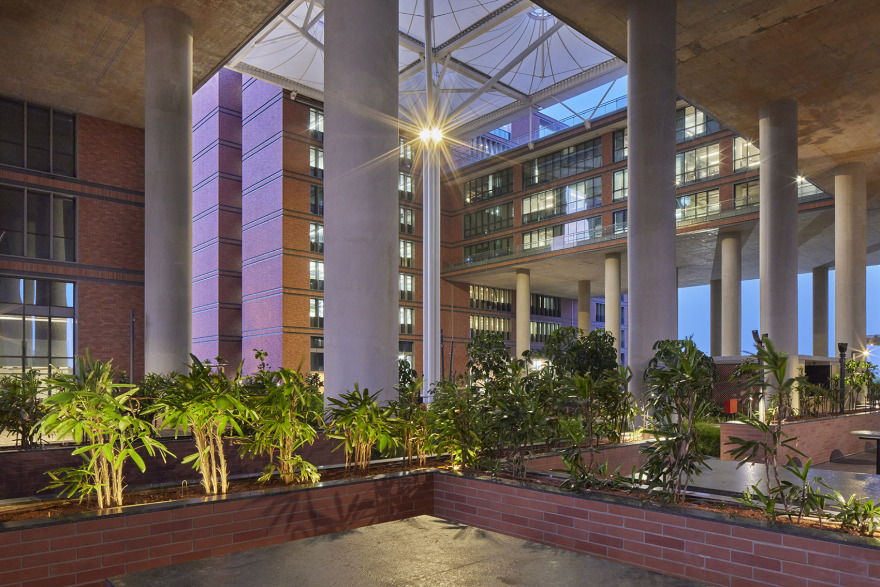

Wipro办公园区通过结合传统的气候生物学原理与现代建筑方法,展示了可持续的办公环境。该项目不仅注重能效、环境和谐与员工福祉,还为未来地区的工作场所设定了一个标杆。
The Wipro office campus exemplifies a sustainable workplace by balancing traditional bioclimatic principles with contemporary construction methodologies. Designed for energy efficiency, environmental harmony, and occupant well-being, it represents the vision and values of one of India’s leading multinational corporations—creating a benchmark for future workplaces in the region.
▼场地平面,site plan © Morphogenesis

▼一层平面,ground floor plan © Morphogenesis

▼五层平面,fifth floor plan © Morphogenesis

▼六层平面,sixth floor plan © Morphogenesis
▼立面,elevation © Morphogenesis

▼剖面,section © Morphogenesis

Project Name:Campus for Wipro
Typology:Commercial Campus
Location:Hyderabad
Status: Built
Client: Wipro Ltd.
Built-up Area: 16,35,725 sq. ft.
Site area: 37.91 Acres
Climate: Composite


南京喵熊网络科技有限公司 苏ICP备18050492号-4知末 © 2018—2020 . All photos and trademark graphics are copyrighted by their owners.增值电信业务经营许可证(ICP)苏B2-20201444 苏公网安备 32011302321234号
苏公网安备 32011302321234号客服
消息
收藏
下载
最近