

创作上传
VIP
收藏下载
登录 | 注册有礼
查看完整案例

收藏

下载

分享
雨舍的设计始于一场雨。海南的雨季,雨总是来得毫无预兆,停得也同样仓促。那天骤雨停歇,空气中还弥漫着潮湿的凉意,我们攀上场地中央的沙土丘,脚底的沙粒沾着水汽,软绵绵地陷落,四周的林木和山谷在雨后忽然现出清晰的轮廓。雾气低垂,像一层薄薄的纱幕,远处的山峰一半隐没在云层之中。那一瞬间,整个场地的层次与边界被清晰地揭示出来:哪一段地势会被淹没,哪一处地形在雨后才会显现,哪一条路径因为雨水的冲刷而蜿蜒可见。自然在短暂的开阖之间,将一种潜藏的秩序悄然呈现。我们于是决定,把这份转瞬即逝的可见性凝固下来,把建筑整体抬升五米,以此回应那条“时节—气候—地形”的隐秘分界。这不再是简单的几何操作,而是一次与时间的契约。建筑要在这里学会顺应和等待,懂得何时退隐,何时显露,何时聚拢人群,又何时让自然独自陈述。
The design of the Rain House began with a downpour. In Hainan’s rainy season, the rain always arrives without warning and ceases just as abruptly. On that day, as a sudden shower ended, a damp chill still filled the air. We climbed the sandy hill in the center of the site; the sand beneath our feet, moist with vapor, softly gave way. The surrounding forests and valleys, washed by the rain, suddenly emerged with sharp clarity. A low-hanging mist, like a thin veil of gauze, half-shrouded the distant mountain peaks. In that instant, the layers and boundaries of the entire site were clearly revealed: which areas would be submerged, which landforms would only appear after the rain, and which paths were carved into view by the runoff. In a brief moment of opening and closing, nature quietly unveiled a hidden order. We decided then to solidify this fleeting visibility, to elevate the entire structure by five meters in response to that hidden boundary line of “season-climate-topography.” This was no longer a simple geometric operation, but a pact with time. Here, the building would have to learn to adapt and to wait, to know when to retreat, when to reveal itself, when to gather people, and when to let nature speak for itself.
▼建筑被群山环绕,Surrounding context© 王宁

▼顶视,Top view© 王宁

海南的气候,粗犷而直白,让这种契约显得必不可少。这里每年台风呼啸而来,阵风如野兽般撕扯屋檐,暴雨倾盆而下,天地间一片混沌。面对这样的环境,用混凝土来建造几乎是唯一的答案。它并非源于某种形式的执着,而是一种对生存条件的回应,在每年的风暴季节,只有混凝土的厚重才能保证建筑的整体稳定,不至于在狂风中碎裂飘零。在这种气候逻辑下,宽大而深远的屋檐也成了必然。大雨和暴雨来临时,雨水被风卷裹,斜刺而来,屋檐必须伸得更远,活动空间必须内退几分,才能避开那溅起的湿意。这是一种人与气候反复协商而出的形式:屋檐下的庇护,不只是避雨,它更是生活在风雨中的延续。于是,混凝土与大屋檐的基本材料与逻辑,构成了雨舍展开建筑叙事的基础。
The climate of Hainan, raw and direct, makes such a pact essential. Every year, typhoons howl through, with gusts that tear at the eaves like wild beasts and torrential downpours that plunge the world into chaos. Faced with such an environment, building with concrete is almost the only answer. This choice does not stem from a formalistic obsession but is a response to the conditions of survival. During the annual storm season, only the mass of concrete can ensure the building’s structural integrity, preventing it from shattering and scattering in the gale-force winds. Following this climatic logic, wide and deep eaves also became a necessity. During heavy downpours, rain is swept sideways by the wind, and the eaves must extend far out, with living spaces recessed, to shield inhabitants from the splashing moisture. This is a form born from repeated negotiation between humans and the climate: the shelter under the eaves is not just for avoiding rain; it is a continuation of life within the wind and rain. Thus, the fundamental materials and logic of concrete and large eaves form the foundation upon which the architectural narrative of the Rain House unfolds.
▼建筑概览,Exterior view© 王宁
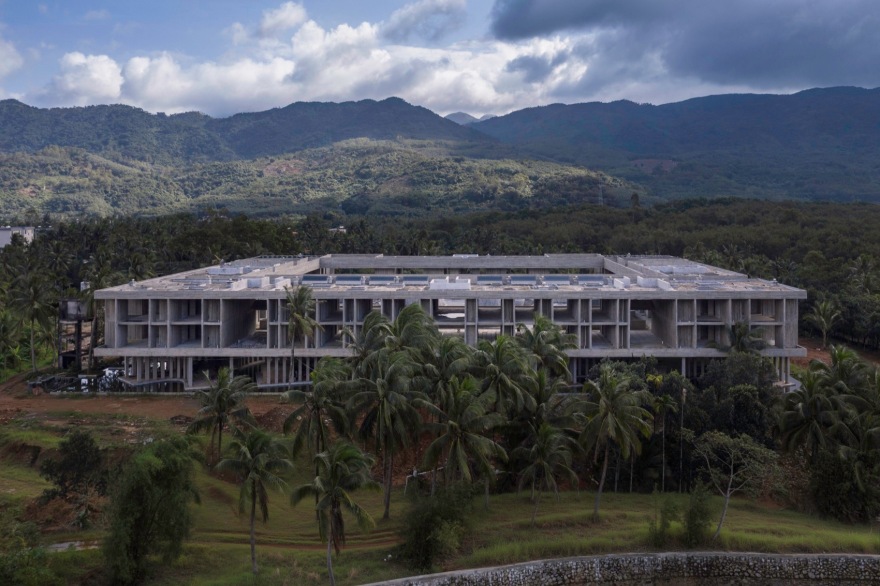
▼混凝土与大屋檐的基本材料与逻辑,Basic materials and logic of concrete and large eaves © 王宁

自这一条高起的基准线开始,建筑展开了三重叙事。最高处,是一个方院。它的存在,是一种温和而坚定的态度:我们仍然需要院落这种共同体的结构,仍然需要一种人们聚合与分散的秩序,承续了中国传统社会中最熟悉的空间记忆。但我们并不想让它成为沉重而封闭的围合,而是让它成为按时间变化而开启的共享场所。白天,它是驻留、教学和创作的场地,阳光洒落,鸟鸣隐约;夜间,它变为展演、集会和对话的舞台,灯火摇曳,人声交织。方院是中国人熟悉的空间结构,却因架空在下方自然的廊道之上,而显出一种轻盈。
From this elevated baseline, the building develops a threefold narrative. At the highest level is a square courtyard. Its existence represents a gentle yet firm stance: we still need the communal structure of a courtyard, an order for people to gather and disperse, carrying on the most familiar spatial memory of traditional Chinese society. But we did not want it to be a heavy, closed enclosure. Instead, it is a shared space that opens according to the rhythms of time. By day, it is a place for residency, teaching, and creation, with sunlight filtering through and the faint sound of birdsong. By night, it transforms into a stage for performances, assemblies, and dialogue, with flickering lights and interwoven voices. The square courtyard is a familiar spatial structure for the Chinese, yet by being suspended above the natural corridors below, it takes on an air of lightness.
▼架空的方院,Elevated courtyard © 郭曦
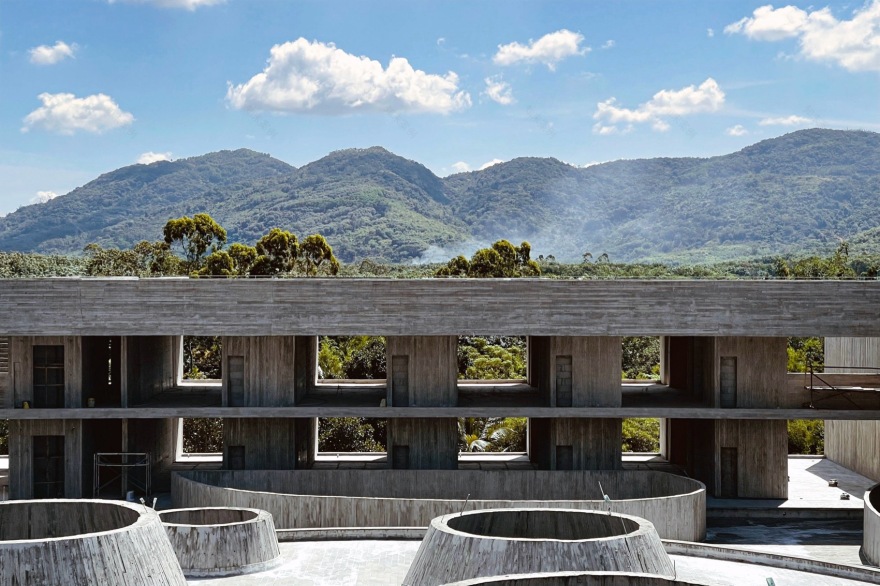
▼方院近景,Courtyard close view© 安立

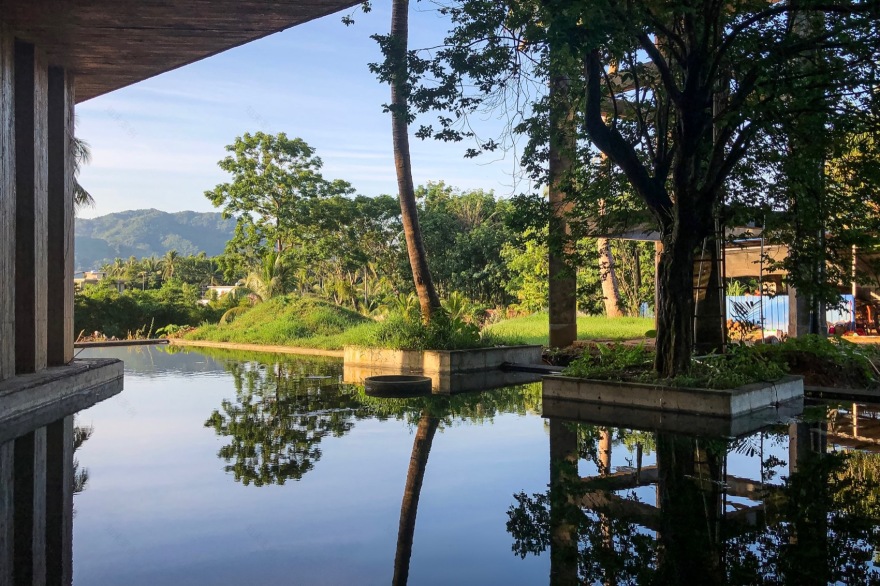
首层与屋面承载着另一种逻辑,这里更接近园林,雨与风成为编织故事的线索。首层的自然廊道蜿蜒曲折,不遵循几何的法则,而是随林木与风向悄然延展。它让方院漂浮起来,使院落这种形式在传统与自然之间重获新生。蜿蜒的柱廊随着树木与山景的方位而转折,连续的柱列如林木般布置,既构成了流动的路径,也创造出与气候对话的界面。空气从柱间流动,风声、叶声与人声在此交织。柱廊围合而出的水庭,最初的构想是雨林中水树交织的意向,让庭院在湿润和绿意中生长。但场地给予了我们更直接的契机——山泉水在此处几乎唾手可得。于是我们决定引泉入院,让清冽的泉水在大屋檐下流动,与柱林相伴。泉水的清凉与风道的通透交织,水气蒸散与空气流动结合,使屋檐下的气候凉爽宜人,在海南漫长而炎热的夏季,让屋檐下水庭旁成为人们真正乐于停留和活动的场所,它既是景观,也是气候调节的装置。
The ground floor and the roof are governed by another logic, one closer to that of a garden, where rain and wind become the threads that weave the story. The natural corridors of the ground floor meander, not according to geometric rules, but gently extending with the forest and the direction of the wind. This allows the courtyard to float, giving this traditional form a new life between heritage and nature. The winding colonnade turns with the position of the trees and the mountain views, and its continuous columns are arranged like a forest, creating both a flowing path and an interface for dialogue with the climate. Air moves between the columns, where the sounds of wind, leaves, and people mingle. The water court enclosed by the colonnade was initially conceived with the imagery of intertwined water and trees in a rainforest, allowing the courtyard to grow in moisture and greenery. But the site offered a more direct opportunity—mountain spring water was readily available. We decided to channel the spring into the courtyard, letting its clear, cool water flow under the great eaves, accompanying the forest of columns. The coolness of the spring and the permeability of the wind corridors intertwine; the evaporation of water vapor combines with the flow of air, making the climate under the eaves pleasantly cool. During Hainan’s long, hot summers, the area by the water court becomes a place where people genuinely enjoy lingering and gathering. It is both a landscape and a climate-regulating device.
▼柱廊围合而出的水庭,Water courtyard enclosed by a colonnade © 王宁


屋顶的平台,提供了一种水平性,如同山水画的地头,给人在此观山的参照,让山景仿佛一幅展开的卷轴。屋面雨水的流动路径也被赋予叙事:屋面上的水被坡面收集下来,经由导沟与细管倾泻而下,形成瀑布般的垂直水幕,从屋面到地面的多层楼板横向微微错开,让出下落的空间,使雨水汇入首层水庭,最终流入池塘,成为灌溉与日常使用的资源。实际上,每场雨在这里都是一次可感的事件,气候本身成为了建筑的一部分。
The rooftop platform provides a horizontal plane, like the foreground of a traditional shanshui painting, offering a reference point for viewing the mountains and making the scenery appear like an unfurled scroll. The path of rainwater on the roof is also given a narrative: water is collected by the sloped surfaces and funneled through channels and scuppers, cascading down to form vertical curtains of water like waterfalls. The multiple floor slabs from the roof to the ground are slightly offset horizontally, creating space for the rain to fall, guiding it into the ground-floor water court, and finally into a pond, where it becomes a resource for irrigation and daily use. In effect, every rainfall here is a tangible event; the climate itself becomes part of the architecture.
▼屋顶提供了一种水平性,The roof provides a sense of horizontality © 王宁

▼从屋顶下落的雨幕,Rainfall cascading from the roof © 王宁

地下的谷仓艺术空间,则把叙事引向内向与精神的层面。我们从场地本身的谷仓记忆出发,但赋予它新的灵魂——与天空对话。穹顶光井把天光引入地下,让人们在最封闭的地下空间里,仍然能与天空相遇。晨昏时分的光带、雨后湿润冰凉的空气、下落的雨水回响声,都在这里被增强放大,成为强烈可感的体验。在今日,建筑与天空的关系往往被切断,自然的感受被工业设备取代,但我们始终认为,与天空保持对话,与人的感受保持对话,是一种建筑最重要的精神。雨舍的谷仓,通过一个简单的穹顶,重新为人与天空之间打开了通道,为这种对话提供了可能,这是我们一种极为内敛的坚持。
The underground “granary” art space draws the narrative toward an inward, spiritual dimension. We started from the site’s own memory of a granary but gave it a new soul: a dialogue with the sky. A domed skylight introduces natural light into the subterranean space, allowing people to encounter the sky even in the most enclosed environment. The bands of light at dawn and dusk, the cool, damp air after a rain, and the resonant sound of falling water are all amplified and magnified here, becoming intensely sensible experiences. Today, the connection between architecture and the sky is often severed, and the sensations of nature are replaced by industrial equipment. But we have always believed that maintaining a dialogue with the sky and with human feeling is one of architecture’s most vital spirits. Through a simple dome, the granary of the Rain House reopens a channel between people and the sky, making this dialogue possible—a deeply restrained conviction of ours.
▼把天光引入地下,Bringing daylight into the underground © 王宁

▼地下的谷仓艺术空间,Underground barn-style art space © 郭曦

物质与劳动,也延续了场地的记忆。场地上的旧水塔被保留下来,旧砖被拆解后部分再用,碎砖成为混凝土的再生骨料,老井也被重新接入水系。这些处理并不是出于怀旧,而是让旧物以另一种形式继续存在,成为新的秩序中的时间证据。施工痕迹本身也被写入了建筑的记忆,低技工艺留下的缺陷与纹理、墙体的模板缝、粗糙的抹灰,都是时间和劳动的证据。村民参与了共同建造与持续维护,低技的工艺虽然让这座建筑不那么精致,但这贴近物质与劳动的现实,让建造不再是一次性的事件,而是持续更新的共同实践。
▼村民参与共同建造,Community-built by local villagers © 张军

Materials and labor also carry on the memory of the site. The old water tower on the site was preserved. Old bricks were dismantled and partially reused, with crushed bricks becoming recycled aggregate for the concrete. The old well was reconnected to the water system. These actions were not born of nostalgia but were a way to allow old things to continue existing in a new form, as evidence of time within a new order. The traces of construction were themselves written into the building’s memory: the imperfections and textures left by low-tech craftsmanship, the seams from the formwork on the walls, and the rough plaster are all testaments to time and labor. Villagers participated in the collective construction and ongoing maintenance. Although the low-tech methods make the building less refined, this approach remains close to the reality of materials and labor, ensuring that construction is not a one-time event but a continuous, evolving, and communal practice.
▼水院与旧水塔,Water courtyard and the old water tower © 韩涛
雨舍不是一座完成即凝固的纪念碑,而是一条可被反复书写的时间线。当把气候的节律写入体量,把材料的痕迹转化为叙事,把劳动的粗糙作为美学,建筑便重新获得了与天空、与自然、与人群的深度对话。果木林的成长、墙体的修补、展览与节庆的轮替、泉水与雨水的循环,都让它不断被重写。在这里,建筑不再是静态的物,而是与时间、气候和社区共同成长的过程。在海南的雨幕与阳光之间,雨舍是这样一种尝试——倾听时间,而非仅占有空间的建造实践。
The Rain House is not a monument that is static upon completion but a timeline that can be repeatedly written upon. When the rhythms of climate are inscribed into its form, the traces of materials are transformed into a narrative, and the roughness of labor is embraced as an aesthetic, the building regains a profound dialogue with the sky, with nature, and with people. The growth of the fruit orchard, the mending of the walls, the rotation of exhibitions and festivals, and the circulation of spring water and rain all ensure it is constantly being rewritten. Here, architecture is no longer a static object but a process that grows together with time, climate, and community. Between the rain-swept screens and sunlit days of Hainan, the Rain House is an attempt—a practice of building that listens to time, rather than merely occupying space.
▼屋顶,The roof© 王宁
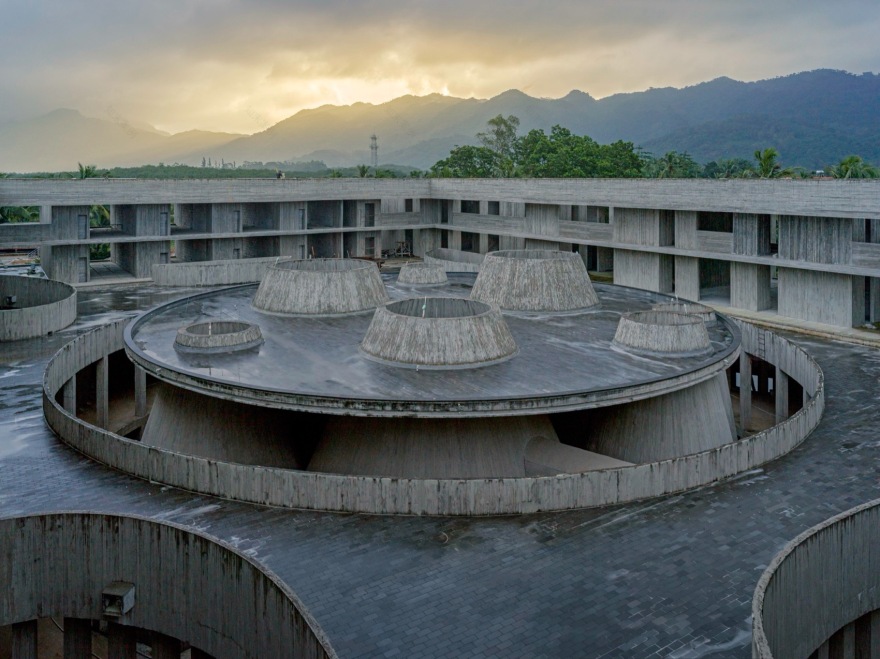
▼远眺,Distant view© 安立

▼材质近景,Material details© 王宁


在建筑学的维度上,雨舍不应仅被视为一处地域性样本,而是一种方法论的展开:它将气候从背景条件提升为形式与制度生成的第一性要素,主张以时间性为场所生成的基底。不同于弗兰普顿的批判地域主义主张调和地域文化与现代建造,雨舍并不是通过抽取地域意象或符号来重建身份,而是通过材料的物性、构造的程序与共同建造的社会实践,将地域性转译为一种可操作的治理逻辑。它不是把地域简化为一种表象,而是把地域的物理条件、气候节律与劳动关系转换为抵御气候与组织公共生活的制度性资源。混凝土的厚重、屋檐的纵深、水庭的蒸散以及劳动留下的痕迹,成为时间性记忆的物证;这些物证既承载着生态与社会的长期负荷,又构成了一种公共性的操作界面,使场所的使用规则得以在气候节律中被协商与重塑。换言之,雨舍把建筑的任务从形式的生产转向时间资产的配置与维护。在方法论上,它提示我们应以过程性的治理思维来理解设计——把建筑视为一种能够调节、分配并延续公共时间的实践,而不是单纯创造新的形态。如此,建筑便不再仅仅是时间的容器或表象的生产者,而成为以物质与制度并行的方式介入时间、延续共同性的实践者。
From an architectural perspective, the Rain House should not be seen merely as a regional specimen but as the unfolding of a methodology: it elevates climate from a background condition to a primary element in the generation of form and order, proposing temporality as the foundation for placemaking. Unlike Frampton’s Critical Regionalism, which advocates for reconciling regional culture with modern construction, the Rain House does not reconstruct identity by extracting regional imagery or symbols. Instead, it translates regionality into an operational logic of governance through the materiality of its components, its tectonic procedures, and the social practice of co-construction. It does not reduce the region to a representation but transforms its physical conditions, climatic rhythms, and labor relations into institutional resources for weathering the climate and organizing public life. The mass of the concrete, the depth of the eaves, the evaporation from the water court, and the traces of labor become material evidence of a temporal memory. This evidence not only bears long-term ecological and social loads but also constitutes an operational interface for public life, allowing the rules of the place to be negotiated and reshaped within the rhythm of the climate. In other words, the Rain House shifts the task of architecture from the production of form to the management and maintenance of temporal assets. Methodologically, it suggests that we should understand design through a process-oriented, governmental mindset—viewing architecture as a practice that can regulate, distribute, and sustain public time, rather than simply creating new forms. In this way, architecture is no longer merely a container of time or a producer of representations, but a practitioner that intervenes in time and perpetuates communality through both material and institutional means.
▼首层总平面图,ground floor plan© 共时建筑

▼二层平面图,first floor plan© 共时建筑

▼三层平面图,second floor plan© 共时建筑

▼顶视图,roof top plan© 共时建筑

▼立面图,elevation© 共时建筑

▼剖面图,section© 共时建筑

项目名称:雨舍
项目类型:建筑
设计方:共时建筑
设计周期:2019-2020
建设周期:2021-2025
设计主持:韩涛、郭曦、贺仔明
项目地址:海南万宁
建筑面积:9600㎡
用地面积:约50亩
摄影版权:王宁、安立、郭曦、韩涛
业主:海南省致盛国际文化艺术创展有限责任公司
主要材料:混凝土、不锈钢、ETFE膜
Project Name: Rain House
Project Type: Architecture
Designer: SCA
Design Period: 2019-2020
Construction Period: 2021-2025
Lead Designers: Han Tao, Guo Xi, He Ziming
Project Address: Wanning, Hainan
Building Area: 9600㎡
Site Area: Approximately 3.34 hectares
Photography Copyright: Wang Ning, An Li, Guo Xi, Han Tao
Client: Hainan Zhisheng International Culture Art and Creative Exhibition Co., Ltd.
Main Materials: Concrete, Stainless Steel, ETFE Film
南京喵熊网络科技有限公司 苏ICP备18050492号-4知末 © 2018—2020 . All photos and trademark graphics are copyrighted by their owners.增值电信业务经营许可证(ICP)苏B2-20201444 苏公网安备 32011302321234号
苏公网安备 32011302321234号客服
消息
收藏
下载
最近