

创作上传
VIP
收藏下载
登录 | 注册有礼
查看完整案例

收藏

下载

分享
作为世界上最大的混凝土消费国,中国每年产生约 24 亿吨建筑与拆除废料。传统的混凝土再利用方式无法适应当代多变复杂的城市环境。由香港中文大学王帅中教授领导的结构平衡实验室创作的《废砼再生》装置,作为第19届威尼斯国际建筑双年展中国馆的十件作品之一,重新思考了废旧的混凝土“重生”的方式,将其视作可供重构的材料而非碎料,以及未来新建筑框架的组成部分。装置创造性地使用了来自威尼斯本地的废旧混凝土,设想了一个完全由废旧混凝土构成的全新的建造体系与工作流程,其核心在于保留原有构件的结构性能,并借助成熟的工业产品,与业界专业人士合作,来最大化拓展混凝土的再利用场景。装置来源于威尼斯当地的废旧混凝土,原为守护海堤的线性构件。经过数字建模、结构计算、现场处理之后,最终于展馆内完成最终的调试与安装。
©结构平衡实验室
As the world’s largest concrete consumer, China generates approximately 2.4 billion tons of construction and demolition waste annually. The installation “Concrete Spolia”, created by [S]Equilibrium Lab under the leadership of Prof. Shuaizhong Wang, is one of ten works for the Chinese pavilion at the 19th International Architecture Exhibition – La Biennale di Venezia, rethinking the approach to reusing discarded concrete, viewing it not as waste but as a material for reconstruction—a component for the framework of future new buildings. The material of the installation innovatively uses local waste concrete from Venice, envisioning a workflow composed entirely of waste concrete. The core lies in preserving the structural performance and aesthetic characteristics of the original components, while using mature industrial products to maximize and expand reuse scenarios for waste concrete. Originally linear components that protected the sea wall, after digital modeling, structural calculation, and on-site processing and drilling, were ultimately reassembled in the exhibition.
▼装置概览,Overview of the installation © 王帅中,朱元龙

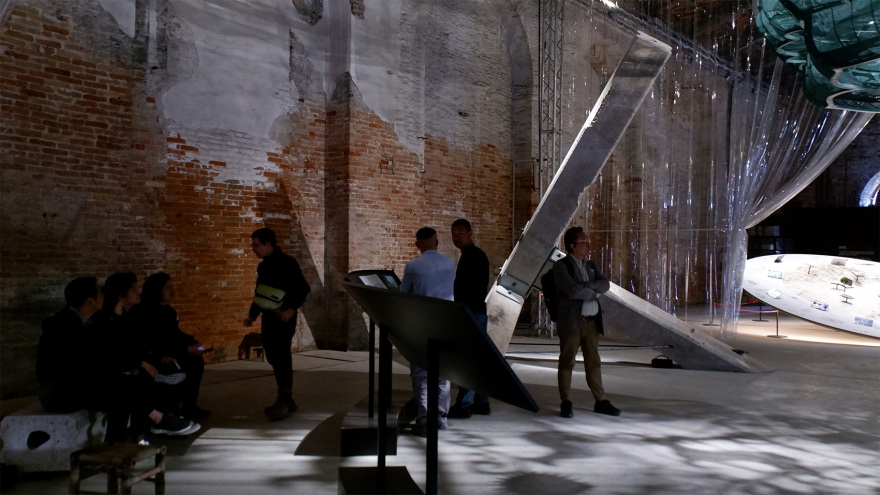
▼展览现场,Exhibition site © 王帅中,朱元龙
当前工程领域的可持续实践,往往注重材料性能与结构属性,而对设计潜力探讨较少:传统的降级再利用(downcycling)逻辑——将混凝土废料粉碎再用作骨料——囿于工程领域的语境下,耗时过长且收益有限,无论是工程抑或设计领域,都正在面临可持续建造领域下的“环境转型”。
Today, sustainable practices in the engineering sector tend to prioritize material properties, parameters and data-driven attributes, often at the expense of exploring diverse design possibilities. The prevailing logic of downcycling, whereby construction waste is crushed and repurposed as aggregates, is frequently time-intensive and yields limited returns. Meanwhile, both the engineering and design sectors are undergoing an ‘environmental turn’ driven by sustainability construction.
▼结构工程与建筑设计发展路径与“环境转型”
Development and recent Environmental turn of Structural
Deisn and Architectural Design © 香港中文大学结构平衡实验室

《废砼再生》则直接回应“废旧混凝土材料可以同时具有美学价值与结构性能”的理念,贯穿设计伊始至终,团队最终采用具有结构挑战性与视觉冲击力和力量感的“悬挑框架”的呈现方案。装置最核心的是“砼”的旅程,也是各个主体之间相互协调与配合的路程。团队依据设计在威尼斯进行了大量考察,与策展团队沟通,最终在威尼斯主岛对岸的海滨的Fusina社区中找到废料回收公司,获得了数根宝贵的混凝土防波堤构件。进行大量测算、扫描、结构验证后,一方面,团队与业界合作开展节点设计和生产,同时在现场对废旧混凝土进行精确切割,最终在多方协同下,混凝土构件船运至中国馆进行节点组装。▼数据测算,Data calculation © 香港中文大学结构平衡实验室

▼装置安装分析,Installation analysis © 香港中文大学结构平衡实验室

Concrete Spolia directly conveys the concept that “Wasted concrete can simultaneously fulfill both aesthetic and structural functions.” The idea comes from the design phase, the team decided on a form featuring a structurally challenging and visually powerful “inclined future concrete frame” At the very core of Concrete Spolia is material, specifically, waste concrete sourced locally in Venice. The journey of this waste was also a journey of coordination and cooperation among various parties. The team conducted extensive research in Venice and, in communication with the curatorial and construction support team, eventually located a waste recycling company in Fusina, a coastal community across from the main island of Venice. There, we acquired several concrete breakwater components. These components were transported by truck to a warehouse by our construction partner. After our team performed measurements, 3D scanning, and structural analysis, a local cutting company was brought in to cut the components on-site. Simultaneously, custom-made joints began their fabrication and transit from the factory. Finally, these concrete components were transported by boat to the Chinese Pavilion site, where they were drilled and assembled with the joints.
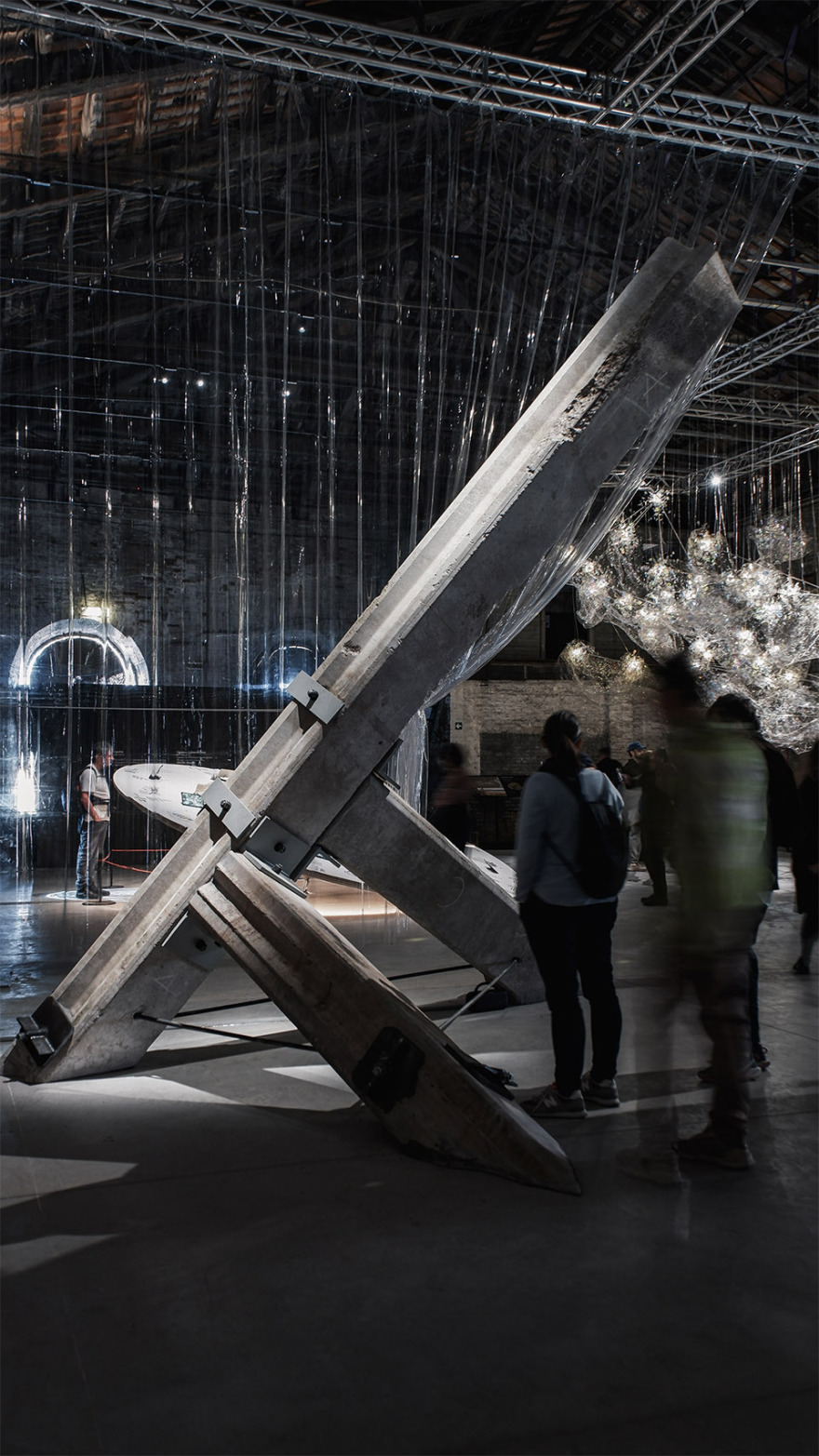
▼悬挑框架,Inclined future concrete frame © 王帅中,朱元龙


《废砼再生》的节点利用标准化的工业连接件,加快了生产流程,也大幅降低了定制构件制作的成本,足以对整体项目预算及碳足迹进行精确控制。装置采用干式装配,使线性构件无需浇筑即可连接,从而便于拆卸与最终的再利用,并尽量减少现场干扰。团队有意避开了资源消耗更大,更加笨重的钢套筒连接件,而是转而采用轻质的角钢与钢板——这套策略为混凝土材料保留了其结构完整性和后续再用的结构潜力,又以轻盈灵动的衔接模式,建构出轻重交织,对比鲜明的美学特征。
▼设计与生产流程,Design and production processes © 香港中文大学结构平衡实验室

The design team adopted standardized industrial joints, which not only expedite production but also reduce the costs associated with bespoke component fabrication. This facilitates precise control over both the overall project budget and its carbon footprint. The project employs dry assembly methods, ensuring that the linear components are connected without casting, which allows for easy disassembly and reuse of elements while minimizing site disruption. We intentionally avoided heavy, resource-intensive steel sleeve connections, opting instead for lightweight angle steel or steel plates. This strategy preserves the intrinsic qualities of the components, including their reusability, aesthetic value, and structural integrity.
▼轻盈灵动的衔接模式,A light and dynamic connection mode © 王帅中,朱元龙
《废砼再生》是基于特定场地的实验,成为工程思维与艺术灵感的衔接媒介,深度探索了可持续与循环建造的可能:它有意刺破单一的,普遍的材料再利用研究的边界,旨在建立一种新的可持续建造模式,兼具工程与美学的表达。装置的搭建过程,是真实建造与工艺流程的在场实验和流程模拟,足以形成有价值的数据参考;也是一场艺术创作的大胆尝试,将废旧混凝土视作创意来源,实现非传统的设计表达。
“Concrete Spolia” serves as a site-specific experiment, functioning as a mediating platform that connects engineering and art within the domain of sustainable and circular construction, intentionally transcends the boundaries of single-domain material regeneration. The project aspires to exemplify an experimental approach grounded in sustainability, serving as a paradigm that integrates both functionality and artistic expression. By simulating authentic industrial scenarios, the project generates valuable data and case studies to inform subsequent real-world applications. Simultaneously, it is also a bold artistic endeavor that treats discarded concrete as a source of inspiration, achieving unconventional design expression.
▼轻质的角钢与钢板,Lightweight angle steel or steel plates © 王帅中,朱元龙


▼装置细部,Installation details © 王帅中,朱元龙


《废砼再生》装置以超尺度的悬挑配合清晰简洁的节点,完成了设计、结构以及搭建的多重挑战,在威尼斯实现了让混凝土重获新生的新宣言。
With over-scaled cantilevers, complemented by clear and simple joints, “Concrete Spolia” writes a new manifesto in the local context for giving waste concrete a new life.
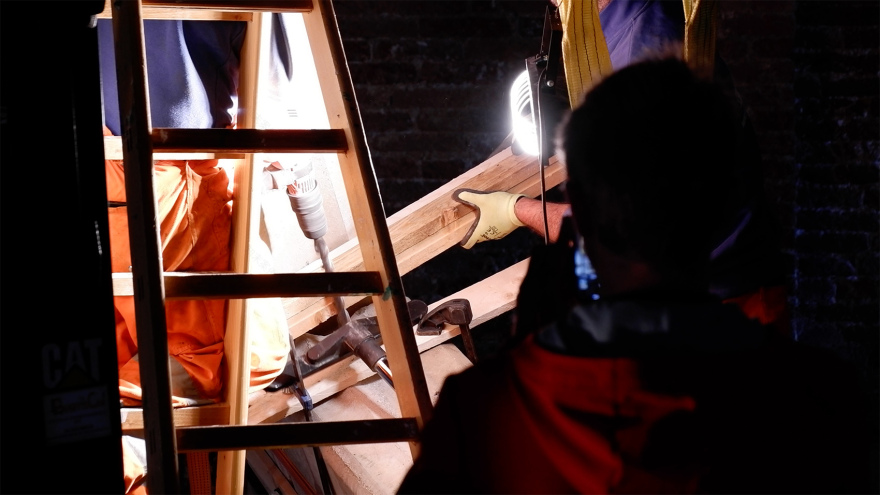
▼施工现场,Construction site © 王帅中,朱元龙


注:“Spolia”源自拉丁语,指从旧建筑或其他来源拆卸下来的装饰材料或构件,用于新的结构或装饰。
“Spolia” originates from Latin and refers to decorative materials or components dismantled from old buildings or other sources for use in new construction or decorative purposes.
▼装置平面落位,Layout plan © 香港中文大学结构平衡实验室

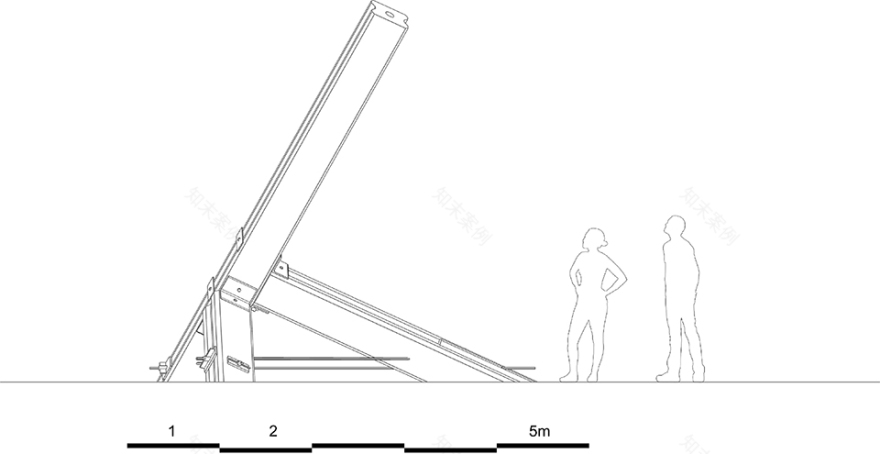
▼装置立面,Elevation drawing © 香港中文大学结构平衡实验室

项目名称:废砼再生
项目类型:装置
设计方:香港中文大学结构平衡实验室 shuaizhongwang@cuhk.edu.hk
项目设计:2024 - 2025
完成年份:2025年五月
设计团队:
项目负责人:王帅中
项目管理:朱元龙
项目团队:王帅中,朱元龙,梅亚岚,谢卓言,李阳芝,林凯逸,赵寒冰
项目地址:Arsenale – Magazzino Delle Cisterne, Castello 2169/F – 30122 Venezia, Italy
建筑面积:5 ㎡,5.20m x 4.60m x 4.90m
摄影版权:王帅中,朱元龙,
合作方:技术支持:Peikko Construction Material (China),搭建支持:WE EXHIBIT,特别鸣谢:李珊、李清鹏、武文潇
客户:第19届威尼斯建筑双年展中国馆
材料:废旧混凝土构件
Project name:Concrete Spolia: Reuse of Building Waste
Project type:Installation
Design:[S] Equilibrium Lab, Chinese University of Hong Kong shuaizhongwang@cuhk.edu.hk
Design year:2024 - 2025
Completion Year: May, 2025
Leader designer & Team:
Principal Designer: Shuaizhong Wang
Project Manager: Yuanlong Zhu
Project Team: Shuaizhong Wang , Yuanlong Zhu , Yalan Mei , Zhuoyan Xie ,Yangzhi Li ,Kaiyi Lin , Hanbing Zhao
Project location:Arsenale – Magazzino Delle Cisterne, Castello 2169/F – 30122 Venezia, Italy
Gross built area:5 ㎡,5.20m x 4.60m x 4.90m
Photo credit: Shuaizhong Wang, Yuanlong Zhu,
Partner:Technical Support & Sponsor: Peikko Construction Material (China) Build Support: WE EXHIBIT Special thanks to:Shan Li , Qingpeng Li , Wenxiao Wu
Clients:the Pavilion of China at the 19th International Architecture Exhibition – La Biennale di Venezia
Materials:Wasted Concrete
南京喵熊网络科技有限公司 苏ICP备18050492号-4知末 © 2018—2020 . All photos and trademark graphics are copyrighted by their owners.增值电信业务经营许可证(ICP)苏B2-20201444 苏公网安备 32011302321234号
苏公网安备 32011302321234号客服
消息
收藏
下载
最近