

创作上传
VIP
收藏下载
登录 | 注册有礼
查看完整案例

收藏

下载

分享
如何平衡传统风貌、对称秩序与当代建造技术及多样化功能需求,是双莲轩茶室改造设计的核心议题。该项目位于苏州常熟沙家浜风景区,四周环水,原建筑为钢筋混凝土结构,外观采用歇山小青瓦屋顶与红漆立柱等仿古元素,实则属于常见仿古风格建筑。随着建筑老化及消费模式变化,景区希望在维持传统风貌的基础上,融入茶饮、文创、展览等复合功能,提升建筑品质与空间体验。改造设计以“线索性表皮”为策略,旨在通过表皮处理串联风貌、功能、结构与场地等多重因素,既塑造鲜明的建筑形象,又回应复杂的空间诉求。
Balancing traditional style, symmetrical order with contemporary construction techniques and diverse functional requirements forms the core challenge for the renovation of the Twin Lotus Teahouse. Located within the Shajiabang Scenic Area in Changshu, Suzhou, and surrounded by water, the original building was a reinforced concrete structure. Its appearance featured antique-style elements like a hip-and-gable roof with small black tiles and red-lacquered columns, making it a typical example of pseudo-classical architecture. With the building aging and consumer habits evolving, the scenic area sought to integrate composite functions such as tea service, cultural/creative retail, and exhibitions while preserving the traditional aesthetic, thereby enhancing both the building quality and spatial experience. The renovation employs a “cladding-as-clue” strategy, aiming to use the facade treatment to connect multiple factors—style, function, structure, and site—creating a distinct architectural identity while responding to complex spatial demands.
▼项目鸟瞰,aerial view of the project© 游航

▼项目概览,overview of the project© 游航


传统风貌与当代材料
Traditional Style and Contemporary Materials
改造保留了原有主体结构,并重点修复屋面仿古风貌,因此设计的焦点集中在横梁以下的立面区域。原建筑遮阳帘遮挡景观视野的问题,成为表皮设计的出发点。设计采用竖直与水平方向的多层次构造系统:竖向分为上部遮阳区、中部通透区及下部实墙区,并在遮阳区与通透区间设置金属挑檐遮阳;水平方向则分为玻璃中间层、木格栅室外层和内凹通透区,整体包裹建筑东、南、西三面。
▼结构轴测图,structure axonometric©蚁丘建筑 + 珞珞建筑

The renovation preserved the primary load-bearing structure and focused on restoring the antique-style roof. Consequently, the design focus shifted to the facade below the beams. The original sunshades, which obstructed views, became the starting point for the cladding design. A multi-layered construction system was adopted in both vertical and horizontal directions: Vertically, it is divided into an upper sun-shading zone, a middle transparent zone, and a lower solid wall zone, with a metal cantilevered eave for shade between the shading and transparent zones. Horizontally, it consists of a central glass layer, an outer wooden grille layer, and an inner recessed transparent area, collectively wrapping the building’s east, south, and west facades.
▼建筑周围环境,the surrounding environment© 游航


设计借鉴了江南园林中的漏窗与明瓦窗意象。漏窗借窗芯纹样实现借景与光影效果,明瓦窗则利用贝壳薄片与玻璃组合形成朦胧框景。双莲轩以当代工业化材料重新诠释这一传统:外侧采用成品木格栅拼接成波纹图案,呼应周边水景;内侧使用长虹玻璃,模拟贝壳片的半透明滤光效果。木格栅与长虹玻璃叠合,在室内形成动态光影,随视角变化呈现波光粼粼的视觉体验,既满足遮阳功能,又唤起与传统园林的意象关联。这种做法不仅回应了遮阳与景观的矛盾,也体现了当代建造逻辑:采用“层叠”而非传统“穿插”的构造方式,适应大尺寸工业化材料与分工建造的需求,实现传统意向的现代转译。
▼设计图解,design strategy©蚁丘建筑 + 珞珞建筑

The design draws inspiration from the imagery of latticed windows (lou chuang) and shell-and-glass windows (ming wa chuang) found in Jiangnan gardens. Latticed windows use intricate patterns to frame borrowed scenery and create light/shadow effects, while shell-and-glass windows combine thin shell pieces with glass to form hazy, framed views. The Twin Lotus Teahouse reinterprets this tradition using contemporary industrial materials: the outer layer employs prefabricated wooden grilles assembled into a ripple pattern, echoing the surrounding water scenery; the inner layer uses fluted glass to simulate the semi-transparent, light-filtering effect of shell pieces. The superposition of wooden grilles and fluted glass creates dynamic light and shadow interiors, producing a shimmering visual experience that changes with the viewer’s perspective. This approach fulfills sun-shading functions while evoking associations with traditional gardens. It not only addresses the conflict between shading and views but also reflects contemporary construction logic: utilizing a “layered” assembly method rather than traditional “interlocking” joinery, adapting to the use of large-format industrial materials and division-of-labor construction, thus achieving a modern translation of traditional intent.
▼立面采用成品木格栅拼接成波纹图案,Latticed windows use intricate patterns to frame borrowed scenery and create light/shadow effects© 游航

▼木格栅与长虹玻璃叠合,The superposition of wooden grilles and fluted glass© 游航


▼内侧使用长虹玻璃,模拟贝壳片的半透明滤光效果,the inner layer uses fluted glass to simulate the semi-transparent, light-filtering effect of shell pieces© 游航


秩序性
Orderliness
双莲轩原有歇山顶与南侧拱桥共同强化了中轴对称秩序。改造设计通过表皮与空间处理,进一步凸显这一特征:
▼窗口与景观的视线关系,The visual relationship between the window and the landscape©蚁丘建筑 + 珞珞建筑

The original hip-and-gable roof and the southern arched bridge jointly reinforced a central axial symmetry. The renovation design further accentuates this characteristic through the cladding and spatial treatment:
▼强化了中轴对称秩序,模拟贝壳片的半透明滤光效果,reinforced a central axial symmetry© 游航


1. 南立面将原有两个入口合并居中,强化轴线;木格栅表皮自南面向东西两侧对称展开。
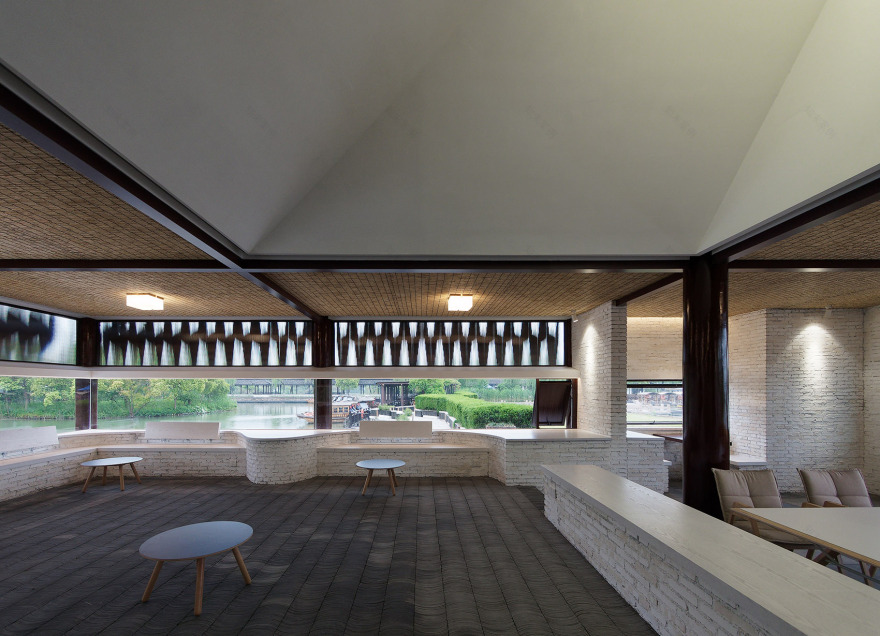
2. 立柱与墙体脱开,柱身涂深棕色,墙体留白,增强立柱视觉表现,明确五开间中轴秩序。
3. 室内延续外部对称性,吊顶、灯具及坡顶梁间设置的对称发光顶棚,共同营造古典氛围。
4. 平面布局上,从南侧拱桥至北侧开窗形成连续轴线。入口大门居中,两侧对称设置竖向玻璃窗与L形墙垛,强化入口中心感与场所感,使内外秩序连贯统一。
1. The south facade consolidates the original two entrances into a single, centered main entrance, strengthening the central axis; the wooden grille cladding unfolds symmetrically from the south face towards the east and west sides.
2. Columns are separated from the walls, with the columns painted dark brown and the walls left white, enhancing the visual presence of the columns and clarifying the axial order of the five-bay structure.
3. The interior continues the external symmetry. The ceiling, lighting fixtures, and symmetrically arranged luminous ceilings set between the sloping roof beams collectively create a classical ambiance.
4. In the plan layout, a continuous axis runs from the southern arched bridge to the northern window. The centered entrance door is flanked symmetrically by vertical glass windows and L-shaped wall piers, reinforcing the centrality and sense of place at the entrance, ensuring a coherent order from inside to out.
▼立柱与墙体脱开,Columns are separated from the walls© 游航


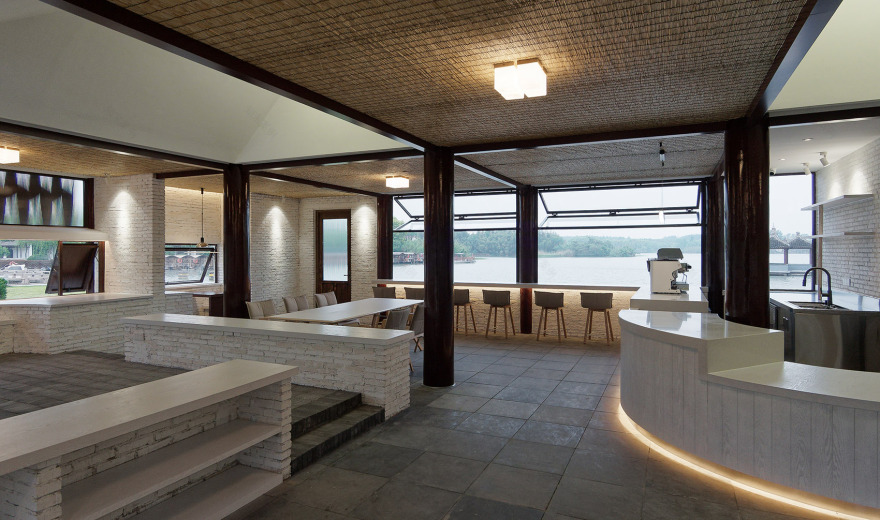
▼共同营造古典氛围,create a classical ambiance© 游航


▼强化入口中心感与场所感,reinforcing the centrality and sense of place at the entrance© 游航

灵活性
Flexibility
尽管南立面强调对称,东、西、北侧视角中建筑更多以斜向被感知,表皮设计转而灵活应对内部功能与景观差异:
Although the south facade emphasizes symmetry, the building is often perceived obliquely from the east, west, and north sides. Here, the cladding design responds flexibly to internal functions and varying landscapes:
▼取景框将视线交汇在室外景观,The viewfinder converges the line of sight into the outdoor landscape© 游航

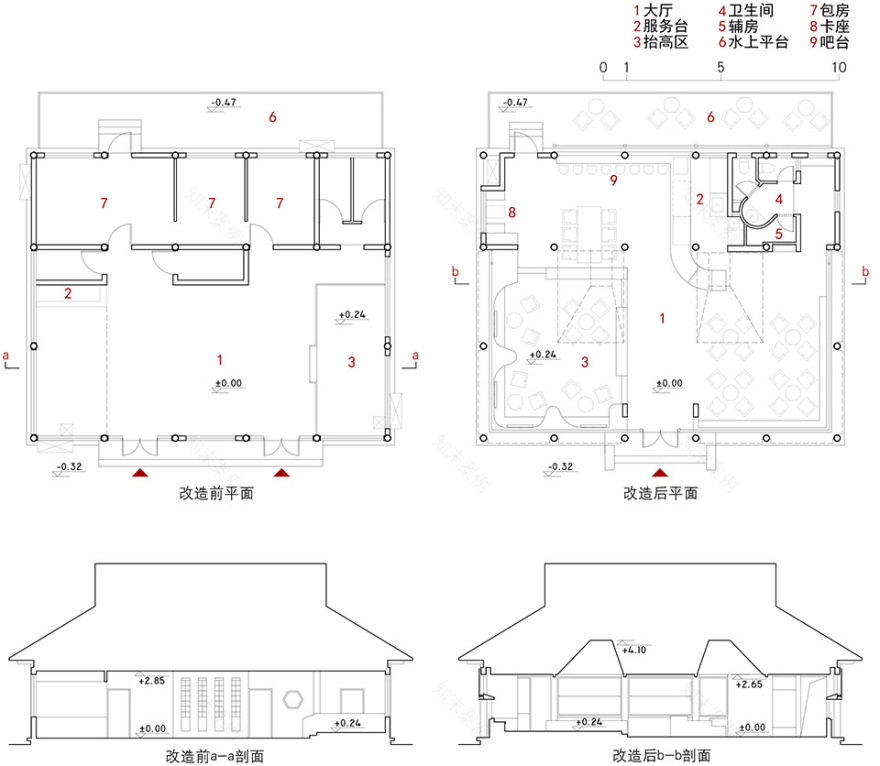
1. 东北角设置后勤区(卫生间、储藏间),其余区域开放,形成与对称屋顶对比的不规则平面。
2. 东侧座椅区与入口平齐,墙体设低矮书架,长窗将东南拱桥与栈道景观框为长卷。
3. 西侧区域抬高0.24米,墙体转化为波浪形固定座椅与条状书架,兼顾展览需求,并引导视线俯视近处水景,眺望北侧湖景。
4. 北立面设折叠窗与吧台,引入开阔水景;卫生间端部设方窗,既改善走道体验,又形成内外视线通廊,连接北侧景观亭。
5. 在斜向视角下,表皮通过转角长窗形成室内外叠合观景效果,弱化体量感,增强空间层次。Z字形平面与斜向动线打破了严格对称,丰富了空间体验。
1. A service area (restrooms, storage) is located in the northeast corner, with the remaining areas kept open, creating an irregular plan that contrasts with the symmetrical roof.
2. The eastern seating area aligns with the entrance level; the wall incorporates low bookshelves, and a long window frames the southeastern arched bridge and boardwalk scenery like a scroll painting.
3. The western area is raised by 0.24 meters; the wall transforms into a wavy fixed seat and strip bookshelves, accommodating exhibition needs while guiding views downward towards the nearby water and outward towards the northern lake scenery.
4. The north facade features folding windows and a counter, introducing expansive water views; a square window at the end of the restroom corridor improves the passage experience and creates a visual corridor connecting to the northern landscape pavilion.
5. From oblique angles, corner long windows create superimposed viewing effects, layering interior and exterior scenes, diminishing the sense of mass, and enhancing spatial depth. The Z-shaped plan and diagonal circulation break strict symmetry, enriching the spatial experience.
▼北立面设折叠窗与吧台,The north facade features folding windows and a counter© 游航

▼东侧座椅区,The eastern seating area© 游航


▼引入开阔水景,introducing expansive water views© 游航


▼天窗设计,skylight design© 游航


表皮作为建筑设计的要素之一,具有表现力与中介特质。双莲轩改造中,表皮作为“线索”,不仅塑造视觉形象,更串联起风貌、功能、结构与场地等多重因素,在传统与现代、秩序与灵活之间取得平衡。其多层次构造兼顾整体感知与局部变化,容纳设计的具体性,逐步异化并丰富初始意图,最终实现“兼容并蓄的统一”。这一策略为类似仿古建筑改造提供了可借鉴的路径。
As one element of architectural design, enclosing façade possesses expressive and mediating qualities. In the Twin Lotus Teahouse renovation, the cladding acts as a “clue,” not only shaping the visual image but also weaving together multiple factors—style, function, structure, and site—achieving a balance between tradition and modernity, order and flexibility. Its multi-layered construction accommodates both overall perception and local variation, incorporates design specifics, and gradually differentiates and enriches the initial intent, ultimately realizing an “inclusive unity.” This strategy offers a replicable path for the renovation of similar pseudo-classical buildings.
▼场地平面,site plan©蚁丘建筑 + 珞珞建筑

▼改造前后平面及剖面,plan and section before and after renovation©蚁丘建筑 + 珞珞建筑
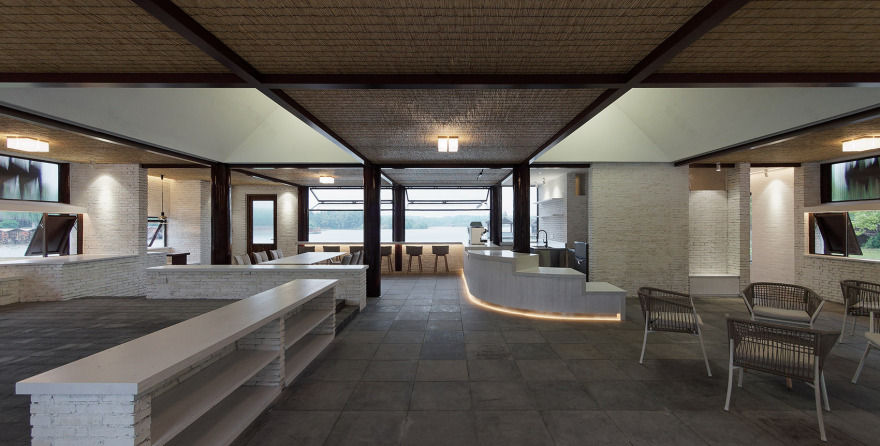
▼细部,detail©蚁丘建筑 + 珞珞建筑

项目名称:双莲轩建筑改造设计
项目类型:咖啡吧+茶室
设计方:蚁丘建筑、珞珞建筑;
完成年份:2023.5
设计团队:吉宏亮,游航
项目地址:江苏苏州常熟沙家浜风景区
建筑面积:200㎡
摄影版权:游航
客户:苏州沙家浜旅游度假区管委会
结构形式:钢筋混凝土结构(主体)+原木结构(局部)
材料:金砖、青砖、长虹玻璃、实木板、小青瓦、镀锌钢、角钢
Project name: Project type:café&teahouse
Design:yiqiustudio&luoluoarchitects;
Completion Year:2023.5
Team:JI Hongliang、YOU Hang
Project location:Shajiabang Scenic Area, Changshu, Suzhou, Jiangsu Province
Gross built area:200 ㎡
Photo credit: YOU Hang
Clients:Suzhou Shajiabang Tourism Resort Administrative Committee
Materials: Gold Brick、 Blue Bric、Fluted Glass、 Solid Wood Board、 Chinese Terracotta Roofing Tile、Galvanized Steel、Angle Steel




南京喵熊网络科技有限公司 苏ICP备18050492号-4知末 © 2018—2020 . All photos and trademark graphics are copyrighted by their owners.增值电信业务经营许可证(ICP)苏B2-20201444 苏公网安备 32011302321234号
苏公网安备 32011302321234号客服
消息
收藏
下载
最近