

创作上传
VIP
收藏下载
登录 | 注册有礼
查看完整案例

收藏

下载

分享
华中科技大学游泳馆选址于华中科技大学南门东侧,西接绿树成荫的坡地,东临校园湖泊,项目同20年前落成的光谷体育馆隔湖相望,南临车流繁忙的城市主干道—珞喻路。游泳馆旨在为高校师生拓展体育教学与锻炼空间,地上一层建有一个10泳道国际标准比赛池、一个6泳道热身训练池,游泳馆配置300个固定坐席,二层为大空间多功能球类场馆,地下配置室内跑道、功能训练房及地下车库等功能。
The natatorium at Huazhong University of Science and Technology is located to the east of the south gate, adjacent to a tree-lined slope to the west and a campus lake to the east. The project faces the Guanggu Sports Center across the lake, which was completed 20 years ago. The natatorium is bordered to the south by the busy urban thoroughfare Luoyu Road. It aims to expand the space for sports education and exercise for the university’s faculty and students. The ground floor features a 10-lane international standard competition stadium, a 6-lane warm-up training stadium, and 300 fixed seats. The second floor houses a large multi-functional gymnasium, while the basement includes an indoor running track, functional training rooms, and an underground parking garage.
▼游泳馆与光谷体育馆鸟瞰,Aerial View of the Natatorium and Guanggu Gymnasium©谭刚毅
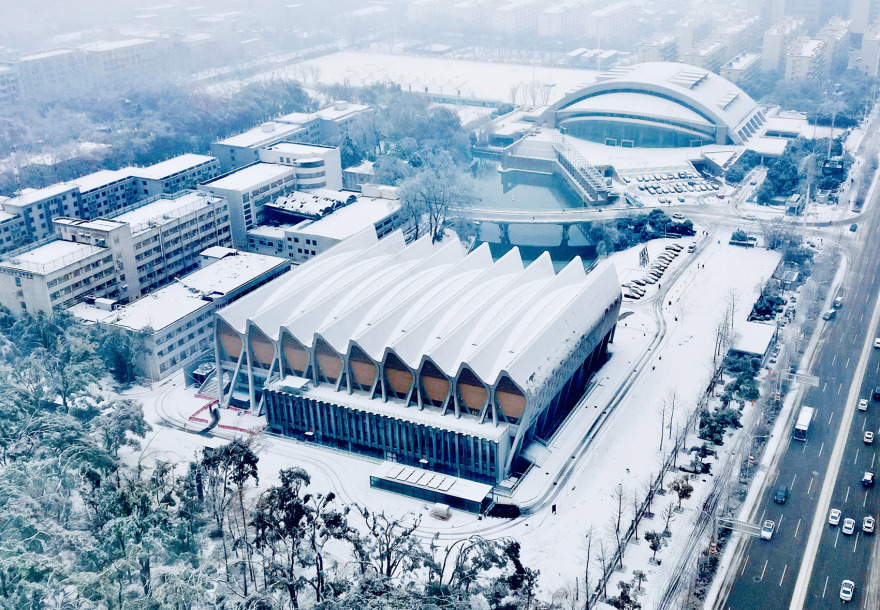

▼从光谷体育馆隔湖望向游泳馆,Looking Across the Lake from Guanggu Gymnasium to the Natatorium©谭刚毅

一、 规划——嵌入网格,提升节点脉络
I. Planning — Embedding into the existing Grid, Enhancing Node Connectivity
因为红线范围内存有大量珍贵的香樟树,项目实际用地非常紧张,而用地东边则是校园南四门入口及20年前落成的光谷体育馆。规划设计通过尽量压缩建筑轮廓,以求最大限度保留了基地西侧的现状绿植,并嵌入校园规划网格之中。同时,通过建筑出入口优化与建筑局部退让,在游泳馆、学校南四门及光谷体育馆之间规划了一体化的广场空间,新旧两个体育建筑积极对话,在时间与空间维度延续提升了高校体育场所营建的脉络。区域内游泳馆、香樟树林、光谷体育馆以及设计保留的湖泊形成有机的整体,不仅赋予校园愈加浓厚的运动氛围,作为珞喻路的重要公共节点,也为城市创造了积极的城市空间。
▼总平面布局与校园环境关系,Site Plan and Campus Environment© 孙一民工作室

Due to the presence of numerous precious camphor trees within the site, the actual space available for the project is very limited. To the east of the site lies the entrance of the South Fourth Gate of the campus and the Guanggu Sports Center, which was completed 20 years ago. The planning and design aim to minimize the building footprint as much as possible to preserve the existing greenery on the west side of the site and embed the project into the campus planning grid. Additionally, by optimizing the building entrances and making partial building setbacks, an integrated plaza space has been planned between the natatorium, the South Fourth Gate of the school, and the Guanggu Sports Center. This allows for an active dialogue between the new and old sports buildings, extending and enhancing the network of university sports facilities in both time and space dimensions. The natatorium, camphor forest, Guanggu Sports Center, and the preserved lake form an organic whole within the area. This not only enhances the sports atmosphere on campus but also creates a positive urban space at the important public node of Luoyu Road.
▼城市、校园与游泳馆鸟瞰,Aerial View of the City, Campus, and Natatorium©邹林
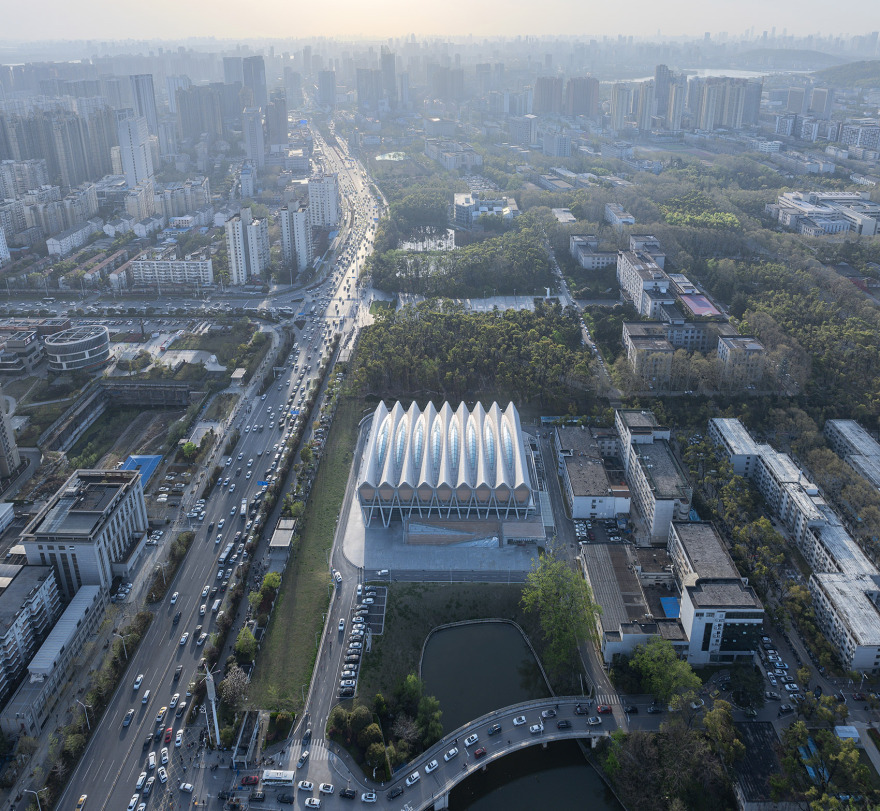
▼游泳馆鸟瞰,Aerial View of the Natatorium©邹林

二、功能——垂直叠放,预留生长条件
II. Function — Vertical Stacking, Reserving Growth Conditions
面对项目复杂的功能要求,受限的建筑轮廓,不断加大的校园停车缺口及建筑高度的控制条件。设计根据各功能的特点,将功能进行了垂直叠放,各功能高效布局并有独立的出入口。设计还对未来的功能扩展提前规划,预留生长条件。
Given the project’s complex functional requirements, limited building footprint, increasing campus parking shortfall, and building height restrictions, the design adopts a vertical stacking approach for the various functions based on their characteristics. Each function is efficiently laid out with independent entrances and exits. Additionally, the design anticipates future functional expansion by reserving conditions for growth.
▼球类馆内部,Interior of the Gymnasium©邹林

三、 立面——还原气质,彰显校园特色
III. Facade — Reflecting Campus Characteristic and Features
立面设计呼应华中科技大学“森林大学”的景观特色,还原基地原有树林的“场所气质”。东西贯穿式的结构单元似一束光纤,隐喻学校光学学科的密切关联,结构单元拼合形成的建筑立面朝东西两侧打开,“林景”与“湖景”在建筑交汇,朝向城市道路的南立面则以雕塑感形象展示予城市。建筑材质上采用有水波纹效果的GRC外墙板,契合游泳馆 “水”的主题。
The facade design responds to the “forest” characteristic of Huazhong University of Science and Technology, restoring the original “spatial character” of the site’s woodland. The east-west spanning structural units resemble a bundle of optical fibers, symbolizing the university’s close connection to optical sciences. These structural units form a facade that opens to the east and west, blending “forest views” with “lake views” where the building intersects. The south facade facing the urban road is designed with a sculptural quality to present a striking image to the city. The building’s exterior materials include GRC exterior wall panels with a water ripple effect, aligning with the natatorium’s “aqua” theme.
▼游泳馆西入口门厅,West Entrance Lobby of the Natatorium©邹林

▼结构单元拼合形成有韵律的东西立面,Structural Units Combine to Form a Rhythmic East-West Facade©邹林
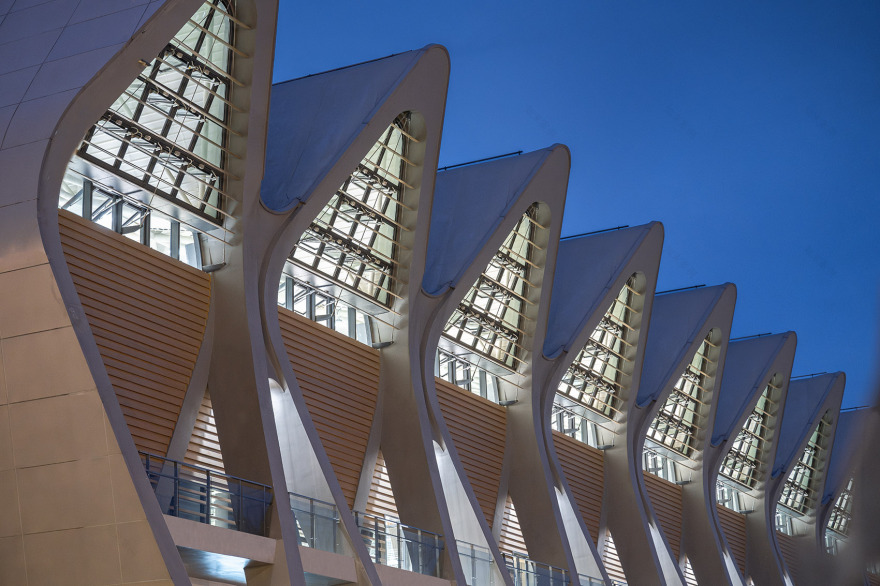
▼游泳馆东立面–球类馆高侧窗与办公条形窗,East Facade of the Natatorium – High Side Windows of the Gymnasium and Strip Windows of the Office©邹林

四、 结构——“重轻”结合,因功能而异的大跨结构
IV. Structure — Combining “Heavy” and “Light”, Large-Span Structures Varying by Function
项目中游泳馆与球类馆两层大空间叠合,基于两种功能不同使用特点,结构设计采用了不同的体系。游泳馆屋面采用预应力混凝土单向密肋大跨梁结构,均匀规律的外露结构梁,保证了潮湿的环境下的使用寿命与低维护成本。球类馆屋面采用张弦立体钢桁架轻型结构,结构尽量利用了起伏屋面,有效提升了室内空间高度与视觉高度。
In the project, the natatorium and the two-level large-space gymnasium are stacked. Based on the different functions, the structural design employs different systems. The roof of the natatorium uses a prestressed concrete unidirectional ribbed large-span beam structure, with uniformly exposed structural beams to ensure longevity and low maintenance costs in a humid environment. The gymnasium roof adopts a lightweight cable-stayed steel truss structure, utilizing the undulating roof to effectively enhance the interior spatial and visual height.
▼泳池馆屋面的预应力混凝土单向密肋大跨梁结构,Prestressed concrete single-ribbed large-span beam structure of natatorium roof©邹林

▼球类馆屋面天窗与张弦立体桁架结构,Skylight and string truss structure on the roof of the Stadium©邹林

五、机电——高度集成,营造纯净的大跨空间
V. MEP — Highly Integrated, Creating a Pure Large-Span Space
机电管线,尤其是暖通空调管线因其截面较大,一直是保证建筑空间纯净的难点。本项目有效利用了游泳池池岸下方的贯通廊道空间,将“综合管廊”理念引入项目中,廊道内既布置游泳池水循环等管线,同时将暖通空调主管等集成布置于其中,通过隐藏在夹墙中的垂直支管连接侧墙末端空调喷口,满足两层大空间的空调要求。即便两层大空间不布置吊顶,也很好的保证了空间的纯净效果。
Mechanical, electrical, and plumbing (MEP) systems, especially HVAC ducts due to their large cross-sections, have always posed a challenge in maintaining the purity of building spaces. In this project, the space under the stadium deck is effectively utilized to create a continuous corridor, introducing the “integrated pipeline corridor” concept. This corridor accommodates stadium water circulation pipes and integrates main HVAC ducts within it. Through vertical branches hidden in the partition walls connected to the air conditioning vents at the ends of the side walls, the air conditioning requirements of the two large spaces is satisfied. Even without suspended ceilings in these large spaces, the design effectively maintains a clean and uncluttered environment.
▼空调支管从负一层“综合管廊”通过夹层到球类馆,风管风口与结构一体化设计,Air conditioning branch pipes come through the mezzanine from the basement’s “integrated pipe corridor” to the second floor. Integrated design of air conditioning tuyere and structure©谭启钧

六、生态——自然采光通风,优化开放模式,打造低能耗运营
VI. Ecology —Natural Lighting and Ventilation with Optimized Open Mode leads to Low Energy Consumption Operation
项目设计充分利用落地窗,高低侧窗,天窗等,保证对自然光的最大化利用,通过打造檐廊空间,设置遮阳百叶等方式避免了直射光及眩光的影响。在挑檐下方等不容易被雨水侵入的部位设置了侧向开启扇,充分利用热压、风压进行自然通风。自然采光通风降低项目的了照明能耗与过渡季节的暖通能耗。另外,在游泳馆泳池配置上,任务书要求设置一个8泳道比赛池,一个8泳道热身池,考虑到学校游泳馆使用的周期性特点,设计建议采用6泳道热身池+10泳道比赛池的大小池模式,增加开放模式以更加精准匹配使用工况,并在两池之间设置活动隔断,如此将能大大降低游泳馆使用过程中的净水、暖通及恒温能耗。多种措施打造低能耗运营。
▼游泳馆开放模式对比分析,Comparative analysis of natatorium opening mode© 孙一民工作室

The project design makes full use of floor-to-ceiling windows, high and low side windows, and skylights to maximize natural light utilization. To avoid direct sunlight and glare, the design incorporates eaves spaces and shading louvers. Side-opening vents are installed in areas not easily penetrated by rain, such as under eaves, to leverage thermal and wind pressure for natural ventilation. This approach reduces lighting and HVAC energy consumption during transitional seasons. Additionally, the natatorium configuration initially required an 8-lane competition pool and an 8-lane warm-up pool. Considering the cyclical usage patterns of the university natatorium, the design proposed a 6-lane warm-up pool and a 10-lane competition pool with a flexible operation mode for them. This combination allows a more precise match to different usage conditions and significantly reduces water purification, HVAC, and constant temperature energy consumption during operation. These measures collectively contribute to low-energy consumption during operation.
▼高低侧窗与天窗采光下的球类馆内部,The interior of the stadium under high and low side Windows and skylights ©邹林

▼挑檐下方高侧窗上不收雨水影响的通风开启扇,Side-opening vents are installed under eaves, to leverage thermal and wind pressure for natural ventilation, and are less infected by the rain©谭启钧

▼游泳馆西立面与西侧香樟树林,West Facade of the Natatorium and the Camphor Woods on the West Side ©邹林

▼从光谷体育馆隔湖望向游泳馆(夜景),Looking Across the Lake from Guanggu Gymnasium to the Natatorium(Night)©谭刚毅

▼平面图,floor plan©孙一民工作室


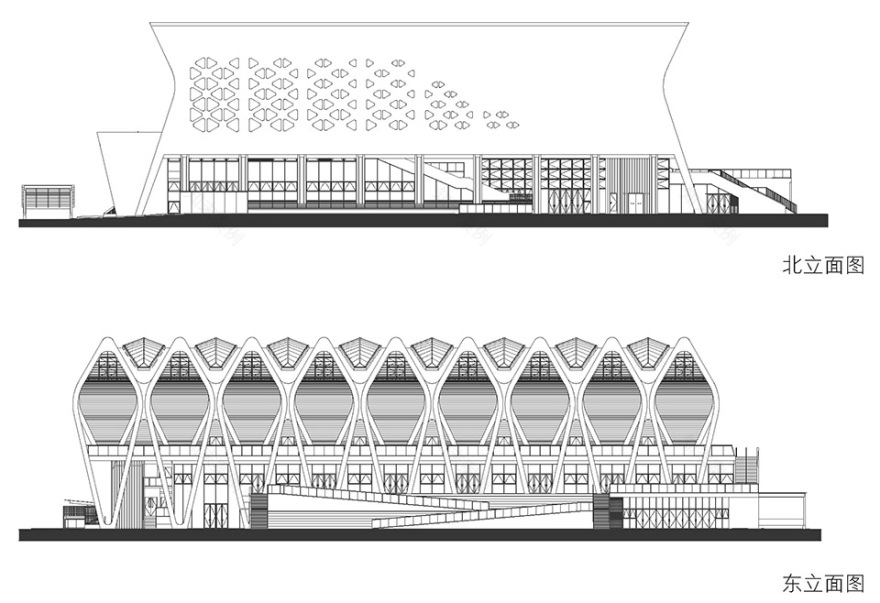
▼立面图,elevation©孙一民工作室
▼剖透视图,sectional perspectives©孙一民工作室

▼剖面图,section©孙一民工作室

▼局部大样,detail drawing©孙一民工作室

项目名称:华中科技大学游泳馆
项目类型:体育建筑
设计方:华南理工大学建筑设计研究院有限公司孙一民工作室;
项目设计:2018.09 - 2019.11
完成年份:2023.03
主创建筑师:孙一民
设计团队:(华南理工大学建筑设计研究院有限公司)建筑:陈辉镇、陶亮、章艺昕、陆仪韦、叶伟康、申永刚、柳庆、彭帆、邹林、李海全、潘雯珣、冷天翔、郭晓、聂昌东;结构(咨询):孙文波;(武汉华中科大建筑规划设计研究院有限公司)建筑:王斯波、潘家亮;结构:陈海忠、王天宇、卢雪来,张华;给水排水:申安付,金铃,程杨;暖通空调:王华鹏,姚江波;电气:甘文霞,王玉、陈敏利;绿建:马文婧;经济:何建宏。
项目地址:湖北省武汉市华中科技大学校内
建筑面积:32,000㎡
摄影版权:谭刚毅、邹林(阿尔法摄影)、谭启钧
合作方:武汉华中科大建筑规划设计研究院有限公司
客户:华中科技大学
材料:钢筋混凝土、钢、玻璃、PVC柔性卷材
Project Name: Swimming Pool of Huazhong University of Science and Technology
Project Type: Sports Building
Design: Atelier Sun of Architectural Design & Research Institute of SCUT Co.,Ltd.
Design year: September 2018 – November 2019
Completion Year: March 2023
Leader designer: Sun Yimin
Project Team: (From Architectural Design & Research Institute of SCUT Co.,Ltd.) Architects: Chen Huizhen, Tao Liang, Zhang Yixin, Lu Yiwei, Ye Weikang, Shen Yonggang, Liu Qing, Peng Fan, Zou Lin, Li Haiquan, Pan Wenxun, Leng Tianxiang, Guo Xiao, Nie Changdong; Structural Consultant: Sun Wenbo; (From Architecture and Urban Planning Design & Research Institute of HUST Co.,Ltd.) Architects: Wang Sibo, Pan Jialiang; Structural Engineers: Chen Haizhong, Wang Tianyu, Lu Xuelai, Zhang Hua; Water Supply and Drainage Engineers: Shen Anfu, Jin Ling, Cheng Yang; HVAC Engineers: Wang Huapeng, Yao Jiangbo; Electrical Engineers: Gan Wenxia, Wang Yu, Chen Minli; Green Building Consultant: Ma Wenjing; Cost Consultant: He Jianhong.
Project location: Campus of Huazhong University of Science and Technology, Wuhan City, Hubei Province
Gross built area: 32,000 ㎡
Photo credit: Tan Gangyi, Alpha Photography (Zou Lin), Tan Qijun
Partner: Architecture and Urban Planning Design & Research Institute of HUST Co.,Ltd.
Clients: Huazhong University of Science and Technology
Materials: Reinforced concrete, steel, glass, PVC flexible membrane


南京喵熊网络科技有限公司 苏ICP备18050492号-4知末 © 2018—2020 . All photos and trademark graphics are copyrighted by their owners.增值电信业务经营许可证(ICP)苏B2-20201444 苏公网安备 32011302321234号
苏公网安备 32011302321234号客服
消息
收藏
下载
最近