

创作上传
VIP
收藏下载
登录 | 注册有礼
查看完整案例

收藏

下载

分享
历史建筑的保护工作,往往孕育着独特的建筑叙事,这些叙事不仅关乎过去,更与当下的建筑讨论与实践密切相关。
Heritage conservation forms its own biotope of project stories—stories that carry urgent relevance for today’s architectural debates and initiatives.
▼项目概览,Project overview © Simon Burko

该项目的故事始于德国帕绍北部的一座农舍。随着业主家族年迈的祖母作为最后一位居住者搬离后,这座世代相传的老房子被彻底遗弃。渗水、腐朽与地基塌陷均已造成严重损毁,一些所谓“专家”的鉴定结论更是令人绝望:这栋房子“无法修复”。▼历史图片,Historical photo © Maximilian Hartinger Architekt

This particular story began when a family abandoned their historic farmhouse north of Passau after the grandmother, the last in many generations to live there, moved out. Water infiltration, rot, and poor foundations had already caused severe damage. Consulted “experts” declared the building unsalvageable, leaving the family discouraged.
▼改造后的老房子,The renovated old house © Simon Burko

新的希望来自新加入该家庭的妻子的热情,以及文物保护部门的支持。测年结果显示,这栋建筑建于1600至1601年间,在该地区属于极为罕见的古迹。虽然历经数百年的改造与破坏,许多细部特征仍然保留,见证着它漫长而复杂的历史。尽管受损严重,但房屋原有的空间尺度与潜力依旧清晰可见。上层与阁楼从未有人居住,过去仅用于储藏粮食与物品。
New hope came with the passion of a newly arrived daughter-in-law and the support of the heritage authority. Dendrochronological studies dated the construction to 1600/1601—exceptionally old for the region. Many characteristic details had survived centuries of alterations (and destructions), testifying to the building’s long and complex history. Despite the damage, the house’s spatial generosity and potential were still visible. The upper floor and attic had never been inhabited, serving only as storage for harvests and other goods.
▼清晰的建筑结构,Clear architectural structure © Simon Burko
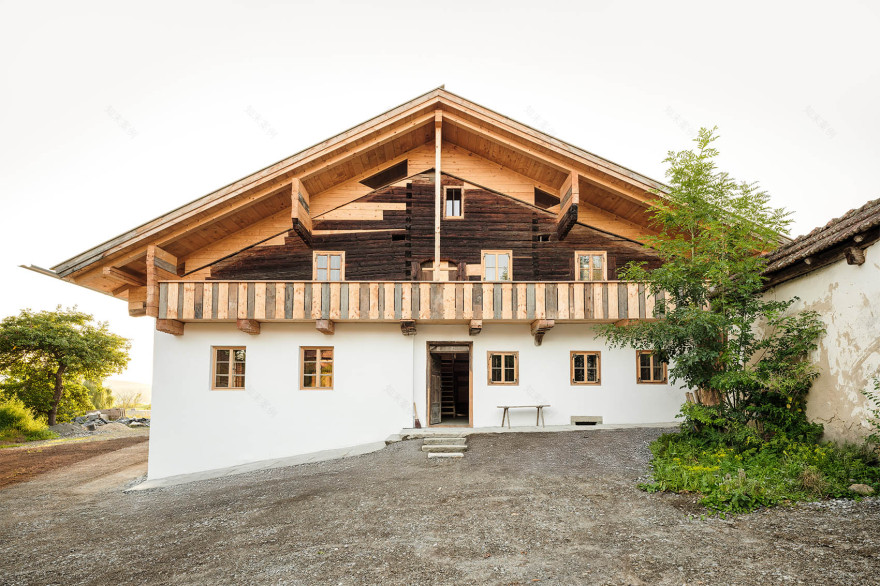
▼建筑与周边环境,Architecture and its surrounding © Simon Burko

修复的最大挑战来自过去的改造。约在1800年,底层部分原木结构被砖石取代——这在当时的地区建筑中并不罕见。然而由于缺乏地基支撑,建筑整体向下滑动近半米,肉眼即可见其倾斜。20世纪中期,屋顶曾被加高,但施工简陋且结构脆弱,导致后续变形与进一步损坏。尽管如此,这次改造被视为建筑本身历史的一部分,决定予以保留。
The greatest challenges stemmed from past interventions. Around 1800, part of the log structure on the ground floor had been replaced with masonry—a common practice in the area at the time. Without proper foundations, the house subsided nearly half a meter downhill, leaving it visibly tilted. In the mid-20th century, the roof had been raised, though executed with modest means, and structurally insufficient. The fragile construction led to further deformations and damage. Yet this intervention, as part of the building’s history, was to be preserved.
▼原木与砖石结构,Log and brick structure © Simon Burko

设计的关键策略,是在原有的木结构内部插入若干与房间等大的新构件。这些“嵌入体”起到了多重作用:一方面加强整体结构,使建筑重新稳固;另一方面在加高屋顶处形成保温层,同时承担旧结构已无法承受的屋顶荷载。它们的几何形态与明亮表面也有效改善了原本昏暗的上层采光。
The key design move consisted of inserting several precisely fitted room-sized volumes into the existing log structure. These elements served multiple purposes: bracing the house, forming an insulated shell—especially in the raised roof area—and carrying the roof loads that the historic structure could no longer support. At the same time, their geometry and bright surfaces improved daylight in the otherwise dim upper floor.
▼新旧材料的结合,The integration of new and old materials © Simon Burko
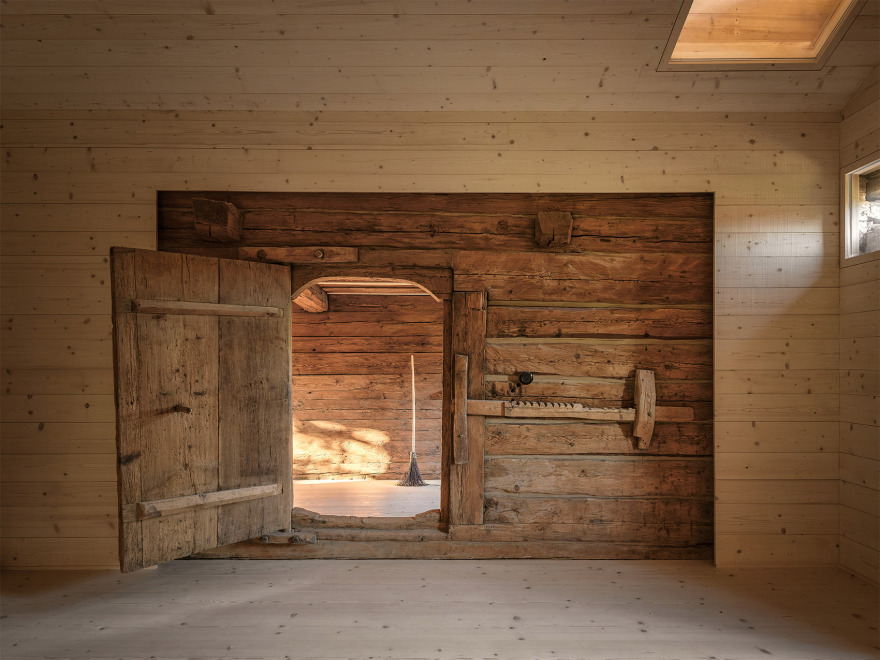

▼原始结构的强化,Reinforcement of the original structure © Simon Burko


修复过程大量采用了传统工艺与材料,通过实验与具有历史技艺的工匠协作得以重现。业主的家人和朋友也亲自参与施工:调制泥灰与涂料,使用酪蛋白石灰与油性涂层,铺设石灰地坪,锻造铁件,或用天然清漆灼烧法保护金属。项目使用的花岗岩取自当地采石场,大部分木材则来自家族自有林地。
The restoration relied on traditional techniques and materials, rediscovered through experimentation and the expertise of craftspeople with historic knowledge. Family and friends contributed significantly through hands-on work: mixing clay plasters and paints, applying casein-bound lime and oil finishes, laying lime screeds, forging iron details, or protecting metal with firnis-burn treatments. Granite came from local quarries, and much of the timber from the family’s own forest.
▼良好的采光,Good lighting © Simon Burko


▼餐厅,Dining room © Simon Burko
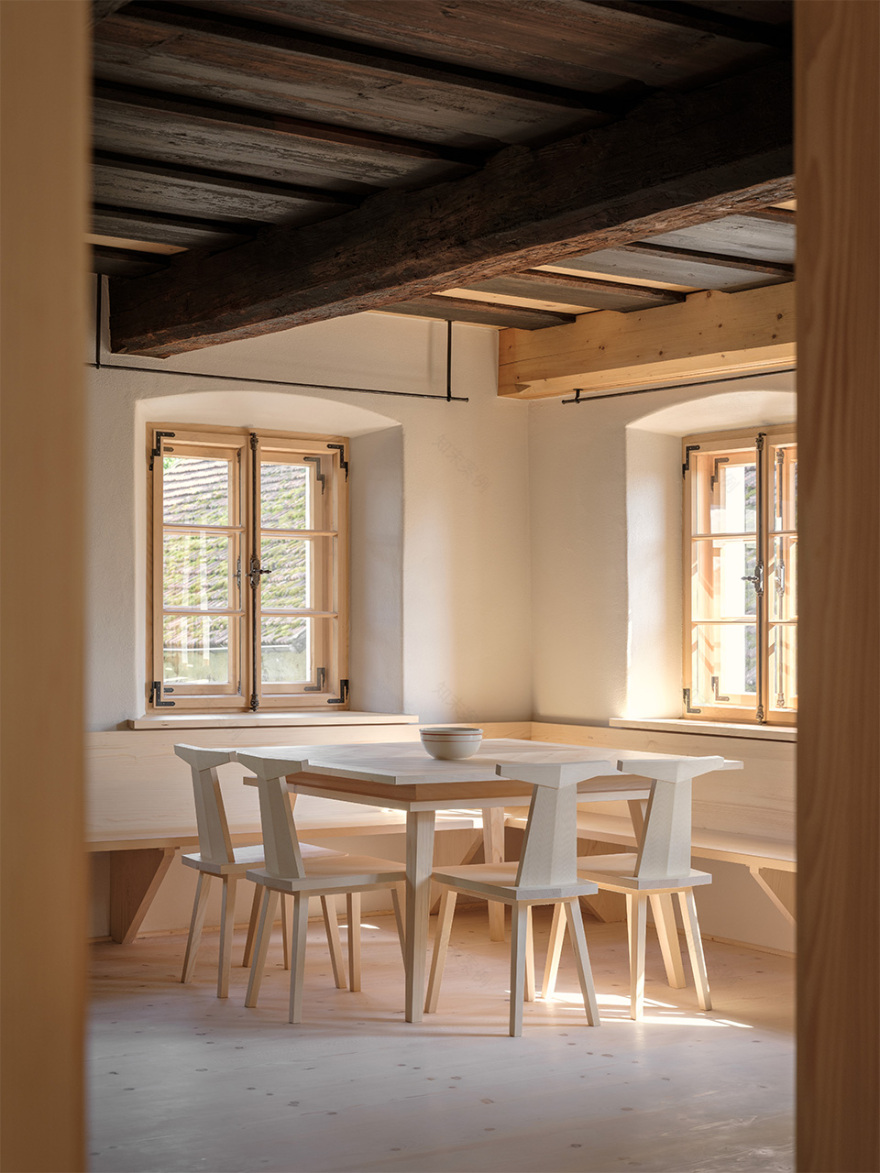
▼新的木质楼梯,New wooden staircase © Simon Burko

随着时间推移,新旧材料将在时间推移和日常使用中逐渐融合,成为传承给后代的家园,直到未来再次迎来修缮的某一天。希望这片农庄遗存的其他建筑,也能以同样的热情与投入被修复再生。
Over time, old and new will merge through patina and use, offering a home to future generations—until the question of repair arises again. The remaining buildings of the farmstead will hopefully be restored and reused with similar dedication.
▼室内小空间,The interior small space © Simon Burko


▼嵌入与融合,Embedding and Fusion © Simon Burko


此项目成为建筑更新转型的一个原型。勇气与投入可以克服对“不可修复”建筑的偏见。知识、材料与工艺仍然存在,只要有决心,风险是可控的。正是这些挑战性的项目,激发了参与者的热情,也吸引了工匠、邻里与专业机构的关注。前提是:必须首先保护现有建筑免于拆除,并让真正的专业知识参与其中。文物保护的经验早已证明——这种做法不仅可行,更应成为常态。
The project stands as a prototype of what the transition in building practice requires. Courage and commitment can overcome skepticism about supposedly “unsalvageable” buildings. Knowledge, materials, and techniques are still available, and with effort, the risks remain manageable. Challenging projects generate enthusiasm among participants and fascination among observers—craftspeople, neighbors, institutions alike. The essential condition: Existing structures must first be protected from demolition, and genuine expertise must be made integral. Heritage conservation has long demonstrated that such practices can—and must—become the norm.
▼材料细部,Material details © Simon Burko


▼区位图,Location plan © Maximilian Hartinger Architekt
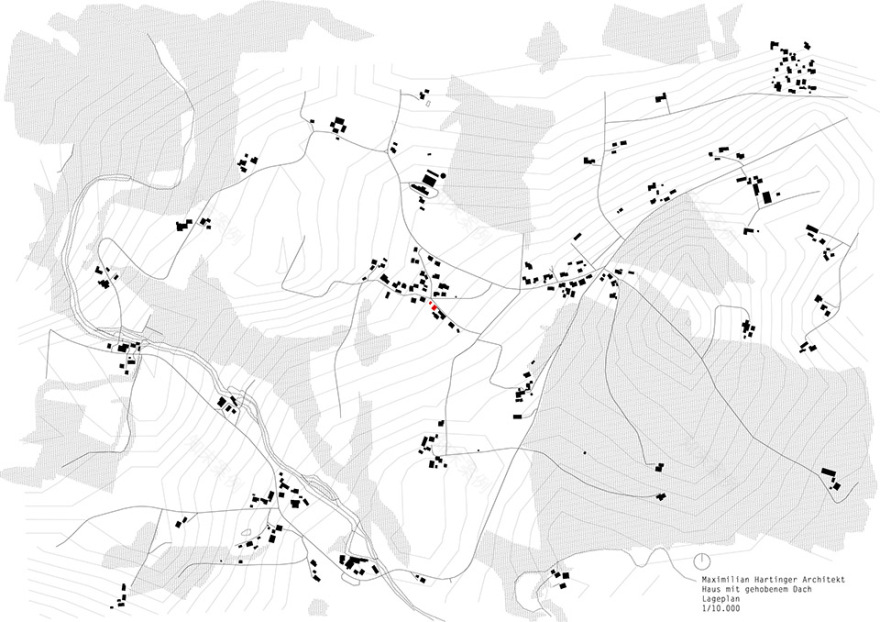
▼总平面图,Site plan © Maximilian Hartinger Architekt

▼一层平面图,Ground floor plan © Maximilian Hartinger Architekt

▼二层平面图,Second floor plan © Maximilian Hartinger Architekt

▼阁楼平面图,Attic plan © Maximilian Hartinger Architekt

▼剖面图,Section © Maximilian Hartinger Architekt

Data:
Location: Wilmerting 21, 94113 Tiefenbach, Landkreis Passau, Bavaria, Germany (publication only upon agreement)
Client: Christina and Robert Roßgoderer, Tiefenbach (publication only upon agreement)
Architecture: Maximilian Hartinger, Munich/Berlin
Assisting construction management: Benjamin Neumeier, Tittling
Survey and preliminary project: Norbert Paukner, Passau
Heritage conservation: Dr. Thomas Kupferschmied (Bavarian State Office for Monument Preservation) & Alois Spieleder (District Office Passau)
Structural engineering: Büro Bergmann, Pfaffenhofen
Energy/Building physics: Ingenieurbüro Hausladen, Kirchheim
Restoration and building materials consulting: Franz Kaltenecker, Hutthurm
Energy consulting: Manuel Breu, Schönau
Timber pest report: Susann Gürtler, Plauen
Applications for subsidies, planning: 2019–2022
Construction period: 2023–2025
Completion: July 2025
Image credits:
Drawings: Maximilian Hartinger Architekt
Historical photo: Maximilian Hartinger Architekt
Photos 2025: Simon Burko
Rights to be clarified if applicable:
Simon Burko Fotografie, Valleystraße 23, 81371 Munich, +49 (0)163 63 66 927
南京喵熊网络科技有限公司 苏ICP备18050492号-4知末 © 2018—2020 . All photos and trademark graphics are copyrighted by their owners.增值电信业务经营许可证(ICP)苏B2-20201444 苏公网安备 32011302321234号
苏公网安备 32011302321234号客服
消息
收藏
下载
最近