

创作上传
VIP
收藏下载
登录 | 注册有礼
查看完整案例

收藏

下载

分享
项目概况
Project Overview
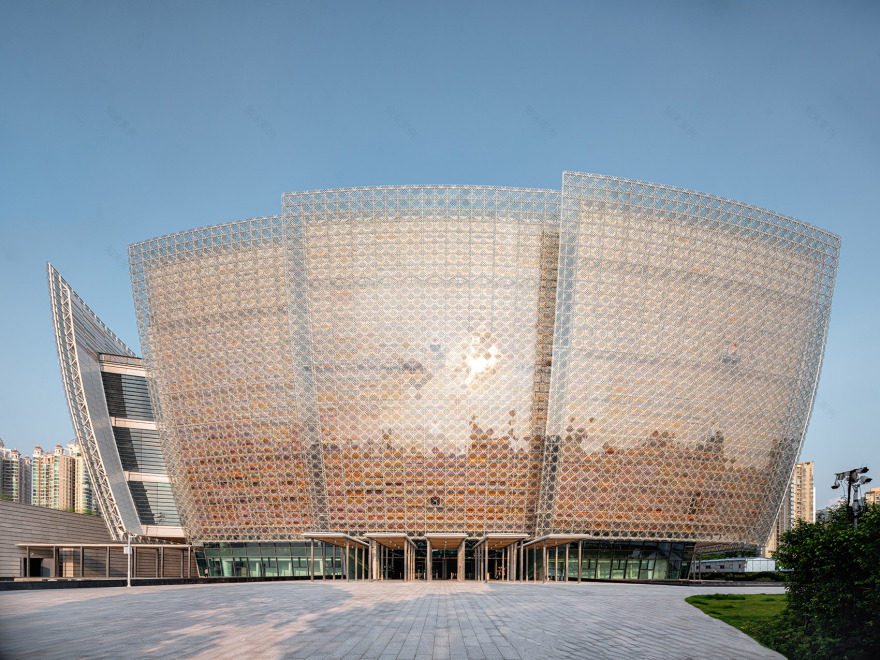
广州美术馆位于广州市海珠区广州塔以南,广州新中轴南部“三馆一场”组团东北侧,南面为在建的广州科学馆,西面为TIT创意园区及设计中的广州博物馆。项目于2014年开始设计,2023年投入使用,总建筑面积79453.1㎡,地上5层,地下2层,总高度为40米。广州美术馆是一个集收藏、展览、研究交流、教育于一体的大型现代化、国际化、数字化广州门户美术平台,建成后成为广州文化新地标和新中轴线上的艺术明珠、城市艺术会客厅,成为传统与科技、岭南与现当代结合的综合性美术馆,是全国唯一兼有“国家重点美术馆”和“国家一级博物馆”称号的艺术机构。
© 广州市文化广电旅游局
The Guangzhou Museum of Art is located south of the Canton Tower in Haizhu District, Guangzhou, on the northeast side of the “Three Halls and One Stadium” complex at the southern end of Guangzhou’s new central axis. It faces the under-construction Guangzhou Science Museum to the south and the TIT Creative Industry Zone and the planned Guangzhou Museum to the west. The project design commenced in 2014, and it was put into use in 2023. With a total floor area of 79,453.1 square meters, the building has 5 floors above ground and 2 floors below, reaching a total height of 40 meters. The Guangzhou Museum of Art is a large-scale, modern, international, and digital art platform serving as a gateway for Guangzhou, integrating collection, exhibition, research communication, and education. Upon completion, it has become a new cultural landmark of Guangzhou and an artistic pearl on the new central axis, an urban art living room, and a comprehensive art museum blending tradition and technology, Lingnan characteristics with modern and contemporary art. It is the only art institution in China holding both the “National Key Art Museum” and “National First-Class Museum” titles.
▼项目概览,overview of the project © 广州艺术博物院
岭南建筑精神的现代转译
Modern Interpretation of Lingnan Architectural Spirit
广州美术馆是全国独有的集多位艺术家名人馆、专题展览馆、交流展览馆于一体的现代化大型艺术类博物院馆,建筑主体坐落于平静的水面上,犹如一朵轻盈的英雄花,风韵灵动,在水一方。因此,储存岭南艺术瑰宝,承载着岭南建筑精神,就成了建筑师专注的主题。托马斯 赫尔佐格教授期待:“它不仅是一座壮丽的美术馆,也是一个珍贵的器皿, 由内而外,散发着艺术之光。于水上绽放的英雄花,仿佛是晶莹剔透的瓷器,充分体现和印证着岭南文化的精神”。
▼区位总图,Location Master Plan
© 德国赫尔佐格与合伙人建筑设计事务所+华南理工大学+广东省建筑设计研究院集团股份有限公司

The Guangzhou Museum of Art is a unique modern large-scale art museum in China, integrating multiple artists’ memorial halls, thematic exhibition halls, and exchange exhibition halls. The main building sits on a tranquil water surface, resembling a light and elegant Kapok flower, charming and lively, standing by the water. Therefore, storing Lingnan’s artistic treasures and embodying the Lingnan architectural spirit became the architect’s focused chosen theme. Professor Thomas Herzog expressed his perspective: “It is not only a magnificent art museum but also a precious vessel, radiating the light of art from within. This “Kapok flower” blooming on the water is like translucent porcelain, fully embodying and testifying to the spirit of Lingnan culture.”
▼美术馆与广州塔,museum & canton tower © 广州艺术博物院

空间组织设计延续了岭南建筑气候适应性策略,借鉴岭南建筑“骑楼灰空间”、“通风遮阳”等传统设计元素,通过大悬挑、双层幕墙、景观水体、自然采光通风等设计,形成现代节能技术与地域文化的有机结合。为游人在参观之余,有一处亲切宜人的滨水空间,让人们驻足停留,在炎炎夏日享受水面扶风的清爽。
The spatial organization design continues the climate adaptation strategies of Lingnan architecture, drawing on traditional design elements such as the “Qilou grey space” and “ventilation and sunshading.” Through large cantilevers, double-layer facades, landscape water bodies, and natural lighting and ventilation, it achieves an organic combination of modern energy-saving technology and regional culture. It provides visitors with a friendly and pleasant waterfront space to linger, enjoying the cool breeze from the water surface during the hot summer.
▼屋檐下的水景空间及廊桥,Water space and bridge under the eaves © 卓泓铎

南、西立面面向岭南广场和相邻地块的广州科学馆开敞,引入自然通风和城市景观;北、东面则设置了2座条形的裙房附楼,相对封闭,隔绝了两侧喧闹的机动车道路,以求闹中取静。建筑四周布置了水景庭院,以及首层四周大进深的悬挑所形成的灰空间,为城市空间和建筑内部空间设立了“缓冲区”,在隔离了外界喧闹的同时,也创造了供人停留的舒适微气候空间环境。
The south and west facades are open towards the Lingnan Square and the adjacent Guangzhou Science Museum, brings in natural ventilation and urban views. The north and east sides feature two strip-shaped podium annexes, relatively enclosed, isolating the noisy motor vehicle roads on both sides to seek tranquility within the bustle. Water courtyards are arranged around the building, along with the deep cantilevered grey space formed around the ground floor, creating a “buffer zone” between the urban space and the building’s interior. This not only isolates external noise but also creates a comfortable microclimate space for people to linger.
▼西北侧的建筑与水景,Northwest side of the building and water scenery © 卓泓铎

建筑在面向岭南广场和TIT开辟了两个公众入口,将城市空间引入建筑内部,东、北两侧为裙房所环绕,布置工作人员,VIP入口和藏品区入口。游人可通过中庭与共享空间向上到达所有展厅,直至屋顶庭院。在东面,观众通过岭南风韵的院落,漫步过小桥,可到达报告厅等公共空间。工作人员和VIP的流线则从东侧的水面小径进入,水景优美,同时又隔绝了观众流线对工作人员和VIP的流线侵扰。
▼内部空间与城市空间关系,Relationship between interior space and urban space
© 德国赫尔佐格与合伙人建筑设计事务所+华南理工大学+广东省建筑设计研究院集团股份有限公司

▼外部流线分析,External circulation analysis © 德国赫尔佐格与合伙人建筑设计事务所+华南理工大学+广东省建筑设计研究院集团股份有限公司

The building opens two public entrances facing the Lingnan Square and TIT, drawing urban space into the interior. The east and north sides are surrounded by podiums, housing staff, VIP entrances, and the collection area entrance. Visitors can ascend through the atrium and shared spaces to all exhibition halls, up to the rooftop garden. On the east side, visitors can pass through courtyards imbued with Lingnan charm, stroll across small bridges, and reach public spaces like the lecture hall. Staff and VIP circulation enters from the eastern water path, offering beautiful water views while separating their route from visitor circulation.
▼室内中庭空间,Interior atrium space © 卓泓铎
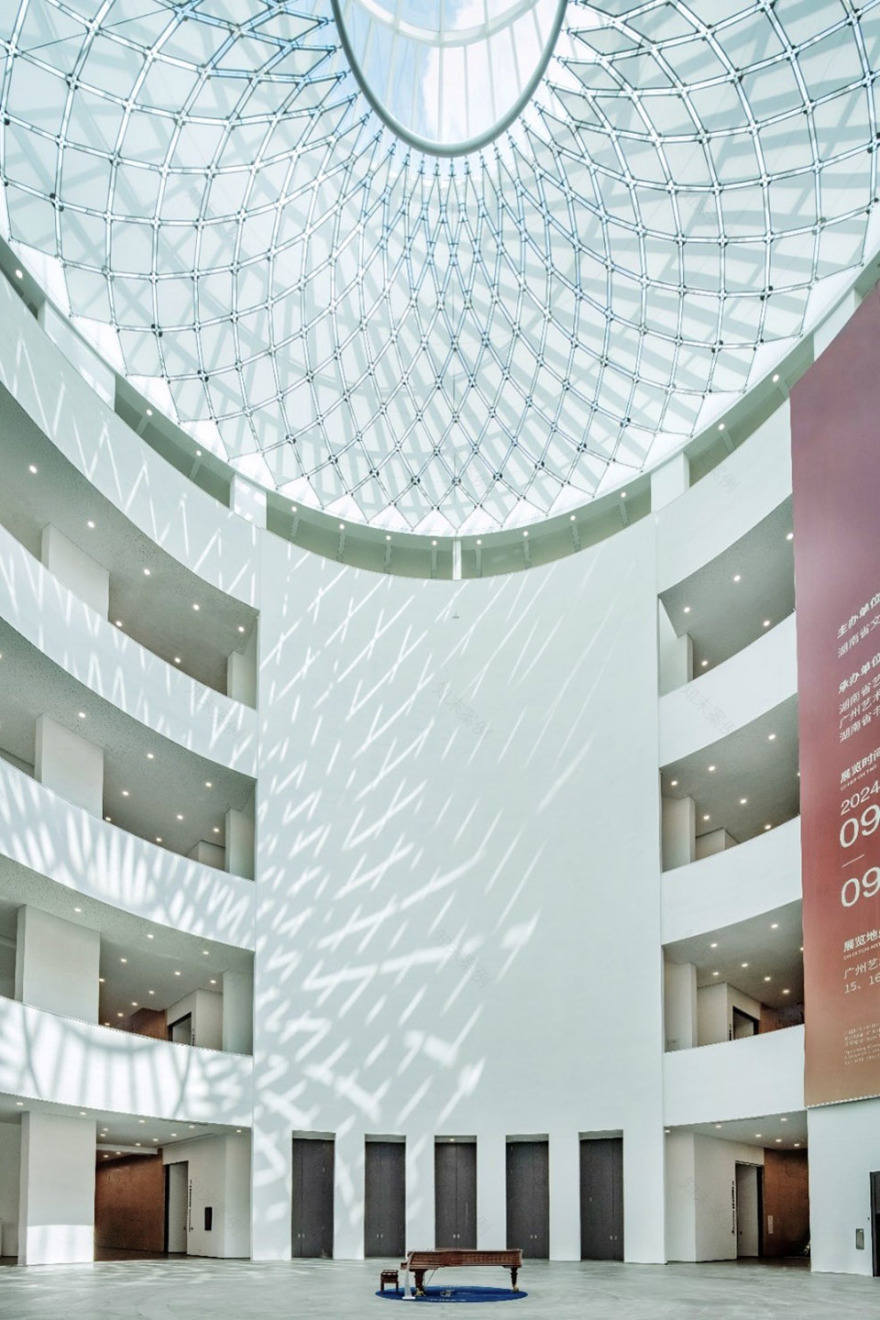

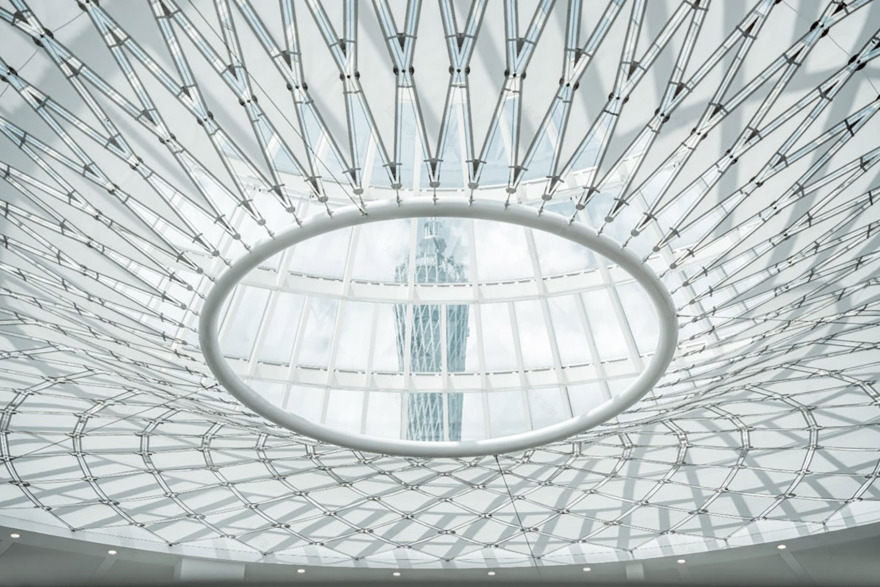
广州美术馆以中央45米通高的圆柱形采光中庭来组织各层展厅的参观流线,是一个具有多功能用途的核心空间。中庭玻璃穹顶宽广开阔,下方设置了索膜结构的固定索膜遮阳系统进行光线调节。中庭索膜遮阳系统轻盈且富有张力,不但隔绝太阳热辐射,也优化了中庭的自然光线和声学效果,结合通风天窗系统,大幅减少人工照明与空调需求,构建出宜人的艺术活动空间。白日里自然光透过玻璃穹顶从45米的空中洒入建筑室内,穹顶天窗的遮阳系统可对光线过滤,保留有利的自然天光,为五层通高的中庭披上柔和的光影面纱,阳光穿透玻璃穹顶洒落柔和与温暖,展现了馆内的静穆感。不同的光影给建筑内部带来了不同的感受。正午时分,阳光洒下,在中庭的地面绘制了一个舞台,位于四至五层之间的“阳光楼梯”,宛如时光的长廊。五层中庭环廊处可将广州塔全貌尽收眼底,与“小蛮腰”一起拍出曼妙身姿。
The Guangzhou Museum of Art uses a central 45-meter-high cylindrical lighting atrium to organize the circulation through the exhibition halls on various floors, serving as a multi-functional core space. The glass dome of the atrium is vast and open, with a cable-membrane fixed sunshading system installed below for light regulation. The atrium cable-membrane sunshading system is light and tensile, not only blocking solar heat radiation but also optimizing natural light and acoustics in the atrium. Combined with the ventilation skylight system, it significantly reduces the need for artificial lighting and air conditioning, creating a pleasant space for art activities. During the day, natural light pours into the building interior through the glass dome from 45 meters high. The sunshading system of the dome skylight filters the light, retaining favorable natural daylight, casting a soft veil of light and shadow over the five-story high atrium. Sunlight penetrating the glass dome sheds softness and warmth, showcasing the solemnity of the interior. Different light and shadow bring varied sensations to the building’s interior. At noon, sunlight spills down, drawing a stage on the atrium floor. The “Sunlight Staircase” between the fourth and fifth floors resembles a corridor of time. From the fifth-floor atrium gallery, one can take in the full view of the Canton Tower, capturing graceful postures of the “Slender Waist (a nickname of the Canton Tower). ”
▼五层雕塑展廊 Fifth-floor sculpture gallery © 卓泓铎

▼中庭与广州塔铎,Atrium and Canton Tower © 卓泓铎
设计引领的建筑美学与技术融合
Integration of Architectural Aesthetics and Technology Led by Design
广州美术馆根据特点的岭南气候特点,建筑设计以绿色节能设计为主要出发点,打造具有时代特色,独具特色的绿色建筑。广州美术馆按国家绿色建筑3星标准进行设计,全方位集成了绿色技术体系。
Based on the characteristic Lingnan climate, the architectural design of the Guangzhou Museum of Art takes green and energy-saving design as the main starting point, aiming to create a green building with contemporary characteristics and unique features. The museum was designed according to the National Green Building 3-Star standard, integrating a comprehensive green technology system.
▼屋顶的彩色光伏系统矩阵,Matrix of colored photovoltaic system on the roof ©卓泓铎

项目全部采用中国自有知识产权的碲化镉薄膜光伏发电技术,除了光电转换效率高之外,也具有灵活多变的可塑性,能更加有效地与建筑外观的进行一体化设计,实现建筑科技与美学的完美融合。项目屋面及立面均采用光伏技术,是全球首个五个立面均采用光伏技术的博物馆类公共建筑。
▼绿色建筑技术集成,Green building technology integration
© 德国赫尔佐格与合伙人建筑设计事务所+华南理工大学+广东省建筑设计研究院集团股份有限公司

The project fully adopts China’s proprietary cadmium telluride (CdTe) thin-film photovoltaic power generation technology. Besides high photoelectric conversion efficiency, it also offers flexible and variable plasticity, allowing more effective integration with the building’s appearance, achieving a perfect fusion of building technology and aesthetics. Both the roof and facades utilize photovoltaic technology, making it the world’s first museum-type public building to employ photovoltaic technology on all five facades.
▼光伏幕墙局部细节,Detail of photovoltaic facade ©广州艺术博物院
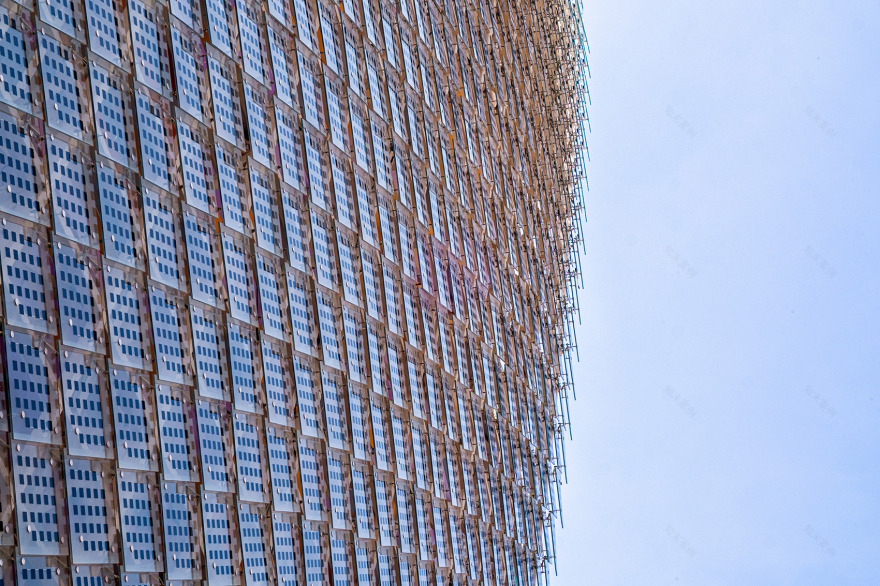
立面采用21008块碲化镉薄膜光伏组件,总计15560平方米。立面光伏组件采用激光刻画技术进行了加工处理,增加了其通透性,实现了光伏组件与彩色铝板双层叠加的特殊外观效果,可跟随光环境的变化而不断变换;屋面采用2970块新型彩色光伏组件,总计2078平方米,由六种色彩的光伏组件组成的阵列,确保了广州美术馆作为广州新中轴线一侧重要公共建筑的第五立面效果。整套光伏系统总装机容量303.8kWp,所发电量主要供建筑内照明等使用,项目总装机容量发电效率达到示范性标准。
The facades use 21,008 cadmium telluride thin-film photovoltaic modules, totaling 15,560 square meters. The facade modules were processed using laser etching technology to increase their transparency, achieving a special appearance effect with the double layer of photovoltaic modules and colored aluminum panels, which constantly changes with the light environment. The roof uses 2,970 new colored photovoltaic modules, totaling 2,078 square meters. The array composed of photovoltaic modules in six colors ensures the effect of the fifth facade for the Guangzhou Museum of Art as an important public building on Guangzhou’s new central axis. The entire photovoltaic system has a total installed capacity of 303.8 kWp, and the electricity generated is primarily used for lighting within the building. The power generation efficiency of the project’s total installed capacity meets demonstrative standards.
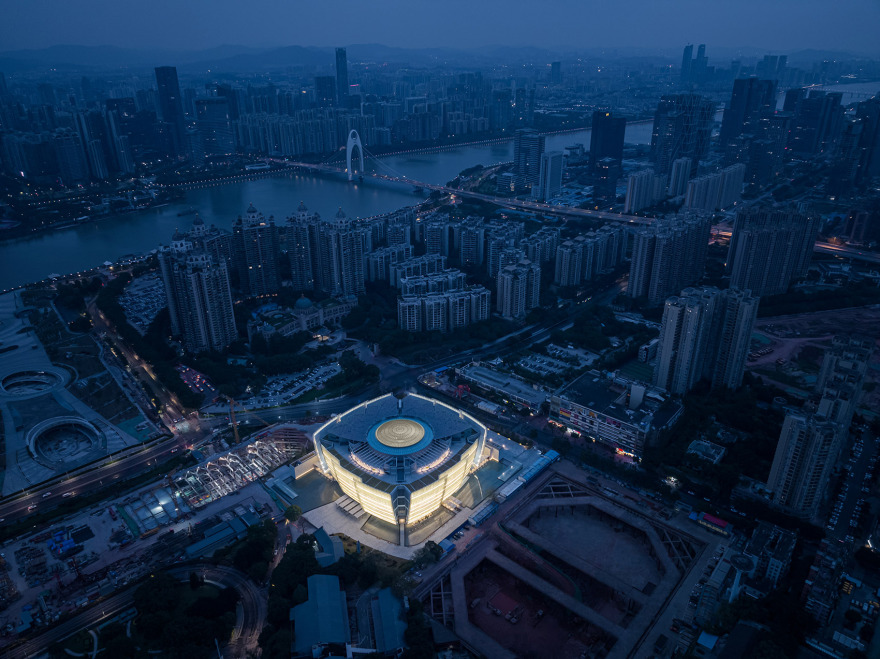
▼鸟瞰夜景,Aerial night view © 楼洪忆
广州美术馆的常规舒适性空调采用了区域冷站供冷技术,移峰填谷,节约运维成本;减少了机房及设备建设成本;减少噪音、废水污染,降低区域环境温度,美化景观环境。
The conventional comfort air conditioning of the Guangzhou Museum of Art adopts district cooling station technology, shifting peak loads and saving operational costs; it reduces construction costs for equipment rooms and machinery; decreases noise, wastewater pollution, lowers the ambient temperature of the area, and beautifies the landscape environment.
▼发光的立面,lightning facade © 楼洪忆

广州美术馆项目照明光源(除藏品库等特殊要求)均采用LED光源,公共区域照明采用智能照明调光控制系统,对照明系统进行分区、分时、调光等精细化控制。广州美术馆采用海绵城市的设计理念,设置绿色屋顶、下沉绿地、透水铺装、景观水池及雨水调蓄池等对雨水进行径流控制,使雨水径流量不超过原径流量;并对屋面雨水进行收集回用,用于绿化、水景补水及冲洗地面,节约了水资源。
The lighting sources for the Guangzhou Museum of Art project (except for special requirements like collection storage) all use LED sources. Public area lighting employs an intelligent lighting dimming control system for zoned, timed, and dimmed precise control.The Guangzhou Museum of Art incorporates the design concept of sponge city, setting up green roofs, sunken green spaces, permeable pavements, landscape pools, and rainwater storage tanks to control runoff, ensuring that stormwater runoff does not exceed the original runoff volume. Roof rainwater is collected and reused for greening, water feature replenishment, and floor cleaning, conserving water resources.
▼夜览,night view© 楼洪忆


广州美术馆以设计为引领,将绿色技术转化为建筑的人文表达与气候策略,证明了大型公共建筑可实现艺术性与可持续性的统一。其技术集成创新不仅为行业树立新标杆,更深刻体现了文化建筑作为城市文明载体与生态责任担当的当代使命,为全球文化建筑的可持续发展提供中国案例。
Guided by design, the Guangzhou Museum of Art transforms green technology into architectural humanistic expression and climate strategy, demonstrating that large public buildings can achieve the unity of artistry and sustainability. Its technological integration and innovation not only set a new benchmark for the industry but also profoundly reflect the contemporary mission of cultural buildings as carriers of urban civilization and bearers of ecological responsibility, providing a Chinese case for the sustainable development of global cultural buildings.
▼总平面图,master plan © 德国赫尔佐格与合伙人建筑设计事务所+华南理工大学+广东省建筑设计研究院集团股份有限公司

▼平面图,plan © 德国赫尔佐格与合伙人建筑设计事务所+华南理工大学+广东省建筑设计研究院集团股份有限公司

▼剖面图,section© 德国赫尔佐格与合伙人建筑设计事务所+华南理工大学+广东省建筑设计研究院集团股份有限公司

项目名称:广州美术馆
项目类型:文化建筑、公共建筑
设计方:德国赫尔佐格与合伙人建筑设计事务所+ 华南理工大学+广东省建筑设计研究院集团股份有限公司
项目设计:2013
完成年份:2023
建筑设计团队:德国赫尔佐格与合伙人建筑设计事务所团队: Thomas Herzog, Roland Schneider, Lingyun Zhang 华南理工大学团队:孙一民,叶伟康,陶亮,梁艳艳、李海全、徐莹、夏晟、邹林、汪奋强,章艺昕,黄祖坚
项目地址:广东省广州市海珠区
建筑面积:79453.1㎡
摄影版权:楼洪忆、卓泓铎、广州艺术博物院
客户:广州市重点公共建设项目管理中心
南京喵熊网络科技有限公司 苏ICP备18050492号-4知末 © 2018—2020 . All photos and trademark graphics are copyrighted by their owners.增值电信业务经营许可证(ICP)苏B2-20201444 苏公网安备 32011302321234号
苏公网安备 32011302321234号客服
消息
收藏
下载
最近