

创作上传
VIP
收藏下载
登录 | 注册有礼
查看完整案例

收藏

下载

分享
在北京二环内,2025年5月开业的大吉巷商区迅速成为城市更新的典范,它将历史文脉与现代商业巧妙融合,形成了独特的文化消费场域。大吉巷的市政公共厕所(以下简称“大吉公厕”)便落座在这片充满活力的区域中,这看似普通的市政设施,经过精心设计后,成为了连接过去与现在的特殊媒介,设计以消隐与反射的手法与毗邻的康有为故居展开了一场跨越时空对话。
Within Beijing’s Second Ring Road, the Daji Lane commercial district, which opened in May 2025, has quickly become a model of urban renewal, skillfully blending historical context with modern commerce to create a unique cultural consumption destination. Nestled within this vibrant area is the Daji Lane Municipal Public Toilet (hereinafter referred to as “Daji Public Toilet”). This seemingly ordinary municipal facility, through meticulous design, becomes a unique medium connecting past and present. Through techniques of obscuration and reflection, the design engages with the adjacent Kang Youwei Former Residence, creating a dialogue across time and space.
▼左侧为大吉公厕,右侧为康有为故居,On the left is the Daji public toilet, and on the right is Kang Youwei’s former residence© UK STUDIO

项目挑战:兼顾历史性与现代性
Project Challenge: Balancing historicity and modernity
大吉公厕位于北京地铁菜市口站C口附近,紧邻康有为故居这一重要历史遗产。康有为故居是了解中国近代史特别是戊戌变法运动的重要窗口,见证了康有为不同的人生阶段,具有很高的历史和文化价值。虽然大吉公厕并不是文化遗产保护对象,但地理位置决定了它必须回应这一特殊历史文脉。同时,大吉巷商区的现代商业气质也要求大吉公厕具备科技、时尚等符合现代生活的属性。
▼大吉公厕区位分析,Location Analysis of Daji Public Toilets©DAGA Architects

The Daji Public Toilet is located near Exit C of Caishikou Station on the Beijing Subway, adjacent to the historic Kang Youwei Residence. This residence serves as a crucial window into modern Chinese history, particularly the Hundred Days’ Reform, and bears witness to the various stages of Kang Youwei’s life, thus possessing profound historical and cultural value. While not designated a cultural heritage site, the Daji Public Toilet’s location necessitates its integration into this unique historical context. Furthermore, the modern commercial atmosphere of the Daji Lane commercial district necessitates that the Daji Public Toilet incorporate technological and fashionable features that align with modern living.
▼在菜市口大街人行道看向大吉公厕,Looking towards the Daji public toilet from the sidewalk of Caishikou Street© UK STUDIO

原公厕是一个造型简单的方形建筑,外立面采用双拼瓷砖,缺乏性格特色。原公厕与康有为故居之间的通道仅1.3米宽,而公厕高度达4.5米,人们通过时会感到显著的压迫感。原室内布局采用了较长的走廊和高窗,室内光线不足且闭塞感强,降低了人们的使用意愿。▼改造前公厕,the public toilet before renovation©DAGA Architects


The original public toilet was a simple square building with a double-tile facade, lacking any distinctive character. The passageway between the original public toilet and Kang Youwei’s former residence was only 1.3 meters wide, while the public toilet was 4.5 meters high, creating a noticeable sense of oppression when passing through. The original interior layout featured long corridors and high windows, resulting in insufficient light and a sense of enclosure, which discouraged use.
▼大吉公厕与镜面中的康有为故居,Daji Public Toilet and Kang Youwei’s Former Residence in the Mirror©UK Studio

设计策略:以镜面为媒介的历史对话
Design Strategy: Historical Dialogue Using Mirrors as a Medium
我们的核心策略是给大吉公厕套上一个“镜面盒子”,既能在消隐本身的同时倒映出边上的康有为故居,形成与历史的空间对话,又具备现代气质,实现历史性与现代性兼顾。
Our core strategy is to put a “mirror box” on the Daji public toilet, which can not only disappear itself but also reflect the former residence of Kang Youwei next to it, forming a spatial dialogue with history, but also have a modern temperament, achieving a balance between historicity and modernity.
▼消隐在环境中的大吉公厕,Daji public toilet hidden in the environment©UK Studio

外部设计:反射与消隐
Exterior Design: Reflective and Invisible
大吉公厕外的镜面盒子由上千个单向镜面玻璃片组成,倒映出一旁的康有为故居。在菜市口大街边的行人能自然地看到大吉公厕和镜面盒子中的康有为故居,在不经意间与历史相遇。
The mirrored box outside the Daji public toilet is composed of thousands of one-way mirrored glass panels, reflecting Kang Youwei’s former residence nearby. Pedestrians along Caishikou Street can naturally see the Daji public toilet and Kang Youwei’s former residence in the mirrored box, inadvertently encountering history.
▼镜面细部,Mirror details©UK Studio


细节上,上千片230*230毫米尺寸的单向镜面玻璃和不锈钢部件互相搭配,现代感十足,与大吉巷商区的时尚气质相呼应。▼镜面细部分析图,Mirror detail analysis diagram©DAGA Architects

In terms of details, thousands of 230*230 mm one-way mirrored glass and stainless steel components are matched with each other, which is full of modern sense and echoes the fashionable temperament of Dajixiang commercial district.
▼镜面盒子上的砖纹金属格栅,Brick-patterned metal grille on mirrored box©UK Studio

镜面在视觉上拓宽了大吉公厕与康有为故居之间狭窄的过道,有效缓解了行人在过道中感到的压迫感。此外,镜面盒子让公厕消隐在环境中,减少其对历史、商业片区的侵扰。
▼镜面盒子轴测分析图,Axonometric analysis of mirrored box©DAGA Architects

The mirrored surface visually widens the narrow passageway between the Daji Public Toilet and Kang Youwei’s former residence, effectively alleviating the sense of oppression felt by pedestrians in the corridor. Furthermore, the mirrored box allows the public toilet to blend seamlessly into the surroundings, minimizing its intrusion into the historic and commercial district.
▼砖纹金属格栅细部,Brick pattern metal grille detail©UK Studio


公厕的北面是菜市口地铁站的排风建筑,无法通行,所以我们在公厕的北立面采用了大吉祥商区已使用的砖纹金属格栅,保证视觉元素统一,兼顾造价的经济性。
To the north of the public toilet is the exhaust building of Caishikou subway station, which is inaccessible. Therefore, we adopted the brick-patterned metal grille already used in Dajixiang Commercial District on the north facade of the public toilet to ensure the unity of visual elements and take into account the economical cost.
▼消隐在环境中的大吉公厕,Daji public toilet hidden in the environment© UK STUDIO

室内设计:现代性与趣味性
Interior Design: Modernity and Fun
大吉公厕的公区的被调整至居中,便于满足男卫、女卫、无障碍厕所和管理室的现代功能布局,改善了空间效率与流线。管理室和无障碍卫生间的墙体和开门采用切角设计,使空间转角更加柔和,提升了室内通行的舒适与安全。
▼原布局与新布局对比,Comparison between the original layout and the new layout©DAGA Architects
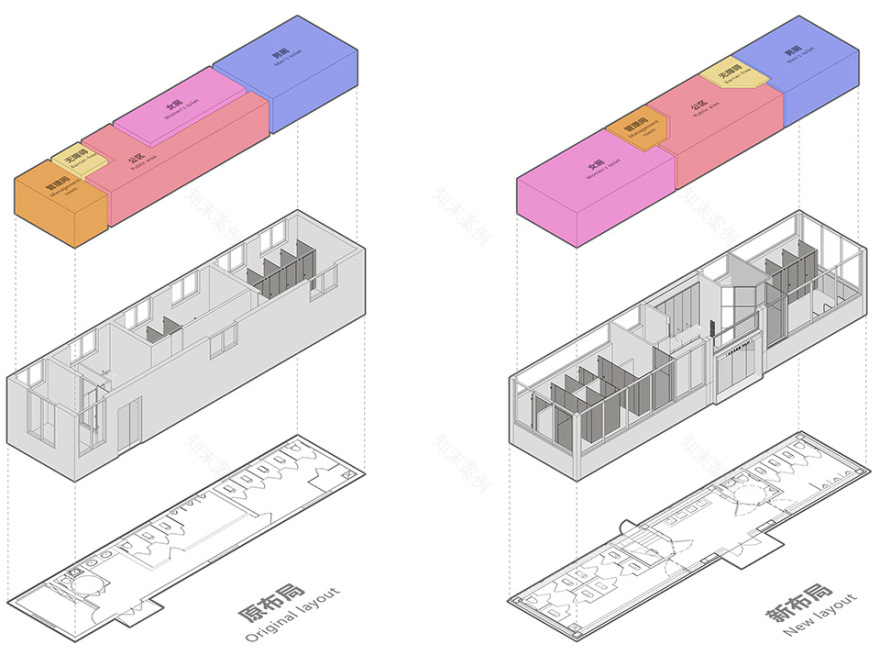
The public area of the Daji public restroom has been relocated to the center, accommodating the modern functional layout of men’s and women’s restrooms, accessible restrooms, and an administrative office, improving spatial efficiency and flow. The walls and doors of the administrative office and accessible restrooms feature a chamfered design, softening the corners and enhancing comfort and safety within the space.
▼室内公区,Indoor public area©UK Studio


室内采用了岩板、可丽耐、不锈钢、玻璃等现代材质,兼顾耐用且易于维护;公区部分采用灰色小砖与铝格栅吊顶,与外立面的方形小玻璃的元素相呼应。此外,室内采用了智慧公厕系统,如激光人体感应器、环境一体机、智慧公厕管理平台等,能实时监测厕位使用状态、环境数据等,提升管理效率与用户体验满足现代生活的审美和功能需求。
The interior utilizes modern materials such as slate, Corian, stainless steel, and glass, ensuring durability and ease of maintenance. Public areas feature a gray brick and aluminum grille ceiling, echoing the square glass elements of the exterior facade. Furthermore, a smart public restroom system, including laser motion sensors, integrated environmental monitoring systems, and a smart public restroom management platform, monitors toilet usage and environmental data in real time, improving management efficiency and user experience while meeting the aesthetic and functional needs of modern life.
▼室内洗手台区细部及灰色小砖与铝格栅吊顶细部,Indoor sink area details and Gray brick and aluminum grille ceiling details©UK Studio


在白天,室外光线强于室内,由于外立面上的镜面盒子采用了单向镜面玻璃,人们在室外看到的是镜面反射出的环境,保证了公厕室内的隐私;人们在室内则能透过单向镜面玻璃看到室外的景色,视野通透,没有了原公厕室内空间的昏暗闭塞感。
▼智慧公厕器件分析,Analysis of Smart Public Toilet Devices©DAGA Architects

During the day, the light outside is stronger than that inside. Since the mirror box on the facade uses one-way mirror glass, people outside can see the environment reflected by the mirror, ensuring the privacy of the public toilet. People inside can see the outdoor scenery through the one-way mirror glass, with a clear field of vision and no longer having the dim and closed feeling of the original public toilet interior space.
▼室内视野十分通透,The indoor view is very transparent©UK Studio

室内的窗下墙高度设定在1.2米,确保大多数使用者在使用设施时能够看到外部景色。此外,男厕小便槽特意设置在面向康有为故居的墙面上,人们在如厕过程中意外地与历史遗产产生趣味的互动。这种布局不仅考虑了功能,更将如厕这一日常行为转化为一种文化体验,是一次挑战传统公厕设计边界的大胆尝试。不过,夜晚室外亮度低于室内,室外的人便能看到公厕室内,带来隐私问题。于是,我们在镜面盒子内增设了一道电雾化玻璃窗,在白天为透明状态,到了夜间便可转变为模糊雾面,保障了人们在公厕夜间使用的隐私性。
▼剖面分析,Profile Analysis©DAGA Architects

The height of the wall under the window indoors is set at 1.2 meters to ensure that most users can see the outside scenery when using the facilities. In addition, the urinals in the men’s restroom are deliberately placed on the wall facing Kang Youwei’s former residence, so that people can unexpectedly have interesting interactions with historical heritage while using the toilet. This layout not only takes functionality into consideration, but also transforms the daily behavior of using the toilet into a cultural experience. It is a bold attempt to challenge the boundaries of traditional public toilet design. However, at night, the brightness outside is lower than that inside, and people outside can see into the interior of the public toilet, which brings privacy issues. Therefore, we added an electro-atomized glass window in the mirror box. It is transparent during the day and turns into a blurred fog at night, ensuring the privacy of people using the public toilet at night.
▼室内电雾化玻璃开、关对比图,Comparison of indoor electro-atomized glass on and off©UK Studio

结语
Conclusion
菜市口大吉巷公厕改造项目不仅是简单的功能性更新,更是一次城市公共设施设计的大胆探索,证明了公厕也可以成为文化传播的载体,使人们每一天的日常生活都有机会与文化记忆相遇,展现出历史文脉与现代设计语言共生的可能性。
The renovation project of the Daji Lane public toilet in Caishikou is not only a simple functional update, but also a bold exploration of urban public facility design. It proves that public toilets can also become a carrier of cultural communication, giving people the opportunity to encounter cultural memories in their daily lives, and showing the possibility of the coexistence of historical context and modern design language.
▼大吉公厕夜景,Night view of Daji public toilet©UK Studio
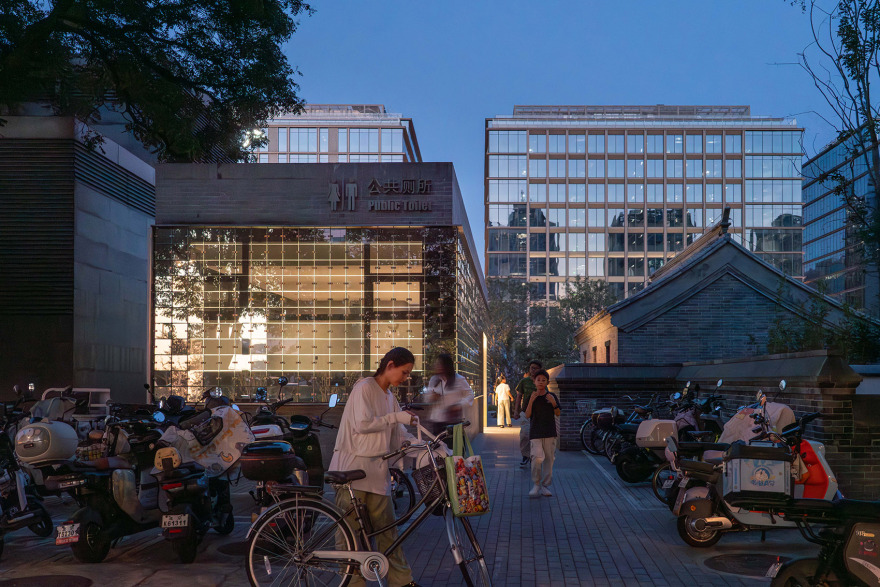

▼夜晚街景,Streetview at night©UK Studio


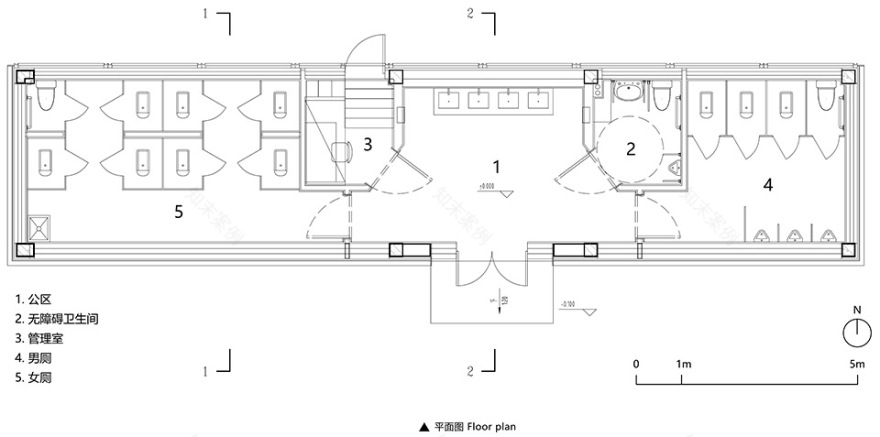
▼平面图,plan©DAGA Architects
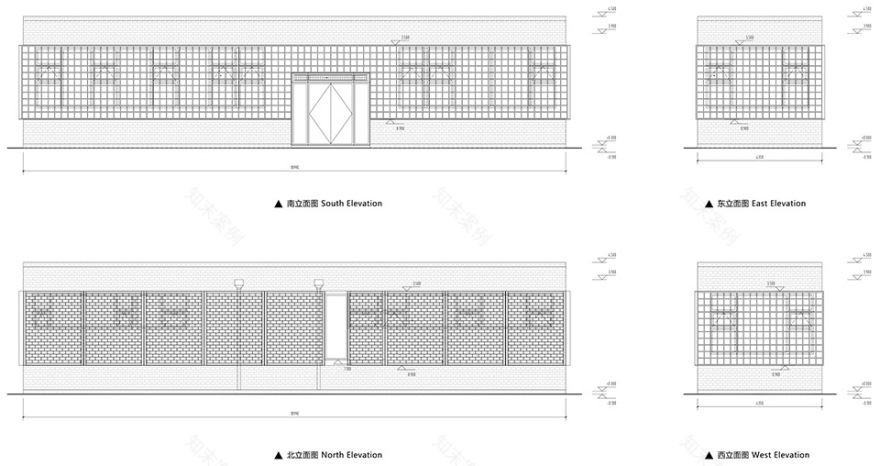
▼立面图,elevation©DAGA Architects
▼剖面图,section©DAGA Architects

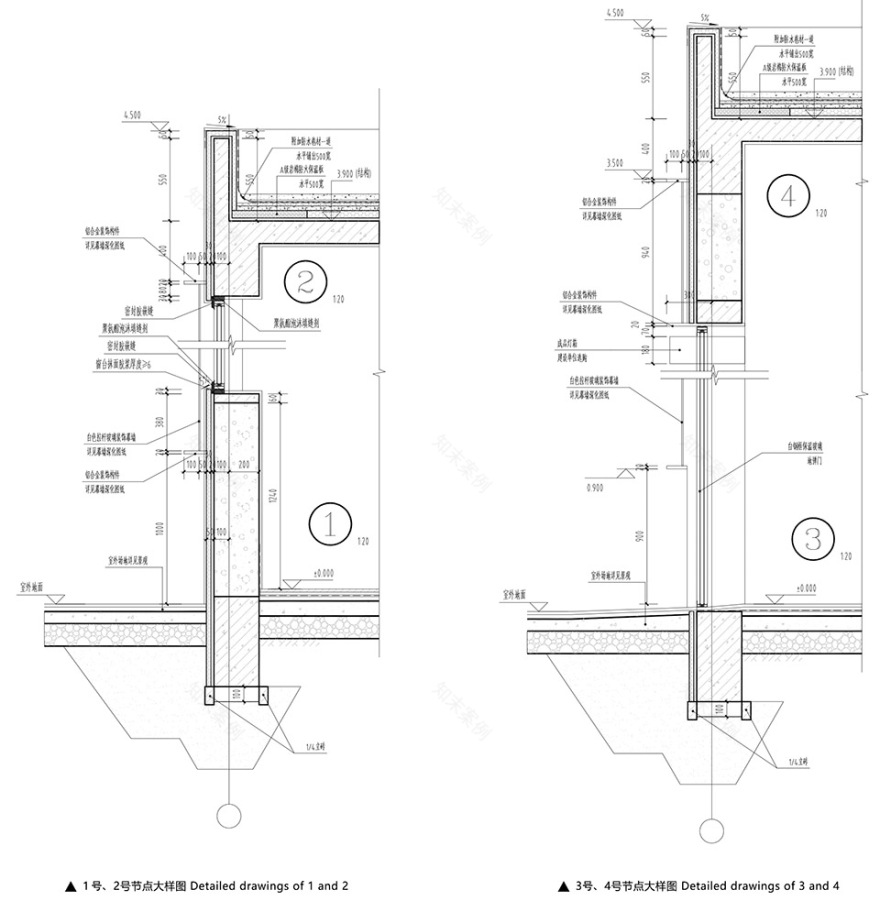
▼节点大样图,detail©DAGA Architects
项目名称:北京大吉巷公厕改造
项目类型:建筑改造/室内设计
开发公司:中海地产新城公司
业主团队: 王璞 张经纬 沙伶韶 杨勇
设计公司:DAGA大观建筑
设计团队: 任晓伟、金盾
设计面积:83平米
设计时间:2024年
项目摄影:UK Studio
材料:青砖,不锈钢,钢索,玻璃,镜子,岩板
标签:北京,建筑设计,室内设计
分类:公共空间,公厕,基础设施




南京喵熊网络科技有限公司 苏ICP备18050492号-4知末 © 2018—2020 . All photos and trademark graphics are copyrighted by their owners.增值电信业务经营许可证(ICP)苏B2-20201444 苏公网安备 32011302321234号
苏公网安备 32011302321234号客服
消息
收藏
下载
最近