

创作上传
VIP
收藏下载
登录 | 注册有礼
查看完整案例

收藏

下载

分享
生与死,是人类意识觉醒以来最根本的哲学命题。从西方宗教对灵魂不朽的笃信,到东方哲学对生死轮回的深刻思辨,不同文明都在探索生命终结之后意识与物质的归处。当代量子物理学对纠缠态与场域的研究显示,意识可能以量子态形式存在于宇宙场域中,这与中国古老的《黄帝内经》阐述的“形神俱妙”之说形成跨时空呼应。在此背景下,殡葬建筑超越其功能性的“终结”意义,成为承载人们精神活动与集体记忆的场所,成为抚慰心灵、连接生死、指向永恒的生命殿堂,是一项极具挑战与价值的设计实践。
Life and death are the most fundamental philosophical propositions since the awakening of human consciousness.From the firm belief in the immortality of the soul in Western religions to the profound contemplation of the cycle of life and death in Eastern philosophies, different civilizations have all been exploring the whereabouts of consciousness and matter after the end of life.Contemporary quantum physics research on entangled states and fields suggests that consciousness may exist in the form of quantum states within the cosmic field, which resonates with the ancient Chinese theory of “the unity of form and spirit” as expounded in the “Yellow Emperor’s Inner Canon”. Against this backdrop, funeral architecture transcends its functional significance of “termination”, becoming a place that carries people’s spiritual activities and collective memories, a sanctuary for comforting souls, bridging the gap between life and death, and pointing towards eternity. It is a highly challenging and valuable design practice.
▼项目鸟瞰,Bird ‘s-eye view of the project © 赵奕龙


▼项目顶视图,Top view of the project © 赵奕龙

▼项目概览,overview of the project © 赵奕龙
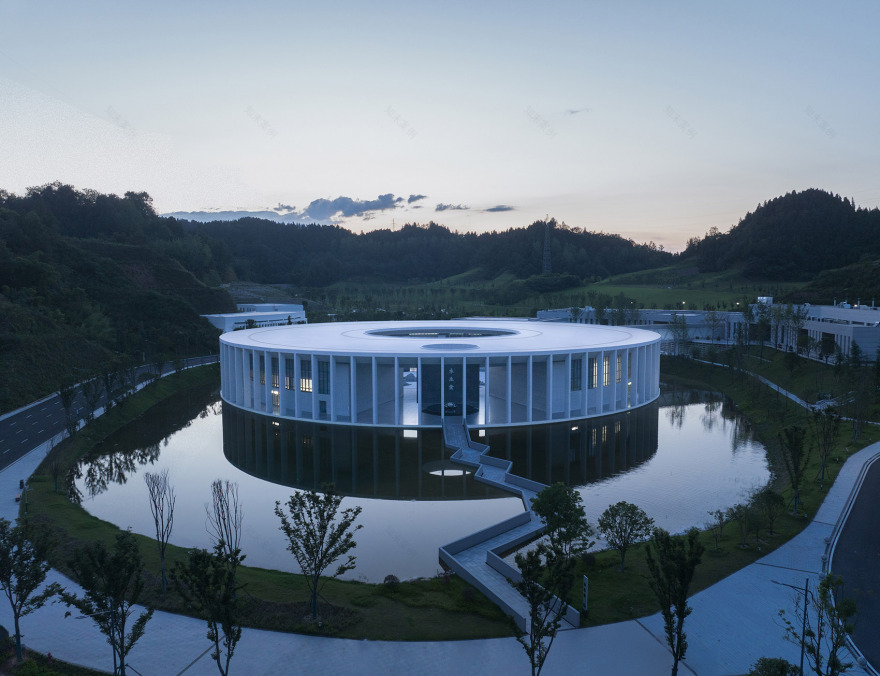

宜昌生命公园是宜昌市新建殡仪馆及公墓的所在地,位于宜昌市郊区三面环山的自然环境中。我们摒弃了常规殡仪馆的布局模式,深入解读场地等高线、水系走向、山体形态和植被特征,形成“依山就势,分散布置”的总体格局,建筑群严格遵循等高线错落有致地分散布置。这种谦逊的姿态最大限度地减少了对自然山体的破坏,使建筑宛如从土地中自然生长出来。
Yichang Life Park is the location of a newly-built funeral home and cemetery in Yichang, situated in a natural setting surrounded by mountains on three sides in the suburbs. We abandoned the conventional layout model of funeral homes and deeply interpreted the contour lines, water system direction and mountain shape of the site, forming an overall layout of “adapting to the terrain and scattered arrangement”. The building complex is arranged in a staggered manner along the contour lines, minimizing the damage to the natural mountains and making the buildings seem to grow out of the land.
▼入口处,entrance © 赵奕龙


▼外廊空间,corridor © 赵奕龙
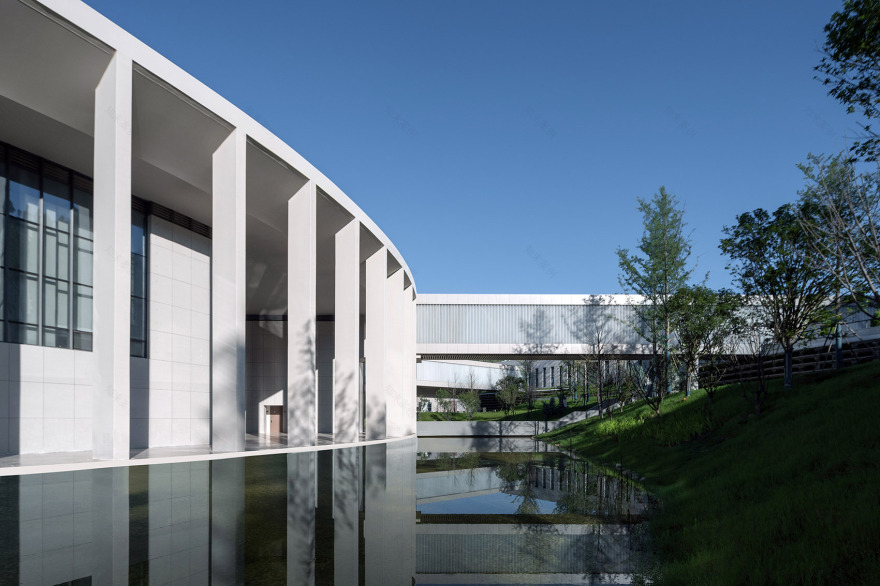
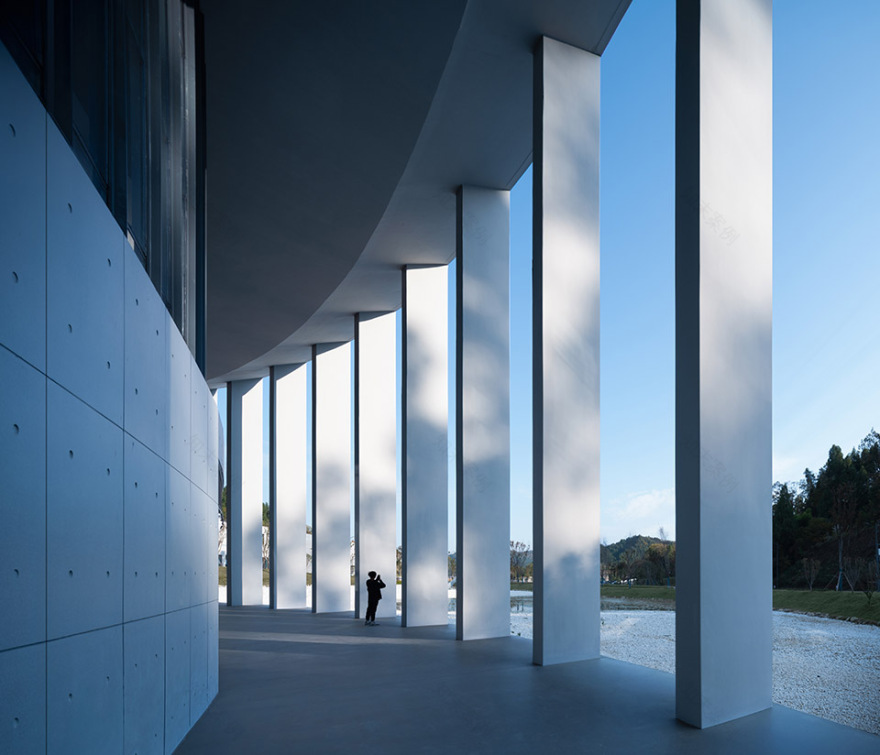
▼立面细部,facade details © 赵奕龙
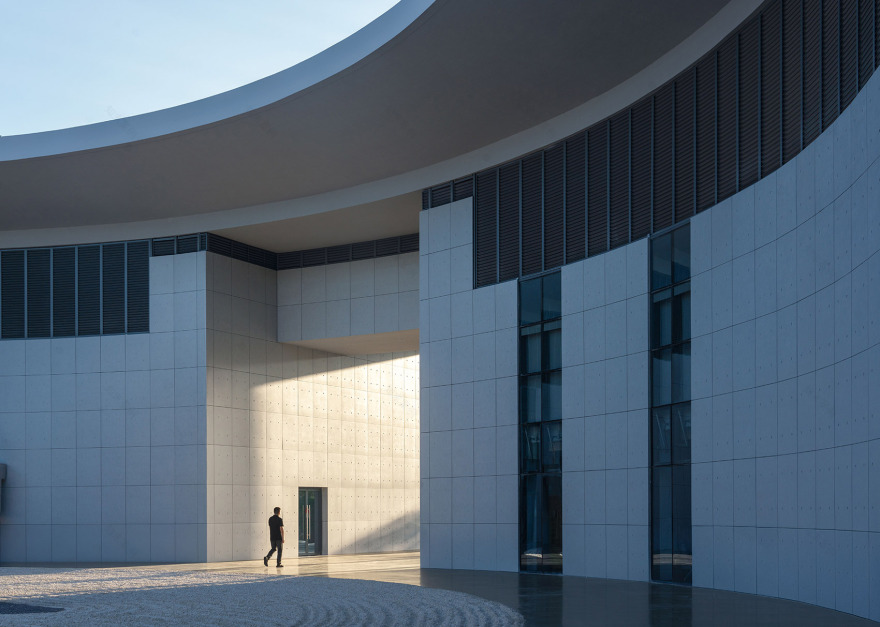
“永生堂”是宜昌生命公园殡仪馆建筑群的主题建筑,是为逝者守灵及举行悼念仪式的场所。我们将“永生堂”置于公园场地中平坦的低洼处,并巧妙地引山泉水汇聚而成人工湖环绕之,形成“水景在前,山景在后”的经典格局。“永生堂”的建筑空间与环境营造,融合了中国传统哲学思想(儒家的“慎终追远”、道家的“生死自然”、佛教的“轮回圆满”),遵循中国风水理论中建筑与环境关系的理想模式(山作为背景和依靠,象征稳定、庇护与永恒;水环绕堂前,象征聚集、流动,更隐喻生命之源与时间之流),吸取了中国文化“天人合一”的智慧,形成鲜明的精神内核。
“The Hall of Eternal Life” is the theme building of the Yichang Life Park Funeral Home complex. It serves as a place for keeping vigil for the deceased and holding memorial ceremonies. We placed “The Hall of Eternal Life” in the flat and low-lying area of the site and ingeniously led mountain spring water to form an artificial lake surrounding it, creating a classic layout of “water in front and mountains behind”. The architectural space and environmental design of “The Hall of Eternal Life” integrate traditional Chinese philosophical thoughts (Confucianism’s “diligence in the end and remembrance of the distant past”, Taoism’s “naturalness of life and death”, and Buddhism’s “reincarnation and completeness”), follow the ideal model of “mountains in front and water behind” in Chinese Feng Shui theory (mountains as the background and support, symbolizing stability, protection and eternity; water surrounding the hall in front, symbolizing aggregation and flow, and also metaphorically representing the source of life and the flow of time), and draw on the wisdom of “harmony between man and nature” in Chinese culture, forming a distinct spiritual core.
▼为逝者守灵及举行悼念仪式的场所,place for keeping vigil for the deceased and holding memorial ceremonies © 赵奕龙
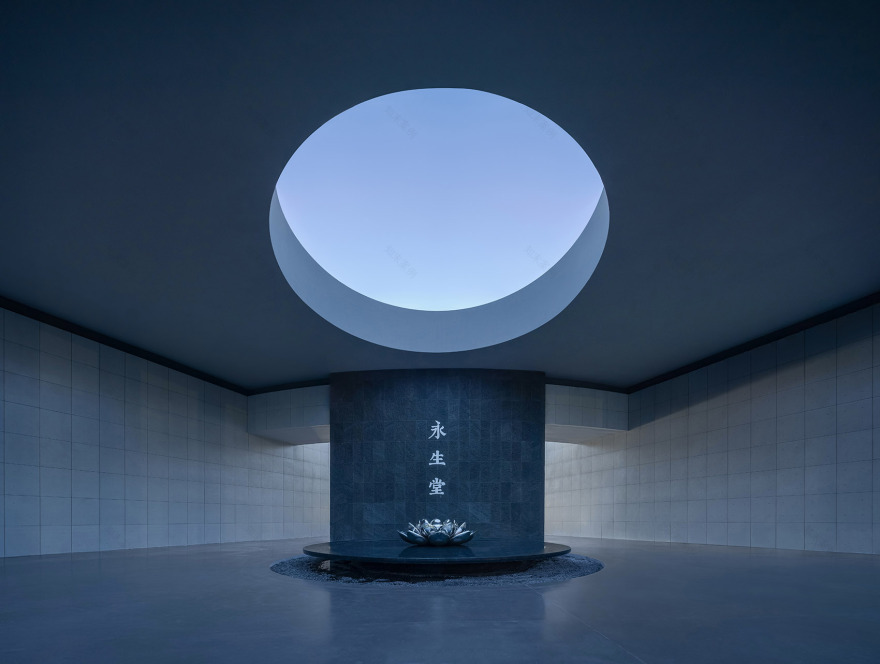
▼内庭院,inner courtyard © 赵奕龙


▼俯瞰内庭院,partial view © 赵奕龙


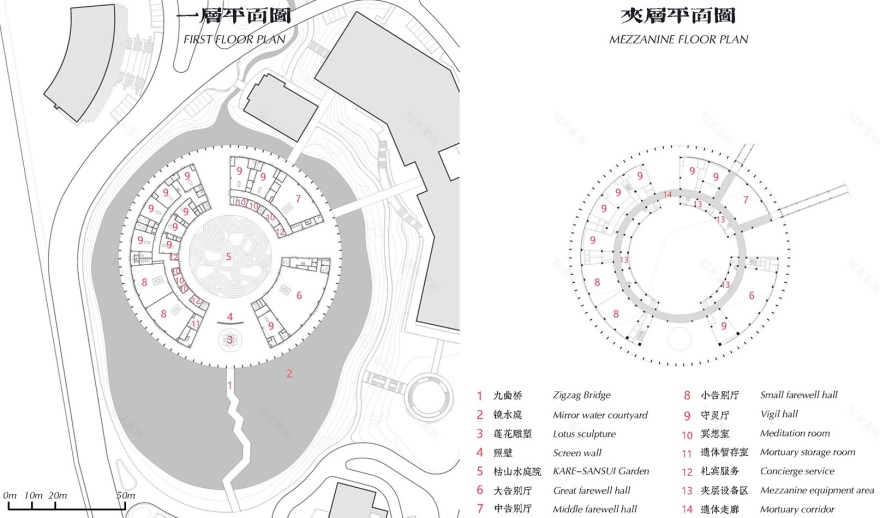
“永生堂”是从中国传统哲学思想的沃土中生长出来的当代建筑,以其对场地山水格局的尊重和创造性转译,并通过九曲桥、照壁、枯山水内庭院、环形柱廊等空间序列和场景,构建了强大而内敛的叙事逻辑。我们采用接近大自然的材料——清水混凝土,进行充满诗意的表达,诠释了“轮回”与“永恒”这一古老而深刻的东方命题。
“The Hall of Eternal Life” is a contemporary architectural work that has grown from the fertile soil of traditional Chinese philosophical thought. It respects and creatively interprets the landscape pattern of the site through a series of spatial sequences and scenes such as the zigzag bridge, the screen wall, the kare-sansui garden, and the circular colonnade, thus constructing a powerful yet reserved narrative logic. We have used natural materials like fair-faced concrete to poetically interpret the ancient and profound Eastern proposition of “reincarnation” and “eternity”.
▼殡仪馆室内空间,corridor © 赵奕龙


“永生堂”不仅仅是一个追思缅怀逝者的场所,更是一个承载集体记忆、引发生命哲思、抚慰生者心灵的精神殿堂。在山水的环抱中,在混凝土的静默里,“永生堂”以其独特的方式回应着人类对生死之谜的永恒叩问:生命或许如流水般逝去,但其精神将如同这循环的柱廊、这环绕的湖水、这亘古的山峦,融入宇宙自然的宏大循环,生生不息,永世回响。
“The Hall of Eternal Life” is not merely a place for mourning and remembering the deceased, but more importantly, a spiritual sanctuary that bears collective memories, inspires philosophical reflections on life, and comforts the souls of the living. Embraced by mountains and waters, amid the silence of concrete, “The Hall of Eternal Life” responds in its unique way to humanity’s eternal inquiry into the mystery of life and death: life may flow away like running water, yet its spirit will merge into the grand cycle of the universe and nature, like the circular colonnade, the surrounding lake, and the ancient mountains, continuing to thrive and echo through the ages.
▼细部,details © 赵奕龙

▼总平面图,master plan © 赵奕龙

▼平面图,plan © 赵奕龙
▼立面图,elevation © 赵奕龙

▼剖面图,section © 赵奕龙
项目名称:宜昌生命公园“永生堂”
项目类型:公共建筑
设计方:中南建筑设计院股份有限公司
项目设计:中南建筑设计院股份有限公司
设计团队:李春舫、戴维、伏果、朱文婷、肖璐瑶、王晟、熊森、刘柳、黄国胜、熊盛辉、邓宇凡、李成波、彭成、贾怡、曹涛、陈卓、高进
项目地址:湖北省宜昌市
建筑面积:20672.13㎡
摄影版权:赵奕龙
客户:宜昌城市更新投资开发有限公司
材料:清水混凝土挂板、玻璃幕墙、真石漆


南京喵熊网络科技有限公司 苏ICP备18050492号-4知末 © 2018—2020 . All photos and trademark graphics are copyrighted by their owners.增值电信业务经营许可证(ICP)苏B2-20201444 苏公网安备 32011302321234号
苏公网安备 32011302321234号客服
消息
收藏
下载
最近