

创作上传
VIP
收藏下载
登录 | 注册有礼
查看完整案例

收藏

下载

分享
褚氏农业作为中国现代农业的标志性品牌,核心种植基地位于云南省新平县哀牢山脉。哀牢山地处云南中部,属于典型的亚热带高原季风气候,昼夜温差极大,年日照时长超过2000小时,特有的红土含有丰富的矿物质。
Chu’s Agriculture, as an iconic brand of modern Chinese agriculture, has its core planting base located in the Ailao Mountains of Xinping. Situated in the central Yunnan, the Ailao Mountains feature a typical subtropical plateau climate, with extreme diurnal temperature variations, over 2,000 hours of annual sunshine, and unique red soil rich in minerals.
▼褚橙庄园生活中心庭院廊道,Chu Orange Manor Living Center courtyard corridor© 素造建筑


多年来,我们的业主对褚橙庄园内的唯一一处还保留着哀牢山原生树种的场地怀有特殊情感。出于对土地的珍视和对品牌文化的思考,业主决定在这片土地上,打造一个既能够体现褚氏农业的企业精神,又能表达乡土温度和时代感的多功能场所。如何处理场地原有的生态环境,特别是保留那些见证了褚橙庄园成长的原生树木成为我们设计的目标与挑战之一。
▼场地气候分析,site climate analysis© 素造建筑

For years, the owner has held a special affection for the only remaining site within the Chu Orange Manor that preserves the native tree species of the Ailao Mountains. Driven by a deep reverence for the land and reflections on brand culture, the owner decided to create a multifunctional space on this site—one that embodies the corporate spirit of Chu’s Agriculture while expressing both rural nostalgia and a contemporary sensibility. Our key design goals and challenges was to address the site’s existing ecological environment, particularly preserving the native trees that have witnessed the growth of the Chu Orange Manor.
▼位于哀牢山中的褚橙庄园生活中心,The Chu Orange Manor Living Center located in the mountain© 素造建筑

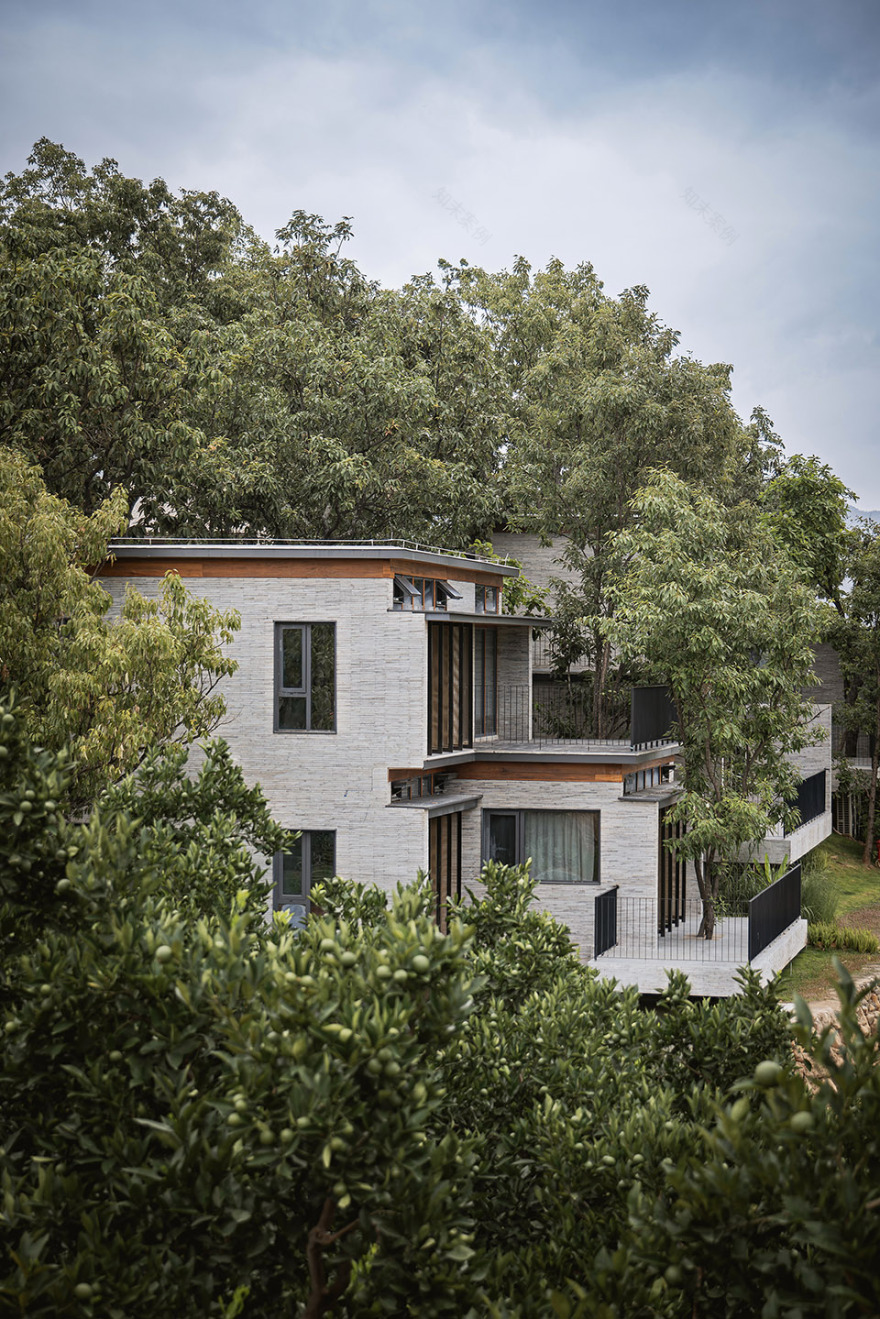
场地位于西南低-东北高的坡地上,呈现出鲜明的矛盾性:一方面,生态敏感较高,山地原生植被覆盖率超过80%。场地环境即为设计带来约束——要求建筑谨慎介入、最小化生态干扰,同时又成为我们设计灵感的来源——原生树种的空间分布暗示了建筑的布局逻辑。
The site is situated on a southwest-low to northeast-high sloping terrain, presenting a striking duality: on one hand, it is highly ecologically sensitive, with over 80% coverage of native mountain vegetation. The site’s conditions imposed constraints—requiring cautious architectural intervention and minimal ecological disruption—while simultaneously serving as a source of design inspiration. The spatial distribution of native trees informed the logical layout of the building.
▼内部庭院,Interior courtyard© 素造建筑

整体景观方面,山顶灌溉水池不仅承担着调节微气候的实用功能,更通过与哀牢山层叠轮廓的视觉呼应,形成了一条贯穿云海与山势的观赏轴线。气候适应性方面,哀牢山谷强烈的西晒与高湿度环境需要我们的设计考虑到遮阳、通风与防潮等基础问题;同时山地瞬息万变的局部气候特征,又要求建筑具备应对突发降雨和剧烈温差的调节能力。
▼场地观赏轴线,site viewing axis© 素造建筑

In terms of overall landscape design, the irrigation reservoir at the mountain peak not only serves the practical function of regulating the microclimate but also forms a visual axis connecting the sea of clouds and the mountain contours, echoing the layered silhouette of the Ailao Mountains. Regarding climate adaptability, the intense western sun exposure and high humidity of the Ailao valley necessitated design considerations for shading, ventilation, and moisture resistance. At the same time, the rapidly changing micro-climate demanded that the building be equipped to handle sudden rainfall and dramatic temperature fluctuations.
▼俯瞰褚橙庄园生活中心,aerial view of the Chu Orange Manor Living Center© 素造建筑

▼从湖对面看向褚橙生活中心,Looking at the Chu Orange Life Center from the opposite side of the lake© 素造建筑

▼褚橙庄园生活中心错落嵌入树林中,The Chu Orange Manor Living Center located in the woods© 素造建筑

1. 生态介入
Ecological Intervention
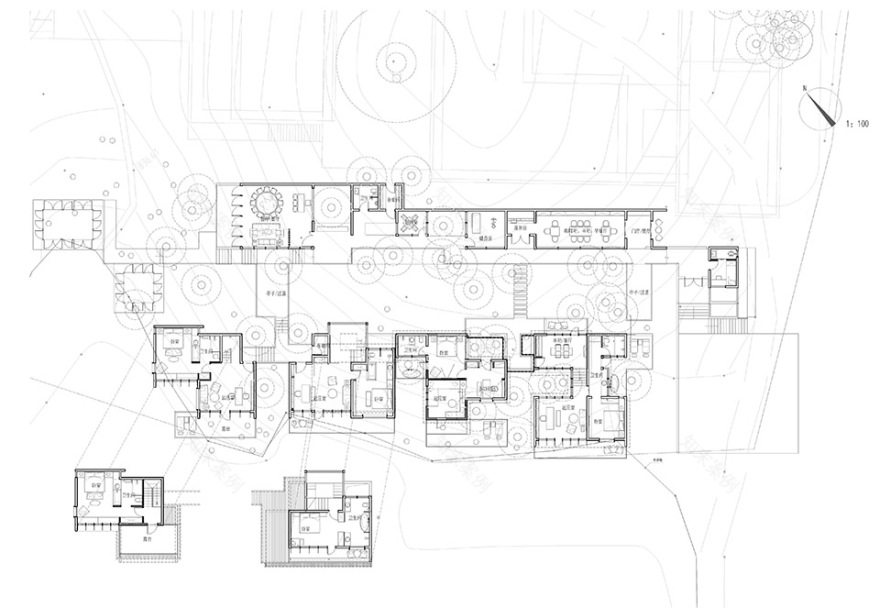
在场地地形和现状条件的基础上,我们结合每一棵树的位置将场地分为可建设用地、宜建设用地,不可建设用地。设计提出”以树为引”的理念,尊重现有树木的空间逻辑——廊道及公共区域依照树冠间隙展开分布,客房单元错落嵌入西边的林间坡地。建筑顺应根系分布形成最小干预的架空体系,最终呈现”镶嵌于林间”的有机聚落形态。
▼场地现状,site condition© 素造建筑
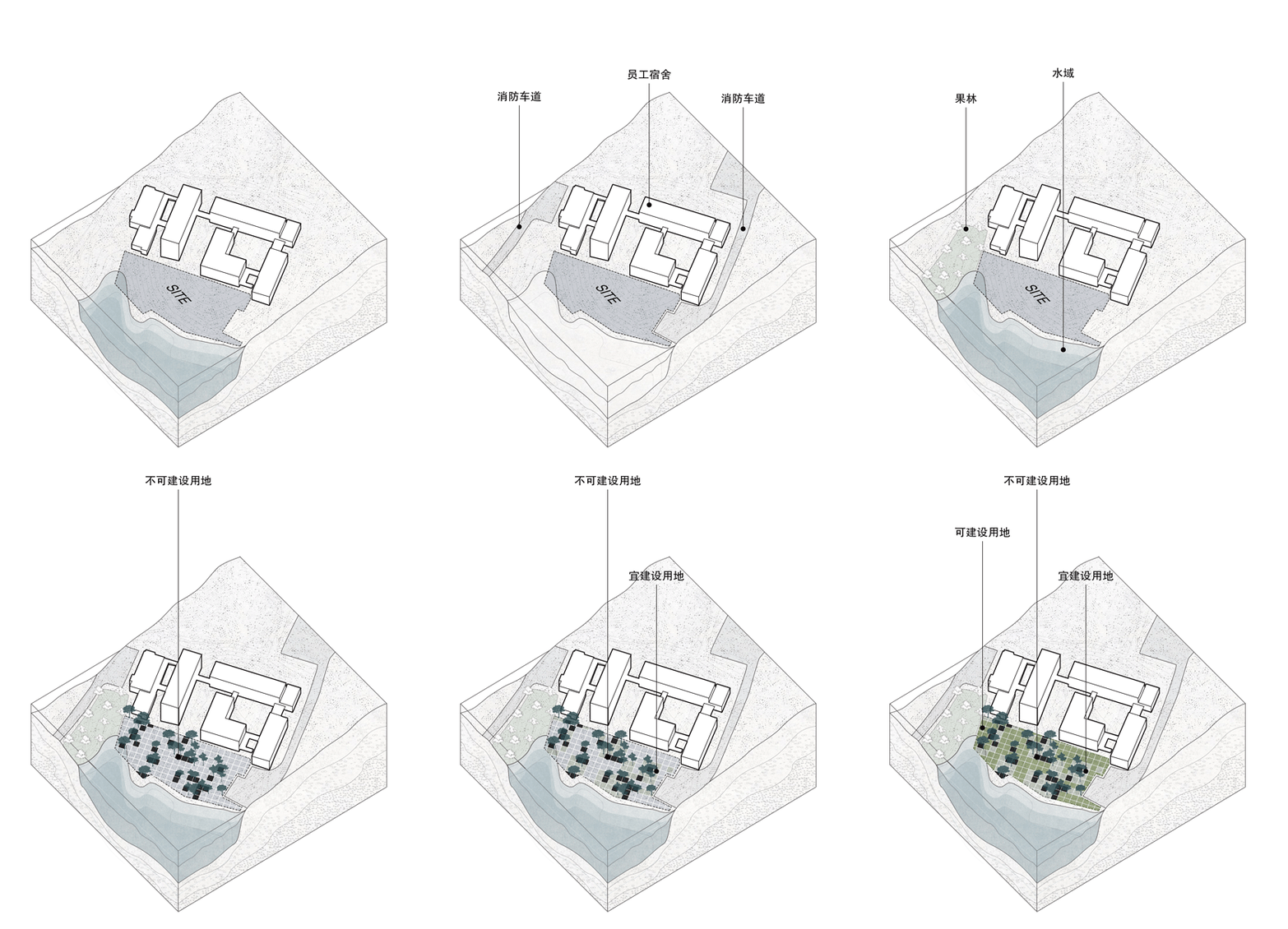
Based on the site’s topography and existing conditions, we categorized the land into buildable, conditionally buildable, and non-buildable zones according to the position of each tree. The design proposed a “tree-guided” concept, respecting the spatial logic of the existing trees—corridors and public areas were distributed within the gaps between canopies, while guest units were staggered and embedded into the western forested slope. The architecture follows the root distribution to form a minimally invasive elevated system, ultimately presenting an organic cluster-like form “inlaid within the forest.”
▼建筑与庭院,The building and courtyard© 素造建筑
经过结构选型的对比与研究,我们采用了装配式钢结构作为主体框架,既满足快速施工的需求,也更符合山地的运输条件。通过局部桩基和轻质基础处理,最大限度地减少对原生植被的破坏。▼场地生成,site development process© 素造建筑
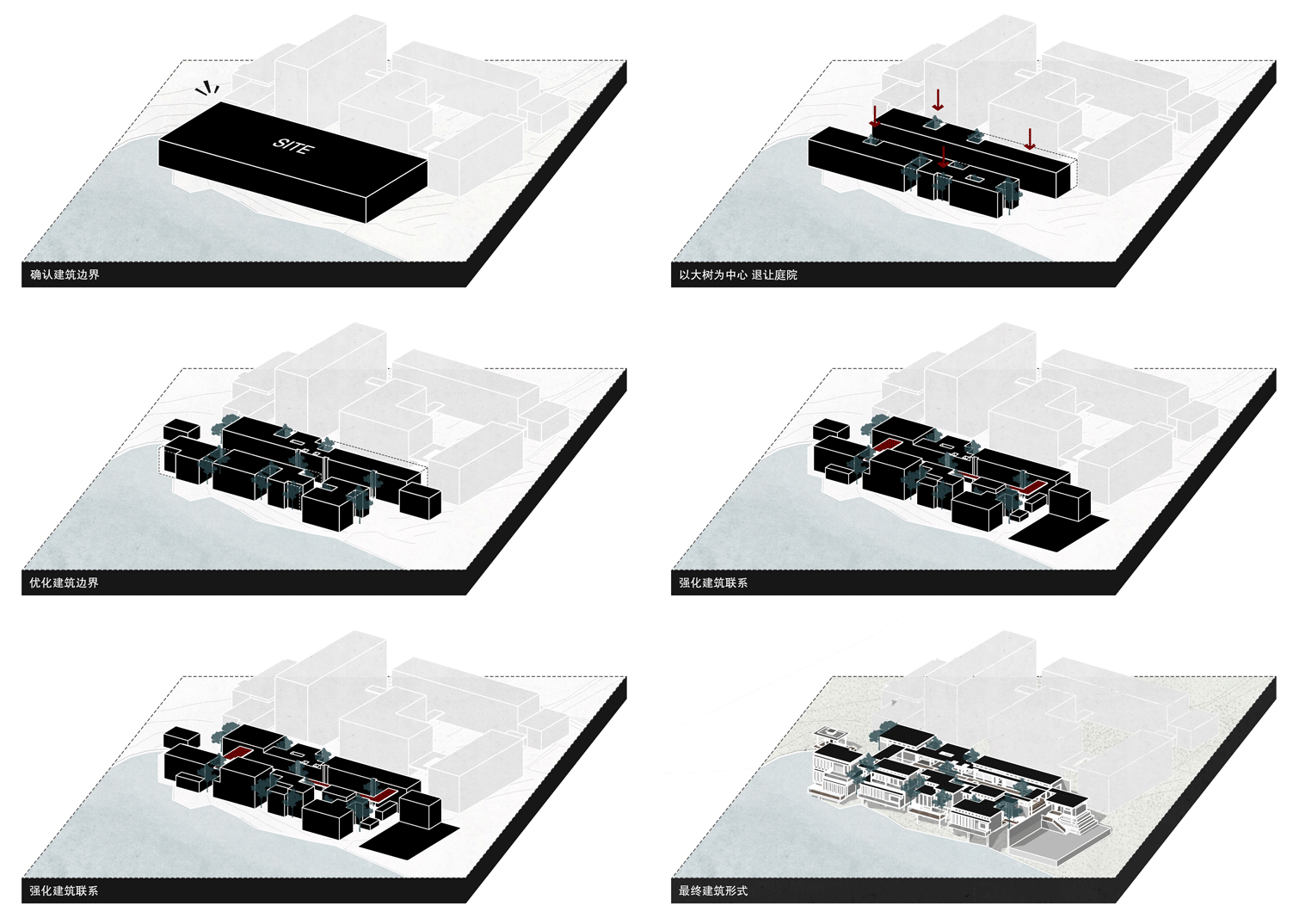
After comparative studies on structural options, we adopted a prefabricated steel framework as the main structure, which not only meets the need for rapid construction but also aligns with the transportation conditions of the mountainous terrain. Through localized piling and lightweight foundation treatments, we minimized disruption to the native vegetation.
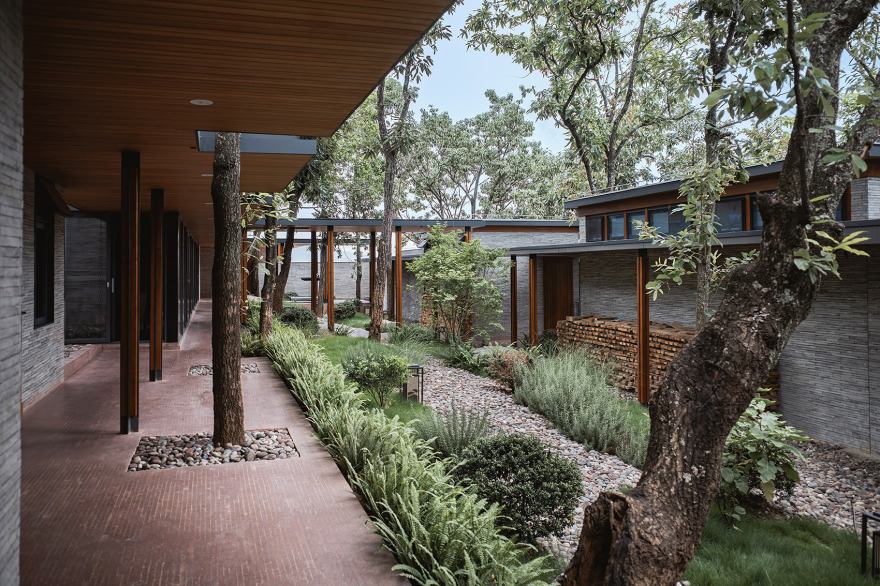
▼廊道十字柱与树,The corridor and trees© 素造建筑


为确保建筑与树木的共生关系,我们采用1:1现场脚手架实景模拟技术,结合平面放线数据,对每棵原生树木坐标锁定。为了保护树木的生长空间,廊道屋顶依据树冠生长轨迹进行开口处理,“刻意”形成”树穿屋面”的效果,同时增添了一份诗意的建筑语言。
To ensure a symbiotic relationship between the building and the trees, we employed 1:1 on-site scaffolding simulations combined with planar layout data to pinpoint the coordinates of each native tree. To protect the trees’ growth space, openings were deliberately designed in the corridor roof following the canopy’s growth trajectory, creating a poetic “trees piercing through the roof” effect as an architectural statement.
▼廊道中的“树穿屋顶”,”Trees Piercing the Roof” in the corridor© 素造建筑


2. 气候适应性创新
Climate-Adaptive Innovation
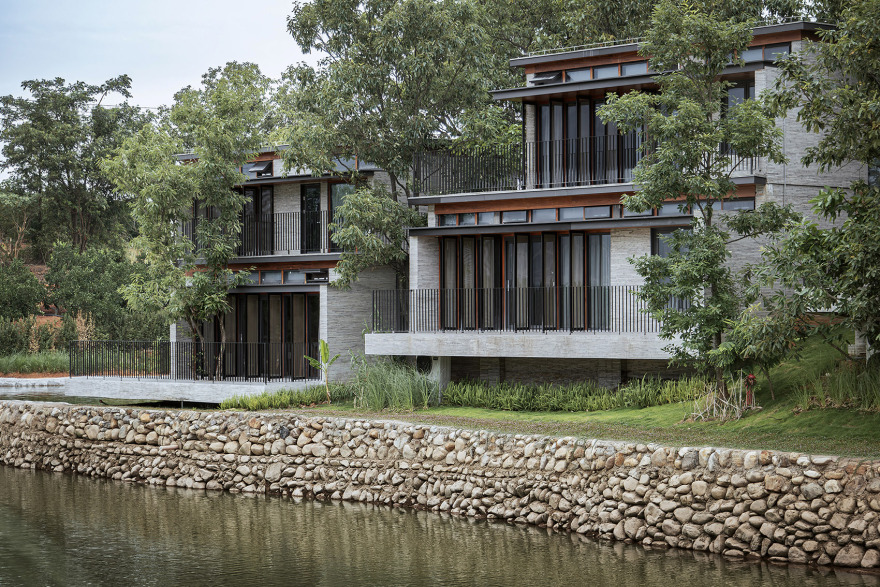
针对亚热带高原气候,我们提出一套”气候适应的空间装置”系统:针对场地西晒问题,采用三重防护缓解:垂直遮阳格栅、保留并增植西侧原生灌木丛形成的生态缓冲带,以及采用高隔热系数的屋面与墙面。热环境调控则巧妙利用山地高差,通过”低吸高排”的气流组织原理,在建筑底部设置冷空气入口,高处布窗,形成自循环的通风系统。这些技术策略不着痕迹地融入建筑形态,使遮阳构件成为立面语言,高窗通风转化为空间的精神性元素,实现技术与艺术的统一。
▼场地高差分析,Analysis of site height difference © 素造建筑

To address the subtropical plateau climate, we developed a system of “climate-responsive spatial devices”. For the intense western sun exposure, a triple-layer mitigation strategy was adopted: vertical sunshade louvers, an ecological buffer zone formed by preserving and enhancing native shrubs on the west side, and roofs/walls with high thermal insulation coefficients. Thermal regulation ingeniously utilizes the mountain’s elevation difference, applying a “low intake, high exhaust” airflow principle—cold air inlets at the building’s base and high windows create a self-circulating ventilation system. These technical strategies are seamlessly integrated into the architectural form: sun-shading elements become part of the façade language, while high windows for ventilation transform into spatial expressions of spirit, achieving a unity of technology and art.
▼立面开窗和遮阳双重格栅,Double grilles for Windows and sunshades on the facade© 素造建筑
3. 建造的逻辑——暴露与隐藏对话
The Logic of Construction – A Dialogue Between Exposure and Concealment
隐藏
Concealment
门窗设计体系上,我们采用了铝合金型材与柚木的复合形式,将传统幕墙的平面盖板重构为U型金属构件,并在其内部精准嵌入柚木,形成”柚木-型材”叠层的构造体系。冷峻的幕墙型材与温润的柚木无缝贴合,隐藏了内部结构的同时使两种材质在对比中形成张力——工业感的线条与木材的生命感并置。这种做法效果上与常规的木包铝或铝包木相似,但在造价上节省一半以上。室内装饰结构的设计上,我们从传统楼阁建筑的”楼楞枋”提取结构基因,转译为装饰性的竖梃系统,并与幕墙相结合,形成富有节奏的空间语言。
For doors and windows, a composite system of aluminum alloy profiles and teak was employed. Traditional curtain wall cover plates were reimagined as U-shaped metal components, precisely embedded with teak to form a layered “teak-profile” assembly. The cool metal and warm wood seamlessly merge, concealing internal structures while creating tension through contrast—industrial precision juxtaposed with organic vitality. This approach achieves a similar effect to conventional wood-clad aluminum or aluminum-clad wood systems but at less than half the cost.
▼铝合金型材与柚木结合的门窗体系,A door and window system combining aluminum alloy profiles with teak wood © 素造建筑

▼作为室内装饰的竖梃系统,A vertical mullion system for interior decoration© 素造建筑

廊道屋顶部分,我们通过将天沟和排水构造完全隐藏于钢木叠合层内部,仅在外观暴露一道1cm宽的黑色氟碳装饰线条,使雨棚与屋面的视觉厚度极大变薄。这种”消隐式”处理既保证了雨水导流的效率,又让檐口在视觉上具有轻薄感,与建筑整体追求的悬浮意象形成呼应。
Drawing inspiration from traditional pavilion architecture, we reinterpreted structural elements like “floor beams and lintels” as decorative vertical mullions, integrating them with curtain walls to form a rhythmic spatial language.
Gutters and drainage systems were entirely concealed within steel-wood composite layers, leaving only a 1cm-wide black fluorocarbon decorative strip exposed. This “vanishing” treatment ensures efficient rainwater diversion while achieving a visually thin, floating eave that echoes the building’s overall suspended aesthetic.
▼廊道屋顶错落,The roofs of the corridors are staggered© 素造建筑

▼屋顶檐口细节,Roof eave details© 素造建筑

▼“悬浮”于林间的建筑,A building “suspended” among the trees© 素造建筑

暴露
Exposure
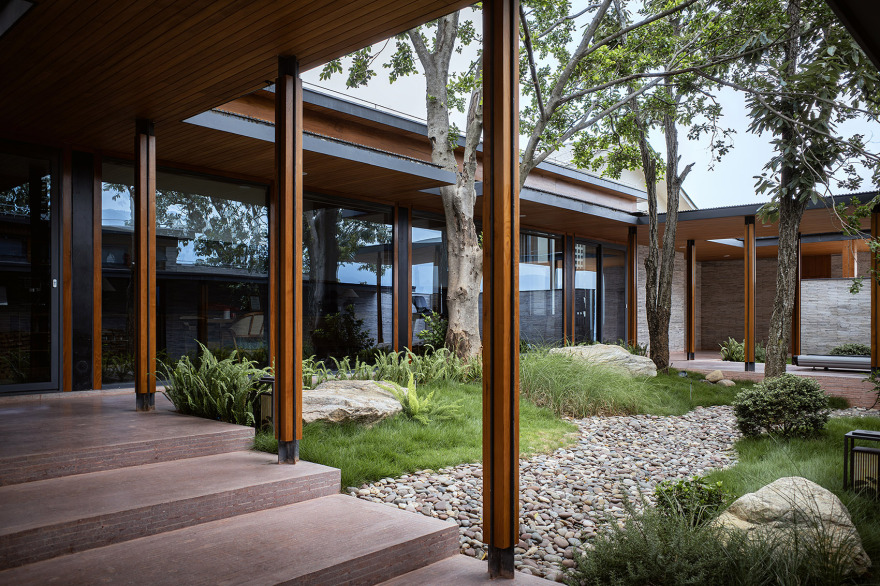
我们认为建筑的结构逻辑为了服务设计可以被完全隐藏,也可以成为空间体验的一部分。在廊道十字柱的构造设计中,我们刻意在柚木饰面与钢结构承重体之间保持20mm的物理间隔。通过材料的清晰分离,严格划定了结构(十字钢柱)与装饰(柚木饰面)的边界,使二者在视觉上形成”力与柔”的辩证对话。柚木不受结构连接件的视觉干扰,其特有的温暖质感与有机肌理得以完整呈现。这种”各美其美”的处理,让每种材料都成为绝对主角。
We believe that structural logic can either be entirely concealed or become an integral part of spatial experience. A deliberate 20mm gap was maintained between teak cladding and the load-bearing steel structure. This clear material separation defines the boundary between structure (steel cross-columns) and decoration (teak cladding), creating a visual dialogue of “strength versus softness.” The teak, free from visual interference by structural connectors, fully expresses its warmth and organic texture, allowing each material to shine independently.
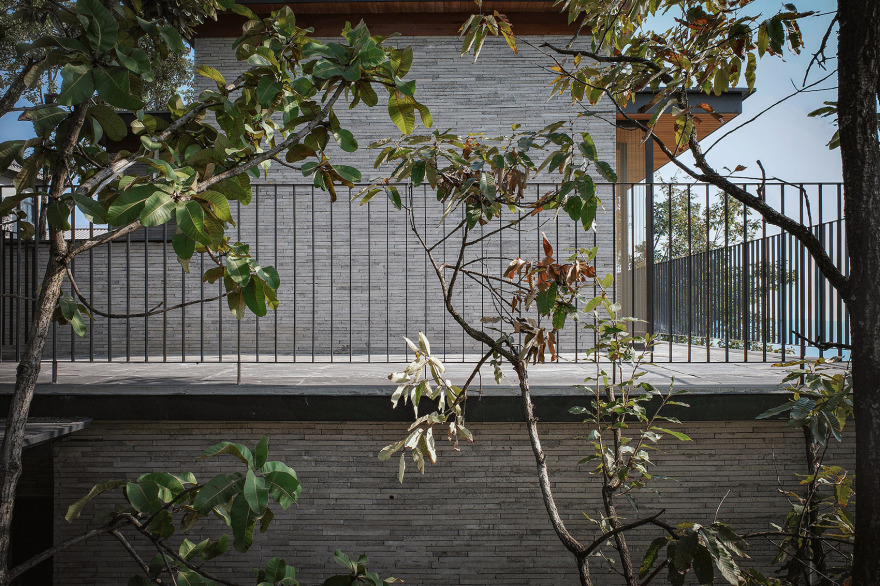
▼建筑外表皮,Building facade© 素造建筑

材料上,我们使用了剪力墙内撑条作为建筑外表皮和地面铺贴,强化建筑内外结构的连续性的同时,通过特殊表面处理,地面与外立面的材料既保持统一的基因,又在质感肌理、色彩层次和细节上形成对比度,创造出”同源异构”的空间体验。
Shear wall lining strips were repurposed as exterior cladding and flooring, reinforcing structural continuity between interior and exterior. Through specialized surface treatments, the flooring and façade share a unified origin yet contrast in texture, color, and detail, crafting a “homologous yet heteromorphic” spatial experience.
▼地面与墙面材质对比,Comparison of floor and wall materials© 素造建筑


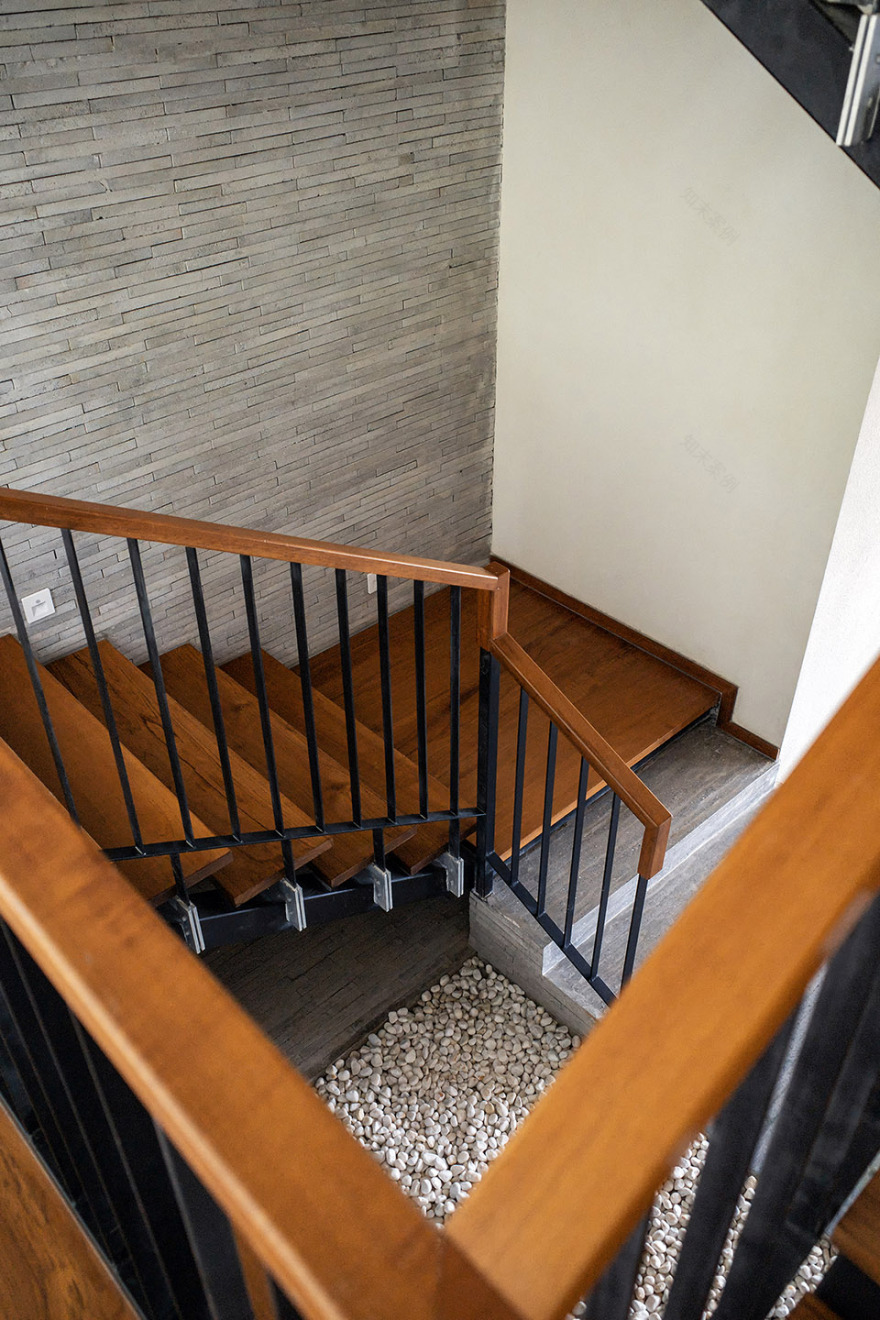
室内扶手栏杆设计上,受力构件和固定螺栓完全裸露的处理,以诚实的方式展现结构的力学传递关系,使每个连接节点都成为可视化的表达。材料选择上,我们采用横向与竖向扁铁组合,通过控制不同方向金属件的厚度差异,既确保了栏杆的结构安全性,又形成了韵律感的视觉构成。
Load-bearing components and fastening bolts are left fully exposed, honestly revealing the mechanics of force transfer and turning each joint into a visible expression. Flat steel bars were arranged horizontally and vertically, with thickness variations ensuring structural safety while creating a rhythmic visual composition.
▼室内楼梯细节,Details of the indoor staircase© 素造建筑
我们希望设计既能超越传统”装饰依附结构”的旧范式,也不是简单的”装饰与结构分离”,而是通过精密的距离控制,让材料在保持各自独立性的同时,形成特定的空间叙事。当使用者近距离观察时,能清晰阅读到每个结构的技术理性与设计的人文温度。
Our design transcends the traditional paradigm of “decoration on structure” or the simplistic “separation of decoration and structure.” Instead, through precise spatial control, materials maintain their independence while collectively shaping a narrative. At close range, users can discern both the technical rationality of each structure and the humanities of the design.
▼廊道与庭院,Corridor and courtyard© 素造建筑

空间体验方面,褚橙庄园生活中心通过被动式遮阳、高窗通风和架空隔热等设计使建筑在不开空调的情况下,实测室内温度降低7-9℃,提升了高湿高热的亚热带河谷环境中的宜居性和舒适性。低饱和度的建筑外观与柚木的搭配,产生现代感的乡土气质和归属感。在环境友好性方面,建筑通过低饱和度的外表皮材料所营造出的稳重和呼吸感来消解体量,最大限度地减少对场地的视觉与生态冲击,竣工后原生植物存活率超过90%。
At the Chu Orange Manor Living Center, passive shading, high-window ventilation, and elevated thermal insulation reduce indoor temperatures by 7–9°C without air conditioning, significantly enhancing livability and comfort in the subtropical valley’s humid, sweltering climate. The low-saturation exterior, paired with teak, evokes a modern yet earthy sense of belonging. Environmentally, the subdued material palette lends the building a grounded, breathable quality, dissolving its mass to minimize visual and ecological impact—post-construction, over 90% of native vegetation survived.
▼外立面遮阳体系,Facade shading system© 素造建筑

▼缝隙中的树,Trees in between the gap© 素造建筑

▼庭院,courtyard© 素造建筑

褚橙庄园生活中心的价值不仅在于其功能性,更在于它展现了一种谦逊的建筑哲学:通过设计的自我克制,让建筑成为土地的”客人”而非”主宰者”;用低技策略实现高舒适度,减少能源依赖;不刻意堆砌传统符号,而是让空间自然唤起地域记忆。最终,这座建筑如同自然生长般融入环境,我们希望空间在使用时能被最深刻表达的并非建筑本身,而是穿过树影的光斑、随风摇曳的树叶和庭院中的微风。
The Living Center’s true value lies not just in functionality but in embodying a humble design ethos: through restraint, the architecture becomes the land’s “guest” rather than its “master”; low-tech strategies achieve high comfort with minimal energy reliance; instead of overt traditional motifs, spaces organically evoke local memory. Ultimately, the structure blends into its surroundings as if grown there naturally. What we hope resonates most is not the building itself, but the dappled light through leaves, the rustling branches, and the courtyard breeze—moments where nature takes center stage.
▼场地特征,site features© 素造建筑

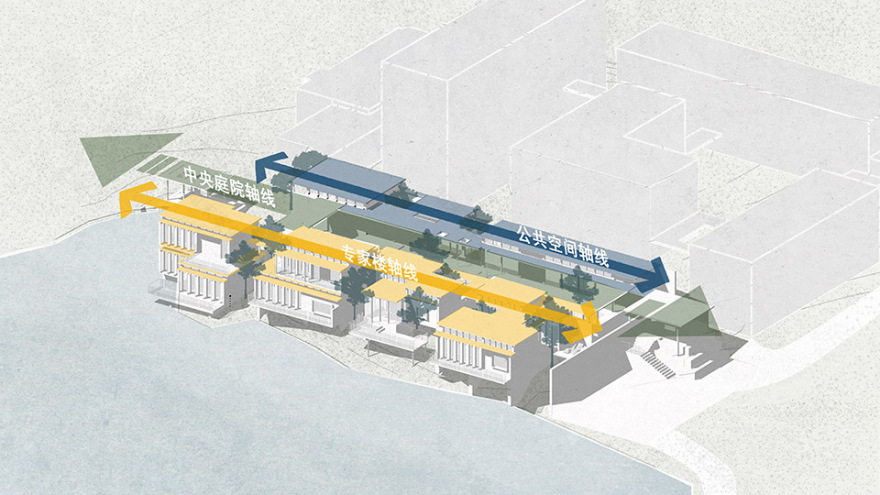
▼空间节奏轴线,Spatial Rhythm Axis© 素造建筑
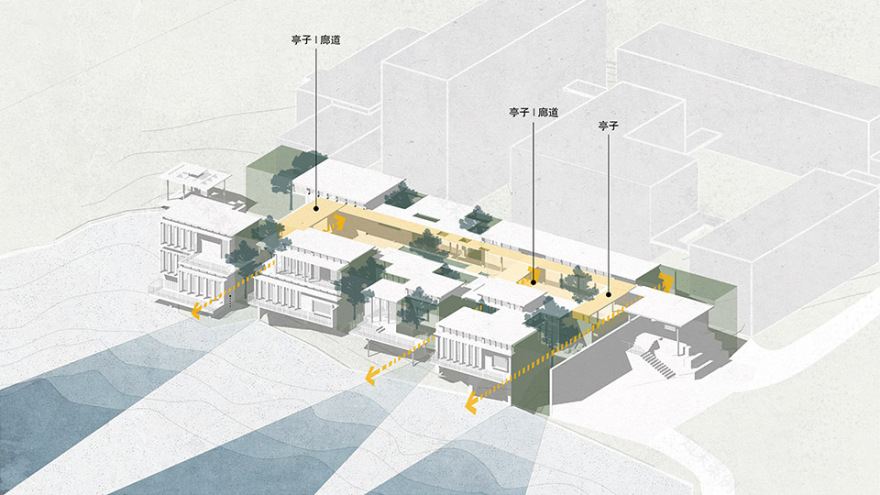
▼平面图,plan© 素造建筑
项目地点:云南省玉溪市新平彝族傣族自治县戛洒镇褚橙庄园内
业主:褚氏农业
建筑室内景观设计单位:素造建筑
主持建筑师 :董文/杜杰
项目建筑师:郭恒瑞
设计团队完整名单:郭旌、张雷、赵胜超、杨宇航、周宇佳、张雯、王慧涵、尹晓文、程春杨、朱文逸、马丽娜、刘雨欣(编辑)
建成状态:建成
设计时间(起迄年月):2022年7月-2023年11月
建设时间(起迄年月):2024年1月-2024年12月
用地面积:约2060㎡
占地面积:648.41㎡
建筑面积:748.64㎡
其他参与者:
建筑施工图设计:陆继行
结构施工图设计:陈涛、马成蝶
给排水施工图设计:李艳波
电气施工图设计:熊敏锐
节能及绿建:贾蓉
施工图审核:上海水石建筑规划设计股份有限公司云南分公司
景观施工图设计: 云南柏莱景观设计工程有限公司
室内施工图设计:素造建筑
照明设计: 西南林业大学李锐工作室
施工总包: 云辰建设工程有限公司
幕墙系统门窗:云南耀辉玻璃制品有限公司
柚木定制加工:昆明聚檀轩家具有限公司
摄影:素造建筑




南京喵熊网络科技有限公司 苏ICP备18050492号-4知末 © 2018—2020 . All photos and trademark graphics are copyrighted by their owners.增值电信业务经营许可证(ICP)苏B2-20201444 苏公网安备 32011302321234号
苏公网安备 32011302321234号客服
消息
收藏
下载
最近