

创作上传
VIP
收藏下载
登录 | 注册有礼
查看完整案例

收藏

下载

分享
光、影、风,是这座小建筑的灵魂。它们与周围的自然紧密相连,树林与山谷的风塑造了这一空间——在这里,自然大于建筑。
——建筑师 孔祥伟
“Light, shadow and wind are the soul of this small building. Closely linked to the surrounding nature, they – together with the wind in the woods and valley – shape this space. Nature outweighs the building itself.”
— Architect Kong Xiangwei
©孔祥伟工作室
缘起
Origin
“卧虎藏龙” 这个带有雄壮色彩的词汇所命名的艺术空间,实为一座极小尺度的建筑,其命名既诙谐又呼应了场地的历史与气象。建筑所在的九仙山位于山东日照五莲县,苏轼曾赞其“奇秀不减雁荡”,更留下“前瞻马耳九仙山,碧连天,晚云间”的千古名句。美术馆坐落于龙潭峡谷畔的卧象山,清代诗人李澄迈笔下“稚龙飞出雨苍苍”正是此间气象的写照。
The building is in Jiuxian Mountain, Wulian County, Rizhao, Shandong. Its stunning scenery once inspired Su Shi to write, “Its grandeur and grace are no less than Yandang Mountain”, and a ci poem: “Looking ahead at Ma’er and Jiuxian Mountains, green to the sky, amid evening clouds; the high platform on the city is truly transcendent…”.
▼项目鸟瞰,aerial view of the project©孔祥伟工作室

▼项目外观,exterior of the project©孔祥伟工作室

▼隐逸在山林中的虫洞美术馆,The Art Museum hidden in the mountains and forests©孔祥伟工作室

▼阳光透过薄壁天窗,洒进画廊,Sunlight filters through the thin-walled skylight and spills into the gallery©孔祥伟工作室

项目位于溪之谷景区,旨在利用场地内的森林,以大地艺术方式打造一座露天森林美术馆。建筑位于道路转折点,南侧狭长地块被栎树林掩映,既作为独立画廊,也是进入森林美术馆的入口。其空间结构令人联想到《桃花源记》中“山有小口,仿佛若有光”的意境——穿过狭小建筑,进入森林,豁然开朗。
The Xi Valley Scenic Area intends to turn its forest into an open-air forest art museum via land art. The building stands at a road turn, with a narrow southern site shaded by oaks. It serves as both an independent small gallery and the entrance to the open-air museum. Like Tao Yuanming’s The Peach Blossom Spring, “a small mountain opening seemed to glow; passing through the narrow building into the forest, one finds a vast open space”.
▼林中画廊,the gallery in woods©孔祥伟工作室


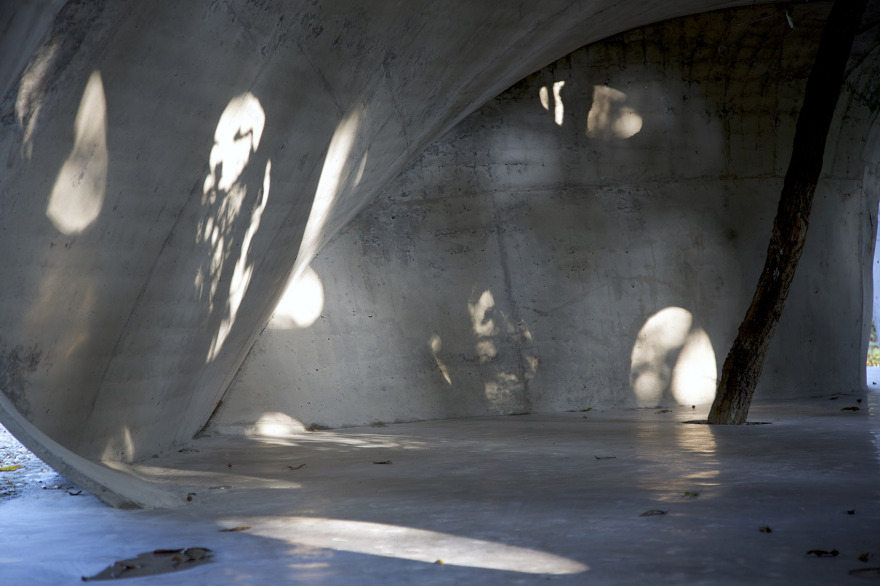
▼阳光透过开窗洒下光影,Sunlight streamed through the open window, casting shadows©孔祥伟工作室


在地营造——在场的惊喜
Local Construction
建筑的建造采用了在地营造的方式,这也是工作是这些年面对自然中的小型建筑所经常采用的建造方法,以真实的四维空间作为画布,以钢筋作为线条,用绘画叠加雕塑的创作方式,与工匠协作塑造空间。
▼施工过程,construction progress©孔祥伟工作室

The building adopted “local construction” – a method the studio often uses for small natural-setting buildings. With 4D space as the canvas, steel bars as lines, and a mix of painting and sculpture, the team worked with craftsmen to shape the space.
▼曲折路径的尽头是弧线作框的一片绿意,At the end of the winding path lies a patch of greenery framed by an arc©孔祥伟工作室

▼流动的美术馆内部光影,The flowing light and shadow inside the art gallery©孔祥伟工作室

建筑的起点是一根12毫米螺纹钢,其韧性、延展性决定了形态的生成。三名当地村民参与建造,其中一位是拥有二十年经验的车床工。复杂场地中的小型建筑可以更紧密的贴近自然,也经常产生空间的趣味性和变化。这些趣味和变化不能预设,而是即时发生。也正是在乡村,才能遇到这些意想不到的惊喜。
Small buildings in complex sites integrate better with nature. During construction, unexpected spatial delights emerge. It started with 12mm deformed steel bars (good toughness/ductility). On day one, three Maojiahe Village villagers joined, including a 20-year lathe operator – rural work always brings surprises.
▼引入阳光和自然,Introduce natural light and nature©孔祥伟工作室

意向生成—-卷纸形成的腔体
Concept Origin – A Cavity from Rolled Paper
建筑未预设形态,委托方全程参与,景区开发者王勇也亲自参与其中。它如同一个可进入的空腔雕塑,“卷纸形成的腔体”是最初的模糊概念——轻盈如纸,可卷曲成形。建筑师引导工匠将钢筋在三维空间中盘旋、捆扎,未使用焊接,材料自身的韧性、垂度和延展性等特性反向决定了建筑形态。这一过程难以言说,工匠成为建筑师的共创者。
Without a preset design, the client (scenic area developer Wang Yong) participated fully. The building is essentially an accessible hollow sculpture.The initial vague concept was “a cavity from rolled paper” – light and curlable like paper. The architect guided craftsmen to twist and bind tough steel bars in 3D space (no welding at first). The steel’s toughness, sag and ductility shaped the building – a wonderful process where village craftsmen became the architect’s assistants.
▼灵感来自“卷纸形成的腔体”,inspired by “a cavity from rolled paper” ©孔祥伟工作室

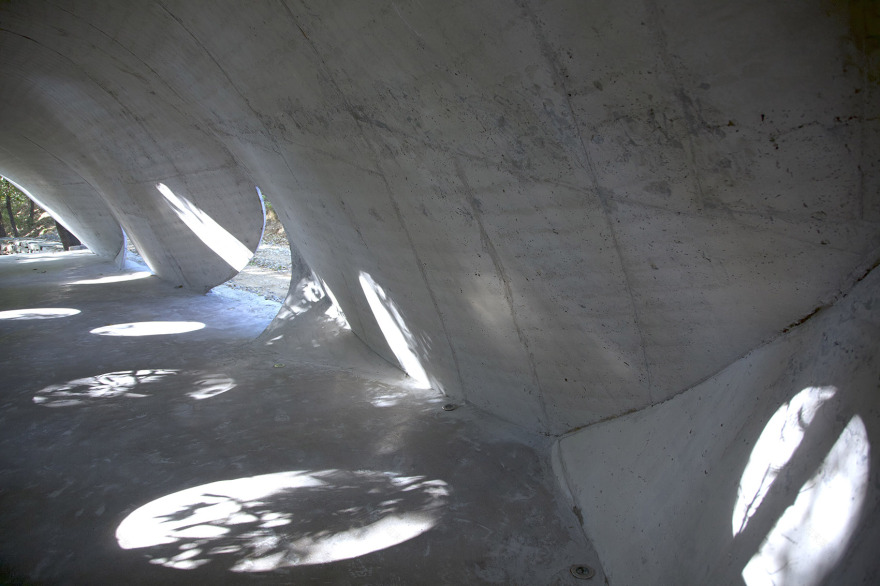
▼光影之旅,journey of light and shadow©孔祥伟工作室


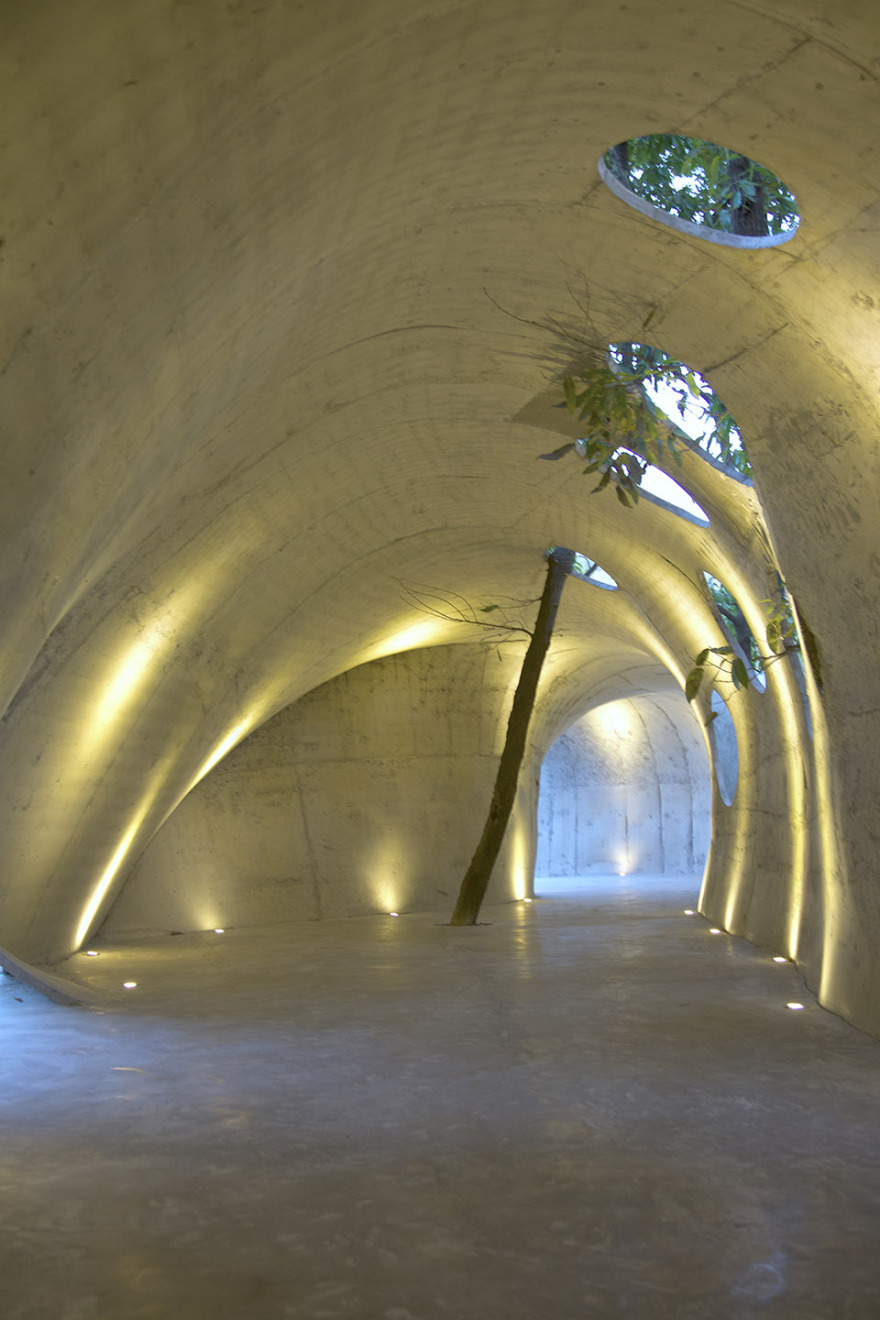
建筑为狭长腔体,入口处四棵树被巧妙避让,树枝的华盖形成前场空间,如巨伞遮荫。面向道路的墙体封闭,下部留隙,光可渗入;面向山谷的墙体则随树木姿态变化,留出孔洞,既为采光观景,也为树枝生长留出余地。建筑中心,一棵栎树被包裹其中。卷纸形成的腔体,就这样随形就势,落地而成。
Site-dictated, it’s a narrow cavity. Four preserved entrance trees form a plaza and shade the entrance. The road-facing wall (near pavement) is enclosed with two concave surfaces; lower gaps let light in and out. The valley-facing wall (near site edge) is shaped by irregular oaks; its curves follow tree trunks. Valley-side holes serve for lighting, viewing and branch growth – an oak is enclosed in the building.
▼留出孔洞为采光观景,Leave holes for lighting and viewing©孔祥伟工作室

▼孔洞为树木生长留出空间,Leave holes for trees to grow©孔祥伟工作室


▼孔洞也成为取景框,The holes also serve as viewfinder frames©孔祥伟工作室

轻薄的挑战——4厘米薄壁混凝土
3-4cm Thin-Walled Concrete Shell
轻与薄既是设计的追求,同时也是和自然的对话,轻盈的人工个构筑物和树林的结合,这本是也是一种诗意意境的表达,4厘米薄的曲面混凝土外壳,在这种施工条件简陋的乡野实现起来还是有很高难度的,全赖于细腻的模板搭建,虽然混凝土离预想的细腻程度有些许距离,但整体的意向还是形成了,一些微观的变化,理解为混凝土的“窑变”,局部的粗粝也略带粗野主义色彩。
Pursuing lightness and thinness was both a design goal and a dialogue with nature. However, a 3-4cm thin curved concrete shell was tough in rural areas, relying on meticulous formwork. Lead craftsman Master Wang and plasterers worked patiently and efficiently. Though the concrete was less smooth than expected, the overall concept was achieved. Micro-variations are seen as concrete “kiln transformation”, and partial roughness adds a touch of brutalism.
▼4厘米薄的曲面混凝土外壳,a 3-4cm thin curved concrete shell©孔祥伟工作室


光与风景——与自然对话
Light, Shadow, Wind and Scenery
光影、声音、风景和自然是建筑表达的核心,建筑与自然的对话被纳入与画廊功能同等重要的考量。在一片森林环境中,美术馆自身即为审美对象。南向孔洞引入阳光与风景,光影在空间中流动,树影在斑驳中形成动态画卷。建筑如虫洞,腔体为室,孔洞为光为景而生。外部形态伏卧如虎,洞内藏光,光影游动如龙,呼应“卧虎藏龙”之名,也暗合苏轼“莫忘使君歌笑处,垂柳下,矮槐前”的意境——只不过此处是“栎树下,翠松前”。
Light, shadow, wind and scenery are the building’s core expressions. Its dialogue with scenery and natural feel matter as much as its gallery function – in the forest, the gallery itself is an aesthetic object.
South-facing valley holes let sunlight filter through leaves into the building, creating a dynamic scene – a delightful human-nature dialogue. The hollow building acts as a wind tunnel; rustling leaves entering through holes become a beautiful melody.
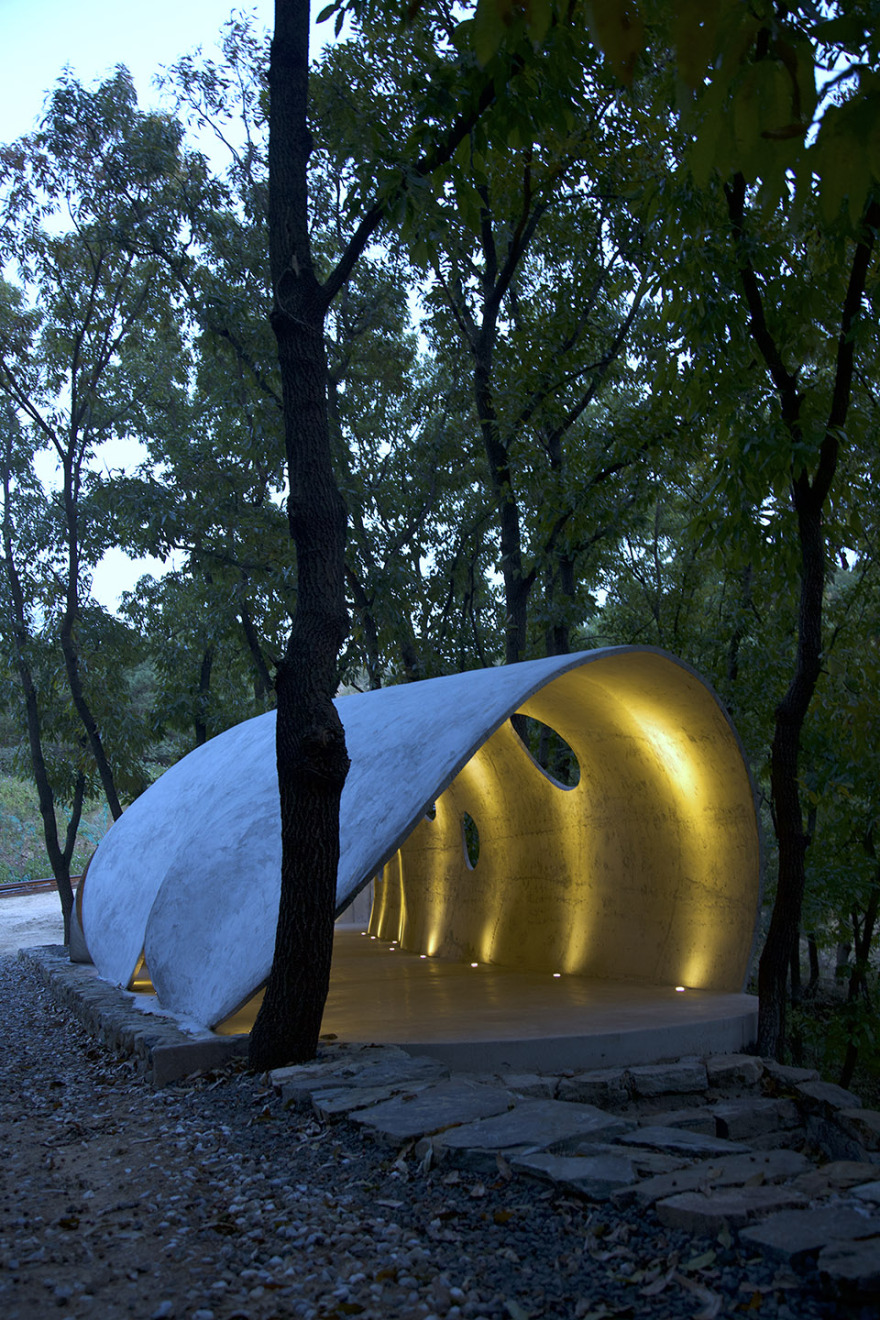
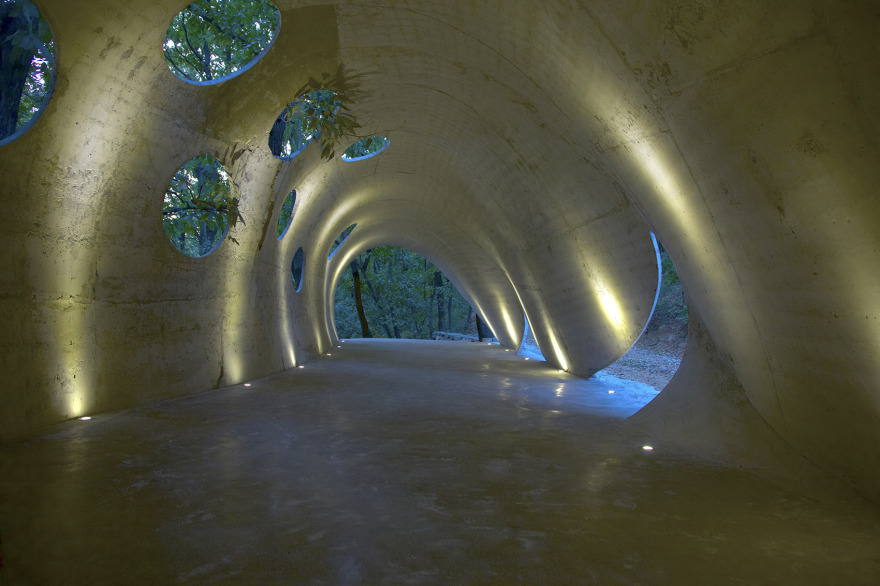
▼灯光下的建筑,building under lights©孔祥伟工作室
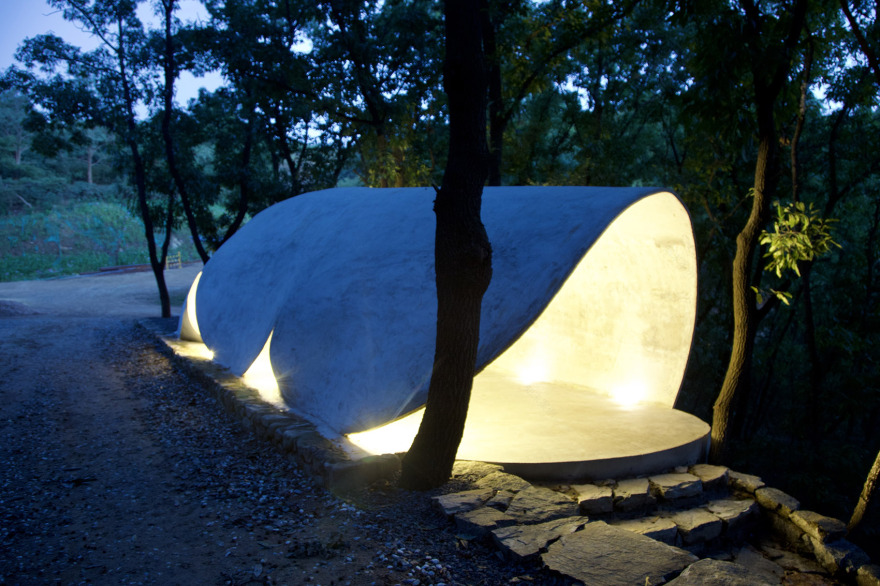
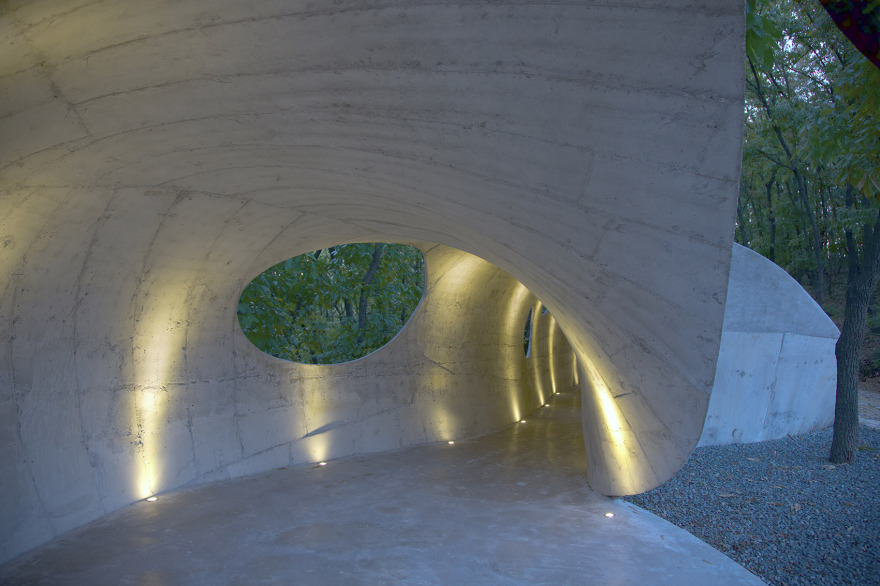
▼灯光下的建筑,building under lights©孔祥伟工作室

项目名称:卧虎藏龙美术馆
项目地点:山东日照五莲县九仙山风景区溪之谷景区
设计团队:孔祥伟工作室
设计师:孔祥伟、崔峻、高灼见
摄影:孔祥伟工作室
Name: Crouching Tiger, Hidden Dragon Art Museum
Location: Xi Valley Scenic Area, Jiuxian Mountain, Wulian County, Rizhao, Shandong
Design Team: Kong Xiangwei Studio
Designers: Kong Xiangwei, Cui Jun, Gao Zhuojian
Company Email:
Photography: Kong Xiangwei Studio




南京喵熊网络科技有限公司 苏ICP备18050492号-4知末 © 2018—2020 . All photos and trademark graphics are copyrighted by their owners.增值电信业务经营许可证(ICP)苏B2-20201444 苏公网安备 32011302321234号
苏公网安备 32011302321234号客服
消息
收藏
下载
最近