

创作上传
VIP
收藏下载
登录 | 注册有礼
查看完整案例

收藏

下载

分享

SUBSTANCE 3D&沉浸式VR体验 | 重塑古埃及文明
Pierre Gable and Guillaume Duflos on November 8 2022 | Interview,Workflow,Designer,Painter
在过去的三年里,Emissive团队一直致力于开发与完善
VR沉浸式探险
项目 -
The Horizon of Khufu
,这项体验可供游客参观胡夫金字塔,此外,还将帮助游客探索金字塔内部的各个部分,在重现历史场景的同时提供4500年前埃及的日常生活视图。到目前为止,VR体验已经接待了超过50,000名游客,目前在Lyon Confluence对外开放。Pierre Gable担任Emissive创意总监;Guillaume Duflos担任Emissive概念艺术家兼高级3D美术师。他们在这里将剖析创造这种VR体验的目标和初衷,并详细介绍工作中的一些实际元素。
The Horizon of Khufu
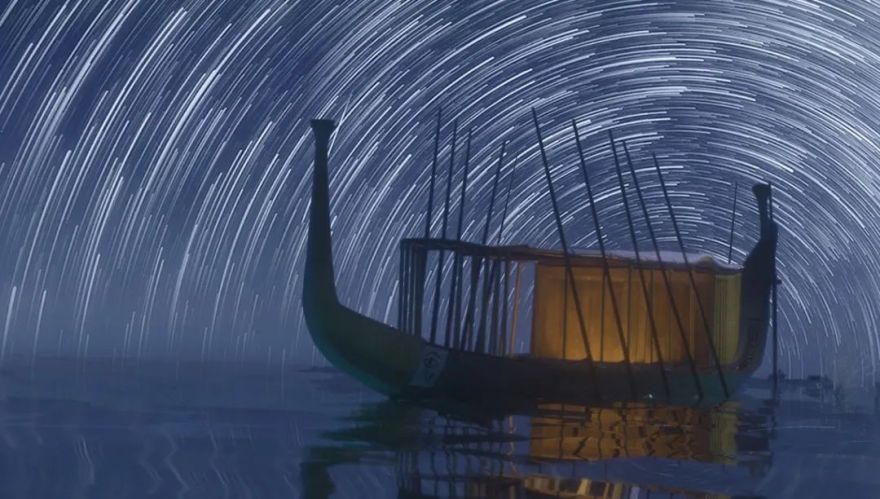
Pierre:
近16年来,我一直与Emissive合作,并围绕Pyramid of Khufu和周围的吉萨墓地进行各种项目研究。早年,我经常与埃及古物学家、哈弗大学教授彼得·德·曼努埃尔(Peter Der Manuelian)一起工作。在一项值得注意的案例中,与Dassault Systèmes合作使我们能够以3D的方式重建马斯塔巴,即胡夫金字塔周围的小墓地。这些对我来说都是不可思议的学习经历,而彼得对历史的了解程度让我明白,在从事这种历史重建时,精确的细节至关重要,就每一点而言则需请教历史专家。如果你想以3D的方式建造一堵墙或者只是为了绘制一面墙,首先需要与历史学家进行交谈,他们会讲述那个时期会使用什么样的方法和材料。
Peter Der Manuelian
https://nelc.fas.harvard.edu/people/peter-der-manuelian

The Origin of the VR Experience
后来,在2016年,我们有幸与一项名为Scan Pyramids的非盈利科学活动合作,他们使用muography(即μ介子粒子)检测Bent Pyramid of Snefru内部的开放空间以及Pyramid of Khufu。我们为这个项目提供了3D经验,并且为了能够提供精确的金字塔3D模型,我们参观了金字塔并进行了拍照,同时扫描了它的外观部分。
一旦我们有了所有的这些数据,作为VR专家,我们便开始思考如何通过VR头戴式耳机观察金字塔。而这就是“胡夫金字塔”VR沉浸式探险的起源。

探险开始的帐篷
在创造这种体验时,我们主要有几个目标。首先,我们希望利用当今可用的数据尽可能准确地记录历史。而在整个项目过程中,我们一直与历史学家保持联系,这让我们在总体上取得了一些成功。至少来自卢浮宫和其他地方的埃及古物学家曾访问过我们,并且他们对所看到的内容感到很满意。
其次,我们想讲述生活在公元前两千五百年胡夫时期的故事。在这项体验中,我们关注那个时代里人性化的一面,以及生活在那个地方人们的感受,他们在很多方面与我们都很相似。这里我们不谈论法老的宝藏;因为这对我们而言并不重要,我们要讲述的是当时人们的故事。

VR是在这两个领域进行交流的绝佳工具。当你身处金字塔内部时,很难想象自己到底在哪里,也很难想象金字塔内不同体积的空间是如何相互连接的。通过VR,我们可以提供欣赏这种空间感更为清晰的方法。
事实上,VR可以帮助我们将参观者带回过去,并看到当时人们的生活,以更好地了解在VR体验中所面临的挑战,比如,参观者回到过去见证葬礼仪式。当然,这些都是我们至今仍在经历的事情。

历史准确性
在这个项目中于我而言最令人兴奋的部分是提供合理的过去观点,并得到科学事实的支持。此外,我还发现与历史专家合作非常有意义,他们通常无法使用3D模型或3D技术,因此我们发现历史学家通常很乐意与我们合作,因为我们的3D专业知识可以帮助他们进行研究,并为其提供新的假设。这将是双赢的局面。
在项目早期,我们认为可以通过金字塔模型进行教学,而且已经实施开展,此外,Peter Der Manuelian在哈弗大学的课程中使用了我们的模型。但就历史准确性的原则而言十分重要,不仅是因为打算向公众提供这种体验,甚至儿童也可以尝试,所以尽可能提供准确的金字塔细节方面的表示。坦白来讲,我们在构建这种体验时,有时候添加楼梯,移动墙壁或在金字塔中创建额外的房间会更为方便。但我们从未歪曲所拥有的事实内容。而且我们希望这种体验会尽可能忠实于现实和历史。
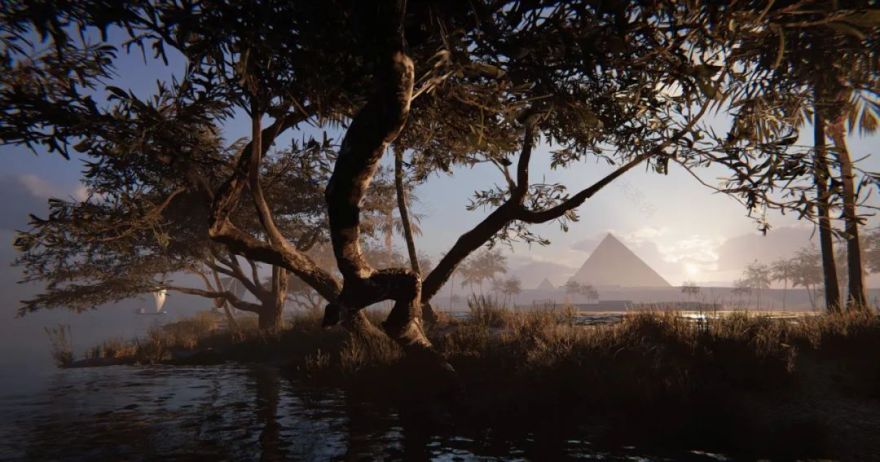
在这项VR体验中,体验者可以看到金字塔周围的区域,正如几千年前一样,而所见到的内容绝对是基于最新的研究发现。甚至在几周前,关于吉萨地区的新历史研究也就此进行了发表。如今,尼罗河位于开罗市中心,距离金字塔八公里;由于在20世纪60年代建设了阿斯旺大坝,那里便不再发生洪水灾害。但在4500年前,它离吉萨高原会更近些。关于河流位置的最新认识是通过分析该地区植物的花粉得出的,而存在的某些类型的花粉揭示了历史上不同时期水的位置和水位。而历史学家用来揭示历史秘密的方法是非常了不起的。

3D创作中的第一步
Guillaume:
在3D中重建金字塔的首个阶段包括汇集尽可能多的参考图像,并规划应该如何呈现场景外观。这是我在担任概念艺术家时所负责的一部分;因为胡夫金字塔已经非常出名了,所以我不得不考虑如何走出每个人对金字塔的固有印象。
幸运的是,我们能够通过激光扫描和摄影测量来扫描金字塔的各个部分。而基于激光扫描数据,我们可以创建精确且高清的3D模型以及一些纹理信息。此外,我们还在同一区域通过摄影测量捕获数据以强化纹理和材质。在扫描时,我们主要关注的是岩石和石头,还有峰顶部分。特别是对于金字塔顶峰部分的扫描非常棘手,因为扫描通常是从地面开始进行的。

当然,金字塔是如此之大,以至于很难将所有东西都扫描一遍。而金字塔的整个表面已经被无人机扫描过,且处于中等范围内,即使在这种情况下,分辨率也并没有达到我们理想的高度。
因此,扫描数据即我们的起点,但我们不能直接将这些信息发送到应用程序中。我们必须重新对这些信息进行大量的修改。例如,我们扫描的任何纹理都将包括当天的照明条件。而在这种情况下,我们必须尽可能多地删除这些照明数据,这样就能够在阳光直射、阴影或夜间等一系列情况下真实地显示纹理。

Substance 3D应用程序在这里很有帮助。它们对于划分需要处理的不同通道非常实用。我们还可以根据需要分离反射率或法线贴图等。

基于扫描的资产与手动创建的资产
我觉得目前基于扫描的媒体已经达到了极好的写实主义水平。同时,这个项目包含许多我们必须从头开始创建的资产。因此,该项目的挑战之一是确保基于扫描的资产质量水平与我们手工制作的资产之间保持统一性。此外,还必须要确保进入体验的参观者无法分辨出这两种类型资产之间的区别。


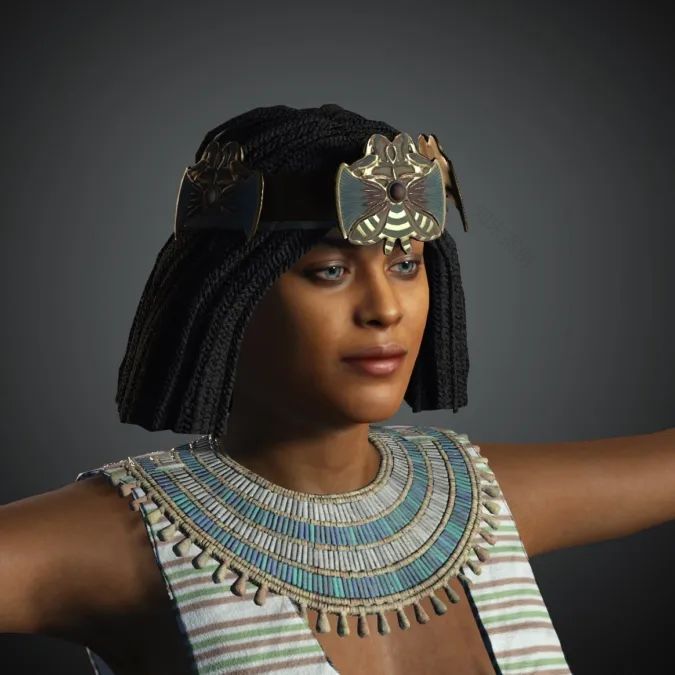
这尤其适用于体验中的所有互动元素。你回想一下80年代或90年代的老卡通片,例如那些Hanna-Barbera老卡通片,如果在悬崖顶上看到一堆石头,就能马上知道哪一块会掉下来。我们希望避免总体场景和每个场景交互元素之间的所可能出现的明显质量差异。

最优化
优化是工作中最大的要素。扫描作为金字塔的一部分,对此我们将得到大约2000~3000万个多边形,这对应用程序而言太多了。而为了显示金字塔的整个面貌,我们必须将这个数字减少到大约30000~40000个多边形,而这意味着我们必须对每次扫描进行大量返工,并手工创建任何尚未扫描的部分。
对于VR创作,必须要记住的是场景将在头戴式耳机中同时呈现两个屏幕,每只眼睛一个,而它们之间会存在轻微的差异,以实现双目视觉。这就是VR场景和桌面设备上显示的电子游戏之间的巨大区别:VR需要两倍的渲染能力。因此,注意使用的多边形数量和纹理大小尤为重要。
我们利用大量的精力进行优化,并试图通过极少的资源让一切看起来不错。
Emissive
工作流
Guillaume:
创建VR场景的工作流与任何其他的3D场景基本相同,除了上面提到
的额外因素,每个场景必须同时在两个屏幕上分别渲染。
首先,我们将创建一个高清模型。这里我们可能会用ZBrush完全从头开始雕刻,或
者还可以从摄影测量数据开始。
最终,我们将有一个‘简洁的’模型,由相当多的多
边形组成。
接下来,我们将创建同一模型的低模版本,并在ZBrush或3ds Max中手动进行拓扑。
而最终的低模版本将与我们的高清版本完全一致。
然后我们将展开低模物体的UV,实际上是将3D物体布置为平面2D形状以进行纹
理处理。
我们将在Substance 3D Designer或Substance 3D Painter中创建纹理,无论是基于
摄影数据还是完全从头开始。
我们通常会在Designer中创建‘干净的’平铺
材质,并选择在Painter中进行任意内容的绘制,即使我们是基于摄影测量数据进
行
工
作,我们也可能会需要重新绘制各种岩石或添加污垢等等。
然后,在Painter中我们将高清模型映射到低模物体上。这将有助于应用法线
贴图,
以及之前所创建的任意雕刻细节,同时将物体的文件大小保持的很小,不
至于占
用过多的内存。
填充历史空白
Pierre:
在没有精确历史数据的情况下,与我们合作的历史学家都会极力避免金字塔中任何需要猜测的部分,即使我们已经极其仔细地研究了这些领域,而这些也极有可能是准确的。通常他们的建议是通过洋红色或其他鲜艳的颜色以显示缺少一些数据的区域。但这当然对更多的日常体验者来说,并不是很有趣。因此,金字塔的某些部分是根据我们的最佳估测而重新创建的。虽然,我们总是广泛地研究这些问题;但我们从不会轻易做出这样的决定。
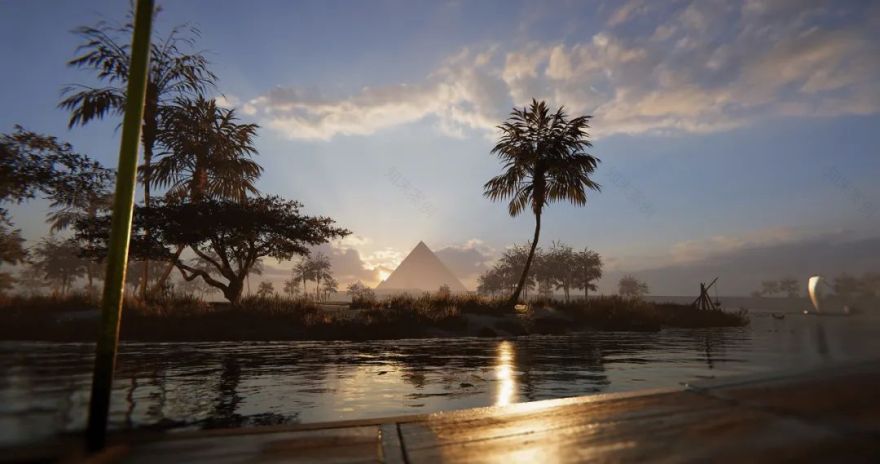
例如,在体验结束时,参观者会看到葬礼寺庙,并见证木乃伊的制作过程。事实上我们并不能百分之百地确定在寺庙的这个小房间里所发生的净化过程和木乃伊的制作过程,因为这座寺庙的任何部分对今天来说都是不存在的,所以很难绝对确定它的任何部分。在这里我们再次依赖历史专家的意见,如Peter所说,在这种情况下,这里可能会有木乃伊。而这就是他在教学时所呈现的方式;他说在这个房间里可能会有木乃伊,但我们并不确定。另一种选择是,如果我们只展示不需要任何猜测的场景和地点,就会完全省略这个场景,那将是不幸的。
Guillaume:
在这些情况下,当我们重新创建缺少信息的区域时,第一步是获取该区域尽可能多的参考照片,以帮助艺术家做出有据可循的创意选择。而金字塔是一个受欢迎的旅游胜地,许多外观部分已经被拍摄过大量的照片。但并非每个部分都是如此,金字塔顶峰就是一个很好的例子;而这个区域对公众而言无法访问,所以在重建金字塔顶峰时,我们不得不使用很少的黑白照片和从远处拍摄的航拍照片,但这带来的结果并不理想。

在这些情况下,艺术家会做出创造性的决定,以确保整体场景的可信度,即使不是百分之百的准确。正如我们所知,在金字塔顶部有很多涂鸦,而一些涂鸦可以追溯到几个世纪以前,其他部分只有50年左右的历史。但关于上面究竟写了什么,对此我们所了解的信息非常稀缺,以至于无法精确地重现涂鸦。在这种特殊的情况下,我们允许自己拥有一些乐趣,同时保持体验顶峰场景整体的可信度。顶峰上的绝大多数涂鸦都非常接近真实存在的东西,但如果仔细观察,你也可以在那里发现一些团队成员的名字。

对于获取金字塔内部以及古代历史中发生场景的参考资料也很棘手。例如,埃及人在他们的雕像上涂了颜料,如果只有一张雕像底座的照片,
至今
上面也只有一层颜料的痕迹,试图确定雕像的颜色便是个很大的挑战。

Bastet女神

与我们合作的历史学家在这里提供了巨大的帮助。而这些内容通常能够将我们引向其他保存得更好的类似文物,并让我们看到更为准确的颜色,或者更为完整的陶器和其他文物。

Pierre:
事实上,陶器是最宝贵的资产之一,考古学家可以确定发现的确切日期。而这也是我们与Peter密切合作所关注的问题,胡夫金字塔内的所有陶器都是合乎历史时段的,在大约50年的时间内,并不超过这个时间。
这些小细节对我来说非常重要。比如,当重新制作合适的陶器时,并将其放置在合适的桌子上,便能够开始带回一些古埃及人的生活方式,我们工作的重要部分之一就是展示构成这个令人难以置信的文明的日常以及非常人性化的方面,甚至能够唤起我们今天又是如何与它们建立起联系。

平衡历史准确性和视觉吸引力
Guillaume:
在历史准确性的需求和创造吸引大众的内容需求之间取得平衡是很复杂的。在创造体验以及与该项目的艺术总监Maxence Fournier合作时,我们的目标通常是制作一些对VR体验中的人而言看起来很出色的东西。但是,当我们朝这个方向走得太远时,往往会有偏离历史真相的风险。
例如,在创建金字塔内部时,我们开始在金字塔边缘放置精心制作的砖块,而这些砖块来自Tourah采石场。但是与该项目有关的历史学家介入,并告诉我们这些石块仅用于金字塔中心及其外壁;而金字塔的边缘是由更为常见且质量较低的石块建造。所以我们返工重新制作了那些部分。在我看来,质量较低的石块看起来并不是那么令人印象深刻,但这就是胡夫金字塔的现实。

当参观者回到过去,观看葬礼现场的场景时,我们知道寺庙的内部已经被粉刷过,但至今并没有人确切地知道使用了什么颜色。与该项目有关的历史学家建议我们不要在场景中绘制石头,以避免插入不正确或虚构的信息。但对于游客而言,这在视觉上并没有那么有趣。最终,我们做出某种妥协,根据现有的信息做出最佳猜测。如上所述,我们很清楚这些雕塑是如何绘制的,所以我们绘制了这些雕像,而寺庙的其他部分则是未涂漆的石头,不过我们添加了一些精美的网帘作为装饰。


创造VR体验的挑战
Pierre:
对于这个项目,我们需要忠实地重建金字塔内部,并作为人们可以在里面实际走动的空间。我们必须尊重金字塔历史以及现实上所带来的的限制,同时确保游客拥有身临其境的体验。例如,在VR中,如果人们穿过墙壁,就会打破沉浸感。因此,为游客找到穿越金字塔的理想路线确实有点令人困惑。

体验中总共有17项不同的场景,大约有60个不同的阶段供游客体验。而在理想的情况下,我们并不希望参观的游客彼此离的太近,换种说法就是体验的总体概念是对金字塔进行VIP访问,由私人导游Mona引领。如果游客遇到太多其他的访客,这也会破坏沉浸感。

为了在体验中找到最佳路线,我们开发了一款工具,它可以模拟各种不同的路径,并绘制出一份地图,以说明如何最优的引导游客群体完成体验。而这涉及大量的试验与验证。我们花了整整一周的时间通过我们目前所拥有的经验建立路径,并且随着项目的进展,该路径可能会继续发展下去。
Guillaume:
我觉得关于这个项目另一个巨大的挑战就是找到核心概念元素,以创造出原创化且视觉上吸引人的东西,同时传达出关于建筑和居住者我们想要表达的东西。

游客首次探索的金字塔内部核心场景对我们而言尤为困难。我们在这里并没有太多的视觉参考,所以很难想象金字塔的这一部分会是什么样子,包括深入到细节层面,比如特定的石块是如何切割和放置在一起的。而游客在这一部分来回走动,这将增加另一层次的复杂性。因此这个场景花了好几个月的时间才完成。
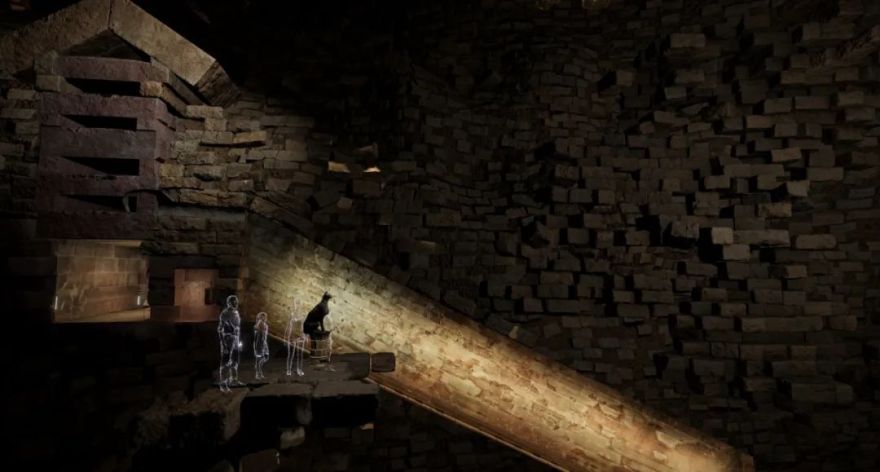

The Legacy of Khufu
Pierre:
Peter曾经告诉我,‘看看这张CD,或者这个U盘;再过一百年或者两百年,它的数据就会消失。而这些埃及人在数千年前将他们的信息刻在石头上,至今我们却仍在研究它们。如果你想传递一些信息,那么可以使用这个媒介。’
这是真的。如果你想让你的故事流传下去,就把它刻在石头上。
所有的作品均由Emissive/Excurio提供。
The Horizon of Khufu
是一个VR沉浸式探险项目,目前在Lyon Confluence对外开放,并将持续开放到2023年3月。
胡夫地平线项目
Lyon Confluence
Nov. 08 2022
, by Pierre Gable and Guillaume Duflos
Explore the Pyramid of Khufu in VR
The Emissive team discuss their goals and methods in creating the Horizon of Khufu, a VR immersive expedition.
For the last three years, Emissive have been developing and refining The Horizon of Khufu, a VR ‘immersive expedition’ that allows people to visit the Pyramid of Khufu. The experience allows visitors to explore sections of the pyramid interior, and recreates historical scenes to provide a view of everyday life in Egypt four and half millennia ago. To date, the VR experience has received more than 50,000 visitors, and is currently open at Lyon Confluence. Pierre Gable is Creative Director at Emissive; Guillaume Duflos is Concept Artist and Senior 3D Artist at Emissive. Here, they break down their objectives and motivations in creating this VR experience, and detail some of the practical elements of their work.
Pierre: I’ve been working with Emissive on various projects around the Pyramid of Khufu, and the surrounding necropolis of Giza, for nearly 16 years. Early on, I frequently worked with Peter Der Manuelian, an Egyptologist and professor at Harvard University. In one notable case, a partnership with Dassault Systèmes allowed us to reconstruct in 3D the mastabas, the small tombs around the Pyramid of Khufu. These were incredible learning experiences for me – Peter is fantastically knowledgeable about Egyptian history, and this really showed me that when you’re working on this kind of historical reconstruction, precise details are vital. You need to consult expert historians on every point. If you want to build a wall in 3D, or even just to paint a wall, you have to speak with the historians first, and they’ll explain what sort of methods and materials would have been used in that period.
The Origin of the VR Experience
Later on, in 2016 , we were fortunate enough to work with a non-profit scientific mission called Scan Pyramids, who were using muography – that is, scans for muon particles – to detect open spaces within the Bent Pyramid of Snefru, then the Pyramid of Khufu. We provided 3D experience on this project and so, to be able to provide an accurate 3D mesh of the pyramid, we visited the pyramid to take photos, and scan sections of its exterior.
And once we had all this data, and being specialists in VR, we began to think about how the pyramid could look through a VR headset. This was the origin of the Horizon of Khufu VR immersive expedition.
The tent from which the expedition begins.
Second, we wanted to tell the story of the people who lived in the period of Khufu, two and a half millennia before Christ. In the experience, we focus on the human side of that time, and on the feelings of the people in that place, who were similar to us, today, in so many ways. We don’t talk about the treasure of the pharaohs; that wasn’t important to us. We wanted to tell the stories of the people of that time.
And VR is an excellent tool to communicate in both areas. When you’re physically inside the pyramid, in real life, it can be difficult to visualize exactly where you are, or how the different volumes of space within the pyramid interconnect. With VR, we can provide ways to appreciate this sense of space more clearly.
And, indeed, VR allows us to transport the visitor back through time to see the lives of the people of that time, and to better understand the challenges they faced – in the VR experience the visitor travels back in time, for instance, and witnesses a funeral ceremony. These are of course the kinds of ordeal that we still experience today.
Historical Accuracy
The most exciting part of this project for me is to provide a plausible view of the past, supported by scientific fact. I also find it very rewarding to work with historical experts – they don’t typically have access to 3D models, or 3D technology, and so we find that historians are often happy to collaborate with us, because our 3D expertise can help them with their research, and help them to make new hypotheses. It’s a win-win situation.
Early on in the project, we were thinking that we could use the models of the pyramid for teaching – and this has happened; Peter Der Manuelian is using our models in his courses at Harvard University. But historical accuracy was important as a matter of principle, as well – just because you’re intending to make the experience available to the general public, and even accessible to children, doesn’t mean that it’s okay to provide an inaccurate representation of the pyramid. Frankly, when we were constructing the experience, there were times when it would have been more convenient to us to add a staircase, or move the walls, or create an additional room in the pyramid. But we never misrepresented the facts that we had . We wanted the experience to remain as faithful to reality, and history, as possible.
In the VR experience you also see the area around the pyramid as it was thousands of years ago, and what you see is absolutely based on the latest research available. Even just a few weeks ago, new historical research was published concerning the Giza area. Today, the Nile is in the middle of Cairo, eight kilometers from the pyramid; flooding no longer occurs there thanks to the construction of the Aswan Dam in the 1960s . But four and a half millennia ago it was much nearer the Giza Plateau. This latest realization concerning the river’s position came by analyzing the pollen of the plants in that area – the presence of certain types of pollen reveals the location and level of water at various points in history . The methods that historians use to uncover the secrets of the past are remarkable.
In cases like this, where new data becomes available, we’ll update the VR experience accordingly. These are often subtle details that a typical visitor to the experience won’t notice – but, because the experience is used for teaching, and because we sometimes use the experience to create pictures or videos that might appear in documentaries, it’s important to maintain that level of historical precision.
First Steps of Creation in 3D
Guillaume: The first stages of creating the recreating the pyramid in 3D involve bringing together as many reference images as possible, and planning out how the scene should appear. This is the part of my role as a concept artist; because the pyramid of Khufu is already so well known, I have to think about ways to step outside the ‘classic’ image of the pyramid that everybody tends to have.
We’re fortunate in that we’ve been able to scan sections of the pyramid, using both laser scanning and photogrammetry. Using the data from laser scans, we can create accurate HD 3D meshes, along with some texture information. We also use photogrammetry in the same areas, to capture data allowing us to enhance our textures and materials. When scanning, we mostly focused on rocks and stones, and the summit. The summit in particular is tricky to scan, as the scanning is often carried out from the ground.
Of course, the pyramid is just so enormous that it’s difficult to scan everything. The entire surface of the pyramid has been scanned by drones, at medium range – but even in this case, the resolution isn’t as high as we’d like.
And so our scan data is a starting point for us, but we can’t just directly send that information into the app. We have to rework that information enormously. For instance, any textures that we scan will include the lighting conditions on the day the scan was carried out. In such a case, we have to remove this lighting data as much as possible, so that we’re able to realistically display the texture in a range of situations – in direct sunlight or in shadow, for example, or during the night.
The Substance 3D apps are helpful here. They’re very practical for dividing up the different channels that we need to work on. We can separate out things like the reflectivity, or the normal map, as needed.
Scan-based Assets Versus Assets Created by Hand
Our scan-based media reached an excellent level of photorealism, I feel. At the same time, the project contained a lot of assets that we had to create ourselves, from scratch. One of the challenges of this project was therefore to ensure unity between the level of quality of our scan-based assets and those we’d crafted by hand. We had to ensure that visitors to the experience wouldn’t be able to tell the difference between those two types of assets.
This notably applied to all the interactive elements of the experience, as well. If you think back to old cartoons from the 80s or 90s – any of those old Hanna-Barbera cartoons, for example – if you see a bunch of rocks on top of a cliff you can see right away which one’s going to fall. We wanted to avoid that visible difference in quality between the general scenery and the interactive elements of each scene.
Optimization
Optimization is the biggest element of our work. Scanning just a part of the pyramid, we’ll come away with a scan of around 20 to 30 million polygons – far too many for the app to work with. To show one whole face of the pyramid, we have to bring that number down to about 30,000 to 40,000 polygons. This means we have to extensively rework each scan, and create by hand any parts that we haven’t scanned.
And creating for VR, you have to keep in mind that your scene will be rendered for two screens within your headset at the same time – one for each eye, with a slight difference between them to allow for binocular vision. This is the big difference between a VR scene and, say, a video game displayed on your desktop: VR requires twice the rendering power. So it’s especially important to pay attention to elements such as the number of polygons used, and the size of your textures.
A lot of effort goes into optimization, and into trying to make things look good, using few resources.
The Emissive Workflow
Guillaume: The workflow for creating a scene for VR is essentially the same as for any other 3D scene, with the extra consideration mentioned above, that each scene must be rendered separately on two screens at once.
First, we’ll create an HD model. We might sculpt that completely from scratch using ZBrush, or we might start from photogrammetry data. Ultimately, we have a ‘clean’ model, comprising a fairly high number of polygons.
Next, we’ll create a low-poly version of that same model, carrying out a manual retopology in ZBrush or 3ds Max. The final low-poly version corresponds exactly to our HD version.
Then we’ll unfold the low-poly object’s UVs, essentially laying out the 3D object as a flat 2D shape, for texturing.
We’ll create our textures in Substance 3D Designer or Substance 3D Painter, either from our photogrammetry data or completely from scratch. We’ll typically create a ‘clean’ tiling material in Designer, and carry out any painting in Painter – even when we’re working from photogrammetry data, we might repaint various rocks, or add dirt, and so on.
Then, with Painter, we project the HD mesh onto the low-poly object. This allows us to apply the normal maps, and any sculpted details we’d created previously, while keeping the file size of the object very light.
Filling a Historical Gap
Pierre: In cases where precise historical data just isn’t available, the historians we work with are keen that we avoid representing any parts of the pyramid that require an element of guesswork – even when we’ve studied those areas in great, great detail, and those guesses are probably accurate. Their suggestion would typically be that we show the areas where we lack some data in magenta, or another bright color. But of course that’s not very interesting for the more everyday visitor to the experience. So some parts of the pyramid are recreated based on our best estimations. We always research such points extensively, however; we never make such decisions lightly.
For instance, towards the end of the experience you see the funerary temple, and witness the mummification process. Really, we aren’t one hundred percent certain that the purification and mummification process occurred in this small room within the temple – almost no part of this temple exists today, so it’s difficult to be absolutely sure about any part of it. Here again, we depend on the opinions of the historical experts, like Peter; in this case, Peter told us that the mummification could have occurred here. And this is how he presents it when teaching; he’ll say that it’s possible that the mummification occurred in this room, but that we aren’t sure. The alternative, if we were to only show scenes and places that require no guesswork at all, would be to omit this scene entirely. And that would be unfortunate.
Guillaume: In these cases, when we’re recreating areas for which we’re missing information, the first step is to get as many reference photos of that area as possible, to allow our artists to make informed creative choices. The pyramid is a popular tourist destination, and so much of the exterior of the pyramid has been extensively photographed. But that isn’t true for every part of it – the summit is a good example here; this area isn’t accessible to the public, so in recreating the summit we were forced to work from a very small number of black and white photos, and from aerial photographs taken from far away. That isn’t ideal.
In these situations, the artist makes creative decisions to ensure the scene is credible overall, even if not 100% factually precise. We know, for instance, that there’s a lot of graffiti at the summit of the pyramid – some of the graffiti dates from a couple of centuries ago, other parts are just fifty or so years old. But information on what has precisely been written up there is so scarce that we haven’t been able to recreate the graffiti exactly. In this particular case, we’ve allowed ourselves to have a little fun, while maintaining the overall credibility of the summit scene of the experience. The vast majority of the graffiti at the summit is very close to what truly exists – but if you look very closely, you can spot a few of the team members’ names in there, as well.
Getting references for the interior of the pyramid, and for the scenes that take place in ancient history, is also tricky. The Egyptians painted their statues, for instance, and it’s a challenge to try to determine the colors of a statue when you might have just a photo of the statue’s base, with just a trace of one layer of paint on it.
The goddess Bastet.
The historians that we work with are an immense help, here. They’re often able to point us towards other, similar sites that are better preserved, allowing us to see things like more accurate colors, or more intact pottery and other artifacts.
Pierre: Actually, pottery is one of the most precious assets allowing archaeologists to put a precise date on discoveries. And this is something that we paid close attention to, and on which we worked closely with Peter; all of the pottery within the pyramid of Khufu is historically appropriate, to within a period of about fifty years, no more than this.
These small details are extremely important to me. It’s when you recreate the right pottery, say, and place it on the right table that you start to bring back some of the memories of how the ancient Egyptians lived. A vital part of our work is to show the everyday, very human moments that comprised this incredible civilization – and even to evoke how we, today, might connect with them.
Balancing Historical Accuracy and Visual Appeal
Guillaume: Balancing the need for historical accuracy in the experience with the need to create something that’s appealing to the general public can be complicated. In creating the experience, when I’m working with the Artistic Director of the project, Maxence Fournier, our goal is typically to make something that looks outstanding for people in the VR experience. But when we go too far in that direction, we often risk veering away from the historical truth.
When creating the interior of the pyramid, for instance, we started to position well-crafted blocks around the edges of the pyramid – detailed, good-quality blocks from the Tourah quarry. But the historians connected to the project stepped in, telling us that the these blocks were only used in the center of the pyramid, and for its casing stones ; the edges of the pyramid were built from more common, lower-quality blocks. So we went back and redid those sections. In my opinion, the lower-quality blocks don’t look as impressive – but that’s the reality of the pyramid of Khufu.
In the scene where the visitor travels back in time, and views the funeral scene, we knew that the interior of the temple had been painted, but today nobody in the world knows exactly what colors had been used. The historians connected to the project advised us to just leave the stone unpainted in that scene, to avoid inserting incorrect, and invented, information. But that isn’t as visually interesting for visitors. Ultimately, we made a compromise of sorts, making our best guesses with the information available. As mentioned above, we had a pretty good idea how the statues had been painted, so we painted those, and we left the rest of the temple as unpainted stone – though we added some fine net curtains, as decoration.
The Challenges of Creating the VR Experience
Pierre: For this project we needed to faithfully recreate the interior of the pyramid as a space that people would physically move through. We had to respect the constraints imposed by the historical reality of the pyramid while ensuring that visitors have an immersive experience. In VR, it would be immersion-breaking if people walked through walls, for example. So figuring out the ideal route through the pyramid for visitors was a bit of a puzzle.
In total, there are 17 different scenes in the experience, with around 60 different stages for the visitors to go through. Ideally, we don’t want groups of visitors to the experience to be too close to one another, either – the concept of the experience is that it’s a VIP visit to the pyramid, with Mona, your personal guide. If you encounter too many other visitors, that can also break the immersion.
To find the best route through the experience, we developed a tool that allows us to simulate the various different paths, and draw a map of how to best guide groups of visitors through the experience. This involved a lot of trial and error. It took us about a full week to establish the path through the experience that we currently use, and that may continue to evolve as the project progresses.
Guillaume: Another big challenge of the project, I feel, was simply finding that core conceptual element of creating something that was original, and visually attractive, and that communicated what we needed to say about the building, and the people who inhabited it.
The scene when the visitor first explores the inner core of the pyramid was particularly difficult for us. We didn’t have a lot of visual references to work from here, so it was hard to imagine how that section of the pyramid would look – down to the level of details such as how the specific blocks of stone had been cut and placed together. And the visitor moves around a lot in this section, which adds another level of complication. It took months to put that scene together.
The Legacy of Khufu
Pierre: Peter once told me, ‘Look at this CD, or at this USB key; in a hundred years, or two hundred years, its data will be gone. These people in Egypt carved their messages in stone thousands of years ago, and we’re still examining them. That’s the medium to use, if you want to transmit information.’
And that’s true. If you want your story to last, carve it into stone.
All artwork courtesy of Emissive/Excurio. The Horizon of Khufu, a VR immersive expedition, is currently open at Lyon Confluence, and will remain there until March 2023.
南京喵熊网络科技有限公司 苏ICP备18050492号-4知末 © 2018—2020 . All photos and trademark graphics are copyrighted by their owners.增值电信业务经营许可证(ICP)苏B2-20201444 苏公网安备 32011302321234号
苏公网安备 32011302321234号客服
消息
收藏
下载
最近